Turning Data Centers Into City Heaters: Finland’s Answer to the Environmental Cost of the Cloud
.avif)
This single 75-megawatt data center, built underground in a former cave, now provides about two-thirds of Mäntsälä’s heating needs (equivalent to 2,500 homes) and has significantly cut energy costs for residents. Finland’s bold experiment – using underground data centers to heat entire neighborhoods – is turning a digital problem into a climate solution. But can this strategy address the broader dangers and social impacts of our growing data center boom?
The Hidden Environmental Cost of Data Centers
The “cloud” that stores our videos, emails, and AI models is not light and fluffy at all – it’s built on thousands of power-hungry, water-thirsty servers on the ground. Data centers worldwide have a massive environmental footprint. In 2023, U.S. data centers alone consumed about 176 terawatt-hours of electricity, roughly as much power as the entire nation of Ireland. This demand is expected to double or even triple by 2028 as artificial intelligence drives explosive growth in computing needs. To cool their racks of servers, data centers also guzzle enormous amounts of water. Even a mid-sized facility can use as much water as a small town, while the largest hyperscale centers require up to 5 million gallons of water a day – roughly the daily usage of a city of 50,000 people. In arid regions, the strain is acute: in water-stressed Arizona, for example, some server warehouses are permitted to use over one billion liters of water per year, enough to fill an Olympic-sized pool every single day.
Beyond water and electricity, data centers occupy vast land and can indirectly contribute to carbon emissions. Most facilities span acres of impermeable concrete and steel, eliminating green space and farmland. If powered by fossil-fueled grids, their energy use translates into significant CO₂ emissions. Globally, data centers already account for an estimated 2% of greenhouse gas emissions, rivaling the airline industry (though many operators are now pledging a shift to renewables). Even the act of cooling servers produces waste heat – typically treated as a nuisance and vented into the air or water, further contributing to thermal pollution. In fact, up to 40% of a data center’s power is spent just on cooling the equipment, meaning a huge portion of the energy ends up as low-grade heat that literally goes up in smoke (or steam).
A Growing Community Backlash
These environmental costs aren’t just abstract global problems – they hit home in local communities. As tech giants race to build new AI supercomputing centers, many American towns and suburbs are grappling with the side effects. In some cases, residents are pushing back against data center construction projects that threaten to disrupt their quality of life. A recent proposal in Palm Beach County, Florida, for instance, would convert 200 acres of land near the Arden community into a “modern hyperscale AI facility” spanning 1.8 million square feet. Locals were alarmed: the site is adjacent to family homes, a new elementary school, and even a wildlife preserve. Noise pollution from industrial cooling fans and backup generators is a top concern – county reports note that data centers “have been attributed…to creation of noise” that could penetrate quiet neighborhoods. Residents also worry about water usage and waste, since the planned center would consume huge volumes of water for cooling and then need to dispose of the heated wastewater. “You should not put a data center next to homes and a school and a wildlife preserve,” one frustrated resident said, voicing the community’s feeling that such projects were being rushed through with little transparency or local input.
This Florida case is not unique. Across the United States, the rapid data center boom (especially for AI) has sparked what some call a NIMBY (“Not In My Backyard”) backlash. Loudoun County in Virginia – the world’s densest data center hub – has seen complaints about round-the-clock noise and new high-voltage transmission lines needed to feed the servers. In other areas, community activists point out environmental justice issues: many data centers cluster in already polluted or low-income areas, adding to local air quality problems by running large diesel backup generators and drawing more fossil-fueled power. One analysis found that about one-third of California’s data centers are located in the most polluted 10% of areas in the state, which could worsen health dispariti. Indeed, researchers estimate the growth of data centers (and their emissions) could contribute to 600,000 new asthma-related cases by 2030, with over $20 billion in public health costs. These sobering numbers highlight why many communities view new data centers warily – as “mechanical monsters” devouring resources and threatening local well-being.
Finland’s Underground Solution: Warming Cities with Waste Heat
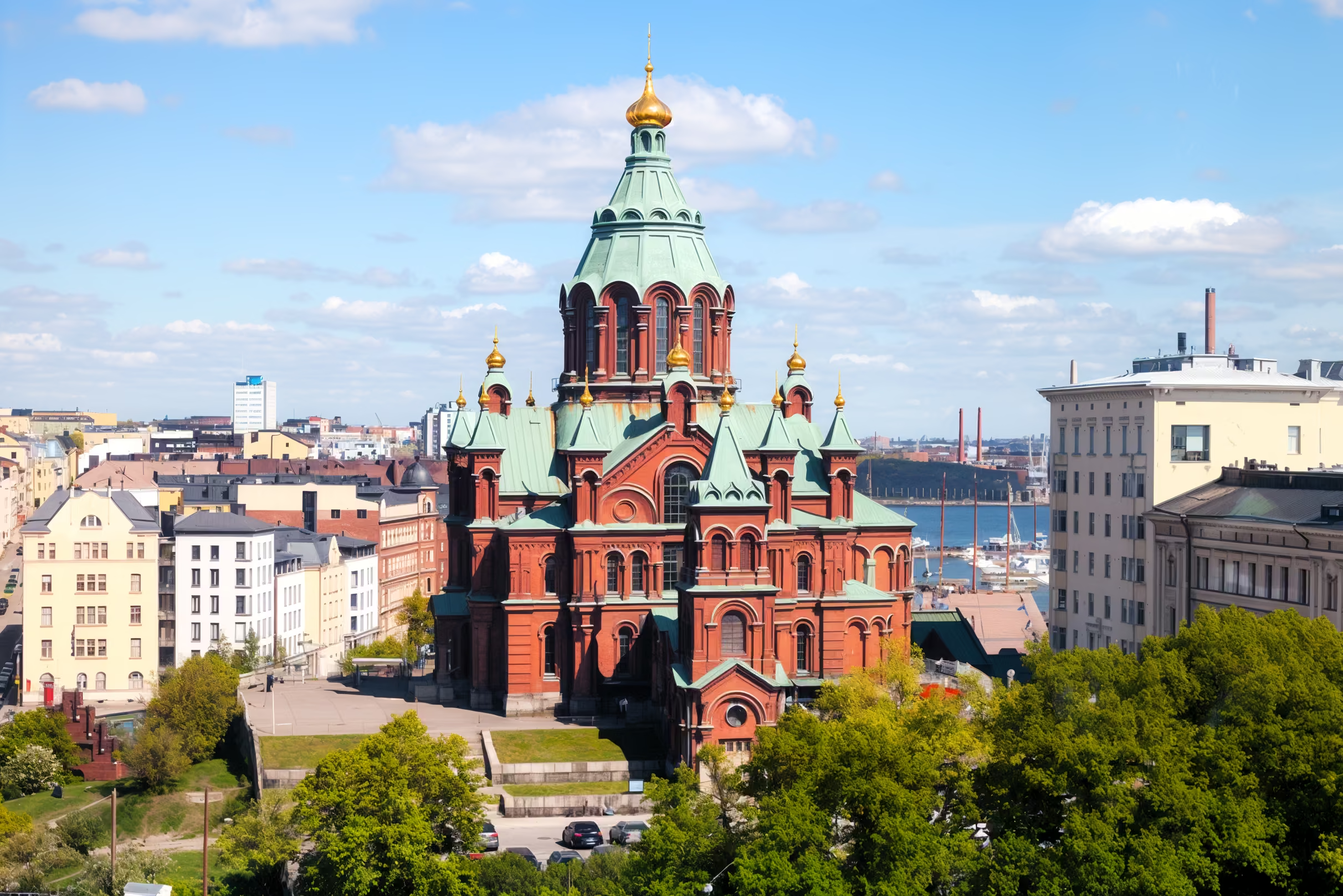
While some American towns see data centers as unwelcome neighbors, Finland has flipped the script – by literally burying data centers underground and making them serve the public good. In Helsinki, Espoo, Oulu and other Finnish cities, massive server farms are being built in underground caverns (often repurposed from old military bunkers or bedrock storage tunnels). These subterranean data centers benefit from the natural insulation of hard granite and Finland’s cold climate, which makes cooling the servers much more efficient. But the real innovation is what Finland does with the heat those servers generate: capture it and use it to heat homes.
Finland’s cities have long operated district heating networks – systems of insulated hot water pipes under the streets that deliver heat to buildings from centralized plants. This gave Finnish engineers a golden opportunity to recycle data center heat. Instead of venting warm air to the outside, underground data centers in Finland are equipped with heat exchangers and pumps that transfer their waste heat into the district heating water. The concept is akin to turning data centers into giant “digital boilers” for the city. Helen Oy, Helsinki’s energy utility, pioneered this approach in 2010 by partnering with IT company Academica to hook up a 2 MW data center under Uspenski Cathedral to the municipal heating grid. The warm water from cooling the servers was pumped out to heat nearby apartment blocks and even a public swimming pool – an early proof that the Internet’s exhaust could replace fossil fuels in the heating mix.
Fast forward to today, and Finland is scaling this up dramatically. Microsoft is investing in a massive data center campus near Helsinki (in Espoo and Kirkkonummi) that will become one of the world’s largest waste-heat recycling projects. Once operational, this cluster of underground data centers is expected to supply 40% of the entire city of Espoo’s heating needs – roughly 100,000 homes. A newly constructed heat recovery plant by Finnish utility Fortum will take water warmed to ~30°C by the servers and boost it to 115°C using large heat pumps and electric boilers. That superheated water will then flow through Espoo’s district heating network, displacing coal and natural gas. In fact, the initiative has already enabled the shutdown of a coal-fired power plant, and it’s projected to significantly cut the city’s carbon emissions by 2030. Finnish officials estimate that by the end of this decade, 10% of all city heating nationwide could come from data centers – a stunning twist in which data centers become a pillar of sustainable urban infrastructure rather than an energy drain.
Crucially, Finland’s strategy addresses location, which is the linchpin of data center impacts. “If we accept that data centers need to exist for our Zoom calls, then we need to find the best locations for them,” notes Veera Lyytikäinen, a senior environmental officer who assessed Microsoft’s project. “The best place is one where waste heat can be utilized and the data center can run on renewable energy.” By deliberately siting data centers near cities with district heating and ensuring they are powered by clean electricity (Finland’s grid is largely low-carbon, thanks to nuclear and wind), the Finnish model turns data centers into efficient co-generators of heat. Each server farm becomes a community asset, not just a silent neighbor. This approach even yields economic and social co-benefits: residents enjoy lower heating bills, cities cut their dependence on imported fuels, and tech companies gain positive public relations as “beneficial neighbors”. It’s a virtuous cycle aligning the digital economy with local sustainability.
Nordic and Baltic Innovators Turning Heat to Power
Finland is not alone in this push. Throughout the Nordic and Baltic region, chilly climates and forward-thinking utilities are making waste heat recovery from data centers the new normal. Denmark was one of the earliest adopters: in Odense, Denmark’s third-largest city, Facebook (Meta) built a hyperscale data center that now recycles server heat to warm 6,900 homes via the municipal heating system. The facility uses heat pumps to raise the temperature of warm air from the servers and then feeds hot water into the local grid, providing a steady heat supply even on cold winter nights. Facebook’s Danish data center runs entirely on renewables and donates about 100,000 MWh of heat per year to the community – positioning the company as an anchor of the city’s energy transition.
In Sweden, Stockholm has gone a step further by making heat reuse a core part of its city planning. The Stockholm Data Parks initiative actively recruits data center operators to locate in the city and plug into an “open district heating” network. As a result, dozens of data centers and other industries now feed excess heat into Stockholm’s 3,000 km of heating pipes. By 2022, Stockholm’s program had 20 heat suppliers recovering enough energy to warm 30,000 apartments annually. The city ultimately aims for all its district heat to come from renewable or recovered sources by 2030. Nearby, in Sweden’s capital region, companies like Conapto are retrofitting server halls to send hot water into district networks. Germany has also joined the trend: new efficiency laws will require large data centers to reuse a portion of their waste heat, pushing operators to collaborate with utilities or local businesses that can utilize the thermal output.
Even smaller Baltic countries are exploring these synergies. Estonia and Latvia have strong district heating traditions and are eyeing data centers as the next heat source. In Latvia, a pilot project uses server farm heat to warm a university campus, while Lithuania is investigating data center heat for greenhouses and aquaculture. And in Ireland – a country which, despite its cool climate, has faced strain from data centers consuming ~20% of its electricity – one of Amazon’s data centers recently began supplying a new district heating loop in Tallaght to warm public buildings and student housing. These examples show a regional pattern: Northern Europe is turning its digital infrastructure into an opportunity to cut waste and carbon, essentially “turning data into heat.”
Challenges and Limits of Waste-Heat Recycling
As promising as these projects are, experts caution that data-center heat is no silver bullet for the industry’s broader environmental issues. First, waste heat reuse works best under specific conditions: a dense heat demand nearby and a pre-existing distribution network. Many large data centers (especially in the U.S.) are built on cheap land in remote industrial parks, far from any neighborhood that can use the heat. Extending hot water pipelines long distances is expensive and inefficient. This is why urban planning is key – cities like Helsinki or Stockholm can integrate data centers into their energy infrastructure by design, whereas a data hall on a rural prairie cannot easily serve as a town furnace. Additionally, the heat captured from servers is relatively low-temperature, often around 30–50°C (86–122°F). To make it useful for heating homes or hot water, it must be “upgraded” with electric heat pumps to higher temperatures, which incurs extra cost and energy use. In places where electricity is pricey or carbon-intensive, the economics of installing big heat pumps can be a hard sell. For example, Germany’s push for heat reuse has hit hurdles because utilities balk at the cost of new heat pump installations for data center projects.
There’s also the reality that waste heat alone doesn’t eliminate the data center’s footprint. Even if heat recycling becomes common, data centers will still consume huge amounts of electricity – so it’s critical that power comes from renewable sources to truly reduce emissions. Finland and Denmark have an edge here, with abundant wind, hydro, and nuclear power making their grids relatively clean. In contrast, a data center feeding heat into a district system while drawing coal-based electricity would be robbing Peter to pay Paul environmentally. Moreover, heat reuse does nothing to mitigate water usage or IT hardware waste. Some Nordic projects (like Microsoft’s in Finland) avoid water entirely by using air cooling and heat pumps, but many data centers still rely on water cooling towers that evaporate water into the atmosphere. That means communities must weigh if the local water supply can support these facilities, even if their waste heat is put to use.
Finally, from a social perspective, not all tech companies have been eager to adopt what might be seen as a “niche application” of their operations. Large cloud providers benefit from economies of scale and often prefer standardized, stand-alone campuses. Aligning them with municipal heat networks requires coordination, public-private partnerships, and sometimes subsidies. Sweden, for instance, eliminated a tax break on data center electricity in 2023, which had encouraged companies to participate in heat recovery programs – and the change has slightly dampened enthusiasm for new projects in Stockholm. It’s a reminder that supportive policy (or incentives) may be needed to make heat recycling attractive in the long run.
A Sustainable Path Forward
Despite the challenges, Finland’s experience shows a compelling path forward: with smart planning, the digital economy’s byproducts can be turned into assets. Data centers will continue to multiply in our AI-driven world, but they don’t have to be “environmental villains”. By tapping into waste heat, Finland avoids burning tens of thousands of tons of fossil fuels for warmth, slashing urban carbon emissions and helping meet climate targets. Every neighborhood warmed by servers is one less reliant on oil or coal. As one commentator noted, the Finnish approach “solved a heating problem and a global waste problem at the same time”. In other words, it’s a step toward aligning our virtual lives with sustainable real-world systems.
Could this be the answer moving forward? Finland’s strategy is elegant and innovative, but not a panacea. It brilliantly addresses one aspect of data centers’ impact (waste heat), and in doing so it fosters a more positive relationship between data centers and communities. The sight of steaming plumes from a data center heating plant in Espoo, or the knowledge that your emails and video streams are indirectly warming your home, can make the abstract cloud feel tangibly beneficial. For communities in the U.S. that have felt burned by data center projects, such examples offer a new perspective: maybe data centers can be good neighbors if designed right. “Heat recycling positions data centers as beneficial neighbors,” as one data infrastructure expert put it, helping to counter community tensions about their impact.
That said, waste heat reuse must go hand-in-hand with broader efforts: massive investments in renewable energy (so that the data centers themselves run cleanly), improvements in energy efficiency and cooling technology, and policies to manage water use responsibly. In some cases, solutions might even involve moving compute tasks in time or location – for instance, shifting non-urgent data processing to countries or hours where surplus renewable energy is available. Tech companies with global footprints are already exploring such load shifting to minimize their carbon intensity. There is no single fix for the data center dilemma, but Finland’s underground city-heating data centers demonstrate one powerful principle: with creativity, the biggest problems can contain the seeds of their own solutions. In a country of long, dark winters, Finland found warmth in the glow of servers – a modern hearth harnessed from the heart of the digital world. It’s an inspiring blueprint for others to follow, ensuring that the next wave of AI and cloud growth can coexist with healthier communities and a cooler planet.

)%20(1).avif)