Iceland and the EU, Again: Why a Fast-Track Referendum Could Redraw the Nordic-Baltic Map
.avif)
A center-left coalition government formed after Iceland’s November 2024 snap election agreed to put the “continuation of accession talks” to a national referendum by 2027. In late February 2026, that timetable abruptly felt less like “sometime this decade” and more like “possibly this summer.” A POLITICO-affiliated report (E&E News) said Iceland is weighing a vote on restarting EU membership talks as early as August 2026, citing two people familiar with preparations.
Why the acceleration? The reporting—and Icelandic officials’ own framing—points to a new mix of geopolitical and economic pressures that resonate in a country that has long balanced between Europe and the United States. The fast-track narrative explicitly ties the speed-up to “geopolitical upheaval,” including U.S. tariff moves affecting Iceland and renewed controversy over Greenland’s strategic future.
Iceland’s Prime Minister, Kristrún Frostadóttir, has argued that geopolitics will inevitably color the debate, while cautioning against a referendum driven by fear rather than a clear-eyed assessment of trade, economy, finance, and culture. That balance—between strategic anxiety and economic calculation—is likely to define how the referendum plays not only in Iceland, but across Nordic-Baltic communities watching from North America.
How Iceland got here from EFTA and the EEA to the 2009 application and the long pause
Iceland’s relationship with European integration has always been tight but selective. A quick timeline shows why the current moment is best understood as a “return,” not a sudden pivot:
- Iceland joined the European Free Trade Association (EFTA) in 1970 and later entered a free trade agreement with the European Community in the early 1970s.
- In 1994, Iceland joined the EEA, which effectively tied it into the EU’s single market while leaving it outside EU institutions.
- After the 2008 financial crisis, Iceland applied for EU membership in July 2009; the European Commission delivered a favorable opinion in February 2010, and the Council decided in June 2010 to open accession negotiations.
- Negotiations advanced quickly by the standards of EU enlargement. By April 2013, 27 negotiating chapters had been opened and 11 provisionally closed.
- In May 2013, a new government put accession negotiations on hold.
- In March 2015, Iceland’s government requested that the country “should not be regarded as a candidate country for EU membership,” and the EU Council “took note.”
That last step created enduring ambiguity that still matters strategically today. Official EU documentation emphasizes the “not to be regarded as a candidate” request, rather than a clean, universally accepted “withdrawal.” At the same time, Icelandic political debate often uses the language of “withdrawing” the bid, and the topic resurfaced in 2025 when European Commission President Ursula von der Leyen publicly suggested the original application remained valid if Iceland chooses to resume the process.
For Iceland’s diaspora readers, this nuance is not procedural trivia—it shapes what “fast-tracking” can practically mean. If Brussels treats the old file as still structurally usable, Reykjavík could plausibly restart from an advanced baseline. If not, the process may require more formal resets (and more time).
Iceland is already inside much of Europe’s rulebook
To much of the world, “EU membership” sounds like a binary: in or out. But Iceland already lives in Europe’s economic and mobility architecture in ways that many Americans and Canadians underestimate.
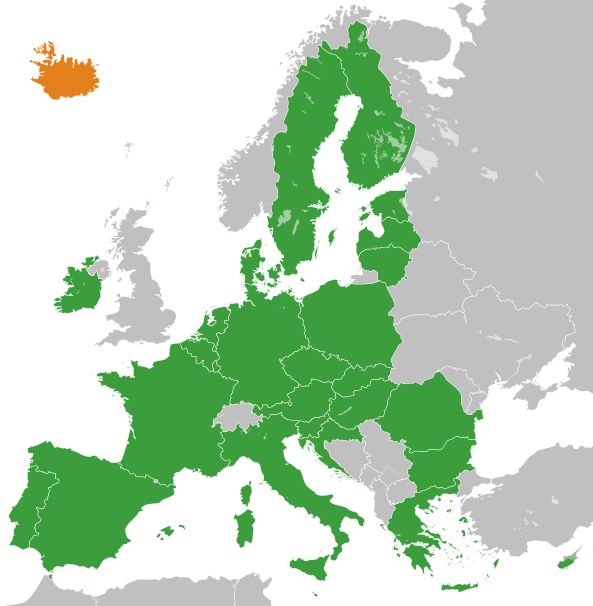
Through the EEA, Iceland participates in the EU’s internal market. The EU describes the EEA as bringing Iceland, Liechtenstein, and Norway “into the EU’s internal market,” guaranteeing the free movement of goods, services, people, and capital, and extending internal-market-related policies (competition, transport, energy, and more). The European Commission’s Iceland country page goes further, noting that “a significant proportion of the EU’s laws are applied in Iceland today,” and that Iceland participates in various EU agencies and programs, though without voting rights.
There are two implications that matter for the renewed accession debate:
First, the “alignment gap” is smaller than it is for most candidate countries. The European Parliament’s January 2026 briefing describes EU-Iceland relations as “largely shaped by the EEA Agreement,” which has been in force since 1994 and enables the four freedoms across the EEA. This helps explain why Iceland once moved rapidly through accession chapters.
Second, the EEA is not a full substitute for membership. The EU’s own EEA explainer is explicit about what the EEA does not cover: among other things, it excludes the Common Agriculture and Fisheries Policies, the EU Customs Union, the EU Common Trade Policy, the Common Foreign and Security Policy, and the Economic and Monetary Union. In other words, Iceland is economically integrated, but not institutionally sovereign within the EU system—and not fully sheltered by its common trade and policy instruments.
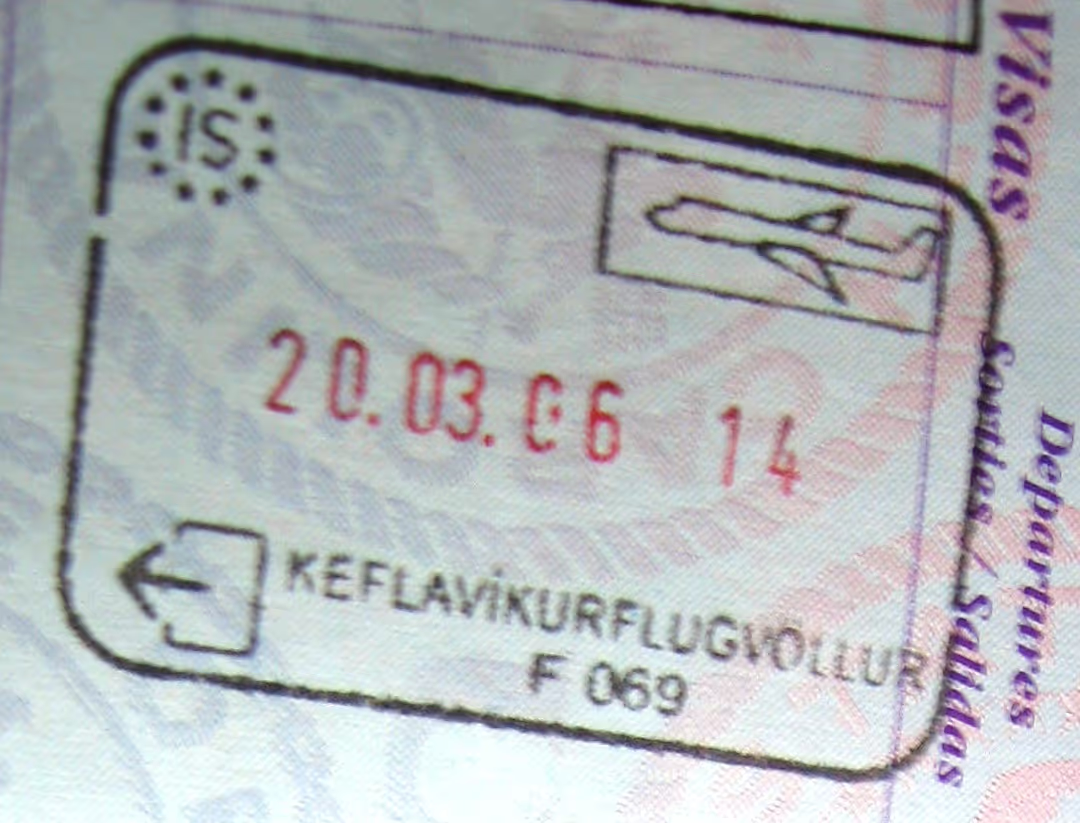
Schengen is the other piece of the puzzle. Iceland signed an agreement to participate in Schengen cooperation in December 1996 and has fully implemented Schengen since March 2001, according to Iceland’s government. The European Parliament likewise highlights Iceland’s participation in justice and home affairs cooperation “primarily through the Schengen Agreement.”
For Nordic-Baltic communities in North America, this context matters because the referendum is not about “joining Europe” in the travel sense—many of the practical mobility benefits already exist—but about where Iceland sits in Europe’s economic and political decision-making.
.avif)
What would change with full EU membership
The argument for Iceland joining the EU is often summarized as “a seat at the table.” That phrase is emotionally compelling, but it is also analytically accurate—because Iceland already follows extensive internal-market rules through the EEA while lacking formal decision-making power. The EU’s own description of the EEA underscores that EEA-EFTA states do not “formally access the EU decision-making process,” even though they can input during preparatory phases. A long-running Icelandic critique, echoed in policy analysis, is that EEA states can be obliged to absorb much of the acquis without a vote.
But membership is not just “more voice.” It would also mean hard policy trade-offs, especially in three areas:
Fisheries and the politics of sovereignty
No issue carries more symbolic weight in Icelandic EU debates than fisheries. During the earlier accession effort, the talks had made progress on many chapters but had not yet tackled sensitive chapters including agriculture and fisheries, according to a detailed 2013 analysis from the Centre for European Policy Studies (CEPS). The same analysis describes fisheries as an “emblem” issue for voters who fear pressure to grant EU fishing vessels access to Icelandic waters.
This is not merely cultural. The EEA itself explicitly keeps Iceland outside the EU’s Common Fisheries Policy, and the EU’s EEA explainer notes that Iceland issues its own fishing quotas and retains restrictions on ownership and establishment in the fisheries sector. Full EU membership would move Iceland into a different legal and political framework for fisheries—precisely where public consent has historically been hardest to build.
Currency and the euro question
Iceland’s current government has made currency politics central to the new debate. When the 2024 coalition agreement was announced, Iceland’s incoming government said it would set up an expert panel to study the pros and cons of keeping the króna versus adopting the euro.
Here, the Nordic-Baltic comparison becomes especially salient. Finland uses the euro; Sweden and Denmark keep their own currencies, but Denmark has a formal euro opt-out embedded in EU law. Sweden, meanwhile, is listed by the EU as a non-euro area country “expected” to adopt the euro once conditions are met, illustrating how euro adoption can be politically delayed even inside the EU.
For Iceland, the question is layered: EU membership does not automatically equal immediate euro adoption, but joining the EU would insert Iceland into a path where euro adoption becomes the standard expectation for most members.
Trade policy, tariffs, and the sharp edge of geopolitics
The “fast-track referendum” reporting ties urgency to trade and security shockwaves. In 2025, Icelandic and European reporting linked the EU debate to U.S. tariff policy and wider uncertainty in the North Atlantic.
One reason this stings is structural: the EEA does not include the EU Customs Union or the EU Common Trade Policy. Iceland can be tightly integrated with Europe’s market rules while still exposed to tariff blows and trade-policy bargaining it cannot influence from inside EU institutions.
The European Commission’s Iceland page notes that two-thirds of Iceland’s foreign trade is with EU member states—an economic fact that makes any disruption in EU-adjacent trade architecture disproportionately important. In that light, the referendum is not only a question of identity or sovereignty; it is also a question of how Iceland insures itself against a more volatile trade environment.
Nordic and Baltic comparisons: three models for small states
For readers from the Nordic-Baltic “eight” (Denmark, Finland, Iceland, Norway, Sweden, Estonia, Latvia, Lithuania) living in the U.S. and Canada, Iceland’s moment is best understood through three regional models.
Model one: Nordic EU membership with selective integration
Denmark joined the European Communities (the EU’s predecessor) in 1973. Finland and Sweden joined in 1995. Sweden’s own government describes how an advisory referendum in November 1994 produced a “yes” majority (52.3% yes, 46.8% no), a result political parties had agreed to respect.
These Nordic cases show that EU membership can coexist with strong national distinctiveness—and, crucially, with opt-outs or political choices that shape integration depth. Denmark’s euro opt-out is formally recognized in EU law. Sweden remains outside the euro area despite EU expectations about eventual adoption.
This matters for Iceland because it weakens the argument that “joining means losing everything.” Nordic experience suggests membership can be negotiated and politically managed—though not cost-free.
Model two: “Half-in, half-out” through the EEA and Schengen
Norway and Iceland remain the region’s best-known examples of deep economic integration without EU membership. The EEA brings Iceland (and Norway) into the single market while leaving them without formal access to EU decision-making.
Norway’s referendums—53.5% “no” in 1972 and 52.2% “no” in 1994—illustrate how durable the sovereignty argument can be in the North. Yet the Norwegian case also illustrates something else: rejecting EU membership does not automatically mean economic isolation, because the EEA can preserve the four freedoms.
For Iceland, this model is the status quo—but the renewed referendum debate suggests the status quo may feel less protective in a world where trade, security, and Arctic geopolitics are less predictable.
Model three: Baltic EU membership as a strategic and monetary anchor
Estonia, Latvia, and Lithuania joined the EU in the 2004 enlargement wave. Each used a referendum to legitimize the choice—Estonia passed its referendum with about two-thirds support and roughly 63% turnout, and Latvia likewise passed with about two-thirds support and about 73% turnout, according to archival European documentation.
The Baltic states also show what “full-spectrum” integration can look like: all three later joined the euro area—Estonia in 2011, Latvia in 2014, Lithuania in 2015—anchoring monetary policy inside the eurozone.
Iceland is not in the same post-Soviet security situation, but the Baltic experience is relevant because it demonstrates why small states may prioritize institutional anchoring when they perceive the external environment as unstable. That logic—anchoring through institutions—has re-entered Icelandic debate alongside heightened attention to Arctic security and transatlantic uncertainty.
What a fast-tracked referendum can and cannot accelerate
A key risk in current headlines is conflating three different questions:
- Should Iceland reopen or continue accession negotiations?
- Should Iceland join the EU?
- How quickly could Iceland realistically become an EU member?
The proposed near-term referendum, as described by Icelandic leaders and multiple reports, is primarily framed around restarting/continuing accession talks rather than immediately ratifying membership. That distinction matters because a “yes” vote would not, by itself, make Iceland an EU member. It would politically authorize the next technical and diplomatic steps.
What “yes” would unlock quickly
If Iceland votes yes to resume talks—especially if Brussels accepts Von der Leyen’s view that the application remains valid—two accelerators could kick in.
The first is that Iceland’s earlier negotiations were already well advanced. Official EU material states that by the time talks were put on hold in 2013, 27 negotiating chapters had been opened and 11 provisionally closed. That is a very different starting point than, say, a brand-new applicant.
The second is that Iceland’s EEA-based alignment reduces the distance-to-membership in many policy domains. The European Parliament highlights how the EEA has embedded Iceland in the single market since 1994 and enabled the four freedoms, while Iceland also participates in Schengen cooperation.
This is why some reporting suggests Iceland could, in theory, become the EU’s “quickest win” among countries in the accession universe.
What would still take time
Even in the most optimistic scenario, EU membership is a multi-stage, unanimity-heavy process—designed to go slowly when politics demand it. The European Commission’s accession-process explainer lays out the basic architecture: application, Commission opinion, candidate status, negotiations structured by clusters/chapters, and—at the end—an Accession Treaty signed and ratified by all EU member states and the candidate country, with the European Parliament also required to give consent.
Two bottlenecks stand out for Iceland:
The first is fisheries (and, to a lesser extent, agriculture and parts of energy policy). The CEPS analysis is explicit that these were among the sensitive chapters not yet touched when negotiations advanced in other areas, and that fisheries is politically emblematic in Iceland. No referendum can dissolve that conflict; it can only decide whether Iceland is willing to negotiate it.
The second is domestic legitimacy. Iceland’s prime minister has argued that the last time the country went through this process there was no initial vote explicitly asking whether to start—calling that a mistake—and emphasizing the need for a mandate. In practice, this implies a political expectation of at least one referendum, and potentially another at the end to ratify membership, even if EU law does not require it.

What to watch next
If the referendum is indeed pulled forward into 2026, four signals will matter most for readers tracking from the United States and Canada:
A clear parliamentary roadmap and referendum question wording, because a vote on “reopening talks” can produce a different coalition of supporters than a vote on “membership.”
Poll trendlines that distinguish between support for talks, support for membership, and support for currency change. Icelandic polling cited in European reporting suggests these are related but not identical attitudes.
Signals from Brussels on procedural status—whether Iceland is treated as restarting an old file or launching a new candidacy—especially given the visible domestic debate about whether the application is “still valid.”
Whether trade shocks and Arctic-security anxiety continue to intensify. The fast-track reporting explicitly links urgency to tariffs and Greenland-related concerns, which could keep EU membership framed as risk management rather than identity politics.

)%20(1).avif)