Nordic Countries (and Estonia) Lead the World in Clean Governance (2025 Rankings)
%20(1).avif)
2025 Corruption Rankings: Nordics and Estonia on Top
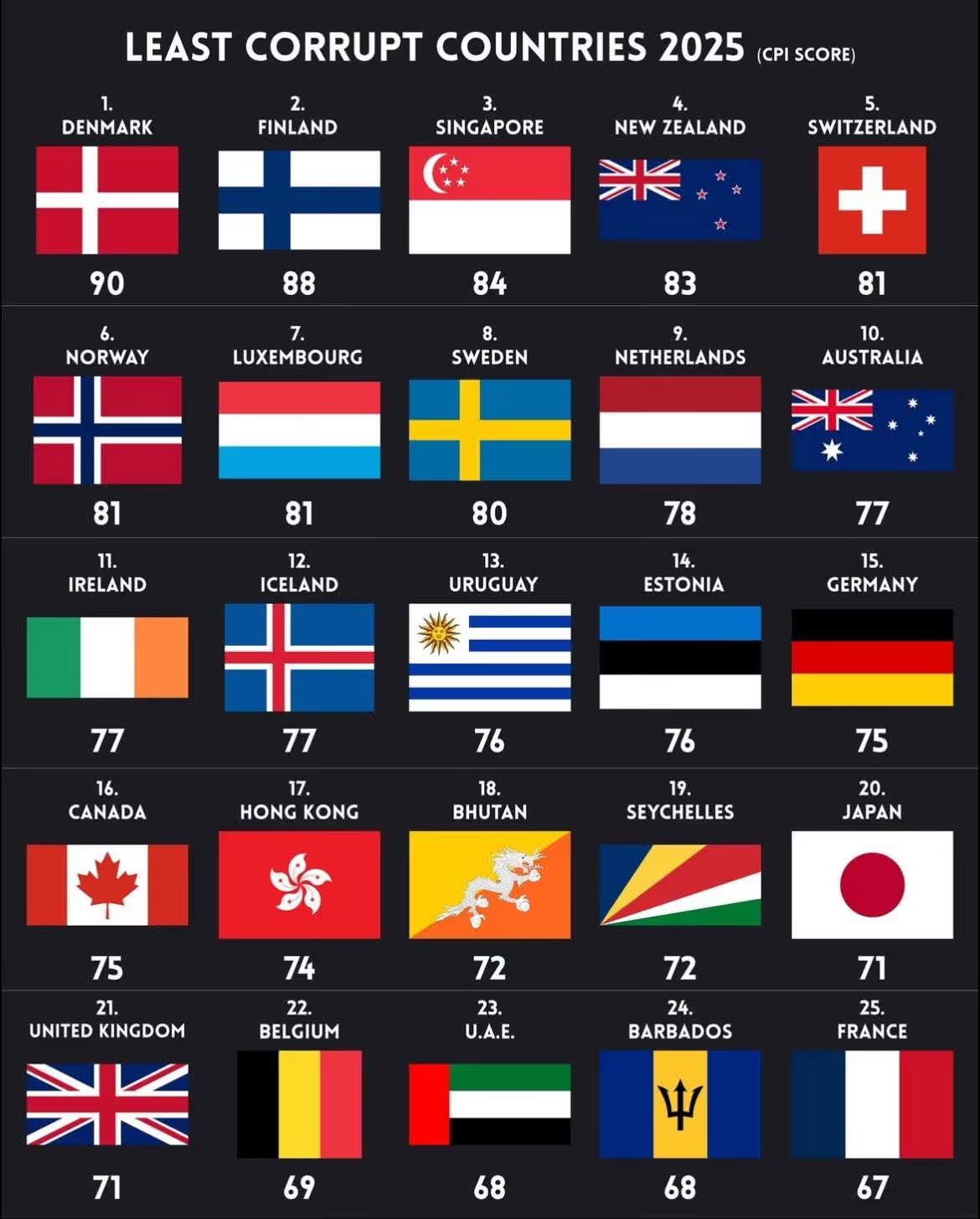
According to Transparency International’s Corruption Perceptions Index (CPI) 2024, published in early 2025, Denmark is ranked the cleanest country in the world with a score of 90/100, closely followed by Finland at 88. Other Nordic countries also dominate the top tier: Norway (score 81) and Sweden (80) have among the highest scores globally, and Iceland (77) sits comfortably in the top 15. Impressively, Estonia – though not geographically Nordic, often seen as adopting the Nordic model – joins this elite group with a CPI score of 76, ranking around 13th worldwide (the highest in Central and Eastern Europe). By comparison, major Western European economies like Germany (75) and France (67) score lower than these northern nations.
To put these numbers in perspective, the global average CPI score is only 43, and more than two-thirds of countries score below 50. In other words, most nations struggle with significant corruption, while the Nordic states and Estonia are noteworthy outliers of clean governance. At the very bottom of the rankings are conflict-torn and institutionally weak states – South Sudan (score 8), Somalia (9), Syria (12) and the like – illustrating the chasm between the world’s least and most corrupt environments. In 2025, the Nordic countries and Estonia clearly lead the world in integrity, setting an example that many others aspire to.
“The list of least corrupt countries often overlaps with the most developed nations,” notes a World Population Review analysis. High-income democracies tend to have the robust institutions and oversight needed to curb corruption, whereas the poorest and most conflict-ridden countries suffer a vicious cycle of weak governance and graft. The Nordic and Estonian case proves that clean governance is possible – and highlights how they got there.
The Nordic Recipe: Transparency, Trust and Accountability
It’s no coincidence that Denmark, Finland, Sweden, Norway and Iceland consistently top anti-corruption rankings. These societies share historical, cultural, and institutional factors that create an environment where corruption finds little room to thrive. “Top performers share key characteristics: high levels of press freedom; access to budget information so the public knows where money comes from and how it is spent; high integrity among people in power; and judiciaries that don’t differentiate between rich and poor, and that are truly independent,” observes Transparency International. In short, openness and rule of law are deeply ingrained.
Transparency is a longstanding tradition in the Nordic region. Sweden famously passed the world’s first freedom of information law back in 1766, and all Nordic countries have modern transparency and public access laws. Government budgets and records are generally open to public scrutiny, which makes it hard to hide wrongdoing. For example, Finland’s public sector has been lauded for its openness; citizens can access a wealth of information on government decisions and spending. This legacy of open government has earned the Nordics their reputation as the world’s most corruption-free zone.
Another pillar is strong institutional integrity. These countries have professional, merit-based civil services and independent watchdog agencies. Courts prosecute malfeasance without bias, and even high-ranking officials are not above the law. Enforcement of anti-corruption laws tends to be consistent. Bribery, embezzlement, and conflicts of interest are not tolerated in public office, and there are clear codes of conduct for officials. As a result, petty bribery is virtually nonexistent in daily life – it’s unheard of to pay a bribe to police or bureaucrats in Norway or Denmark, for instance. This clean reputation is reflected in surveys: only about 2% of people in Estonia (now culturally aligned with the Nordics) report paying a bribe for public services, the lowest in the EU according to a 2021 barometer.
Perhaps most importantly, high social trust and civic integrity underlie the Nordic model. These societies exhibit a remarkable level of trust in each other and in public institutions. In Denmark, for example, there is a deeply rooted “general societal trust” – people are expected to be honest and responsible, and in turn the public trusts that officials will act in the best interest of society. This culture of trust has historical roots: the Nordic countries have enjoyed long periods of stable democracy and relative peace, allowing trust to accumulate over generations. The payoff is tangible: fewer security hurdles, less red tape, and a cooperative relationship between citizens and the state. “People who hold power…are trusted to act in the best interest of society, and there is very little corruption,” notes an overview by the Danish government on its culture of trust. In practical terms, a business in Finland or Sweden can usually expect fair treatment and doesn’t need “connections” or bribes to get things done – a stark contrast to many countries.
Political accountability is also robust. The Nordic countries are stable democracies with active civil societies and free media that hold leaders accountable. Whistleblowers and investigative journalists have played key roles in exposing the rare cases of misconduct, ensuring that corruption scandals (when they occur) lead to public outcry and reforms rather than being swept under the rug. Voters likewise reward clean governance; governments know that corruption can be a career-ending scandal in these high-trust societies.
It’s worth noting that even these top-performing countries are not entirely corruption-proof – but they handle challenges openly. For instance, Denmark’s reputation took a hit with the Danske Bank money-laundering scandal (involving billions of illicit funds flowing through its Estonian branch). This highlighted how even “clean” countries face risks like financial crimes that the CPI doesn’t fully capture. Likewise, Sweden and Norway have seen minor declines in CPI score recently, marking their lowest scores on record (Sweden at 80, Norway 81) amid concerns of lobbying influence and other loopholes. The takeaway, however, is that these nations respond to such threats with greater scrutiny and reforms. “It isn’t enough for top performing countries to lead by example with a clean public sector: they have to become leaders across the board,” Transparency International argues, urging high-scoring countries to close remaining loopholes like money-laundering havens and foreign bribery by their companies. In essence, the Nordics continuously strive to improve integrity, which helps them maintain public trust.
Estonia: A Baltic Standout Embracing the Nordic Model
Among Europe’s post-Soviet states, Estonia is a remarkable success story in combating corruption. In the 1990s, after regaining independence from the USSR, Estonia faced the challenge of uprooting entrenched corrupt practices and building new institutions. Today, it ranks alongside Western Europe’s cleanest countries on corruption indices – far ahead of its Baltic neighbors Latvia and Lithuania (which score around the mid-50s to low 60s on the CPI). Estonia’s rise from a corruption-plagued past to the 12th least corrupt country globally in 2023 is no accident; it stems from deliberate reforms and a cultural shift often inspired by Nordic examples.
One key factor in Estonia’s success is its digital governance revolution. Often called the “e-Estonia” model, the country invested heavily in e-government systems that digitized everything from citizen ID cards to tax filing and public services. By moving services online, Estonia drastically reduced the bureaucratic red tape and face-to-face interactions that can breed petty corruption. As Transparency International’s Estonia chapter notes, “Estonia’s own success in stamping out corruption can be attributed to the wide use of e-governance and a well-working law on public information.” Since 2000, Estonia’s Public Information Act has mandated government agencies to make information accessible on official websites, creating unprecedented openness. Today, “all the information [citizens] need is available online… There is no need to find answers by going through piles of papers,” an Estonian anti-corruption expert observed, noting that less paperwork and fewer in-person hoops mean “less chance of asking for or giving a bribe.” In other words, digital transparency has closed many avenues for corruption in Estonia’s public sector. Everything from business registrations to medical prescriptions is handled electronically with clear records, leaving little room for officials to solicit illicit favors.
Estonia also enacted strong legal frameworks and integrity bodies early on. It adopted a comprehensive Anti-Corruption Act in 2012 covering all public officials, accompanied by strict ethical codes in the civil service. The government regularly updates a national Anti-Corruption Action Plan (the current plan covers 2021–2025) to set objectives for transparency, fair competition, and law enforcement against corruption. Institutions like the Ministry of Justice coordinate anti-corruption policy, and specialized bodies oversee areas like political party financing and conflict of interest compliance. Thanks to these efforts, most of Estonia’s public institutions today are characterized by high integrity and transparency. Facilitation payments (informal “grease money”) and gift-giving to officials in exchange for services are explicitly illegal and culturally stigmatized. Even the police force, once susceptible to bribes under Soviet rule, has gained public confidence through effective mechanisms to detect and punish internal corruption. As a result, everyday Estonians rarely encounter bribery – a stark turnaround from the 1990s.
Crucially, Estonia benefited from close ties with the Nordic countries, which helped transplant a culture of clean governance. In the early transition years, a wave of Finnish and Scandinavian investors and advisors came to Estonia. “As Finnish business people set up shop in Estonia in the early 1990s, they brought with them clean business practices,” notes Tarmu Tammerk of Transparency International Estonia. These businesses insisted on proper bookkeeping, transparent contracts, and “no unofficial salaries,” modeling Western standards that gradually took root in the Estonian private and public sectors. This influence, combined with Estonia’s own political will, “helped mold a new business climate” in the country, easing the adoption of democratic, free-market principles and undermining the old networks of cronyism. In essence, Estonia “Nordic-ized” itself – learning from neighbors like Finland and Sweden on how to foster a high-trust, low-corruption society.
Today, Estonia stands out as the least corrupt country in Eastern Europe, often mentioned in the same breath as the Nordics when it comes to governance. It has leveraged its digital prowess not only to fight corruption but also to boost economic competitiveness. The country ranks among the top in Europe for ease of doing business and digital services, illustrating a clear correlation: countries that score well on corruption indices also tend to rank high on ease-of-business metrics. As Invest Estonia (the country’s investment agency) proudly points out, Estonia “alongside other Nordic nations, is among the global leaders in digital transformation and governance, leveraging technology to enhance government services, increase transparency, and combat corruption effectively.” The inclusion of Estonia in this leading pack is a testament to how far it has come from the corrupt Soviet legacy. Challenges remain (for example, ensuring transparency in political party finances and lobbying is an ongoing effort), but Estonia’s progress offers a roadmap for others: strong political will, modern technology, and alignment with best practices can yield dramatic improvements.
A Study in Contrasts: Clean vs. Corrupt Systems
The Nordic countries and Estonia underscore how certain systemic features can keep corruption low – and how their absence can cause corruption to fester elsewhere. Compare these clean governance models to more corrupt nations or regions, and the contrasts are stark:
- Rule of Law and Justice: In high-integrity countries, courts and law enforcement are independent and non-partisan, prosecuting bribery or fraud whether the culprit is a clerk or a cabinet minister. In highly corrupt states, by contrast, the judiciary may be under political control, and powerful elites enjoy impunity. It’s not uncommon in those places for investigations to be quashed or judges bribed. As Transparency International notes, the worst-scoring nations often have “weak public institutions like police and the judiciary” that lack independence. In Western Europe, even a whiff of scandal triggers investigations, whereas in, say, Venezuela or Syria (both near the bottom of the CPI), corruption may reach the highest offices with little consequence.
- Transparency and Free Media: The Nordics have uncensored press and robust freedom of information; officials operate in a glass house of public scrutiny. Conversely, countries plagued by corruption often muzzle journalists and restrict information. For example, Somalia, South Sudan, and Yemen – all at the bottom of the CPI – suffer not only conflict but also closed political systems where reporting on corruption can be dangerous. Without transparency, shady deals and nepotism thrive in the dark. Meanwhile, Nordic countries routinely rank among the very top in global press freedom indices, and they pioneered open-data portals so citizens can track everything from government budgets to procurement contracts. This means anyone can blow the whistle with evidence, a powerful deterrent against misconduct.
- Political Culture and Public Attitudes: Perhaps the hardest difference to quantify is culture. In low-corruption societies, there is a strong social norm against graft – both leaders and citizens largely agree that corruption is a serious wrong, not a tolerable shortcut. Public officials in Finland or Denmark are expected to serve the public interest honorably – any abuse of office is a scandal. By contrast, in some high-corruption environments, graft can become “normalized” as a part of doing business or securing basic services. Citizens may be forced to pay bribes for hospital care or permits, and top leaders might openly use their offices to enrich themselves. This breeds cynicism and erodes trust. The Nordics enjoy the opposite: a virtuous cycle where honest governance breeds public trust, and that trust further reduces the temptation to cheat or cut corners.
- Economic Equity and Stability: Notably, many of the least corrupt countries also have lower income inequality and strong social safety nets (the Nordic welfare model). While corruption isn’t solely a developing-world problem, extreme corruption does correlate with unstable, poor states. War-torn and poverty-stricken nations often rank as most corrupt because instability, scarcity, and lack of oversight create fertile ground for bribery and fraud. The Nordic states and Estonia benefit from relatively equitable economies – a large middle class and robust public services mean fewer people are desperate enough to engage in petty corruption. And leaders there cannot easily exploit poverty to buy votes or loyalty with kickbacks, as sometimes happens in weaker states.
In summary, clean countries distinguish themselves by the strength of their institutions and civic norms. As one global study observed, the top nations on the CPI also tend to be those with “reliable and extensive welfare benefits, low corruption, and well-functioning democratic institutions.” In contrast, the bottom-ranked tend to be those afflicted by authoritarianism, conflict, or lack of any real checks on power. The case of the Nordic region and Estonia highlights that corruption is not an inevitable cultural fate – it is largely a function of good governance structures and values. When countries put the right laws, transparency mechanisms, and accountability in place, and when a culture of integrity takes hold, corruption can be pushed to the margins.
Why It Matters: Innovation, Prosperity and Happiness in Clean Societies
Beyond moral or legal ideals, low corruption has real, positive impacts on societies. The success of the Nordic and Estonian models isn’t just in scoring high on an index – it translates into tangible benefits in everyday life, the economy, and even national psyche.
One major impact is on economic innovation and efficiency. In a country with honest governance, businesses compete on a level playing field; contracts are awarded on merit, not favoritism; entrepreneurs don’t need bribes to get permits; and investors can trust the rules won’t suddenly change. All of this encourages investment and innovation. It’s telling that the Nordic economies consistently rank among the world’s most competitive and innovative. In fact, four of the five Nordic countries are in the top 12 of the World Economic Forum’s Global Competitiveness Index, scoring highly in categories of institutional strength and innovation capability. Estonia, too, punches above its weight in tech startups and digital entrepreneurship – being corruption-free has made it a magnet for investors (and talent) who value a transparent business climate. Researchers have noted a clear correlation: countries with lower corruption tend to have higher productivity and GDP per capita, because resources are allocated more efficiently rather than siphoned off to the corrupt. As Denmark’s Ministry of Foreign Affairs highlighted, the lack of government corruption makes dealing with the state “clear and predictable for companies,” reducing the costs of doing business and fostering trust-based commerce. In Denmark’s case, one political science professor even estimated that up to a quarter of the nation’s wealth can be attributed to the high level of trust (and low corruption) in society. While that figure may be hard to pin down precisely, it underscores an important point: clean governance is an economic asset.
Another benefit is seen in social well-being and happiness. The Nordic countries famously top the World Happiness Report year after year. This is not a fluke – one of the report’s key indicators is the absence of corruption and presence of trust in institutions. The 2017 World Happiness Report noted that freedom from corruption and high trust are among the crucial factors explaining why Nordic people report such high life satisfaction. Essentially, when citizens trust their government and each other, society is less anxious and more cohesive. Public services like healthcare and education are delivered more effectively (since funds aren’t lost to graft), and people feel secure that their tax money is used for public good. “The Nordic countries lead the world in trust in government…and freedom from corruption,” which directly contributes to their citizens’ happiness and sense of security. Low corruption also means less everyday frustration: individuals don’t have to navigate bribery to get things done, and they rarely experience the injustice of seeing corrupt actors go unpunished. All this improves quality of life. For example, in high-trust Denmark, it’s common to see unstaffed roadside farm stands where buyers take produce and leave cash in a jar – a simple sign of how social trust (fostered by low corruption) makes life more relaxed. While that’s a quaint example, it reflects a bigger picture: trust and transparency create a virtuous cycle of societal contentment.
Moreover, low corruption correlates with higher public confidence in democracy. Voter turnout in Nordic countries tends to be high, and governance is generally stable, because people believe in the system. Contrast this with highly corrupt countries, where citizens often lose faith in elections and public institutions, sometimes leading to unrest or authoritarian backlash. By safeguarding integrity, the Nordic countries and Estonia sustain a healthier relationship between the government and the governed.
Finally, consider human development and social justice. Corruption disproportionately hurts the most vulnerable – diverting funds from schools, hospitals, and infrastructure that benefit ordinary people. The Nordics, by largely avoiding such leakages, can invest heavily in social welfare. This contributes to their enviable records in education, health, and equality. It’s no surprise that they rank at the top of human development and gender equality indexes. In these countries, meritocracy has a better chance: young people with talent and ideas can succeed without needing political connections or bribe money. That social mobility further fuels innovation and optimism.
Closing Thoughts
The world can learn a great deal from how Northern Europe and Estonia have kept corruption in check. Their experience shows that corruption is not an insurmountable cultural trait but a governance challenge that can be managed and mitigated. Strong transparency laws, impartial courts, accountable politics, digital solutions, and a culture of trust together form a powerful antidote to corruption. Of course, no country is perfect – even in Scandinavia, vigilance is needed to address new risks like global money laundering and lobbying influence. But in 2025, the Nordic nations and Estonia offer a hopeful example that clean government is possible and it pays off. From bustling startup hubs in Tallinn and Stockholm to the high living standards of Copenhagen and Helsinki, the evidence is clear: when leaders and citizens unite to demand integrity, society flourishes. As Transparency International’s chair noted, “Corruption is an evolving global threat… The dangerous trends revealed in this year's index highlight the need to follow through with concrete action now to address global corruption.” The Nordic-Baltic experience proves that taking such action – and nurturing a culture of honesty – can yield societies that are not only less corrupt, but more resilient, prosperous, and happy.


)%20(1).avif)