Finland Is the World’s Happiest Country Again. Finns Still Don’t Sound That Excited About It.

Finland, characteristically, has responded with something closer to a shrug.
That may be exactly the point.
The 2026 World Happiness Report once again placed Finland first, with an average life-evaluation score of 7.764 out of 10. Iceland came second, Denmark third, Sweden fifth, and Norway sixth, meaning all five Nordic countries landed inside the global top six. Costa Rica, meanwhile, made one of the year’s biggest leaps, rising to fourth place.
But the word “happiness” can be misleading. The World Happiness Report does not ask people whether they are cheerful, smiling, exuberant, or emotionally radiant. It is based on life evaluation: respondents are asked to place their lives on a ladder from the worst possible life to the best possible life. In other words, Finland’s annual victory is less a prize for national enthusiasm than a measure of whether people believe life is fundamentally working.
That distinction matters. Finnish happiness is not necessarily the happiness of applause, optimism, or visible delight. It is closer to the happiness of reliable buses, clean tap water, public libraries, social trust, functioning schools, personal space, low corruption, forest access, and a reasonable expectation that nobody will bother you unless something truly needs to be said.
Finland’s soft-power miracle is that a country not especially known for self-promotion has become the global face of wellbeing.
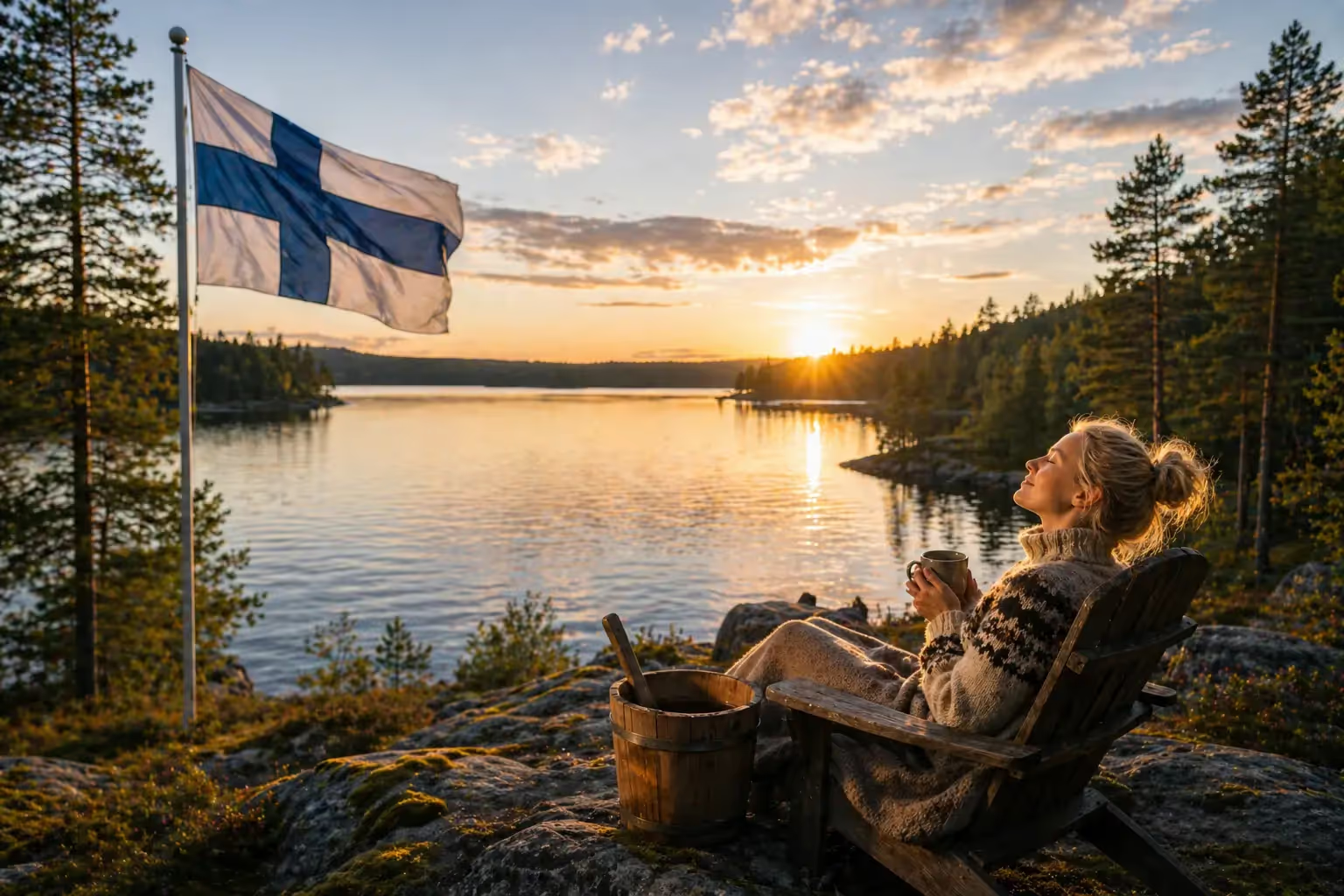
The quietest brand in global happiness
Finland’s happiness brand is strange because it runs against almost every rule of modern branding. It is not loud. It does not depend on glamour. It does not ask people to perform joy. In fact, much of the country’s appeal to outsiders now comes from the feeling that Finland is not trying very hard to impress them.
Visit Finland’s 2026 response to the ranking leaned into that contradiction. Its message was not “come celebrate” but “switch off.” The tourism board described Finnish happiness as stepping away from screens, slowing down, spending time in nature, swimming in a lake, heating the sauna, walking in the forest, sharing food at a summer cottage, and putting the phone away for a while.
That is not happiness as entertainment. It is happiness as relief.
The timing is important. The 2026 World Happiness Report focused heavily on social media and wellbeing, especially among children and young people. Its landing page notes that young people in North America and Western Europe are much less happy than 15 years ago, during the same period in which social media use has sharply increased.
Finland’s official reply, then, was not just a tourism slogan. It was almost a philosophical counteroffer: instead of more stimulation, less; instead of constant visibility, privacy; instead of optimization, ordinary life.
Finnish happiness is infrastructure
To understand why Finland keeps winning, it helps to remove the word “happy” for a moment. Replace it with “secure,” “trusted,” “balanced,” or “unshowy.” The result sounds much more Finnish.
ThisisFINLAND, the country’s official public diplomacy platform, describes Finnish happiness through a series of foundations: trust, transparent governance, safety nets, social cohesion, equality, education, access to nature, sauna, simplicity, and work-life balance.
Those are not mood enhancers in the shallow sense. They are systems. They reduce friction. They make everyday life less anxious.
In Helsinki, city officials have framed the ranking in similarly practical terms. A March 2026 city release connected Finland’s continued success to education, equality, public services, a well-designed urban environment, and the everyday reliability of neighborhoods, schools, and services. The same release noted that Helsinki has taken concrete steps around youth wellbeing in the digital age, including restrictions on phone use during the school day in comprehensive schools beginning in August 2025.
This is where the Finnish case becomes especially interesting for readers in the United States and Canada. Many North American conversations about happiness focus on mindset, lifestyle, wellness routines, or individual choice. Finland’s example suggests that private happiness is deeply public. It is shaped by whether institutions work, whether people trust one another, whether children are supported, whether cities are designed for daily life, and whether nature is treated as part of ordinary wellbeing rather than a luxury escape.
In that sense, Finland’s “happiness” is less a national personality trait than a civic achievement.
The right to be left alone
There is also something culturally specific about the Finnish version of contentment. It is not sentimental. It is not performative. It often sounds underwhelming when translated into English.
A Finnish person may describe happiness as a good cup of coffee, a quiet walk, a sauna that is hot enough, a lake that is cold enough, or a day when nothing unnecessary happens. The drama is in the absence of drama.
Yle, Finland’s national broadcaster, captured this distinction in its coverage of the 2026 report. The article cited a University of Helsinki social policy researcher who argued that the index is not really measuring emotional happiness, but life satisfaction — a cognitive assessment of how life feels overall. He also pointed to institutions, trust, welfare-state resilience, and Finnish moderation as explanations for the country’s high ranking.
Moderation may be the least exportable part of Finland’s happiness formula. It does not make for easy headlines. It is hard to package. It is almost anti-viral. But it may be central to why the country’s wellbeing story remains compelling.
A culture of modest expectations can sound pessimistic from the outside. Yet it can also create space for gratitude. If happiness is not imagined as constant excitement, then a great deal more of life becomes acceptable, even satisfying. A well-planned city. A quiet train. A dry pair of socks. A friend who does not overstay. A public service that simply works.
Libraries, saunas, forests, and the public imagination
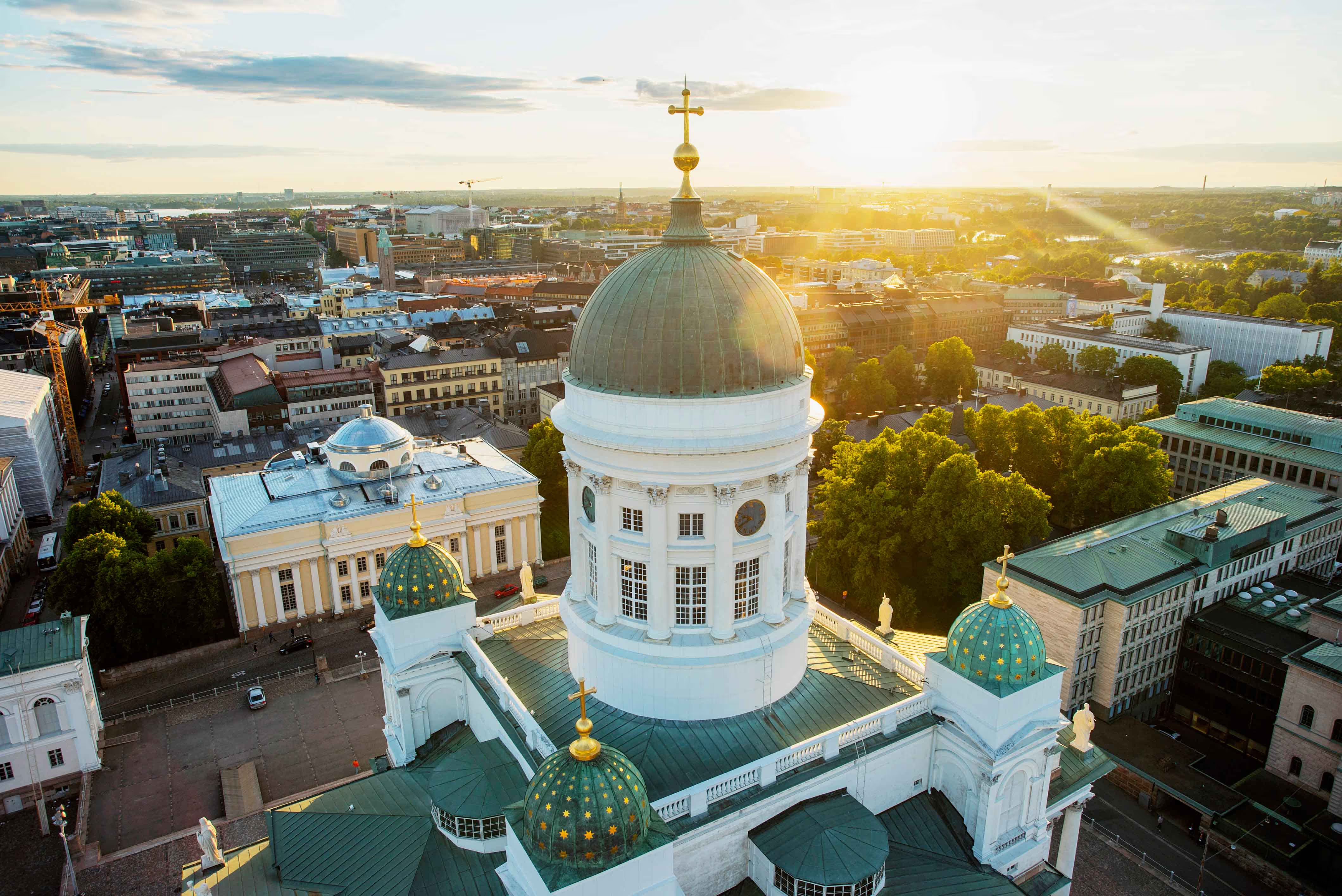
Few places express the Finnish model better than Helsinki Central Library Oodi. Opened in 2018, Oodi is a public library, architectural landmark, civic living room, and symbolic argument about what a society should provide. Visit Finland describes it as a free, non-commercial urban public space open to all, located directly across from Parliament.
That location feels almost too perfect. On one side: representative democracy. On the other: a warm, accessible public building where people can read, work, gather, create, borrow, sit, and simply exist without having to buy anything.
Oodi is also part of a broader Helsinki design story. Visit Finland describes the Töölönlahti area as one of the city’s richest clusters of iconic architecture, with Parliament House, Finlandia Hall, Kiasma, Musiikkitalo, and Oodi standing near one another.
The connection between architecture and happiness is not decorative. Built environments either support daily life or make it harder. Oodi’s symbolic power lies in its ordinariness: it is spectacular, but it serves everyday needs.
The sauna plays a similar role. Internationally, the sauna is often treated as a lifestyle trend. In Finland, it is closer to a shared language. ThisisFINLAND describes sauna as an egalitarian space where people can relax, detach from daily pressure, and reconnect with themselves and others.

The forest completes the triangle. Nature is not a weekend luxury in Finland’s national self-image; it is part of the emotional architecture of life. The official Finnish explanation for happiness repeatedly returns to access to nature, daily movement, seasonal contrast, water, woods, and the calming effect of being outdoors.
Together, the library, sauna, and forest tell a story: happiness is not something Finland claims to possess because its people are endlessly joyful. It is something the country builds into the background.
The Nordic exception — and its limits
Finland’s ninth consecutive win also keeps the broader Nordic story alive. In 2026, Iceland, Denmark, Sweden, and Norway all ranked among the top six countries in the world.
That dominance can become a cliché if handled carelessly. The Nordic countries are not utopias. They face loneliness, aging populations, mental-health concerns, economic pressures, political tensions, climate anxiety, and debates over immigration and identity. Finland itself is not immune to youth wellbeing concerns; Yle’s coverage of the 2026 ranking points readers to recent reporting on declining life satisfaction among young people in Finland.
The 2026 report’s emphasis on social media also complicates the Nordic success story. A country may rank first overall while still worrying about younger generations, digital dependency, isolation, or changing social habits. The lesson is not that Finland has solved happiness. It is that Finland has built unusually strong buffers against unhappiness.
Those buffers may now be tested by the same forces reshaping life elsewhere: algorithmic distraction, weaker social connection, economic uncertainty, and the pressure to live publicly online.
That is why Finland’s quiet response feels newly relevant. The Finnish message is not that happiness is easy. It is that wellbeing may require boundaries — with work, with technology, with noise, and even with the demand to appear happy.

What North America can learn from Finland
For Nordic and Baltic communities in the United States and Canada, Finland’s ranking is more than a charming annual headline. It is a reminder that cultural inheritance can carry practical wisdom.
Finnishness in North America is often preserved through food, design, music, language, sauna culture, Lutheran and secular community institutions, summer camps, folk traditions, and family stories. But the deeper inheritance may be a worldview: do not overstate; do not waste; make things useful; respect silence; trust is precious; nature restores; public life matters; comfort does not need to be flashy.
These ideas are not limited to Finns. They resonate across the Nordic and Baltic worlds, where small countries have often treated education, culture, resilience, and social cohesion as survival tools.
In a North American context, Finland’s happiness ranking can therefore be read in two ways. As news, it says Finland is No. 1 again. As culture, it asks a harder question: what would it take to make everyday life feel less exhausting?
The answer is not simply “move to Finland,” though tourism campaigns would not mind if some readers tried. The answer is to look at the conditions that make Finnish life satisfaction possible: trust, public spaces, access to nature, healthy boundaries, education, modest expectations, and social systems that reduce fear.
The anti-happiness happiness story
Perhaps the reason Finland keeps winning is that it does not chase happiness in the way the world often defines it.
It does not sell happiness as constant self-expression. It does not confuse wellbeing with luxury. It does not require enthusiasm as proof of gratitude. It leaves room for melancholy, privacy, silence, winter, awkwardness, and the human need to be undisturbed.
That may be why Finland’s global happiness brand feels so paradoxically persuasive. In an overstimulated age, the happiest country in the world is not promising ecstasy. It is offering something rarer: enough.
Enough trust to relax. Enough nature to breathe. Enough public life to feel supported. Enough privacy to remain yourself. Enough moderation to avoid disappointment. Enough warmth, in the form of sauna, coffee, libraries, and summer cottages, to get through the cold.
Finland is the world’s happiest country again.
Finns may not sound especially excited about it.
That may be the most Finnish evidence of all.

)%20(1).avif)