The Cookbook as Family Archive
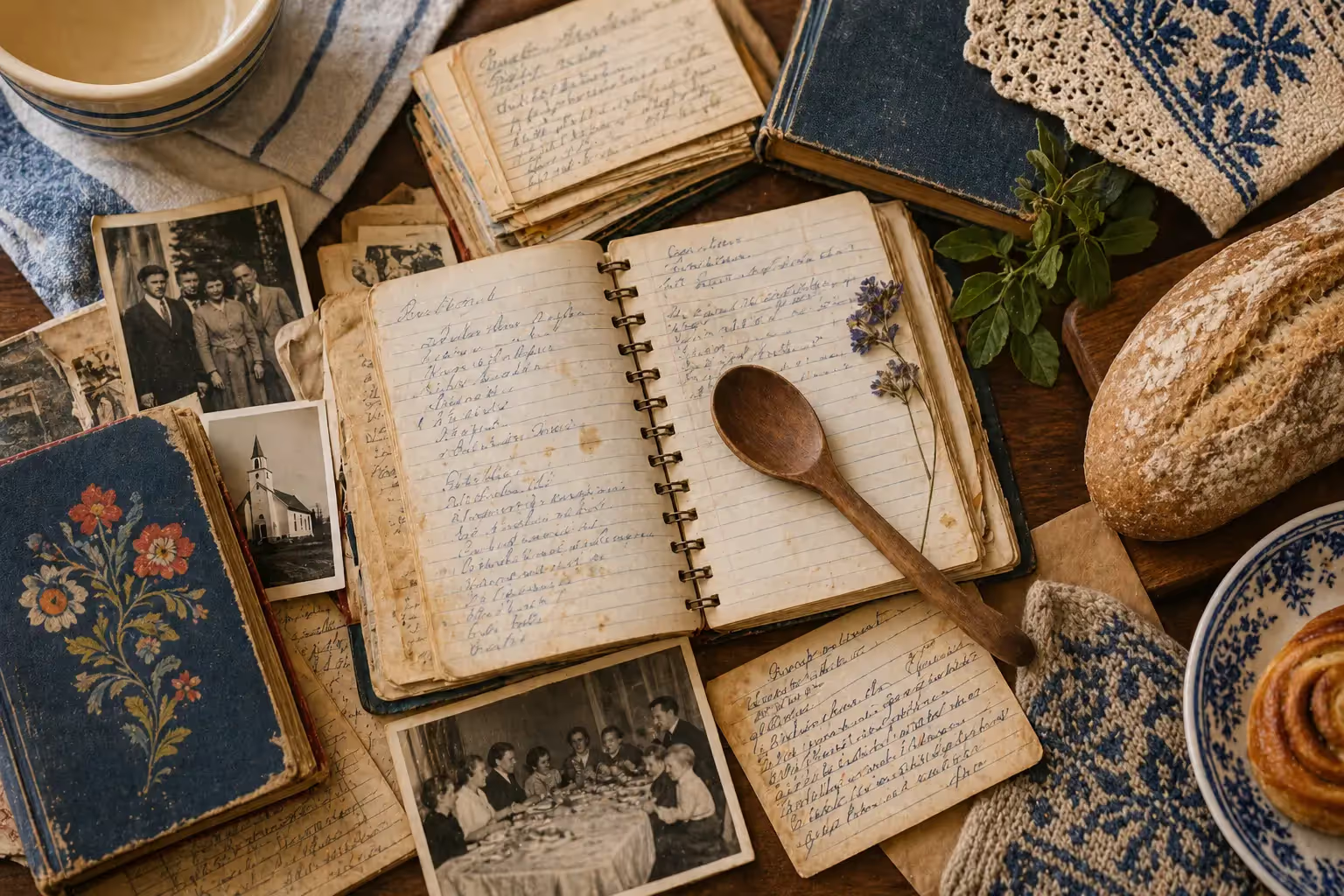
Some family archives live in boxes. Others live in the kitchen.
They appear as splattered recipe cards, handwritten substitutions, folded newspaper clippings, loose pages tucked into old cookbooks, and notebooks with no title but years of authority behind them. They are rarely arranged for historians. They do not announce themselves as cultural documents. And yet in many Nordic and Baltic households across North America, these recipe collections carry a surprising amount of family history.
A cookbook, after all, is never only a cookbook. It is a record of taste, season, scarcity, adaptation, celebration, and labor. It tells you what a family considered worth repeating. It shows what was available in a new country and what had to be approximated. It reveals which dishes were reserved for Christmas, Easter, midsummer, name days, confirmations, coffee tables, church basements, and long winter weekends. It records not just what people ate, but how they remained themselves.
This is especially true in immigrant and diaspora communities, where recipes often become one of the most durable forms of inheritance. Language may thin out across generations. Place names may blur. Family stories may survive only in fragments. But a holiday table can remain remarkably precise. The same rye bread appears. The same buns, cakes, soups, fish dishes, preserves, or celebratory pastries return at the same time each year. A younger relative may not remember the village a grandparent left behind, but they may know exactly how a certain dough should feel when it is ready, or that one dish must be made the day before, or that no gathering is quite right without a familiar plate at the center of it.
These details matter because food is one of the few cultural forms that can be both ordinary and ceremonial at once. It belongs to daily life, but it also has the power to mark time. A recipe can carry a whole calendar inside it. There are dishes that belong to Advent and dishes that belong to midsummer, foods associated with mourning and foods associated with joy, recipes that signal hospitality, thrift, fasting, abundance, or the arrival of guests. Even when descendants no longer speak the heritage language fluently, they often inherit this rhythm. They know which foods mean home, which foods mean celebration, and which foods belong to older relatives whose presence is now recalled through repetition.
In that sense, cookbooks function as domestic archives. Not polished official histories, but lived ones.
They also tell a migration story in miniature. Immigrant cooking is often discussed in terms of preservation, but adaptation may be the more revealing category. A recipe written in Europe may be remade in the United States or Canada with different flour, different fish, different dairy, different seasonal produce, different measurements, and different assumptions about what a local shop can provide. Ingredients are substituted. Techniques are shortened. Quantities become less exact. A recipe once written for a wood-fired stove finds its way to an electric one. Another shifts because a certain berry is unavailable, a certain cut of meat is too expensive, or a family has learned to combine old expectations with new surroundings.
What remains on the page, and on the table, is evidence of negotiation. This is not cultural loss in any simple sense. It is cultural life doing what it has always done: adjusting, improvising, and continuing.
There is also something deeply personal about the form these archives take. Many family recipes are not written for strangers. They assume prior knowledge. They say things like “mix as usual,” “bake until done,” or “add enough flour,” trusting that the reader already belongs to the world in which the recipe makes sense. This can be frustrating to descendants trying to reconstruct a dish years later, but it is also revealing. Such instructions were often never meant to stand alone. They were companions to embodied knowledge, to watching someone work, to being in the kitchen often enough that certain things did not need to be explained.
That is part of what makes inherited recipes so emotionally charged. They preserve not only flavor, but presence. The handwriting itself can feel intimate. So can the evidence of revision: a crossed-out line, a penciled note in the margin, the word “better” beside one version, the name of the aunt or grandmother who made it a certain way. These are not minor details. They are traces of people whose care entered family life through repetition, often without much public recognition.
For that reason, cookbook history is also family history, and often women’s history. It preserves forms of knowledge that were practical, aesthetic, social, and sustaining all at once. It tells us who hosted, who prepared, who remembered, who taught others, who fed the church gathering, who kept holiday expectations alive, and who transformed cultural continuity into work that happened mostly behind the scenes. In many families, the archive of belonging was assembled in kitchens long before anyone thought to call it an archive.
That insight feels especially resonant now, as younger generations across Nordic and Baltic communities look for ways back into family history. Not everyone begins with documents in a formal sense. Some begin with a recipe binder. A page in a parent’s handwriting leads to a question about a grandmother. A holiday dish leads to a conversation about a town, a war, an immigration route, a church community, a farm, or a summer custom. A loaf, a soup, a pastry, or a casserole becomes the starting point for a much larger act of remembering.
This is one reason community cookbooks deserve more attention than they usually receive. Church cookbooks, auxiliary cookbooks, festival booklets, and anniversary compilations may look modest, but they often preserve a remarkable map of diaspora life. They show what people brought with them, what they chose to share publicly, and how communities presented themselves to one another through hospitality. They reveal not only cherished dishes, but networks of care. A name next to a recipe becomes a small historical record. One congregation, one club, one language group, one women’s society at a time, a community leaves behind a portrait of itself.
In an age of searchable recipes and endless digital convenience, these older collections can seem quaint. But their power lies precisely in their specificity. They are not optimized. They are not interchangeable. They belong to someone. They came from somewhere. They carry a social world with them.
That is why so many people hold onto them, even when they no longer cook from them often. The cookbook remains because it is not merely instructional. It is evidentiary. It proves that a family gathered this way, seasoned this way, celebrated this way, adapted this way. It proves that culture was not only declared, but practiced.
For Nordic and Baltic communities in North America, that may be one of the most meaningful things a family archive can do. It can remind descendants that identity is not preserved only in official records, monuments, or public commemorations. It is also preserved in domestic rituals repeated with enough care that they outlast distance, assimilation, and time.
A handwritten recipe is a humble object. But in the right light, it becomes a map of migration, memory, and love.

)%20(1).avif)