What We Keep When We Lose the Language
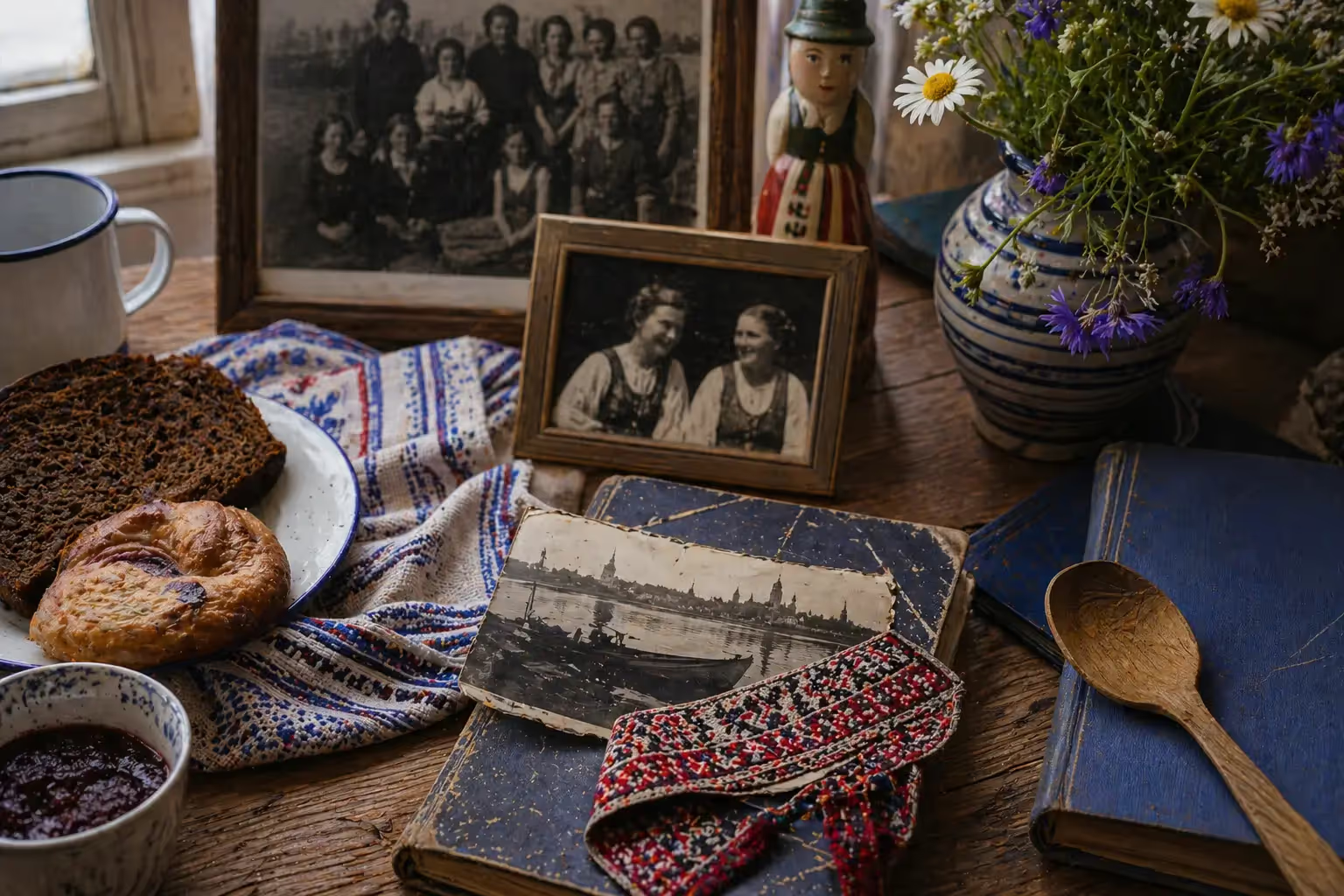
In many Nordic and Baltic homes across North America, the language does not survive intact. A grandparent may have arrived speaking Estonian, Finnish, Latvian, Lithuanian, Icelandic, or Swedish. Their children may have understood more than they spoke. Their grandchildren may know only a few words now, a holiday greeting, the name of a dish, the chorus of a song, a phrase repeated at the table for so many years that it no longer feels borrowed from another country. And yet something unmistakable remains.
This is one of the quieter truths of diaspora life: language matters deeply, but it is not the only vessel that carries culture forward.
For many families, the loss of fluency can feel painful. It can bring guilt, regret, or the sense that a door has narrowed between generations. Adult children often wish they had asked more questions when older relatives were still alive. Parents wonder whether they should have pushed harder. Younger descendants may feel suspended between pride and uncertainty, close enough to claim an inheritance but not always fluent enough to feel entirely secure in it.
That experience is hardly unique to Nordic and Baltic communities, but it has a particular texture here. These are cultures in which song, literature, seasonal ritual, food, family memory, and regional belonging all carry unusual weight. Even when the language recedes, those forms of inheritance can remain vivid. A person may not speak Finnish, but still understand the emotional architecture of a midsummer gathering at the lake. Someone may not read Estonian, but know exactly why a song festival can move a crowd to tears. A family may no longer speak Latvian at home, yet continue to mark holidays with the foods, gestures, and expectations that make those days feel different from the rest of the year.

By The original uploader was Wiglaf at English Wikipedia. - Wiglaf’s Old norse, ca 900.PNG which based on Europe plain rivers.png by Dbachmann.Data sources:NationalencyklopedinBertin, Jacques (1992) Vidal-Naquet, Pierre, ed. The Harper Atlas of World History in Swedish translation: Atlas över mänsklighetens historia, HarperCollins ISBN: 9780062700674.Baker, Peter (2007) Introduction to Old English, WileyHaywood, John (1995) The Penguin Historical Atlas of the Vikings, Penguin BooksRauch, Irmengard (1992) The Old Saxon Language: Grammar, Epic Narrative, Linguistic Interference, Berkeley University Press, CC BY-SA 3.0, Link
Culture often survives in patterns before it survives in sentences.
It survives in the black bread or rye loaf that is never treated as just bread. In the smoked fish prepared a certain way. In the holiday table that seems incomplete without a dish no one outside the family asks for. It survives in saunas and summer houses, in berry picking and mushrooming, in woven textiles, candlelight, choral music, and the instinct that certain celebrations are not truly celebrations unless they are observed with both seriousness and warmth. It survives in names carried carefully across borders. It survives in family stories that grow compressed over time but still retain their core: where people came from, what they escaped, what they rebuilt, what they refused to forget.
It survives, too, in values that are difficult to translate but easy to recognize. Reserve. Endurance. Modesty. Dry humor. A distrust of unnecessary display. A respect for education, craftsmanship, and competence. A belief that beauty belongs in ordinary life, not only in museums or grand occasions. These are not universal traits, and no community is defined by a list. But many diaspora families recognize the outline. They inherit a way of moving through the world long before they can explain where it came from.

By Original uploader and author was Hunef at en.wikipedia - Originally from en.wikipedia; description page is/was here. Modified version of , Public Domain, Link
This is why language loss is both real and incomplete. Something is lost, yes, especially access to nuance, literature, humor, and the intimate ease of speaking across generations without pause or translation. When a language fades, an entire emotional register can fade with it. The family archive becomes harder to read. Old letters sit unopened. Recipes become guesswork. Certain jokes stop at the border of translation. A grandparent’s childhood may become available only in summary.
But it is equally true that identity does not disappear the moment fluency does. Diaspora culture is rarely preserved in perfect form. More often, it is adapted, thinned in one place, deepened in another, and carried forward through repetition. A child may not learn the grammar, but may learn the music. Another may inherit the foods first, then the history, and only later go back in search of the language. Someone else may reconnect through a choir, a folk dance group, a cookbook, a film festival, a summer camp, or a grandparent’s surname entered into a search bar late at night.

By SeriousThinker - Own work, CC BY-SA 4.0, Link
For many younger Nordic and Baltic North Americans, identity now works in precisely this reverse order. They do not begin with fluency and move outward. They begin with fragments and build inward. A meal leads to a question. A question leads to an old photograph. A photograph leads to a city, a parish, a migration story, a song, a national holiday, a secondhand children’s book, an online language class, a first uncertain attempt at pronunciation. What earlier generations may have experienced as a natural continuity, later generations often experience as reconstruction. That process can be awkward, but it can also be deeply meaningful.
There is no single correct way to inherit a culture. Fluency is one form of continuity, and an important one. But it is not the only legitimate one.
This matters because diaspora communities can sometimes be hardest on their own. People who speak the language fluently may feel frustration at how much has been lost. Those who do not may feel they are standing at the edge of a room they cannot fully enter. Publications, organizations, choirs, schools, camps, and community groups all play an important role here. They help widen the doorway. They make room for people who arrive with perfect grammar, partial memory, or only a strong sense that something in this inheritance belongs to them too.

By GalaxMaps - Own work, CC BY-SA 4.0, Link
That generosity may be one of the most important cultural practices of all.
The future of Nordic and Baltic life in North America will not be secured by nostalgia alone, and it will not be secured only by those who have retained everything. It will also depend on those who are returning, reaching, piecing things back together, and deciding that fragments are worth honoring rather than hiding. A remembered song lyric, a holiday table, a family habit, a hard-to-pronounce surname, a child enrolled in weekend language school because a parent wants to repair what was interrupted: these are not small things. They are the living edges of continuity.
What remains when the language is no longer whole is not nothing. It is rhythm, memory, taste, gesture, loyalty, sound, and story. It is a way of recognizing yourself in something older than you, even if you cannot always say it perfectly.
And sometimes that recognition is where the language begins again.

)%20(1).avif)


