Why So Many Nordics Live Alone — and Why It Doesn’t Mean Social Isolation

The latest Eurostat household data show that single-adult living has been rising across the EU, with the share increasing across age groups and single-person households without children growing much faster than households overall between 2015 and 2024. In Finland, meanwhile, Statistics Finland says 47% of household-dwelling units in 2024 were one-person households. This is not a social anomaly. It is, increasingly, a Northern pattern.
To understand that pattern, it helps to stop treating “living alone” as a sign of breakdown and start seeing it as a clue about how a society is organized. In much of Northern Europe, solo living is made possible by a combination of high incomes, strong welfare institutions, gender-equal labor markets, and norms that place a high value on adult autonomy. The OECD describes the Nordic countries as long-standing leaders in family and gender-equality policy, with systems designed to support continuous paid employment for all adults, individualized tax-and-benefit structures, and a “dual earner-dual carer” model rather than dependence on a single breadwinner. In practical terms, that makes it easier for people to leave home, to live independently after separation, and to maintain a household of one without falling immediately into social or economic precarity.
.avif)
That is one reason living alone in the North often says as much about capacity as it does about household preference. In more familistic societies, adults may remain in larger households because care, housing, and financial security are organized through kinship. In the Nordic model, more of that support is externalized through the state, the labor market, and public services. The result is not necessarily less connection, but less compulsory cohabitation. People are more able to choose when to partner, when to separate, and when to age on their own terms. That interpretation is partly an inference, but it is strongly supported by the OECD’s description of Nordic policy as explicitly designed to facilitate employment and independence for all adults, including single parents.
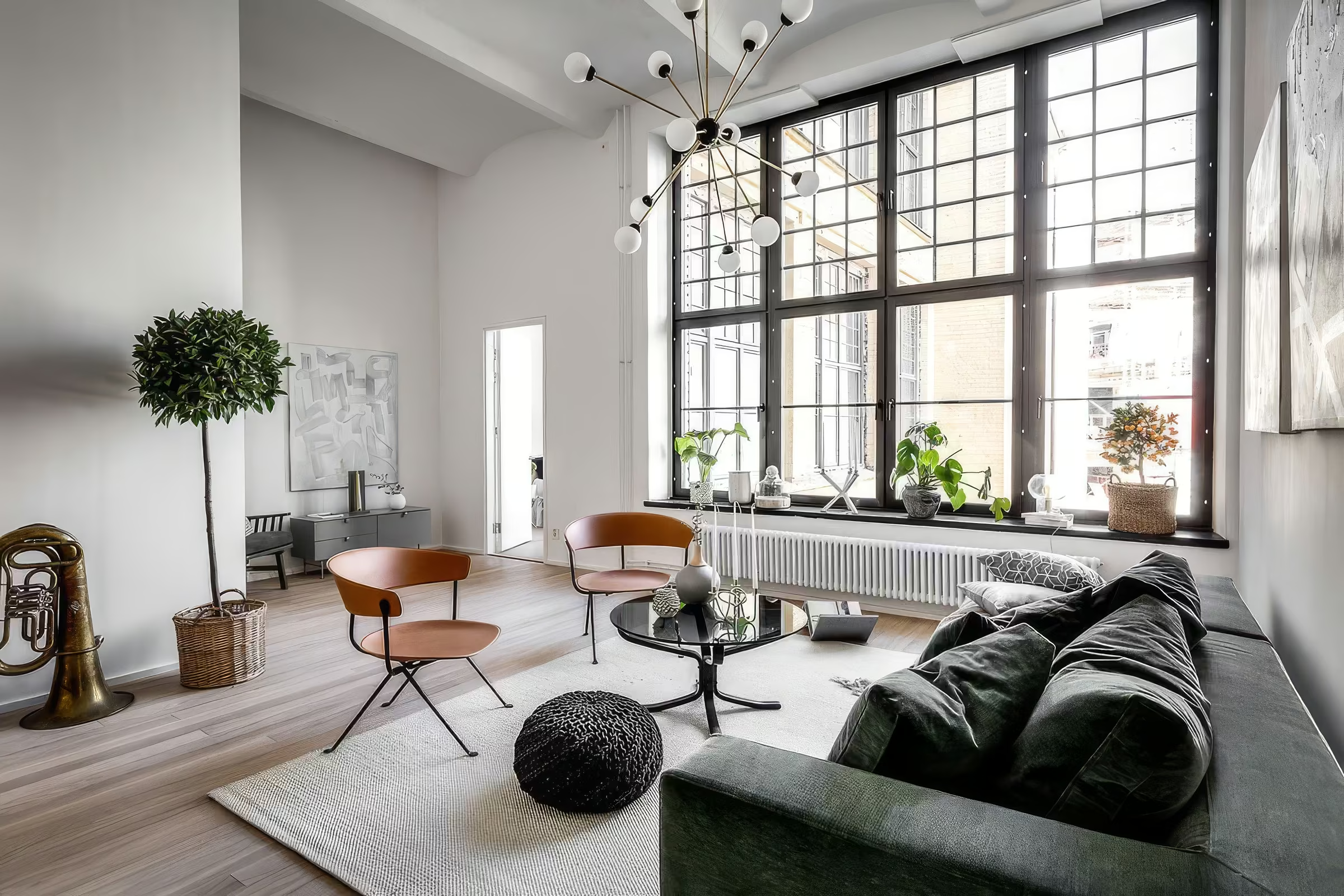
Ageing is the second major part of the story. OECD data on living arrangements show that, in most countries, the share of one-person households rises with age. Eurostat similarly notes that the proportion of single adults increases across the life course, reaching almost one third among people aged 65 and over in the EU. As populations age, more people are widowed, divorced, or simply outlive their partners. In Northern Europe, where longevity is high and older adults often remain in private households rather than multigenerational homes, solo living becomes structurally more common.
.avif)
Gender matters here too. Eurostat’s Ageing Europe found that older women in the EU were far more likely than older men to live alone, and the European Institute for Gender Equality notes that single women in old age face the greatest financial hardship because they cannot rely on a partner’s income or survivor benefits in the same way. The gender pension gap remains wide across the EU, which means that solo living in later life can reflect both independence and vulnerability. So when we see high rates of people living alone in the North, we are also seeing the demographic consequences of women living longer, partnering differently, and increasingly spending old age outside traditional extended-family structures.
Urbanization adds another layer. Eurostat’s urban statistics note that cities continue to attract people in search of jobs, education, innovation, and quality of life. That matters because urban life is especially compatible with one-person households: students, young professionals, divorced adults, and older residents who downsize all tend to cluster in places where apartments, public transport, and services reduce the need for a larger household unit. Finland’s own data point in that direction: in 2024, one-person households remained extremely common, while the number of households in blocks of flats grew the most. Solo living, in other words, is not just a family story. It is a city story.
.avif)
Housing, however, is where the romantic idea of independent Nordic living runs into reality. More one-person households mean more dwellings are needed for the same population, which puts pressure on supply in urban markets. The OECD warns that housing affordability remains a major challenge across advanced economies, with high borrowing costs and pessimistic outlooks for renters, especially for youth, people with low or unstable incomes, and seniors. Statistics Finland has likewise reported rising overcrowding in recent years even as one-person living remains widespread. The North may make solo living socially normal, but it does not make it cheap.
And this is where the distinction between living alone and being lonely becomes crucial. The European Commission’s Joint Research Centre, using the first EU-wide loneliness survey, found that more than one third of respondents were lonely at least sometimes in 2022 and 13% were lonely most of the time. But the same research also showed that loneliness is shaped by the quality and number of meaningful relationships, and that frequency of contact matters. In other words, household size is not the same thing as social connectedness. Someone can live alone and still be well integrated into a dense web of friends, relatives, colleagues, hobbies, and civic life.
.avif)
That distinction is especially important in the Nordic context, where trust and support remain unusually strong. The OECD defines social support as having friends or relatives one can count on in times of trouble, and treats it as a core well-being indicator. The World Happiness Report 2025 once again placed Nordic countries at the top of the global happiness rankings and highlighted that they also rank among the highest in both expected and actual return of lost wallets — an unusually concrete proxy for everyday trust. High-trust societies make independent living less socially risky. You do not need to share a roof with others to feel that others are there.

This is why the Northern rise in solo living should be read less as atomization than as individualization. It reflects a society in which adulthood is less tied to marriage, women’s economic lives are less dependent on men, older people live longer, and cities are organized around mobility and smaller households. But it also reflects something deeper: a model in which social belonging is not assumed to live only inside the family home. It can be distributed across institutions, friendships, neighborhoods, and public life. That does not eliminate loneliness, and it certainly does not erase the risks facing low-income renters or older women living alone. But it does change what living alone means.
.avif)
So the real lesson of Northern Europe is not that people there are becoming detached from one another. It is that, under the right social conditions, independence and connection do not have to be opposites. A society can produce many one-person households and still remain deeply social. In fact, the ability to live alone without being abandoned may be one of the clearest signs of a high-trust society.
.avif)


)%20(1).avif)