Loreen and Ólafur Arnalds’ SAGES Finds New Life With Echoes Edition
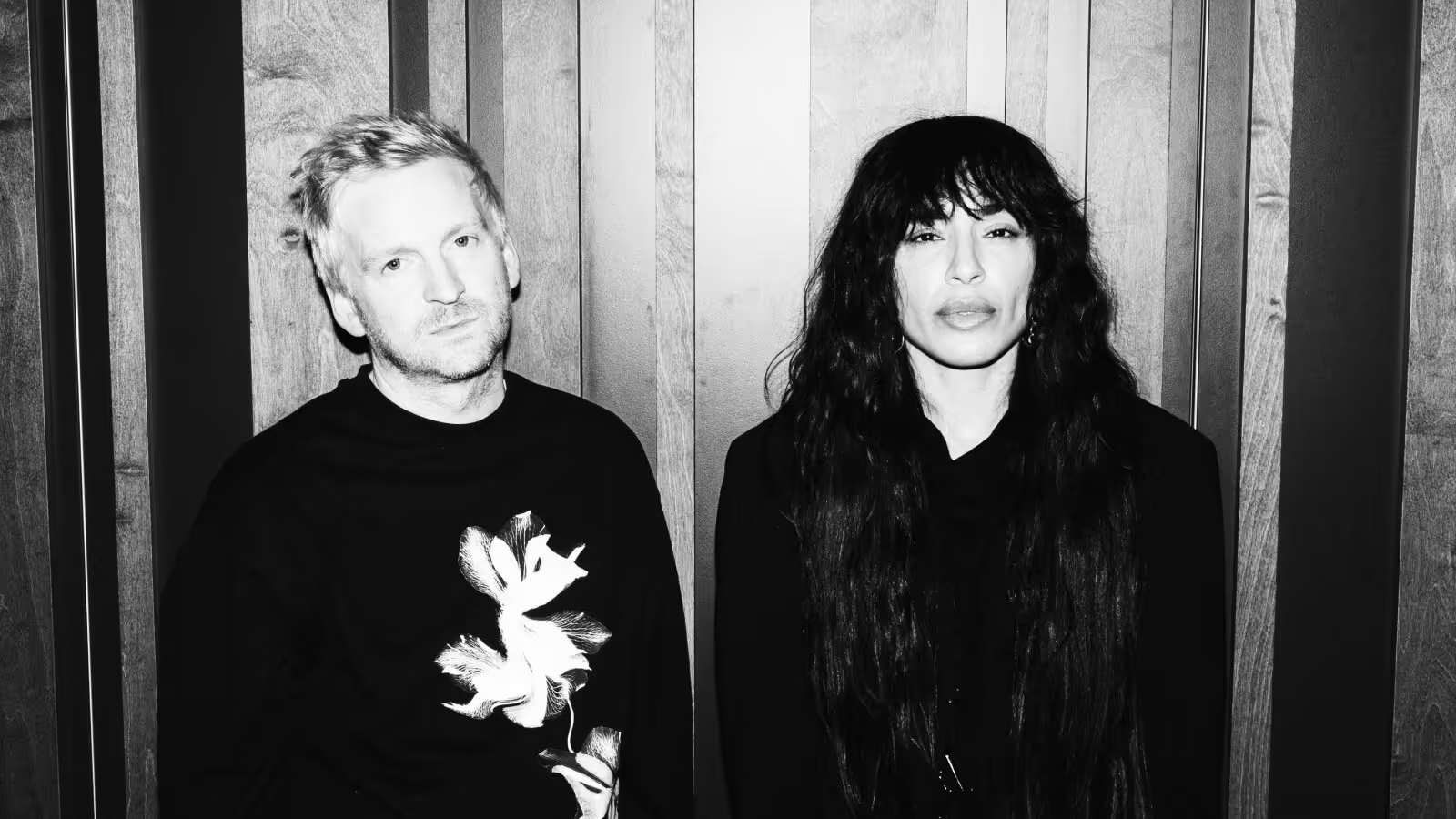
When Ólafur Arnalds recently posted about SAGES (Echoes Edition), many listeners had the same reaction: how did a collaboration between one of Iceland’s most evocative composers and one of Sweden’s most powerful pop voices slip quietly into the world without becoming a larger Nordic music moment?

The answer may lie in the nature of SAGES itself. This was never designed as a maximalist pop campaign or a chart-chasing crossover. Released in 2025, SAGES introduced a three-track collaboration between Arnalds and Loreen that felt more like a ritual than a release: cinematic, physical, spiritual, and deeply restrained. Now, with SAGES (Echoes Edition), the project has resurfaced in expanded form, bringing the original work into dialogue with new textures, remixes, and a wider electronic vocabulary.
The pairing initially looks surprising only on paper. Loreen, born in Sweden and known globally for winning Eurovision twice with “Euphoria” in 2012 and “Tattoo” in 2023, has long carried pop into the territory of performance art, mysticism, movement, and emotional intensity. Arnalds, from Iceland, has built an international reputation through works that dissolve the boundaries between piano, strings, electronics, film scoring, and ambient architecture; his score for Broadchurch won a BAFTA and helped define his cinematic voice for a wider audience.
What SAGES reveals is that both artists have been circling similar questions from different directions. Loreen’s music often treats the body as a vessel for transcendence. Arnalds’ compositions often treat sound as an environment — something one enters rather than simply hears. Together, they created a project that moves slowly, breathes heavily, and asks the listener to surrender to atmosphere.
According to Wise Music Creative, Arnalds and Loreen had admired each other’s work from afar before connecting on social media after Loreen’s second Eurovision victory in 2023. That detail matters. Their collaboration did not begin as a label-engineered duet, but as an artistic recognition: two Nordic artists sensing a shared language before they had fully spoken it.
The first song, “In The Sound Of Breathing,” reportedly emerged in just half a day at Arnalds’ Reykjavík studio. That speed is audible. The track feels instinctive, almost pre-verbal, built around breath, tension, and the slow rise of electronic pressure. Loreen’s vocal presence does not sit on top of Arnalds’ production so much as move through it, as if her voice is another frequency in the architecture. Wise Music describes the track as a delicate synth landscape that gradually intensifies, while Arnalds himself later told Echoes that he connected emotionally with Loreen’s voice and writing instincts, describing their sensibility as almost “animalistic” and spiritual.
“Opening,” the project’s longer, more expansive second pillar, has its own mythology. It was reportedly built from the skeleton of an instrumental track Arnalds had written years earlier, one that found its final form only after Loreen entered the picture. That makes “Opening” feel less like a song discovered in the studio than a door finally unlocked. Loreen has spoken about the track’s sensation of reaching a roofline — chaos and harmony arriving together — and that image captures the music’s central drama: expansion without explosion, release without abandoning control.
The original EP’s visual world deepened the project further. SAGES arrived with a short film directed by Thora Hilmars, starring Loreen and featuring a cameo from Arnalds. The film drew inspiration from the Dancing Plague of Strasbourg, the strange 16th-century episode in which people were said to have danced uncontrollably in public. The reference is not decorative. It mirrors the EP’s interest in surrender, collective tension, and the body as both witness and instrument.
That is where SAGES becomes more than a collaboration between famous names. It becomes a Nordic meditation on instinct. The title itself has been described as a reference to “guides,” connected to following intuition at a time when attention is fragmented and modern life moves too fast. In that sense, SAGES is not escapist. It is a response to overwhelm — a musical attempt to slow the nervous system down enough to hear what still remains underneath.
The new Echoes Edition reframes the project with eight tracks and a total runtime of roughly 38 minutes. It includes the original “In The Sound Of Breathing,” “Unknowing,” “Opening,” and “Echoes,” followed by remixes from George FitzGerald, Lara Somogyi and Cyrus Reynolds, Sofia Kourtesis, and Jessie Marcella. The expanded edition, released April 24, 2026 through Decca Music Group, turns SAGES from a compact three-track statement into a more open-ended sound world.
The remixers are significant because they do not merely decorate the original songs; they suggest different futures for them. George FitzGerald brings the project closer to club-adjacent emotional electronics. Sofia Kourtesis, known for her warm, humanistic approach to dance music, is a natural fit for “Opening,” a track already balancing movement and catharsis. Lara Somogyi and Cyrus Reynolds reshape “Unknowing,” while Jessie Marcella’s remix of “In The Sound Of Breathing” extends the EP’s focus on pulse, space, and release.
The vinyl story adds another layer. Record Store Day listings describe SAGES arriving on vinyl for the first time in 2026, with the project positioned between electronica, modern classical, and alt-pop. The RSD release also emphasizes a new SAGES track and brand-new remixes, suggesting that what first appeared as a small collaborative EP has developed into a fuller creative universe.
For The Northern Voices, the significance of SAGES is partly regional and partly artistic. Nordic music is often discussed through familiar categories: melancholy, atmosphere, restraint, landscape. But SAGES complicates that vocabulary. It is atmospheric, yes, but not passive. It is restrained, but not cold. It carries the cinematic spaciousness associated with Arnalds and the elemental force associated with Loreen, yet neither artist overwhelms the other. The collaboration works because both understand drama as something that can be held back until the listener feels it physically.
In a pop culture environment that often rewards immediacy, SAGES asks for immersion. It does not announce its depth in the first few seconds. It unfolds through pressure, breath, repetition, and release. Loreen’s voice brings human voltage; Arnalds’ production gives that voltage a landscape. The result is music that feels less like a meeting of genres than a meeting of nervous systems.
Perhaps that is why the recent post feels like a rediscovery rather than a simple update. SAGES may have arrived last year, but Echoes Edition gives listeners a reason to return to it with fresh ears. It also reminds us that some of the most interesting Nordic collaborations are not the loudest ones. They are the ones that appear quietly, gather resonance over time, and then return — like an echo — with more to say.


