Latvia’s Quiet Storm: Atvara Brings Ēnā to Eurovision 2026
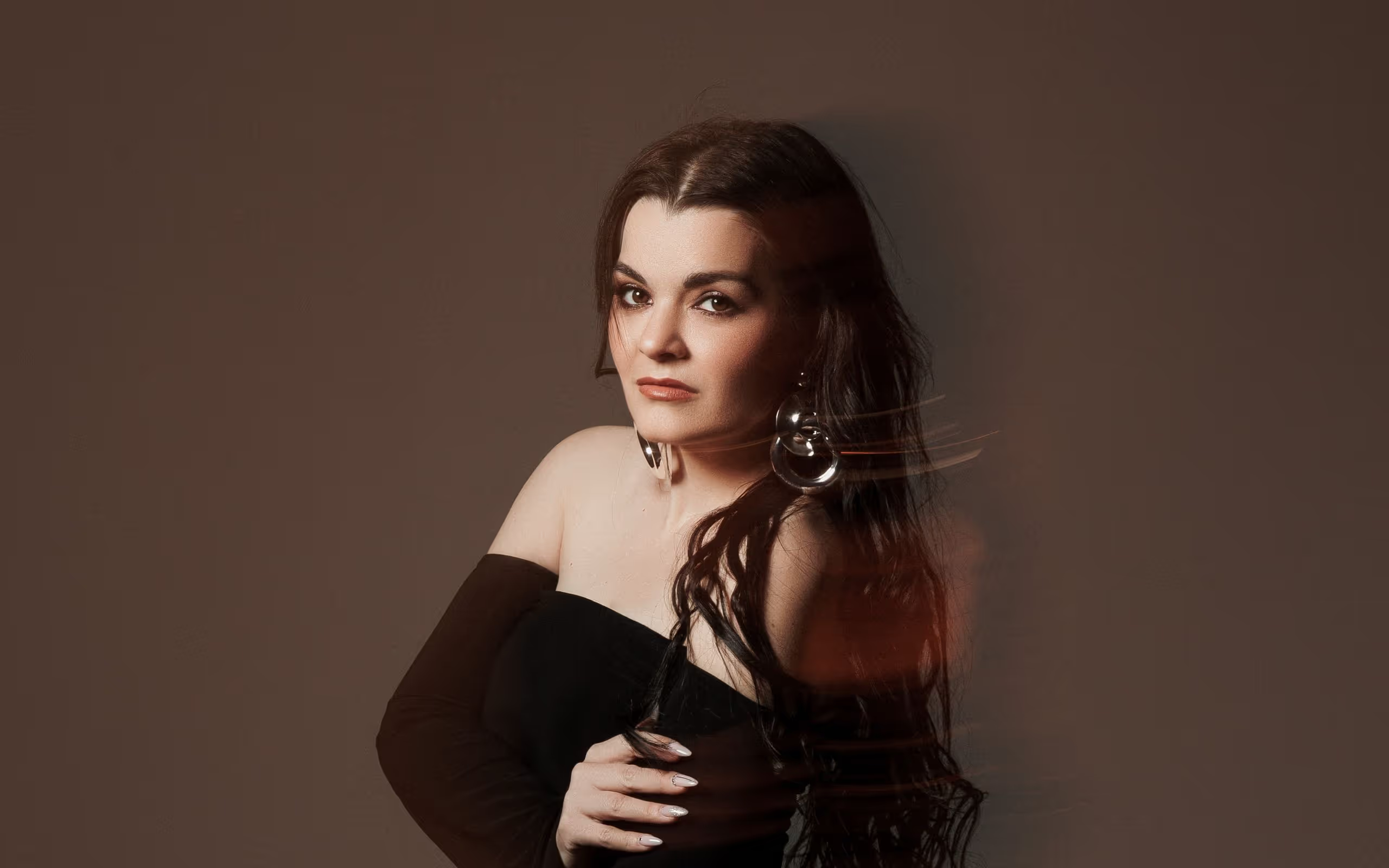
That is already a strong fit for Eurovision, but it also helps explain why Latvia’s 2026 entry stands out in a season crowded with louder gestures.
Atvara’s rise has not been built on a single lane. According to Eurovision’s official materials, she first broke through on TikTok with Pie Manis Tveries, a debut that also received critical acclaim and was featured in the Latvian TV series Nelūgtie Viesi. From there, she collaborated with Intars Busulis on Vai Drīkst Kāpt Dziļāk, released her debut album, and continued building her presence on the Latvian music scene with the single Dzīve Mūs Mētā. By summer 2025, she had sold out a run of solo concerts, and she also expanded her profile as a television presenter by co-hosting the music awards show GAMMA. Taken together, it paints a picture of an artist who has been growing not just as a vocalist, but as a public presence.
Her route to Vienna was equally convincing. Eurovision confirms that Atvara won Latvia’s Supernova 2026 with Ēnā after a ten-song final on 14 February, following two semi-finals on 31 January and 7 February. The final result combined jury and public voting, with Kautkaili finishing second and Emilija taking third. Official Eurovision coverage also notes that Atvara will perform in the second half of the Second Semi-Final on Thursday 14 May, placing her in the latter stretch of a show where atmosphere and memorability can matter as much as immediacy.
What makes Ēnā especially striking is its emotional texture. The official English translation on Eurovision’s participant page is spare but heavy: warmth is offered to strangers while loved ones are met in an emptied-out state; someone once “painted bright” turns black and white; and the repeated refrain describes a person who slowly fades, grows silent, and remains “in the shadow.” Then the song sharpens further, introducing the image of a little girl being told to stay quiet because her father will not come home that night, only to smile and raise a glass the next day. The song never overexplains itself, and that restraint is part of its force. It feels like a portrait of damage that settles gradually into a household, into memory, and into the self.
That gives Atvara a different kind of Eurovision weapon. Many entries aim for instant spectacle; Ēnā seems built around accumulation. Its power lies in the slow tightening of mood, in the sense that the song is not trying to impress the room so much as quietly take hold of it. For a singer already associated with cinematic sound and emotional directness, that is a smart artistic match. Latvia is not sending a generic ballad. It is sending a controlled, intimate piece that trusts gravity over noise. That is a risk, but it is also exactly the sort of risk that can feel unforgettable on the right stage.
And the stage awaiting her is a major one. Eurovision 2026 will take place at Wiener Stadthalle in Vienna, with the First Semi-Final on 12 May, the Second Semi-Final on 14 May, and the Grand Final on 16 May. Official Eurovision information says 35 broadcasters are competing in this 70th edition, hosted by Victoria Swarovski and Michael Ostrowski. ORF’s stage design, created by Florian Wieder, centers on a curved leaf-shaped LED surface, a sweeping arc, and a connected Green Room walkway that will allow a winner’s walk through the audience; Eurovision Village at Rathausplatz will run from 10 to 17 May with free admission. For a performance like Ēnā, that combination of scale and visual flexibility could be especially valuable.
There is also a broader Latvian context hovering in the background. Eurovision’s official Latvia coverage notes that the country debuted in 2000 with Brainstorm’s My Star, which finished third, and then won the contest only two years later with Marie N’s I Wanna before hosting in Riga in 2003. That history matters because Latvia’s Eurovision identity has often been defined by sharp contrasts: bold debuts, sudden breakthroughs, and long stretches of searching for the next truly resonant moment. Atvara does not feel like an attempt to recreate an old formula. She feels more like Latvia betting on emotional precision instead.
In that sense, Ēnā may be one of the more quietly daring entries in this year’s lineup. It does not chase camp, chaos, or bombast. It moves inward. It lingers in pain, hesitation, and the things people leave unsaid. That is not always the easiest path at Eurovision, but when it works, it can cut deeper than almost anything else. Latvia is sending Vienna a song about shadows. The smart bet is that people will remember the darkness long after the lights go up.

