Denmark’s Night on Fire: Søren Torpegaard Lund Brings Før Vi Går Hjem to Eurovision 2026
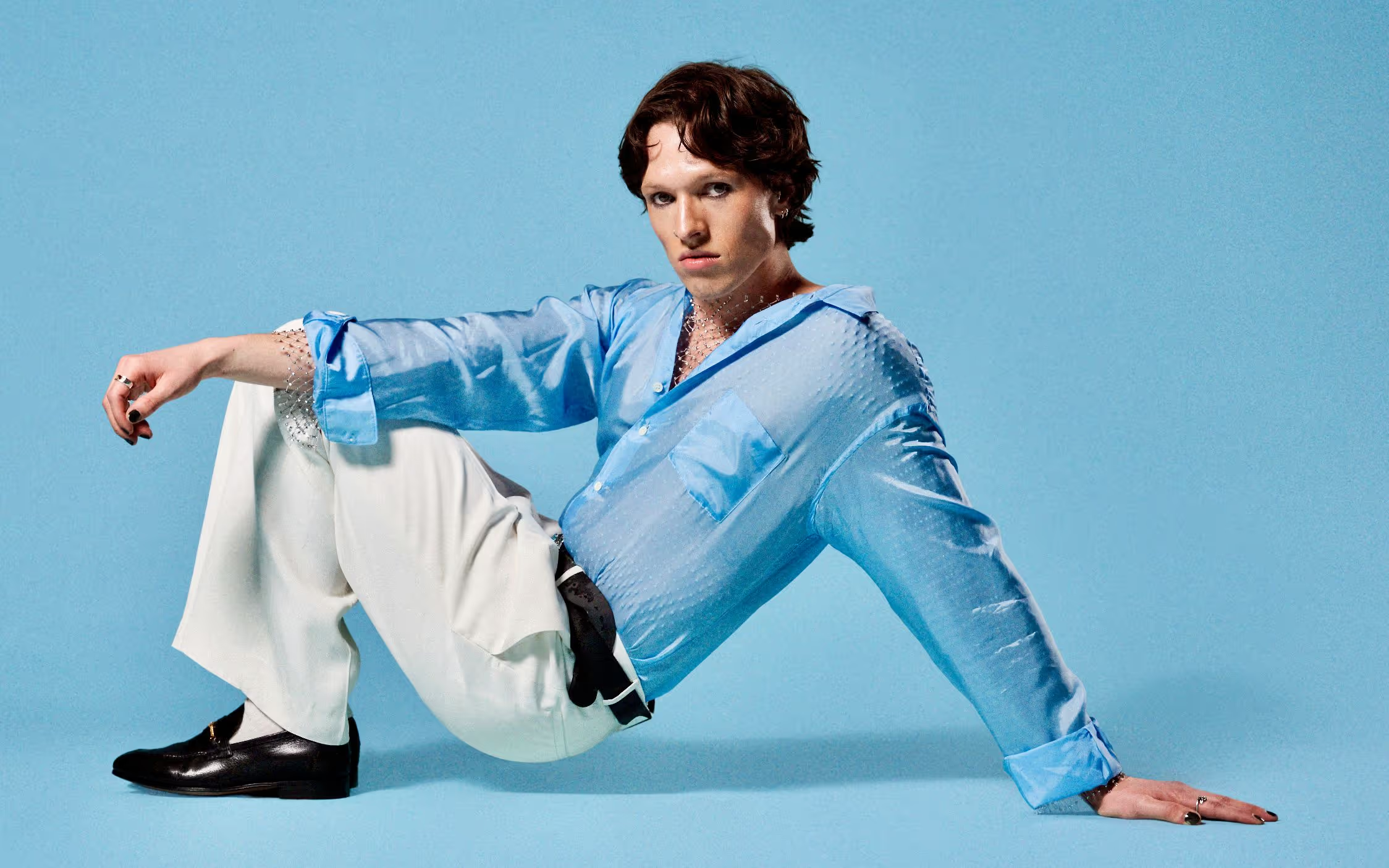
That background already makes him an intriguing Danish representative, but it also helps explain why Før Vi Går Hjem feels built not just as a song, but as a scene. Søren won Denmark’s Melodi Grand Prix 2026 with a unanimous victory, taking both the jury vote and the public vote for a total of 39 points, and will perform in the second half of the Second Semi-Final on 14 May.
The official Eurovision profile sketches a performer who found musical theatre early. Growing up in Gudme, Søren had, by the age of ten, already found his calling in that world; by 17, he had become the youngest person ever admitted to the Danish National School of Performing Arts. From there, he built a professional career across some of Denmark’s biggest productions, including roles such as Tony in West Side Story, Angel in Kinky Boots, and Romeo in Romeo & Juliet. Eurovision’s coverage of his national-final win also notes that he played Tony at the Copenhagen Opera in 2022, reinforcing how firmly his identity is tied to large-scale, emotionally direct performance.
That matters because Søren’s current arc is not simply “stage performer tries pop career.” It is more interesting than that. Eurovision’s participant page frames his recent work as a shift from telling other people’s stories to saying something in his own music. He had already appeared in Melodi Grand Prix before, competing in 2023 with the ballad Lige Her, so this year’s win reads less like an overnight breakthrough than a return, refinement, and payoff. In other words, Denmark is sending someone who understands the pressure of a live televised song contest, but is now arriving with a stronger artistic point of view.
And Før Vi Går Hjem gives him material worthy of that shift. The official lyrics describe a relationship caught between desire and regret, with the night presented as a space where logic burns away and morning consequences can be postponed just a little longer. Fire, neon, smoke, sweetness, acidity, addiction: the song piles sensation on sensation until the emotional atmosphere feels almost physical. Søren himself described it as a song with no breaks, “one long movement,” and likened it to candy that is both sour and sweet. That combination is exactly what gives the entry its pulse. It is dramatic, but not old-fashioned; intimate, but still highly performative. The title translates as “Before We Go Home,” yet the emotional engine of the song is really about resisting the end of the night, even when you know daylight will bring distance and regret.
That is where Søren’s theatre background may become Denmark’s advantage. A performer trained in musical storytelling tends to understand escalation, tension, gesture, and release in ways that can be invaluable on a Eurovision stage. Før Vi Går Hjem is not a static vocal showcase; it is a piece that seems to want motion, chemistry, and a sense of emotional momentum. If Denmark stages it with the same sweep implied by the lyrics, the entry could land as one of those performances that feels less sung than lived through in real time.
As for the contest Søren is heading into, Eurovision 2026 is already clearly defined. The 70th edition will take place in Vienna at the Wiener Stadthalle, with the live shows set for 12, 14, and 16 May. Eurovision has confirmed that 35 broadcasters are participating this year, making it a full anniversary edition, and Denmark has been placed in the second half of the Second Semi-Final. ORF has also revealed a Florian Wieder stage design built around a curved, leaf-shaped LED form and a walkway linking the Green Room to the stage, while anniversary programming will include returning 2025 winner JJ and a Grand Final “Eurovision Allstar” celebration.
There is also a subtle national context around this entry. Official Eurovision coverage noted, ahead of Melodi Grand Prix 2026, that Denmark had reached the Grand Final in Basel 2025 for the first time since 2019. That does not automatically turn Søren into a redemption narrative, but it does mean Denmark arrives in Vienna trying to build continuity rather than merely break a drought. In that sense, Søren Torpegaard Lund feels like a smart choice: polished, camera-aware, emotionally legible, and equipped with a song that thrives on atmosphere. Denmark is not sending the loudest entry of the year. It is sending one that understands seduction, tension, and the dangerous glamour of wanting one more night before the lights come up.

