Finland Turns Up the Heat: Linda Lampenius x Pete Parkkonen Bring “Liekinheitin” to Eurovision 2026
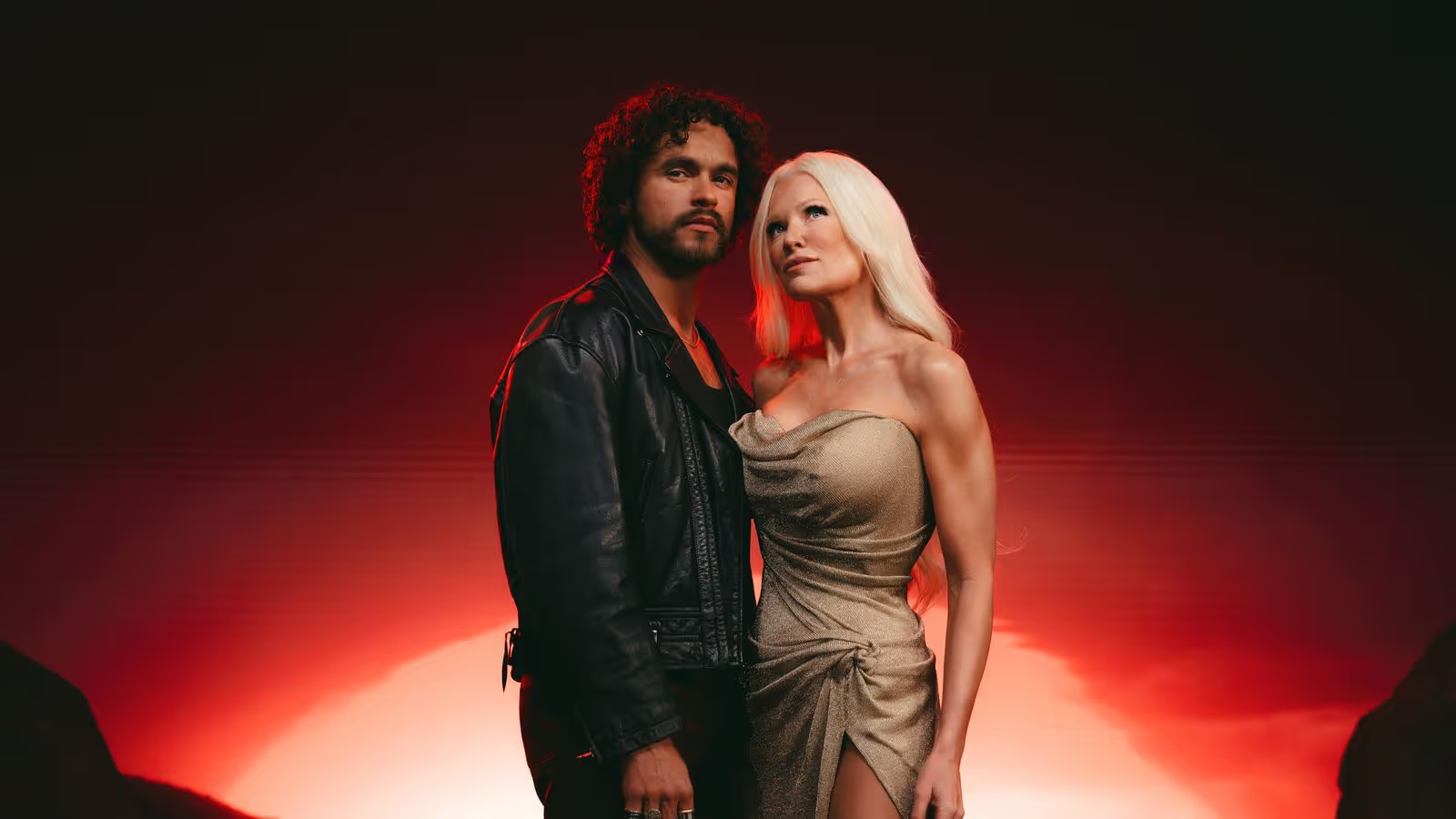
Their song, Liekinheitin, stormed to victory in Finland’s UMK 2026 selection with 570 points, sending them to Vienna as one of the season’s most talked-about combinations. Official Eurovision coverage has described the track as a fusion of rock, classical, and dance elements, which already tells you plenty about Finland’s appetite for drama in 2026.
Lampenius brings a biography that reads like it was built for cross-genre spectacle. She joined the Helsinki Junior Strings at the age of eight and, by her teenage years, was already touring North America, Europe, and Asia. Eurovision’s official artist materials note that a classical solo album made her the best-selling Finnish classical artist of her era, while a separate Eurovision profile on the UMK lineup adds that she later told her story in the autobiography My Untamed Life and in the Linda documentary series, which won a Golden Venla Award. Her official website presents her career as a meeting point between classical refinement and pop energy, which feels especially relevant now that she is stepping onto Eurovision’s biggest mainstream stage.
Parkkonen, meanwhile, arrives with a very different but equally audience-facing kind of credibility. He first broke through with the Finnish Idols TV show, where Eurovision’s UMK profile notes that he finished third in 2008, before going on to release several albums and build a reputation as one of Finland’s leading pop and soul voices. The same official profile emphasizes his experience on Finnish club and festival stages, and that live instinct matters at Eurovision, where vocal control is only half the job and charisma is the rest. This pairing works because Parkkonen brings accessibility and presence, while Lampenius supplies scale, precision, and an unmistakable visual signature.
What makes Liekinheitin more than a novelty pairing is the emotional logic of the song itself. In the official lyric translation on Eurovision’s participant page, the track frames desire as something dangerous, addictive, and impossible to cool down. The central image is not subtle: this is a song about someone who burns, seduces, wounds, and still pulls the narrator back in. That hot-and-cold tension gives the entry its bite. The title translates to “Flamethrower,” and the lyrics play with fire imagery, guilt, temptation, and physical intensity in a way that feels tailor-made for a performance built around friction and release. Eurovision’s own coverage of the UMK result also called the song a “pop behemoth,” and that description feels apt: Liekinheitin is not chasing understatement. It wants impact.
As for the contest they are heading into, Eurovision 2026 is already taking shape. The 70th edition of the competition will be held in Vienna at the Wiener Stadthalle, with the First Semi-Final on 12 May, the Second Semi-Final on 14 May, and the Grand Final on 16 May, all at 21:00 CEST. Official Eurovision sources confirm that 35 broadcasters are participating this year, and Finland has been drawn into the first half of the First Semi-Final. As of the latest official update, the precise running order for the semi-finals was still due to be finalized at the end of March, but the full lineup of 35 songs is already complete.
What is known so far suggests Vienna is leaning into the occasion with confidence. Eurovision has revealed a Florian Wieder stage design centered on a curved, leaf-shaped LED surface, with a connected Green Room walkway intended to create a more immersive winner’s journey through the audience. Eurovision Week plans also include a free Eurovision Village at Rathausplatz from 10 to 17 May, while ORF has announced opening and interval acts designed to underline the contest’s 70th anniversary, including a return appearance from 2025 winner JJ and a Grand Final “Eurovision Allstar” celebration. In other words, Finland is not sending this duo into a small or cautious year; it is sending them into a fully scaled anniversary edition that seems built to reward memorable visual identity.
That may be the clearest reason Linda Lampenius x Pete Parkkonen make sense as Finland’s representatives. Eurovision has always rewarded entries that understand contrast, and this one arrives preloaded with it: classical polish and pop immediacy, virtuosity and raw desire, cool precision and reckless heat. Finland is not going to Vienna with a safe entry. It is going with a deliberately combustible one.

