The Maestro as Influencer: How a New Generation Is Rebranding Classical Music
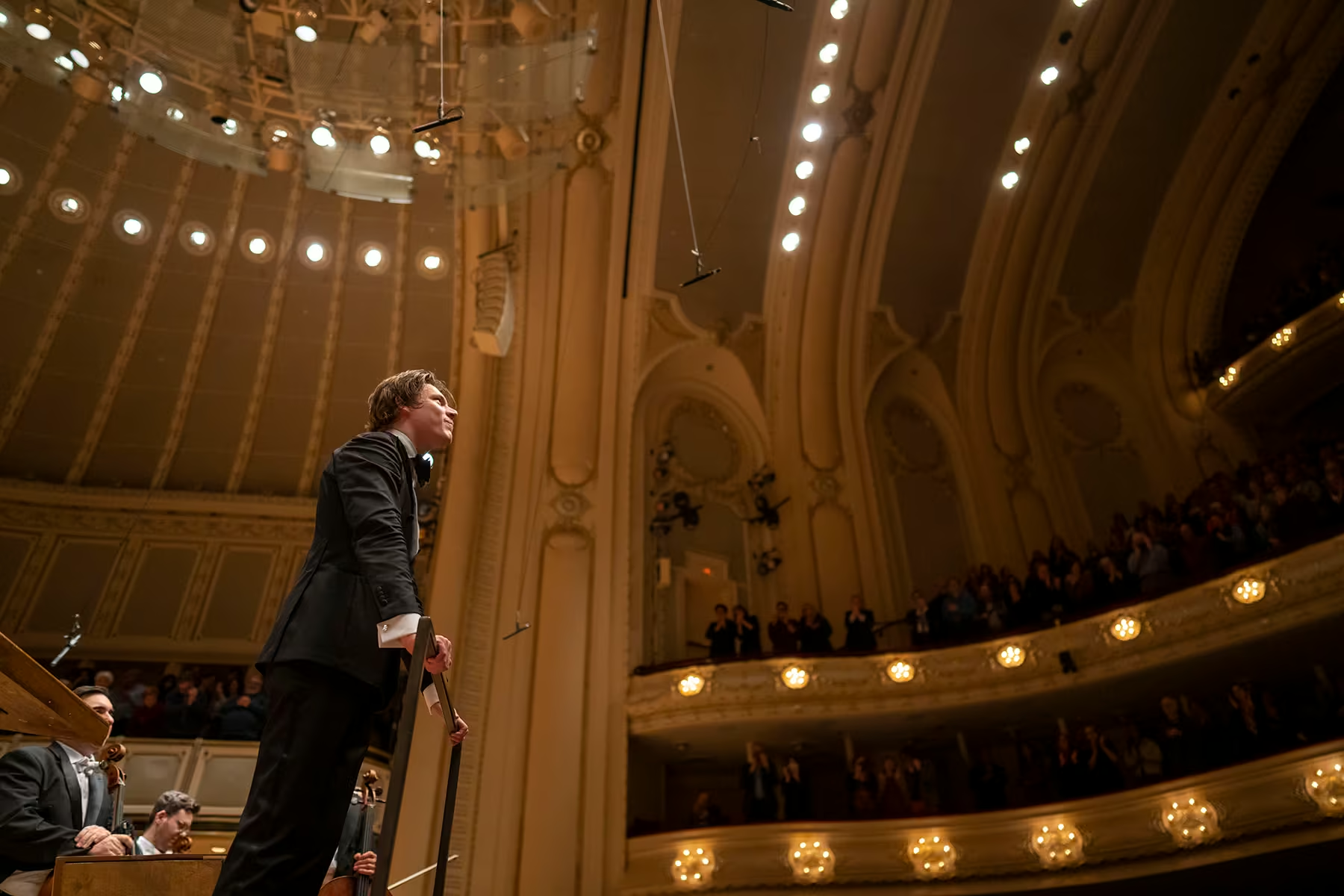
Mäkelä is not simply a prodigy story. He is a signal. His ascent suggests that classical music institutions are increasingly looking for leaders who can do more than conduct well. They want figures who can symbolize renewal, attract media attention, shape repertoire narratives, and make classical prestige legible to audiences raised on image, personality, and digital immediacy. In other words, the modern maestro is no longer just a musical authority. He is also becoming a cultural brand. That inference is borne out by the kinds of appointments being made, the language institutions use to promote them, and the broader pressure orchestras face to reach younger and more diverse audiences.
Chicago’s presentation of Mäkelä makes this especially clear. The CSO describes an immediate “electricity” between conductor and orchestra and emphasizes not only continuity with the ensemble’s legacy, but also the sense of a new chapter. Official materials note that he will conduct at least 14 weeks each season once he begins, a substantial commitment that places him at the center of one of North America’s most important musical institutions. The appointment was framed not as a risky youth experiment, but as a confident investment in artistic leadership for the future.
What makes Mäkelä such an emblematic figure is not only his age, but the scale of his portfolio. According to official biographies from Chicago and the Concertgebouw, he has served as chief conductor of the Oslo Philharmonic since 2020, music director of the Orchestre de Paris since 2021, and will assume the Concertgebouw post in 2027 — the same season he begins in Chicago. That kind of concentration of elite institutional trust in a conductor still in his twenties would once have seemed unusual. Today, it reads like the clearest expression yet of a changing classical marketplace.
The phenomenon is broader than one Finnish star. Another Finnish conductor, Tarmo Peltokoski, born in 2000, has already become music director-designate of the Hong Kong Philharmonic and has accumulated major appointments in Europe while building an international recording profile with Deutsche Grammophon. His official biography describes a career shaped not only by conducting study, but by piano, composition, improvisation, and wide-ranging repertoire. That matters because it suggests that the new maestro is often valued less as a narrow specialist than as an all-around musical personality.
This generational shift is happening at a moment when orchestras are openly confronting audience transition. The League of American Orchestras has argued that audience preferences and priorities have “profoundly changed,” and its recent guidance on audience diversification stresses the need to engage younger and more diverse audiences as a matter of long-term relevance and sustainability. Symphony magazine has likewise noted the “older-and-older-audience phenomenon” and the sector-wide effort to attract younger listeners in a cultural environment full of low-cost alternatives and digital entertainment.
That context helps explain why youth itself has become newly meaningful in conducting. A young conductor can signify energy, freshness, and future potential before a note is even played. But more importantly, younger conductors often arrive fluent in a media environment that older classical institutions have had to learn belatedly. Symphony magazine’s reporting on younger-audience outreach points to the growing use of streaming, social media, and less formal presentation styles in order to make classical music feel contemporary rather than remote. A conductor who already reads as contemporary becomes an asset in that strategy.
Digital culture has changed the medium around the music as much as the music itself. The Berliner Philharmoniker’s Digital Concert Hall, now fifteen years old, has become a model for how elite classical institutions can build global audiences through live and on-demand streaming. During the pandemic, the platform expanded its reach further, attracting new listeners around the world when it was temporarily made free. In such an environment, conductors are no longer experienced only by people sitting in the hall. They are encountered as recurring visual presences: on phones, on tablets, in clips, trailers, interviews, and curated digital packages.
That shift favors conductors who project an immediately legible persona. Mäkelä’s career offers a strong example. His official materials emphasize his parallel identity as a cellist, and his profile has expanded not just through concert appearances but through recordings, including an exclusive Decca Classics contract — described by his representatives as the label’s first conductor signing since Riccardo Chailly in 1978. Recordings, digital distribution, and visual presentation all extend the conductor’s reach beyond the concert hall, turning interpretation into a portable public identity.
To call this branding is not to cheapen it. Classical music has always depended on mythology: Karajan’s control, Bernstein’s charisma, Abbado’s refinement, Dudamel’s exuberance. What is different now is the speed and infrastructure of circulation. Institutional websites, streaming platforms, labels, short-form video, lifestyle photography, and international touring all help produce the conductor not merely as a musician but as a recognizable public figure. The under-35 maestro is therefore not just younger than his predecessors. He is operating inside a different visibility system. That is an inference, but it is strongly supported by how orchestras, labels, and media platforms now package classical leadership.
There is also a deeper artistic reason these figures resonate. Many of the most successful younger conductors do not present themselves as rebels against tradition. They present themselves as unusually intense custodians of it. That combination — youth without triviality — is especially potent. Institutions get the optics of renewal without the fear of artistic dilution. Audiences get a sense of occasion that feels both prestigious and current. This may be one reason the Northern European conducting pipeline has been so striking lately: figures such as Mäkelä and Peltokoski often project seriousness, technical command, and modern presence all at once.
There are, of course, risks to all this. The star system can accelerate careers faster than artistic development. It can encourage institutions to chase symbolism as much as substance. And it can place extraordinary pressure on young conductors asked to embody the future of organizations much older than they are. Some critics have already pushed back against the cult of personality around young podium stars, warning that orchestras should not mistake marketable momentum for mature musical insight.
Still, the larger trend is hard to miss. Classical music is not abandoning authority; it is redesigning how authority looks. The conductor is no longer expected merely to command the score and the orchestra. Increasingly, he must also command attention across platforms, generations, and cultural contexts. In that sense, the rise of the under-35 maestro is about much more than age. It is about how classical music, under pressure to remain vital, is recasting leadership itself.
For The Northern Voices, that makes this more than a music story. It is also a Northern Europe story. Some of the most visible conductors reshaping the image of classical leadership right now are coming from the Nordic world — and they are doing so not only through technical excellence, but through a form of public presence that feels unusually aligned with the needs of contemporary institutions. The baton still matters. But so does the silhouette behind it.

