Lithuania Wants More: Lion Ceccah Brings Sólo Quiero Más to Eurovision 2026

According to Eurovision’s official profile, his creative identity was shaped early by a fascination with visual art, music, poetry, and dance, while formal violin study and later training in ballroom and street dance gave that vision a strong technical base.
That breadth matters, because Lion Ceccah’s story is really about synthesis. Eurovision’s official materials note that he first drew major public attention on X Factor in 2017, then released his debut single Aš čia a year later, staged his first concert at St. Catherine’s Church in Vilnius, and founded Studio 91, a creative space that hosted exhibitions, performances, and the first drag art workshops in Lithuania. The national-final winner story also identifies him as Tomas Alenčikas and adds further detail about his background in choral singing, musical theatre studies, makeup artistry, costume design, and the fashion collective The House of Kulkidz. Taken together, it paints a picture of an artist who has long treated performance as something larger than song alone.
That is part of what makes this Eurovision moment feel earned rather than sudden. Lion Ceccah had already come close in 2025, finishing second in Lithuania’s national selection with Drobė. Returning in 2026, he converted that near-miss into victory: Sólo Quiero Más won EUROVIZIJA.LT after taking more than 38,000 public votes, over double the total of the runner-up, with the national final using a 50/50 split between jury and televote. The official Eurovision coverage also confirms that the song was written by Aurimas Galvelis and Tomas Alenčikas, and that Lithuania will perform in the second half of the First Semi-Final on 12 May.
What makes Sólo Quiero Más especially striking is its refusal to stay in one lane. The official participant page presents the song in Lithuanian, Spanish, English, French, German, and Italian, giving the entry a deliberately borderless feeling. Lyrically, it turns desire into a form of resilience: even in “a mad world,” even with the sky falling, the song insists on wanting more. There is pain in it, but also appetite; doubt, but also defiance. One of its most revealing lines suggests that music can unite “without words,” which is a clever paradox for such a multilingual composition. Rather than sounding fragmented, the song seems built around the idea that emotional urgency can travel across languages without losing force.
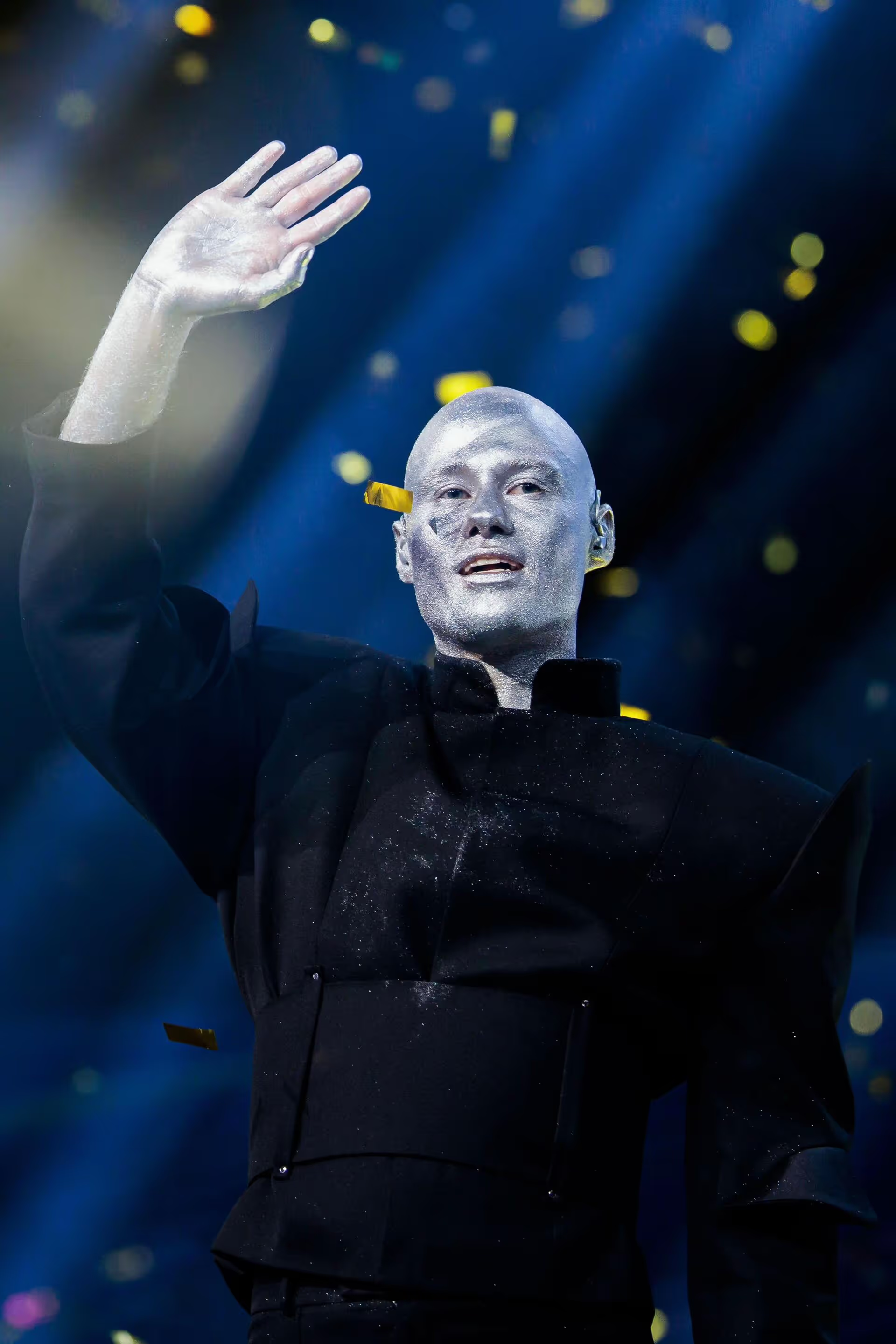
That artistic logic makes Lion Ceccah a particularly interesting representative for Lithuania. His work appears to sit at the intersection of theatre, identity, movement, and visual storytelling, and Sólo Quiero Más feels designed to support exactly that kind of performer. This is not just a vocal number or a radio-friendly chorus vehicle; it is an entry that seems to invite imagery, symbolism, and transformation. In a contest where staging can elevate a song from impressive to unforgettable, that may prove one of Lithuania’s strongest assets.
As for the contest he is heading into, Eurovision 2026 is already well defined. The 70th edition will take place at Wiener Stadthalle in Vienna, with the First Semi-Final on Tuesday 12 May, the Second Semi-Final on Thursday 14 May, and the Grand Final on Saturday 16 May, all at 21:00 CEST. Eurovision’s official overview states that 35 broadcasters will compete this year, with Bulgaria, Moldova, and Romania returning to the lineup. Lithuania is one of the countries drawn into the second half of the First Semi-Final.
Vienna also looks set to reward entries with a strong visual signature. ORF’s official stage concept for 2026, designed by Florian Wieder, centers on a curved leaf-shaped LED surface, a sweeping arc, and a connected Green Room walkway that will allow a “Winner’s Walk” through the audience. Eurovision has also confirmed that Eurovision Village at Rathausplatz will be open in the week leading up to the Grand Final, reinforcing the sense that this anniversary edition is being built as a city-wide spectacle as much as a television event. For an artist like Lion Ceccah, whose appeal is so bound up with image, movement, and theatrical intent, that scale could be an ideal fit.
In that sense, Lithuania is sending more than a song to Vienna. It is sending an artist whose whole career seems to have been preparing for a stage large enough to hold every part of his practice at once: the singer, the stylist, the dancer, the drag advocate, the theatrical mind. Sólo Quiero Más is a fitting title, because that hunger is exactly what the entry communicates. It does not ask for just enough. It asks for excess, connection, and transcendence. And at Eurovision, that kind of ambition can travel a very long way.

