Where Language Finds a Room of Its Own: Inside Latvia’s International Writers’ and Translators’ House
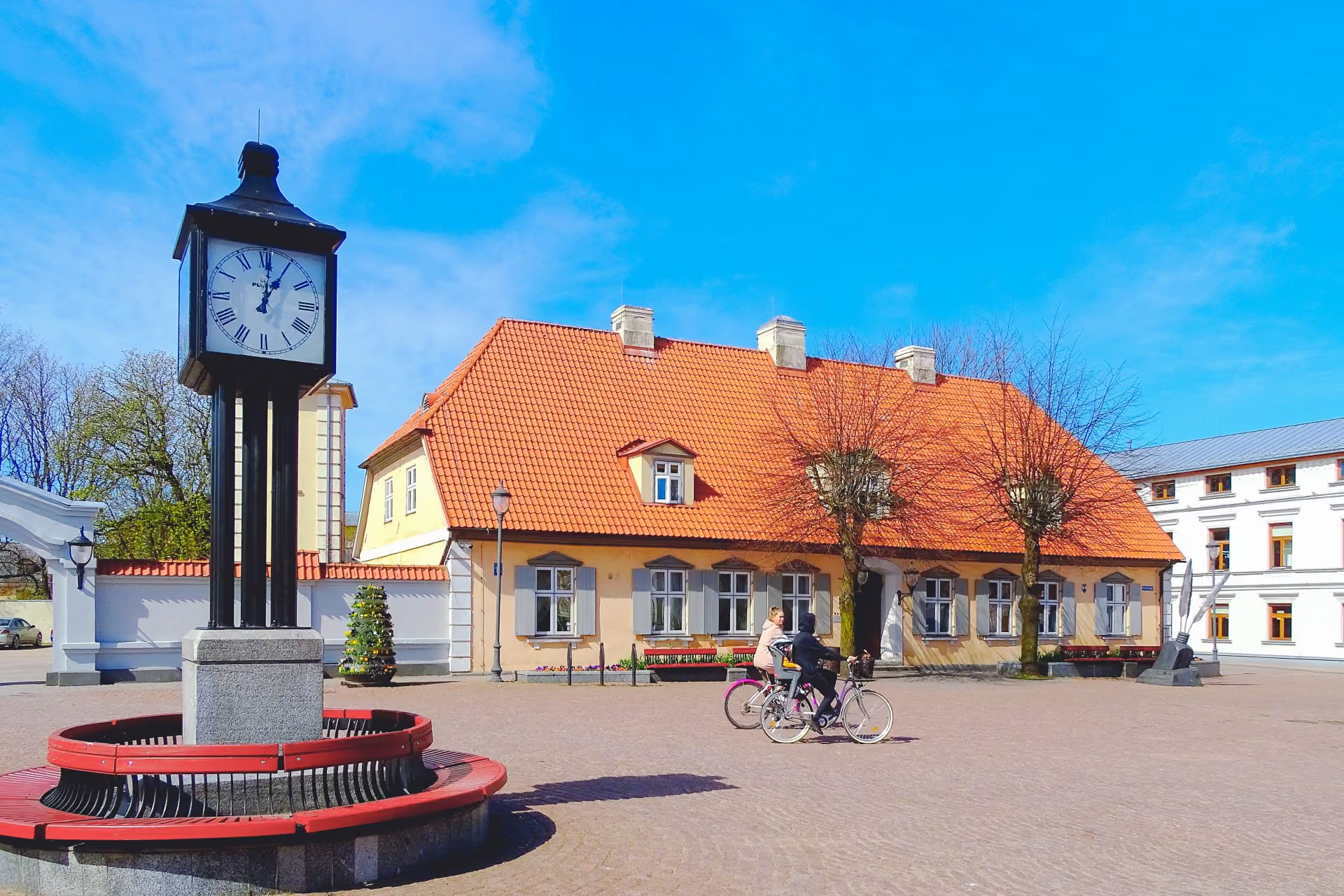
For North American readers interested in Nordic and Baltic culture, it offers a window into a different kind of cultural infrastructure — one less concerned with spectacle than with sustaining the conditions under which books, translations, and literary relationships can come into being.
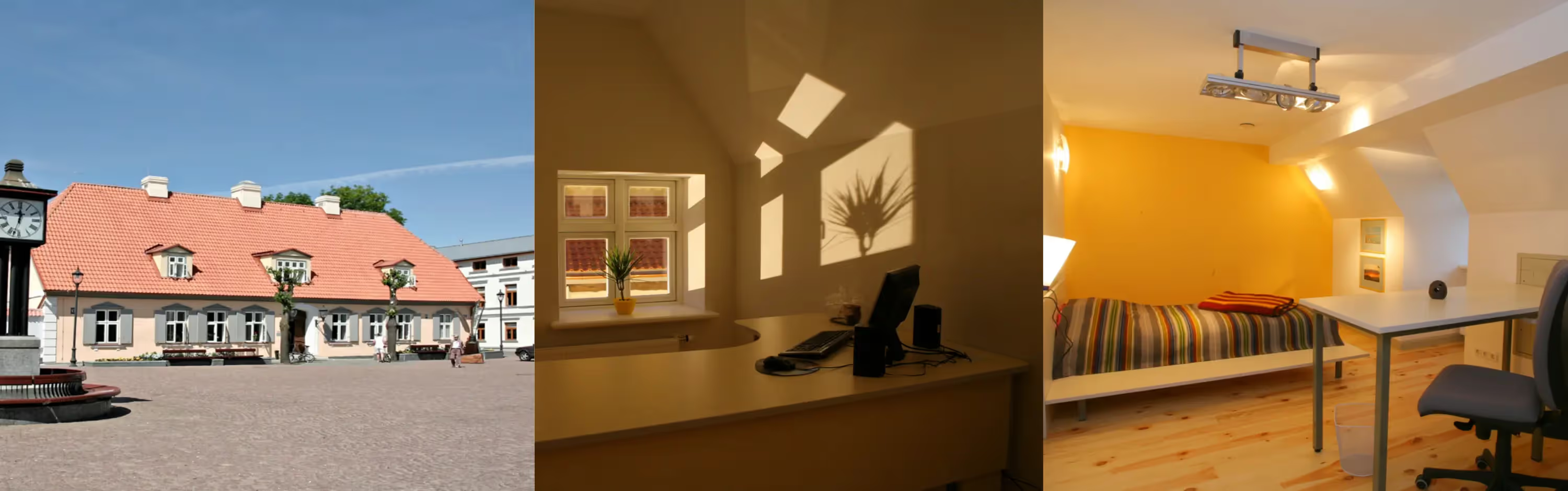
The House welcomes professional authors, literary translators, and researchers whose work is connected to literature. Applicants are expected to have at least one publication of prose, poetry, drama, or literary translation, and the program offers a four-week residency with a modest grant, a quiet place to work, and the possibility of meeting writers and translators from Latvia and abroad. The attached residency materials describe a small, practical, and carefully considered environment: seven rooms, private bathrooms, Wi-Fi, a shared kitchen, library, laundry facilities, bicycles, and two rooms suitable for people with mobility disabilities. Foreign residents contribute €30 per week toward accommodation costs, and the residency grant is listed as €320 after taxes.
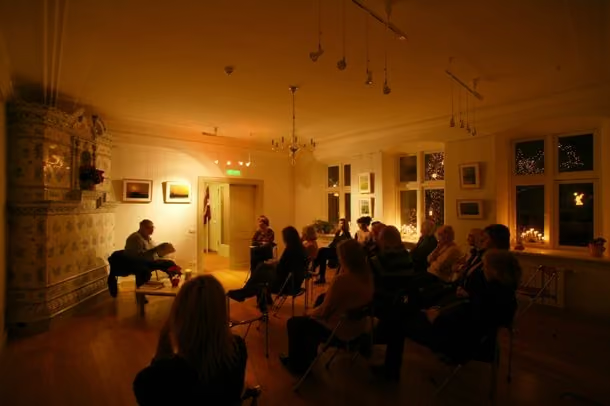
This simplicity is part of its significance. At a time when culture is often framed through festivals, tourism campaigns, and social media visibility, Ventspils offers a quieter proposition: that literary work needs shelter. The House’s own description places it within a broader international geography of writers’ and translators’ centers, naming places such as Visby, Käsmu, and other residences where “language lives” and where writers can step away from ordinary obligations to become, for a short time, full-time workers in language.
That idea feels especially resonant in Ventspils because the city itself carries a layered cultural identity. Ventspils is one of Latvia’s oldest cities, with origins connected to the Livonian Order castle first mentioned in historical documents in 1290. Its seal and coat of arms date back to the 14th century, and during the Livonian Order period the city became part of the Hanseatic trading world. The port later grew in importance under the Duchy of Courland and again in the 19th century, when maritime education, railway development, and trade reshaped the city’s role.
For a writer or translator, this is not incidental scenery. A residency in Ventspils means working in a city where Baltic, Hanseatic, maritime, Latvian, and European histories overlap. The International Writers’ and Translators’ House is itself housed in an 18th-century building that served as the city’s Town Hall from 1850 and later as the Ventspils excursion bureau before opening as a writers’ and translators’ center in June 2006. In other words, the building has long been connected to civic life, movement, and arrival. Its present literary role continues that pattern, but with language as the means of travel.
The House’s stated objective is ambitious in the best sense: to serve as an international multifunctional center for writers and translators in Latvia, further literary development, encourage intercultural dialogue, promote local literary processes internationally, and decentralize literary life beyond the capital. That last point matters. Cultural attention often gathers around capital cities, but literary ecosystems depend on regional places as well — towns where concentration is possible, where visiting authors encounter local readers, and where translation can operate as a form of cultural diplomacy.
Ventspils also offers the kind of landscape that has long shaped literary imagination. The residency’s materials emphasize the House’s central location in a coastal city, while the House’s website describes writers walking through green spaces to reach the beach, where white sand, forest, sky, and sea open onto the creative moment. The city’s Blue Flag beach has held the certification during swimming seasons since 1999, with fine white sand, dunes, and a 1.2-kilometer stretch of coastline. This is not simply a travel detail. For writers, translators, and researchers, landscape often becomes part of the working rhythm — a place to think between sentences.
The city’s cultural depth is reinforced by institutions such as the Livonian Order Castle, now home to Ventspils Museum. The castle is the oldest preserved building in Ventspils, built in the second half of the 13th century and first mentioned in 1290; museum sources describe it as one of Latvia’s oldest medieval fortresses to have retained its original form. For visiting writers, the presence of such a site adds a historical counterpoint to the daily act of writing. The page, after all, is never fully separate from the places in which it is written.
The International Writers’ and Translators’ House also belongs to a wider Latvian literary network. The residency materials direct interested readers not only to Ventspils House but also to Latvian Literature, the platform that promotes Latvian writing internationally. Latvian Literature continues to support translation and publishing abroad through open calls and grant programs, with recent news items highlighting opportunities for foreign publishers and translators as well as translation grant results.
Together, these institutions point to a broader truth: for smaller-language literary cultures, translation is not secondary. It is central. Translation is how books travel, how literary reputations cross borders, and how readers in North America can encounter voices they might otherwise never find. A residency house that welcomes translators alongside authors recognizes this reality directly. It treats translation not as a technical afterthought, but as creative, intellectual, and cultural labor.
That mission has contemporary urgency as well. In 2024, Nordic Culture Point highlighted the House’s work with Ukrainian cultural creators, including a summer conversation on contemporary literature organized with Ventspils Youth House and translator Lina Melnyk. The initiative was connected to residency support for Ukrainian authors and families facing circumstances that made creative work difficult or impossible because of war, displacement, lack of finances, or lack of safe accommodation. In this context, a literary residency becomes more than a peaceful retreat. It becomes part of a cultural safety net.

There is something deeply Baltic in that balance between modesty and endurance. The Ventspils residency is not presented through luxury language. Its promise is more elemental: a room, a desk, a kitchen, a library, a bicycle, a city by the sea, and a community of people who understand why sentences matter. The residency materials even note that Vatsons the cat is the House’s only permanent resident — a charming detail, but also a revealing one. The House is designed for transience: writers arrive, work, exchange, depart, and leave behind traces in books, translations, friendships, and future collaborations.
For North American readers, Ventspils offers a meaningful alternative to the familiar routes through Baltic culture. It is not only Riga, Tallinn, or Vilnius that tell the region’s story. Smaller cities, coastal towns, and regional cultural centers often reveal how national literary life is actually sustained. Ventspils shows Latvia not as a destination to be consumed quickly, but as a place where culture is hosted, translated, and carried outward.
In the end, the International Writers’ and Translators’ House is compelling because it understands literature as both solitary and social. A writer needs quiet. A translator needs concentration. But both also need contact — with other languages, other histories, other rooms, other coastlines, other people doing the same difficult work.
In Ventspils, Latvia has created a place where that work can happen. For those interested in Baltic literature, cultural exchange, and the unseen architecture that supports books before they reach readers, the House is worth knowing.


)%20(1).avif)