From Border State to Strategic Hub: Estonia’s New Role in Northern Europe
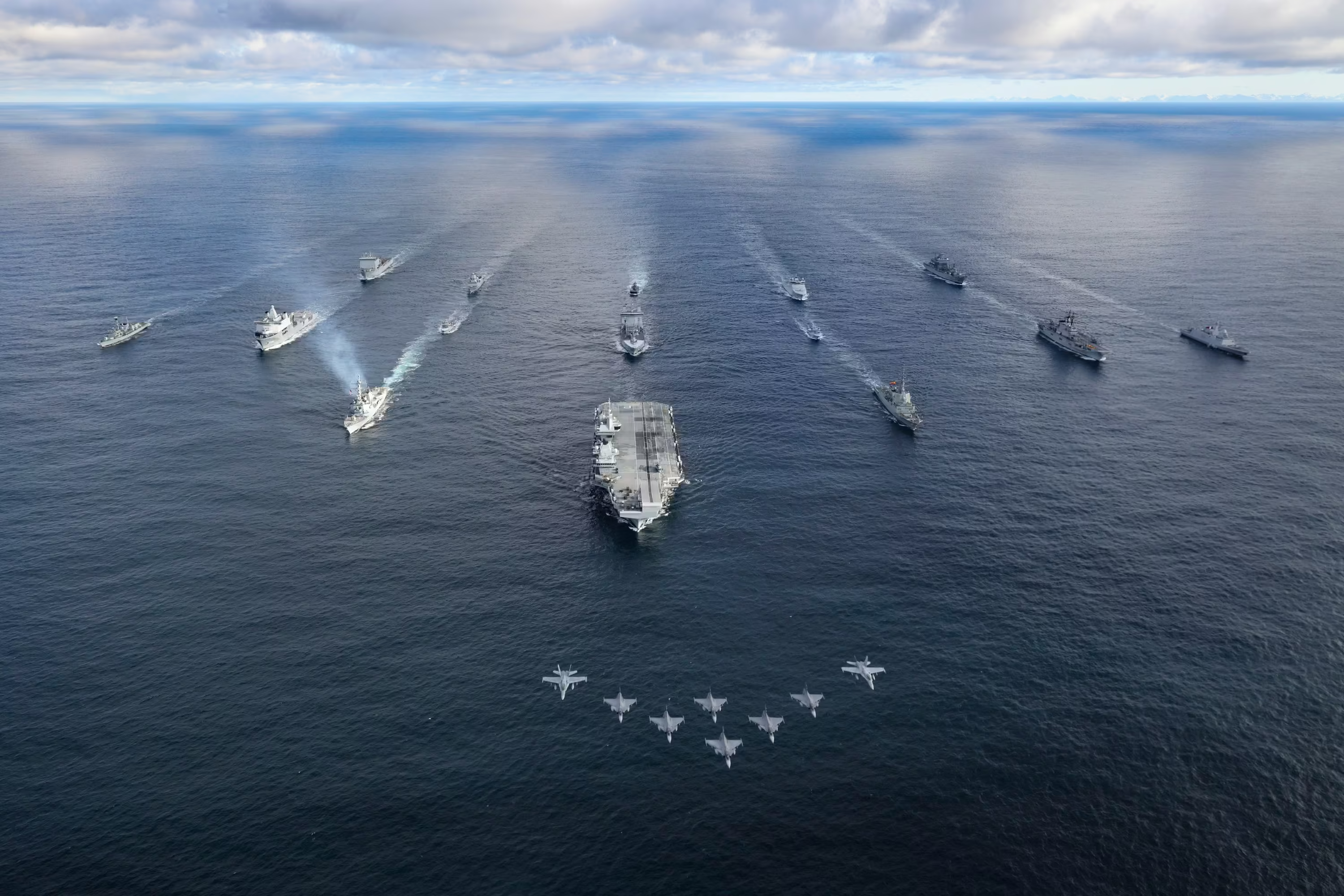
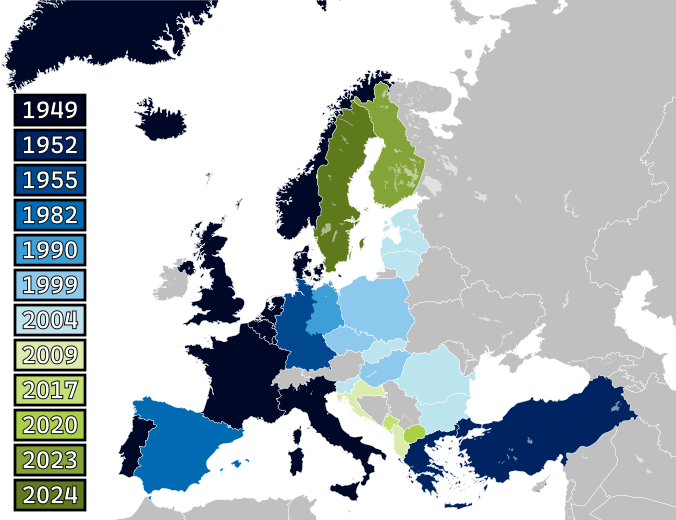
Finland joined NATO on 4 April 2023, Sweden on 7 March 2024, and the Baltic Sea has become a far more integrated Allied space than it was before. In that new map, Estonia matters not only because it sits on the edge of the Alliance, but because it increasingly helps connect the Nordic and Baltic halves of it.
That shift is visible in diplomacy first. Estonia holds the chairmanship of the Nordic-Baltic Eight in 2026, and its own foreign ministry says the goal is to take Nordic-Baltic integration “to the next level,” especially in defence, digital affairs, culture, and the economy. Tallinn is also simultaneously chairing the Baltic Council of Ministers and the Baltic Assembly in 2026, which gives it unusual convening power across both the wider Nordic-Baltic format and the narrower Baltic one. On Estonia’s telling, this is not ceremonial. It is an attempt to turn a region of like-minded small and mid-sized states into a more coherent geopolitical actor.
The language coming out of Tallinn is strikingly ambitious. Foreign Minister Margus Tsahkna has argued that Baltic cooperation now needs a “2.0” phase: less bureaucratic, more flexible, and more explicitly centered on security, connectivity, and support for Ukraine. He has also said that the NB8 has gained new momentum and become the leading platform for addressing regional issues. That matters because it suggests Estonia now sees regional cooperation not as a supplement to NATO and the EU, but as the operating layer through which Nordic-Baltic interests can be organized and projected.
.svg)
Estonia’s role is also expanding because the region’s threats are changing. The older model of Baltic security was mostly territorial: deterrence on land, reassurance in the air, and the memory of Soviet occupation in the background. The newer model is infrastructural. It is about cables, ports, logistics corridors, sanctions enforcement, GPS interference, shadow-fleet activity, and the vulnerability of an undersea world that carries energy and data. Estonia’s 2024–25 presidency of the Council of the Baltic Sea States paid special attention to hybrid threats, including Russia’s shadow fleet, and pushed a memorandum on protecting critical underwater infrastructure. When Tallinn handed the CBSS presidency to Poland in mid-2025, it immediately took over the presidency of the EU Strategy for the Baltic Sea Region through 30 June 2026, again with resilience and connectivity at the center.
This is one reason Estonia now looks less like a margin and more like a hub. It is present in nearly every regional format that matters: NB8, Baltic intergovernmental cooperation, parliamentary Baltic cooperation, the CBSS legacy agenda, and the EU’s Baltic Sea strategy. That density of participation is becoming strategically meaningful because the Baltic region is no longer just coordinating on politics. It is coordinating on systems. Estonia’s NB8 page explicitly frames tighter regional partnership as a necessity rather than a luxury, and describes the eight-country bloc as a highly integrated democratic space of 33 million people with growing geopolitical and economic weight. That is partly branding, of course, but it is also a statement of intent.
NATO’s own posture helps explain why Estonia is so central to this new order. On 14 January 2025, Secretary General Mark Rutte launched “Baltic Sentry” at a summit co-hosted with Finland’s president and Estonia’s prime minister. NATO said the new activity would strengthen protection of critical infrastructure, increase Allied military presence in the Baltic Sea, and improve the ability to respond to destabilizing acts after recent damage to energy and communications cables. When an alliance begins treating seabed infrastructure as a frontline security issue, countries with credibility in warning about regional risk gain influence. Estonia has spent years doing exactly that.
The practical side of this transition is just as important as the political side. On 30 January 2026, the defence ministers of Estonia, Latvia, and Lithuania agreed to establish a joint Military Mobility Area to harmonize peacetime border crossings and transport procedures. Estonia’s defence ministry described the goal in notably expansive terms: a Baltic “military Schengen” that would allow forces and equipment to move on a common, standardized basis and ultimately feed into a harmonized European area. In the same announcement, the ministers tied this effort to the Baltic Defence Line and to joint procurements in air defence, long-range strike, and armored capabilities. Estonia is not just hosting meetings. It is helping turn regional defence cooperation into something operational.
Infrastructure incidents have accelerated this logic. Fingrid said EstLink 2, the undersea electricity interconnection between Estonia and Finland, failed on 25 December 2024. The European Commission responded to the wider pattern of cable incidents by publishing a Cable Security Toolbox on 5 February 2026 and allocating €347 million to strategic submarine cable projects, while stressing that submarine data cables carry 99% of intercontinental internet traffic. The Baltic is therefore not simply a local security concern. It is one of the places where Europe is relearning that resilience has to be built into the systems beneath the sea as much as into the alliances above it. Estonia’s prominence in these debates reflects both geography and preparedness.
Even Estonia’s intelligence language reflects this broader re-mapping. The Estonian Foreign Intelligence Service’s 2026 report highlighted that Moscow now speaks of the Baltic Sea region as a “Baltic-Scandinavian macro-region.” That phrase is revealing. It suggests that Russia itself increasingly sees the Nordics and Baltics not as separate theatres, but as a single interconnected strategic space. Estonia’s current diplomacy is built on the same premise, only from the opposite direction: that the region’s strength lies in acting more as one.
For North American readers, this is the most important point. Estonia is still a border state. It still lives with proximity to Russia, and it still understands risk with a clarity that larger Western capitals sometimes lack. But that is precisely why its role is changing. The country is no longer important only as an object of protection on NATO’s eastern flank. It is becoming one of the organizers of Northern Europe’s new security architecture: a coordinator of Nordic-Baltic diplomacy, a promoter of infrastructure resilience, a driver of military mobility, and a persistent advocate of treating hybrid threats as central rather than peripheral. That is what a strategic hub looks like in 2026.


)%20(1).avif)