The Hidden Soviet Policy That Changed Two Baltics — Not Three
%20(1).avif)
It also helps to use the right term. In the Baltic context, “Russian-speaking” is often more accurate than “Russian,” because the Soviet-era population that grew so dramatically in Estonia and Latvia included not only ethnic Russians but also many Ukrainians, Belarusians, and others whose public and working language had become Russian. As one survey of Baltic language use notes, many non-Russian ethnic groups had shifted partly or fully into Russian and were socially categorized as Russian speakers.
The first thing to understand is that Soviet power changed Baltic demography less by persuading locals to become Russian than by moving Russian-speakers into places the Soviet system most wanted to build, militarize, and administer. The Soviet Baltic was integrated into a centrally planned economy, but that integration was not uniform. Britannica’s overview of the period is blunt: heavy investment in large projects was concentrated especially in Estonia and Latvia, while industrialization and urbanization in less-developed Lithuania began later, in the late 1950s.
That matters because Estonia and Latvia were ideal Soviet frontier economies. They were highly urbanizing, maritime, and strategically exposed to the West. Soviet policy poured migrants into the major cities of both republics, and not only as factory labor. Britannica notes that immigrants also filled white-collar and administrative roles, manned large military concentrations, and were disproportionately present in the Communist Party and state apparatus, while many larger enterprises were administered directly from Moscow. In other words, the demographic shift in Estonia and Latvia was not just a labor story. It was also a power story.

Lithuania, by contrast, was not ignored by Moscow. It was assigned a different balance of functions. Soviet rule transformed all three republics, and Lithuania was industrialized too. But Lithuania remained less urbanized than Estonia and Latvia, maintained a higher birth rate, and entered the late Soviet period with a much larger titular majority. Britannica summarizes the result clearly: Lithuania was less affected by immigration and retained a native population of roughly four-fifths, while Estonia ended the Soviet era about two-thirds Estonian and Latvia only slightly more than one-half Latvian.
Demography reinforced that divergence. A historical study of the Baltic states after the Soviet collapse found that Lithuania’s greater demographic dynamism helped it maintain the native share of the population and limit in-migration more successfully than Estonia and Latvia. By the early 1990s, Estonia and Latvia had foreign-born populations of over 25%, among the highest in Europe, while Lithuania’s stood at just over 10%. Another demographic study similarly observed that when local natural increase matched the wider Soviet rate, as it did in Lithuania, much less immigration was needed.
._%D0%91%D1%8B%D1%85%D0%B0%D1%9E.avif)
There was also a social and cultural difference that Moscow never fully solved. In Lithuania, Soviet rule ran into a stronger institutional rival: the Catholic Church. Scholarly work on Soviet Lithuania describes the Church as one of the most important actors hindering the sovietisation of social and cultural life, while Britannica notes that religious life in Lithuania became a bulwark of national resistance. Rural opposition, including national guerrilla resistance after 1944, was especially pronounced there. That did not stop Sovietization, but it made Lithuania harder to absorb and socially more cohesive in ways Estonia and Latvia, with much more secularized Lutheran environments, often were not.
This is also why the language question can be misleading. Linguistically, Estonian is far more distant from Russian than Lithuanian is. If language similarity were the main driver, Estonia should have been the least Russified of the three. But Soviet Russification in the Baltics was not primarily a matter of linguistic ease. It was a matter of settlement patterns, industrial geography, and whether migrants had to integrate. In Estonia and Latvia, large Russian-speaking urban communities could function in Russian at work and in daily life. Britannica notes that the immigrant population generally saw little need to learn local languages or identify with the native population. The Soviet system did not need Estonian to be close to Russian; it only needed enough people living in Russian.
Latvia, in some ways, became the clearest case of this dynamic. During the Khrushchev thaw, there was an attempt to nativize the political and administrative elite in Latvia, but Britannica notes that the effort backfired, triggered a purge of native elements, and left Latvia more Russified than its neighbors. That is an important reminder that Soviet nationality outcomes were not mechanical. They were shaped by political reversals, bureaucratic struggles, and the center’s willingness to tolerate local elites only up to a point.
So why was Lithuania less transformed? Not because Moscow cared less, but because the Soviet Union did not modernize every republic in the same way. Estonia and Latvia were treated more as urban-industrial-maritime frontier zones, with major cities, ports, military concentrations, and large centrally administered enterprises. Lithuania remained more agrarian for longer, urbanized later, and sustained a stronger demographic and cultural majority among ethnic Lithuanians. Soviet planners were not pursuing one identical colonial formula across the Baltics; they were assigning different places different uses.
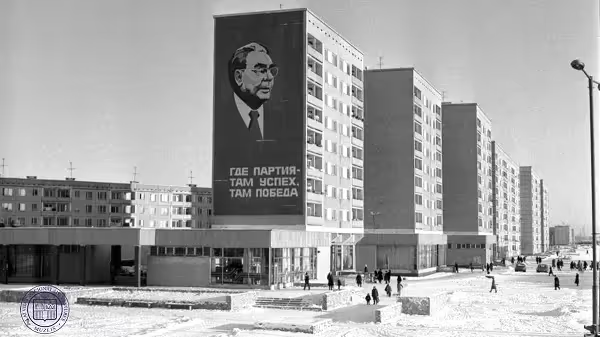
The afterlife of those Soviet choices is still visible today. The same post-Soviet study that highlighted Lithuania’s lower in-migration also notes that Lithuania, with a solid native majority, could offer the “zero option” of citizenship to permanent residents already in 1989. Estonia and Latvia, facing much larger non-native populations, approached citizenship and nation-building more cautiously and contentiously. The demographic map of the late Soviet period did not merely describe the Baltic states. It set the terms of their post-Soviet politics.
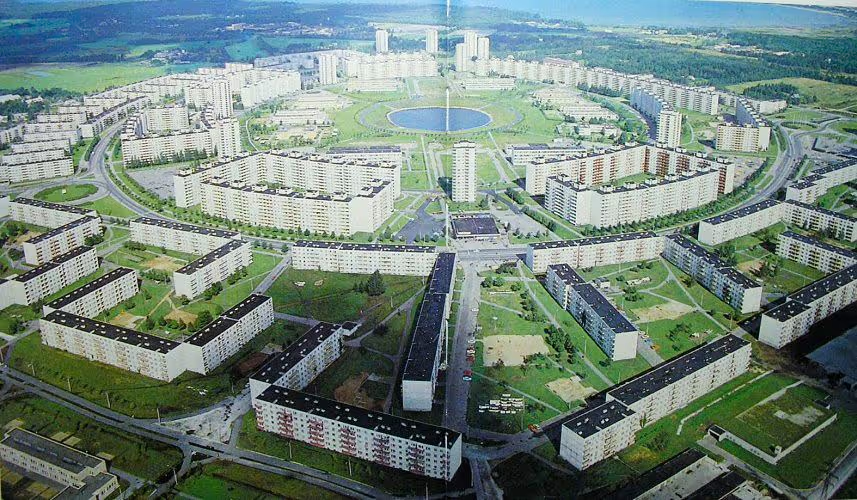
That may be the most useful way to understand the difference. Estonia and Latvia were not more heavily Russified because their identities were weaker, nor was Lithuania spared because its language was somehow easier to defend. The deeper divide was structural. Soviet rule remade the Baltics through factories, ports, military infrastructure, apartment blocks, and migration flows. Where those systems were densest, Russian-speaking communities became largest. Where local demographic weight, rural society, and religious cohesion remained stronger, Soviet demographic engineering had less room to work.


)%20(1).avif)