A Baltic Film Breakthrough at Cannes: Why Ulya Matters Beyond the Festival Bubble

The National Film Centre of Latvia announced on April 9 that Ulya, directed by Viesturs Kairišs and developed with actor Kārlis Arnolds Avots, had been selected for Un Certain Regard at the 79th Cannes Film Festival. Cannes’ own Official Selection list confirms Uļa by Kairišs in the programme, placing the film among a carefully curated slate that often highlights bold, original cinematic voices rather than conventional market-friendly fare.
That distinction matters. Un Certain Regard is not a side note; it is one of Cannes’ most visible platforms for films with distinct artistic perspectives. For a Latvian-led project, especially one produced across Latvia, Estonia, Lithuania, and Poland, the selection signals something bigger than festival validation. It suggests that the Baltic region’s cultural production is becoming harder to categorize as “small,” “local,” or “emerging.” It is entering the same global conversation where memory, identity, gender, sport, and national myth are being re-examined through cinema.

At the center of Ulya is Ulyana Semyonova, one of Latvia’s most extraordinary athletes. The film follows a young girl growing up in a remote Old Believer family in late-1960s Latvia, whose unusual height makes her an outsider before basketball opens a path toward Riga and, eventually, international fame. The National Film Centre describes the story as a teenager’s search for identity, rooted in the biography of the legendary Latvian basketball player.
Semyonova’s real-life legacy is immense. The Naismith Basketball Hall of Fame notes that she was voted Latvia’s most popular athlete 12 times between 1970 and 1985, never lost a game in international competition during her 18-year career, and won Olympic gold medals with the Soviet Union in 1976 and 1980. FIBA’s Hall of Fame lists her as a 213 cm center, a long-time TTT Riga player, and one of the most decorated figures in women’s basketball history.
That makes Ulya more than a sports biopic. It is a film about what happens when a body becomes a symbol before the person inside it has fully formed. For Baltic audiences, Semyonova’s story sits at the intersection of Soviet-era sport, Latvian identity, women’s visibility, and the emotional cost of being made exceptional. For diaspora audiences, especially in North America, those themes carry added resonance. Many Baltic families abroad inherited cultural memory through fragments: songs, churches, summer camps, sports clubs, language schools, political exile stories, and the quiet insistence that small nations must keep telling their own histories or risk having them told by someone else.
This is why Ulya matters beyond Cannes. A festival selection can open doors, but the deeper question is what kind of door it opens. In this case, it opens a space for a Baltic story that is neither folklore nor trauma tourism. It is not simply “about Latvia” in the narrow promotional sense. It is about scale: the scale of a body, the scale of ambition, the scale of a life shaped by family, geography, ideology, and talent.
The film’s production structure also tells a story. FilmNewEurope reports that Ulya is a Latvian, Estonian, Polish, and Lithuanian co-production, produced by Guntis Trekteris through Ego Media, with Pille Rünk of Allfilm in Estonia, Małgorzata Staroń of Staron Film in Poland, and Ieva Norvilienė of Tremora in Lithuania. Ego Media also identifies the film as a co-production among Latvia, Estonia, Poland, and Lithuania, supported by institutions including the National Film Centre of Latvia, Estonian Film Institute, Polish Film Institute, and Lithuanian Film Centre.

That collaboration is important because Baltic cinema often faces the same challenge as Baltic culture more broadly: limited domestic markets, modest production budgets, and a constant need to translate local specificity for international audiences without diluting it. Co-production is not just a funding mechanism. At its best, it becomes a cultural infrastructure — a way for neighboring countries to pool craft, institutions, technical talent, and distribution pathways.
In Ulya, that infrastructure is visible in the creative team itself. The National Film Centre lists Latvian, Estonian, Polish, and Lithuanian contributors across writing, cinematography, costume design, makeup, editing, and sound. This is precisely the kind of regional collaboration that can help Baltic films compete globally, not by mimicking larger film industries, but by building a shared ecosystem strong enough to support ambitious work.

The timing is also significant. Latvia’s recent international visibility has already been transformed by Flow, Gints Zilbalodis’ dialogue-free animated feature, which premiered in Cannes’ Un Certain Regard section in 2024 and went on to win Latvia’s first Academy Award, for Best Animated Feature, in 2025. It would be simplistic to suggest that Ulya is “the next Flow.” The two films appear radically different in form, subject, and emotional register. But together they point to a pattern: Latvian cinema is no longer appearing on the world stage as an anomaly. It is beginning to build continuity.

For North American Baltic communities, that continuity should matter. Diaspora life often depends on cultural rituals that repeat: annual festivals, choir rehearsals, folk dance performances, commemorations, and community gatherings. These are essential, but they can sometimes make heritage feel archival — something preserved rather than actively produced. A film like Ulya disrupts that pattern. It offers a contemporary work of art that draws from history without being trapped in nostalgia.
It also gives younger diaspora audiences a different entry point into Baltic identity. Not everyone will connect first through language fluency or inherited political memory. Some may connect through cinema, sport, gender, aesthetics, or the universal awkwardness of adolescence. A teenager in Toronto, Chicago, New York, Los Angeles, or Vancouver does not need to know every detail of Soviet sports history to understand the drama of being seen for one physical trait before being understood as a person. That is the power of a regional story told with emotional precision: it becomes legible without becoming generic.
The Latvian diaspora is not marginal to this conversation. Latvia’s official country portal notes that some of the largest Latvian communities abroad are in Canada and the United States, alongside the United Kingdom, Germany, Australia, and others. For these communities, international recognition of Baltic cinema is more than a matter of pride. It can shape programming at cultural centers, universities, film festivals, museums, and community organizations. It can create reasons for second- and third-generation audiences to gather around a new cultural text rather than only inherited ones.

This is where diaspora audiences can play a meaningful role. They can help ensure that films like Ulya do not disappear after the festival circuit. They can ask local festivals to screen Baltic films, organize community conversations around them, connect them to women’s sports history, invite scholars and filmmakers into dialogue, and treat cinema as part of cultural diplomacy. Prestige begins at Cannes, but longevity is built by audiences.
There is also a broader representational stakes. Too often, Baltic countries enter global media through geopolitics: NATO, Russia, energy security, cyber defense, demographic anxiety. Those stories are real, but they are incomplete. Culture gives the region a fuller vocabulary. A film like Ulya shows Latvia not only as a geopolitical borderland, but as a place of complex lives, rural communities, religious minorities, athletic mythology, artistic risk, and unresolved memory.
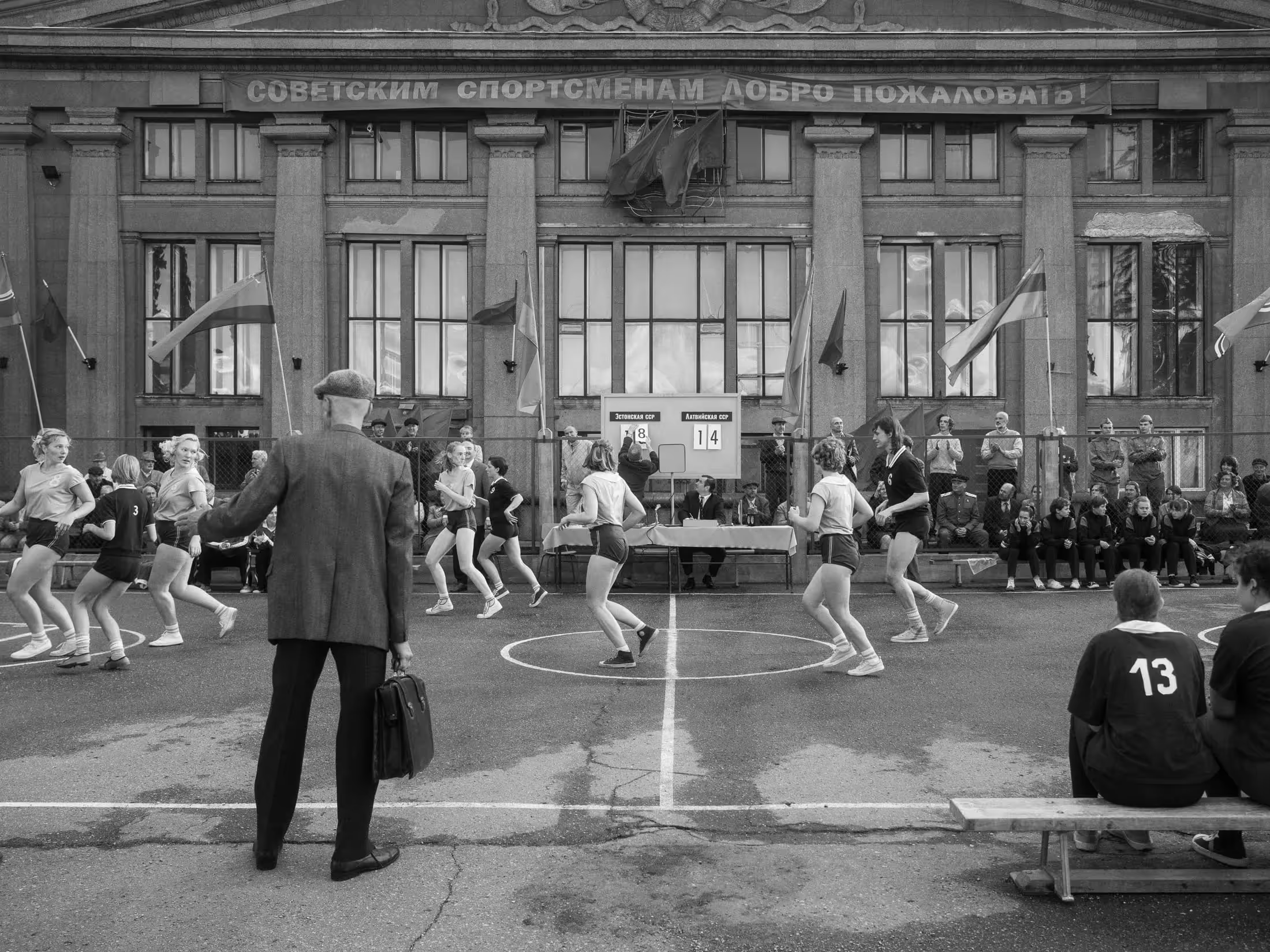
That is why this Cannes selection should be read as a breakthrough, but not as an endpoint. The true significance of Ulya will not be measured only by reviews from the Croisette. It will be measured by whether the film helps Baltic cinema travel further, whether it encourages more regional co-productions, whether it reaches diaspora audiences hungry for contemporary cultural connection, and whether it expands the imagination of what stories from Latvia and the Baltics can be.
Cannes may provide the spotlight. But the real question is what happens when that spotlight moves on. For Ulya, the answer should involve more than applause. It should involve attention, distribution, conversation, and a recognition that Baltic cinema is not asking merely to be included. It is arriving with stories the wider world has not yet learned how much it needs.


)%20(1).avif)