What Summer Camps and Folk Schools Still Give the Diaspora
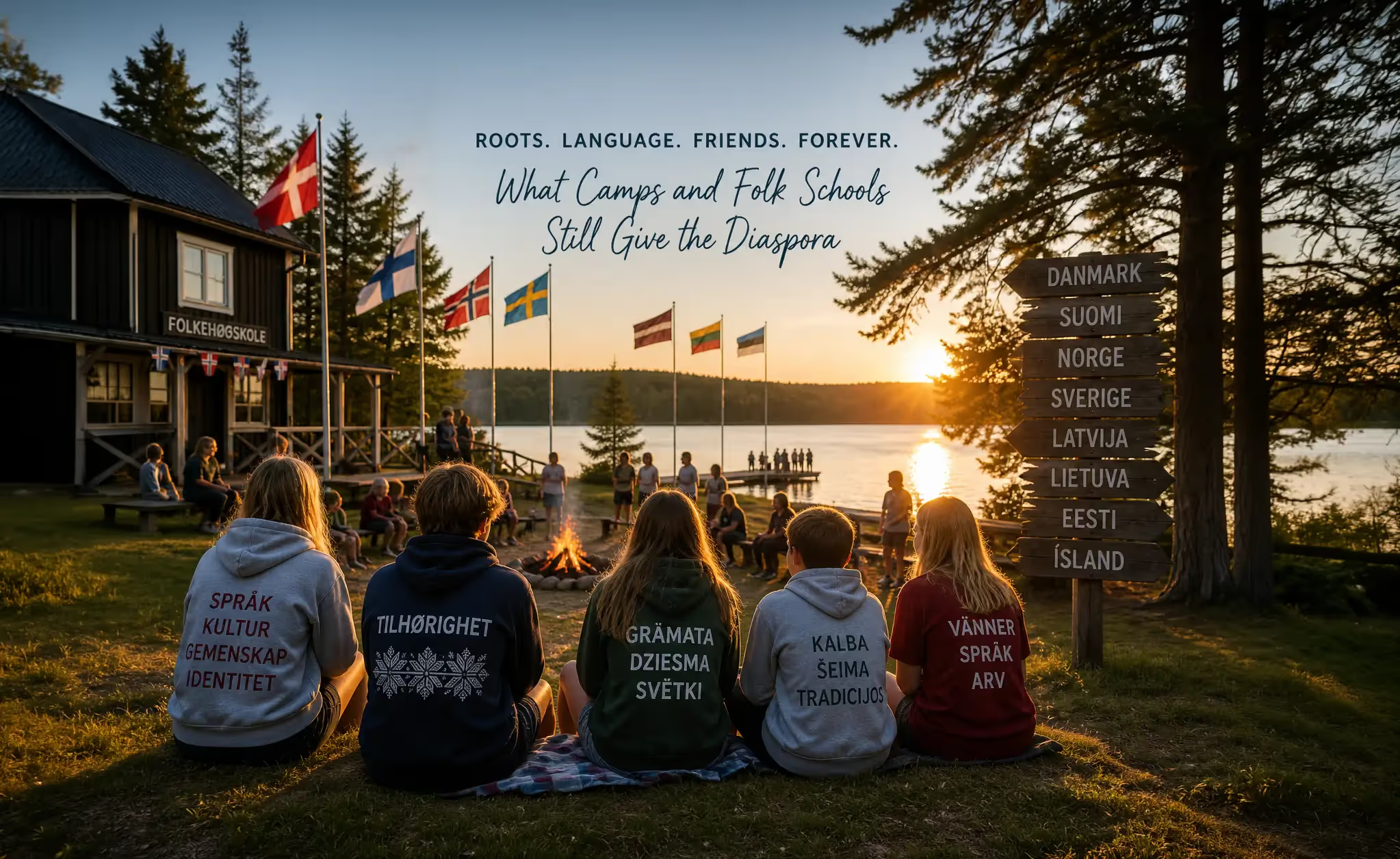
By the time a child can say tere, hei, labas, sveiki, or takk fyrir without looking embarrassed, something has already shifted. The word may still sound tentative. The accent may be inherited imperfectly, borrowed from grandparents, Sunday school teachers, YouTube, or a parent who understands more than they speak. But at camp, the word is no longer a museum label. It is something used at breakfast, shouted across a lake, sung around a fire, written on a cabin sign, whispered during homesickness, and laughed over with friends.
That is the quiet power of Nordic and Baltic summer camps, language weekends, folk schools, and youth gatherings across North America. They do not simply preserve culture. They make it livable.
Heading into summer 2026, the evidence is everywhere. In Minnesota, Concordia Language Villages is again offering Nordic immersion through programs such as Skovsøen Danish Language Village, Salolampi Finnish Language Village, Skogfjorden Norwegian Language Village, and Sjölunden Swedish Language Village. Its 2026 calendar includes Danish youth and high school credit sessions in June; Finnish one-, two-, four-week and credit programs from late June into July; Norwegian day camps, youth sessions, and a four-week “Folk High School” program from June 29 to July 25; and a Swedish day camp from July 27 to 31.
In Vermont, Camp Neringa’s 2026 Lithuanian calendar includes Family Camp in English from June 28 to July 4, Family Camp in Lithuanian from July 12 to 18, Children’s Camp in Lithuanian from July 19 to August 2, Children’s Camp in English from August 3 to 15, and Cultural Days from August 26 to 30. In Michigan, Camp Dainava’s 2026 schedule includes Lithuanian Scout Camp from June 25 to July 3, Jaunųjų Ateitininkų Stovykla from July 14 to 19, Lithuanian Heritage Camp from July 26 to August 2, and teacher courses from August 2 to 9.
The Latvian Center Garezers in Three Rivers, Michigan, is preparing a full 2026 summer rhythm of preschool, children’s camp, middle school, and summer high school programming. Its posted calendar includes preschool weeks from June 22 through July 31; children’s camp sessions beginning with Latvian Gateway from June 21 to July 1 and continuing through late July; middle school sessions from June 21 to August 1; and the Gaŗezera Vasaras Vidusskola summer high school from June 20 to August 2.
For Estonian families in Canada, Jõekääru continues a tradition more than 70 years old, describing its purpose as helping children strengthen connection to Estonian culture, traditions, language, music, craft, dance, sports, nature, and identity. Its 2026 weeks are listed from June 27 to July 25, including the Kalev Volleyball Camp week. Seedrioru, another major Estonian gathering place in Ontario, describes its summer camp as a place for Estonian language, music, dance, and arts, with campers coming from across North America and beyond, and emphasizes “fun, memories & life-long friendships.”
Norwegian-American and Norwegian-Canadian networks are also active. Sons of Norway District Six lists Trollfjell Folkehøgskule for ages 14 to 17 from June 28 to July 11, 2026, and Camp Trollfjell for ages 8 to 13 from July 12 to 25 at Camp Norge in Alta, California, with activities including daily Norwegian lessons, rosemaling, axe throwing, folk dancing, and Scandinavian cooking. Sons of Norway District Four notes Trollhaugen Language Arts and Cultural Camp near Alix, Alberta, from August 9 to 15, 2026, with an all-ages, family-participation model.
And the circle extends beyond childhood. Snorri Programs, which has connected Icelanders and North Americans since 1999, describes its mission as linking people with relatives, heritage, identity, Icelandic language, lifelong friendships, and cultural immersion. Its main 2026 North American-to-Iceland program has closed applications, while Snorri West still listed one 2026 spot for Icelanders ages 20 to 30 traveling to connect with communities of Icelandic descent in the U.S. and Canada. Icelandic Camp in Gimli, Manitoba, meanwhile, is described by the Icelandic National League of the United States as an eight-day experience where youth of Icelandic descent take part in language lessons, Viking crafts, saga writing, and shared heritage.
These examples matter because diaspora identity can easily become abstract. It can turn into a checkbox, a flag on a wall, a recipe made once a year, a song learned phonetically, a costume worn on special occasions, or a family story that younger relatives are too shy to claim. Camps and folk schools interrupt that drift. They put culture back into the body.
At camp, identity is not explained first. It is rehearsed. A camper learns when to stand, how to join a circle dance, how to carry a tray in a dining hall where the food has unfamiliar names, how to say good morning without apologizing, how to sing even when they are not a singer. They discover that heritage is not only heroic history or geopolitical memory. It is also a joke understood by people who know the same awkward childhood Saturday-school routine. It is the smell of sauna, rye bread, lake water, wool, mosquito spray, coffee, cardamom, and pine.
The language learning is real, but it is often not the only lesson. Finlandia Foundation National, in supporting Salolampi scholarships, says it believes Finnish should be spoken and understood and describes Salolampi as an immersive Finnish experience shaped by architecture, food, daily activities, lakeside sauna, and camp store treats and souvenirs. That description points to something important: children remember language more deeply when it is attached to place, appetite, movement, and belonging.
The same is true for Baltic camps. Neringa is not simply offering Lithuanian language exposure; its summer 2026 calendar moves between family, Lithuanian-language, English-language, children’s, and cultural-day formats, which means the camp is serving multiple realities of diaspora life at once. Some families arrive fluent. Some arrive half-fluent. Some arrive with no usable language but a strong sense that something has been handed down and should not end with them. The flexibility of these programs acknowledges that identity transmission is not linear. It skips, weakens, revives, adapts, and returns.
Dainava’s calendar shows another model: a camp ecosystem that serves scouts, youth groups, heritage campers, families, young people, adults, and teachers. That matters because diaspora culture survives when children can see a future path. The camper becomes the counselor. The counselor becomes the teacher. The teacher becomes the parent. The parent returns to the same dining hall with a child who rolls their eyes, then eventually understands.
Folk schools add another layer. North House Folk School in Grand Marais, Minnesota, is not a diaspora camp in the narrow sense, but it belongs in this story because it carries the wider Nordic folk-school inheritance into North American life. Its 2026 calendar includes Hide Week from May 12 to 18, Northern Landscapes Festival from May 29 to 31, Summer Solstice and Wooden Boat Festival from June 19 to 21, and Craft Exploration Camps for adults and families from August 11 to 15. Handwork 2026 describes North House as teaching traditional northern crafts in a noncompetitive, supportive environment, with more than 90 percent of courses open to complete beginners.
That phrase—“complete beginners”—is central to the future of diaspora culture. A usable identity must have room for beginners. It must welcome the child who cannot roll an r, the teenager who feels both proud and self-conscious, the adult who wants to learn rosemaling or weaving or a song their grandmother knew, and the mixed-background family trying to decide which traditions to keep. If cultural spaces require perfection, they become brittle. If they allow practice, they become alive.
The American Swedish Institute in Minneapolis offers another version of this accessible entry point. Its 2026 summer day camps invite children ages 6 to 12 into Nordic history and culture through storytelling, cooking, art, imaginative play, and the Turnblad Mansion; its listed offerings include Passport to Sweden: A Swedish Language and Culture Camp on August 13, while several other camps were already marked sold out. The fact that some programs sell out is its own signal. Families are not merely nostalgic. They are actively looking for places where culture can be experienced with other children, not explained alone at home.
What do younger generations actually take away?
Friendship, first. Almost every camp description eventually returns to it, whether explicitly or implicitly. Seedrioru says it is “more than just a summer camp” and emphasizes memories and lifelong friendships. Snorri Programs tells young adults they can connect with relatives and make lifelong friends. This is not decorative language. For young people in small diaspora communities, friendship is infrastructure. A child may be the only Latvian, Estonian, Finnish, Icelandic, Norwegian, Swedish, Danish, or Lithuanian kid in their school. At camp, they are no longer the explanation. They are part of the room.
Confidence, second. The confidence is not only linguistic, though language matters. It is the confidence of seeing adults who treat the culture as normal, not exotic. It is the confidence of realizing that one can participate without knowing everything. It is the confidence of returning home with songs, dances, phrases, jokes, and friends that make identity feel less inherited than chosen.
Ritual, third. Camps understand what modern life often forgets: repeated actions shape belonging. Morning flag-raising, evening campfire, grace before meals, folk dancing, sauna, midsummer, church services, handcraft, cabin cleanup, closing ceremonies, and final songs all become emotional memory. Garezers’ 2026 calendar, for example, does not list only camp sessions; it also lists church services, a season opener, clean-up days, board meetings, and participation around the Grand Rapids Song and Dance Festival. That wider calendar shows how camp becomes a seasonal village.
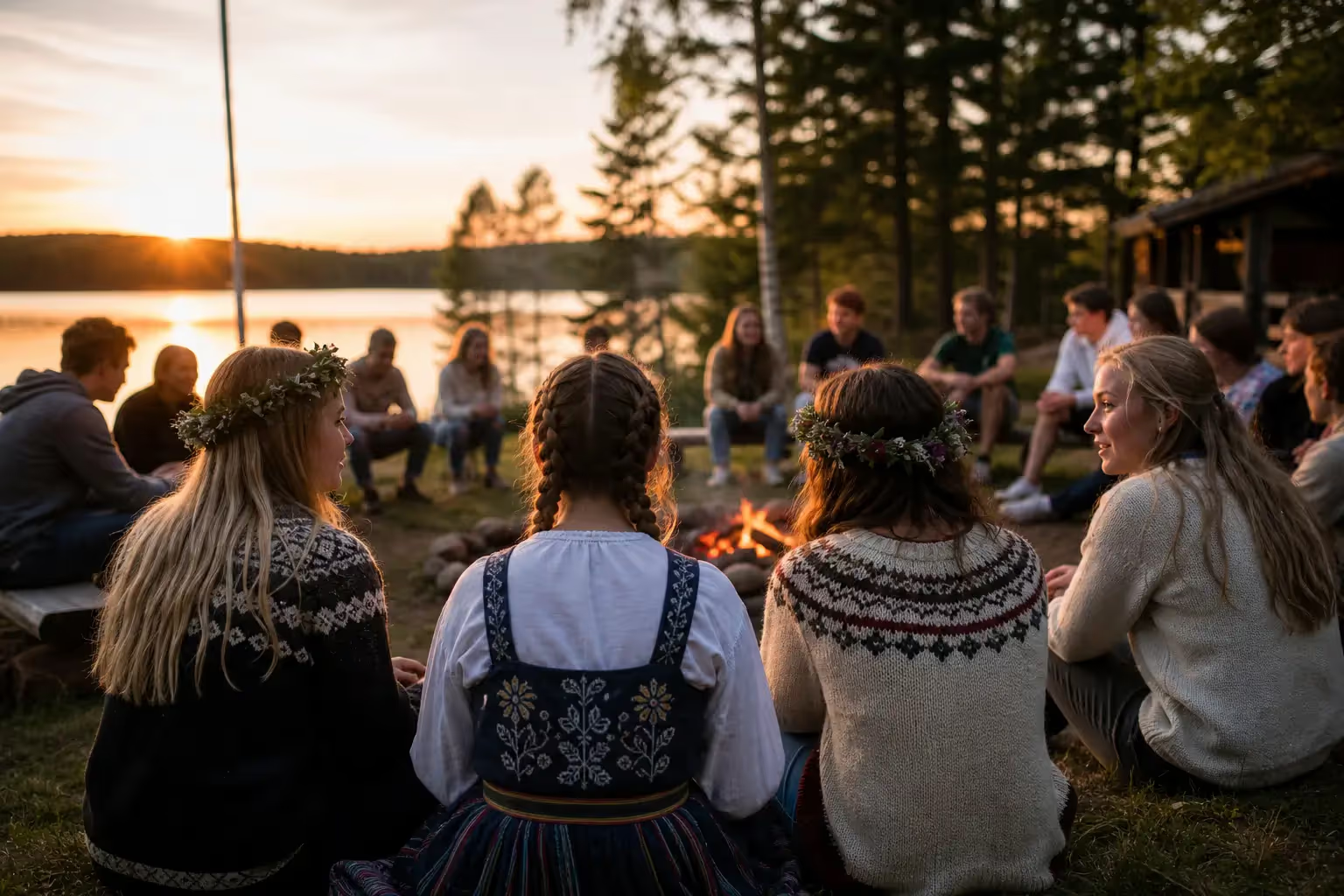
Finally, young people take away a usable sense of identity. Not a perfect one. Not a pure one. A usable one.
Usable identity means a young Lithuanian American can know that heritage is not confined to a national holiday. It can be volleyball, song, prayer, drama, language, and late-night cabin conversations. Usable identity means an Estonian Canadian can return from Jõekääru or Seedrioru with language fragments and still feel more whole. Usable identity means a Norwegian American teenager at Trollfjell can learn rosemaling and folk dancing without needing to become a museum piece. Usable identity means a Finnish American child at Salolampi can connect sauna, food, architecture, and language into one lived memory. Usable identity means a Latvian teenager at Garezers can understand that a summer high school is not only school; it is a rehearsal for adulthood inside a cultural community.
This is why summer 2026 feels timely. Younger generations are growing up in a world that offers endless identity labels but fewer embodied communities. They can access genealogy records, streaming music, TikTok recipes, language apps, and national news from anywhere. Yet many still hunger for something the screen cannot provide: the feeling of standing among peers and being recognized.
The diaspora does not survive because children are told to care. It survives when they are given experiences worth caring about.
A camp song is not a policy. A folk-school class is not a political platform. A language weekend is not a substitute for fluency. But together, these gatherings do something profound. They give young people permission to belong before they are experts. They transform heritage from a burden into a place. They make culture social, physical, joyful, and repeatable.
And perhaps most importantly, they teach that identity is not only what came before. It is what you can do with others now.


)%20(1).avif)