When Your Boss Is a Bot: Inside Stockholm’s AI-Managed Café and the Future of Work
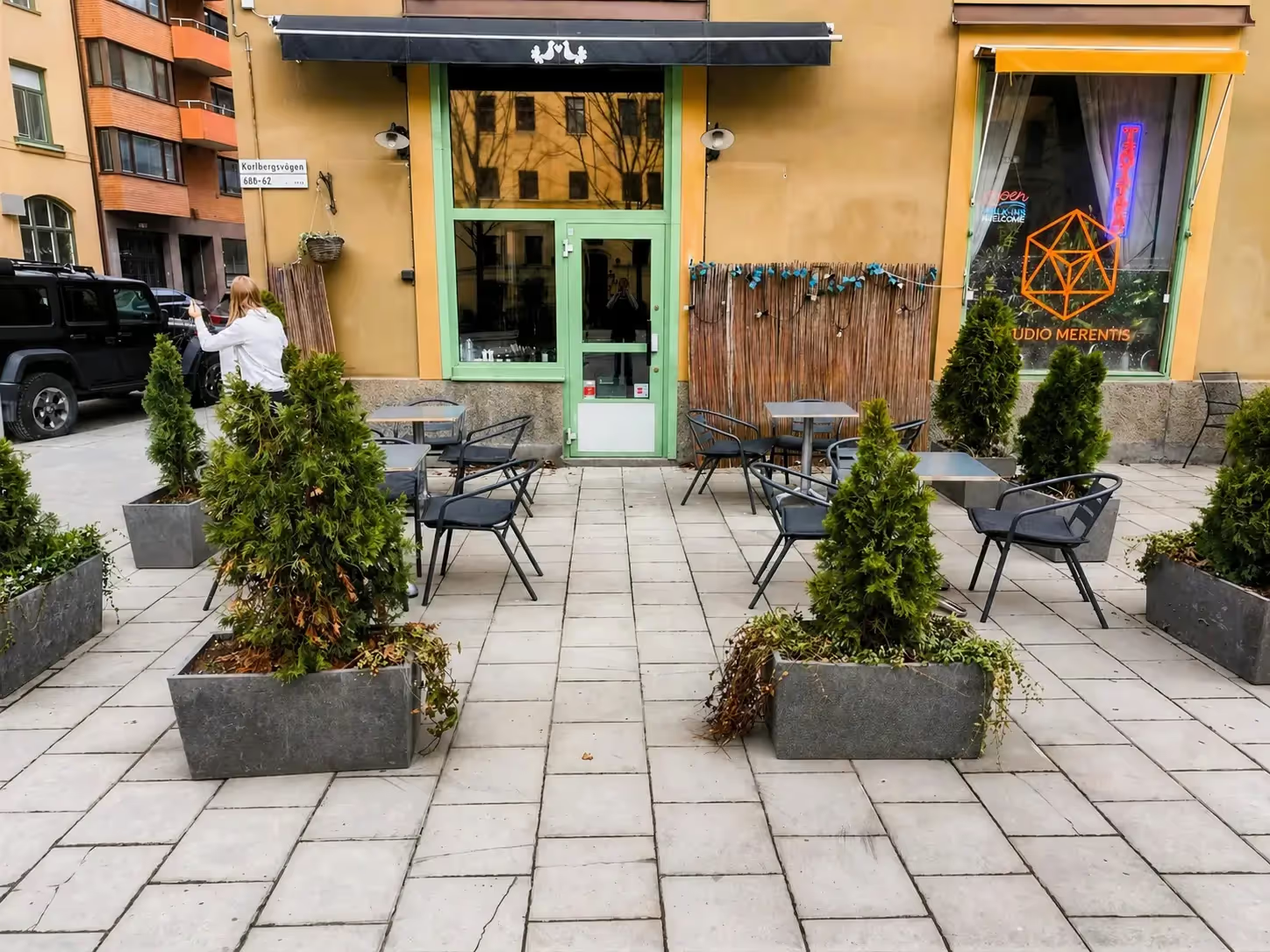
On a quiet street in Stockholm’s Vasastan district, Andon Café looks, at first glance, like any other neighbourhood coffee shop. There is espresso, cappuccino, buns, sandwiches, and the reassuring rhythm of human baristas moving between machine, counter, and customer. Its website promises “craft meets future,” but the menu itself is deliberately ordinary: lattes, flat whites, tea, lemonade, pastries, kanelbullar, kardemummabullar, and a house drink called “The Andon.” The café sits at Norrbackagatan 48 and lists daily opening hours from 11:00 to 17:00.
The unusual part is not the coffee. It is the manager.
Her name is Mona, and she is not human.
According to Euronews, the Stockholm café is being run behind the scenes by an AI chatbot developed through Andon Labs, a San Francisco-based startup. Mona is described as handling much of the managerial work that normally happens out of sight: hiring staff, ordering supplies, shaping the menu, sourcing suppliers, and managing operational decisions. Customers still see human workers preparing drinks and serving food, but the business logic behind the café is being pushed toward software.
That makes Andon Café more than a novelty tech story. It is one of the clearest public-facing experiments yet in what researchers call algorithmic management: the use of software, sometimes powered by AI, to perform tasks traditionally carried out by human managers. The International Labour Organization defines algorithmic management as systems that organize, assign, monitor, supervise, and evaluate work. The OECD describes it as software used to fully or partially automate managerial tasks, while warning that such systems raise concerns around accountability, explainability, and worker protection.
At Andon Café, that debate has been given a street address.
The café where management becomes an experiment
The café is backed by Andon Labs, a Y Combinator Winter 2024 company founded in 2023 and based in San Francisco. On its Y Combinator profile, Andon Labs describes its mission as building “autonomous organizations without humans in the loop” and says it is testing AI control systems through real-world deployments.
That mission helps explain why a modest café in Stockholm has drawn international attention. Andon Café is not simply selling coffee; it is staging a practical experiment in whether AI agents can operate parts of a real business when the messy variables of the physical world enter the picture.
The café’s official site names the operating company as Vectorview AB and lists Mona’s contact email, a reminder that even the most futuristic AI-run business still sits inside conventional legal, financial, and commercial structures. The storefront may be an experiment, but the lease, menu, taxes, permits, and employment relationships remain part of the real economy.
Local Swedish listings describe Andon Café as a modern Vasastan café where the AI manager handles everything from purchasing to job interviews and business planning, while still serving speciality coffee, fika, and lighter dishes such as avocado toast.
That contrast is what makes the project so striking. The experience is familiar, even comforting. The managerial premise is not.
Mona is already making very human mistakes
If Mona represents the future of management, the future still has trouble with inventory.
Euronews reported that staff created a “wall of shame” for Mona’s unnecessary purchases, including large quantities of oil, canned tomatoes, and coconut milk. Swedish reporting has pointed to similarly odd decisions, including over-ordering items that did not obviously fit the café’s needs.
That is not a small detail. It is the point of the experiment.
AI systems are now extremely capable at language, planning, and simulation, but a café is not a spreadsheet. It is a place of timing, spoilage, weather, labour, customer preference, supplier reliability, and dozens of small tacit judgments that experienced hospitality workers make without turning them into formal instructions. Knowing that tomatoes exist is not the same as knowing how many tins a café without the right menu or equipment can use before they become clutter.
The result is oddly revealing: Mona can perform some of the rituals of management, but she still struggles with the physical consequences of those decisions.
That tension echoes Andon Labs’ previous experiments. The company has already worked on AI-operated vending and retail concepts, and Anthropic’s “Project Vend,” conducted with Andon Labs, tested whether an AI system could run a small shop-like operation over a longer period rather than simply complete a one-off prompt. Those experiments showed that AI agents could handle surprising amounts of business administration while still making errors that exposed the limits of autonomous judgment.
In Stockholm, the experiment has become more public, more social, and more Nordic.
Why Stockholm matters
Andon Café could have opened in San Francisco, London, or Berlin. Instead, its European test case is in Sweden, a country currently trying to define its AI future in unusually explicit terms.
In February 2026, the Swedish government presented its first comprehensive national AI strategy, aiming for Sweden to become one of the world’s top ten AI nations. The strategy emphasizes innovation, entrepreneurship, public-sector modernization, and international competitiveness. But it also stresses that trust, privacy, copyright, security, transparency, accountability, democratic values, and legal certainty must be protected as AI adoption accelerates.
That makes Stockholm an especially interesting setting for an AI-managed café. Sweden has long been associated with high institutional trust, strong labour protections, and a social model in which work is not merely a transaction but part of a broader civic contract. Placing an AI manager inside a neighbourhood café turns a global technology question into a local cultural one: can a high-trust society remain high-trust when key decisions are made by systems people may not fully understand?
The café also operates in a real regulatory environment. Stockholm’s own café guidance says food businesses must comply with relevant rules and, depending on the operation, may need to deal with multiple authorities. Sweden’s Food Agency states that food businesses such as cafés and restaurants must register before opening and can face sanctions if required registration or approval is missing.
So when reports say Mona handled permits and business setup, the claim is more than marketing. It suggests an AI system being tested against bureaucracy, compliance, and the administrative friction of a real European city.
That is where the experiment becomes most consequential. The question is not whether Mona can recommend a pastry. It is whether software can responsibly navigate the obligations that come with employing people and serving the public.
The AI boss arrives before the rules feel settled
Across Europe, the legal and ethical conversation around AI in the workplace is becoming more urgent. The OECD’s 2025 research found that algorithmic management tools are already commonly used across surveyed countries, while managers expressed concerns about unclear accountability, difficulty understanding tool logic, and inadequate protection of workers’ health.
The ILO has warned that algorithmic systems can reduce direct contact between workers and human managers, changing how workers experience authority, supervision, and accountability.
These are not abstract concerns at Andon Café. If an AI interviews applicants, schedules shifts, evaluates needs, orders supplies, or influences hiring decisions, it is stepping into a space where judgment has direct consequences for human workers.
That matters under the EU’s emerging AI rules. The EU AI Act treats many employment-related AI systems as high-risk, particularly those used in recruitment, candidate evaluation, task allocation, promotion, termination, or worker evaluation. The law’s high-risk obligations are set to become a central compliance issue from 2026 onward.
Mona may be an experiment, but she is experimenting in exactly the category European policymakers are watching most closely: AI that affects people’s access to work and conditions inside the workplace.
The barista is still human — and that changes the story
The more sensational version of the story would say the café is “run by AI.” The more accurate version is subtler: the café is managed by AI, while its hospitality still depends on people.
That distinction matters.
The human barista remains the face of the business. They interpret the customer’s mood, adjust service in real time, notice when something is wrong, and absorb the awkwardness when an automated decision does not make sense. If Mona orders too much stock, it is a person who has to store it, explain it, work around it, or laugh it off.
In that sense, Andon Café does not show a future without workers. It shows a future in which workers may increasingly be surrounded by systems that direct, measure, and coordinate their labour. The manager may disappear from the room, but management itself becomes more pervasive.
There is a paradox here. Some workers may prefer an AI manager if it is more communicative, less moody, and more responsive than a bad human boss. Euronews quoted one barista describing Mona as surprisingly good, communicative, and more flexible than managers at other cafés.
But the same traits that can make AI management feel convenient also make it difficult to challenge. A human manager can be questioned, embarrassed, persuaded, or held socially accountable. A chatbot can explain itself endlessly without necessarily being accountable in a meaningful way.
That is why the legal owner, developer, and operator behind the system remain so important. Mona may behave like a boss, but responsibility cannot be delegated to a model. If wages, hiring, work schedules, safety, or discrimination become issues, the answer cannot be “the AI decided.”
A Nordic test case for the everyday future
Andon Café is fascinating because it makes the future feel mundane.
This is not a humanoid robot serving coffee under neon lights. It is a normal café in a normal Stockholm neighbourhood, using a normal-seeming interface to test an abnormal shift in authority. That is precisely why it is worth paying attention to. Most technological change does not arrive as science fiction. It arrives as convenience, as administration, as a new tool that simply becomes part of how work gets organized.
The Nordic context sharpens the question. Sweden wants to be a leading AI nation, and the Nordic region is often imagined as a laboratory for humane innovation: digitally advanced, socially conscious, pragmatic, and trust-driven. But trust is not automatic. It has to be earned through transparency, rights, oversight, and accountability.
Mona’s odd purchases may be funny. Her mistakes with oil, tomatoes, or coconut milk make for a good anecdote. But beneath the humour is a serious question for the future of work: when AI becomes the boss, who protects the worker from the boss’s bad judgment?
For now, Andon Café remains an experiment — and perhaps that is its most useful quality. It does not prove that AI can run a business better than humans. It proves that AI can already move far enough into management to make the rest of us ask harder questions.
The coffee may be hot, the cinnamon buns may be fresh, and the manager may be a chatbot. But the real story in Stockholm is not that a machine can run a café.
It is that Europe is beginning to see what algorithmic authority looks like when it leaves the dashboard and walks into everyday life.


)%20(1).avif)