Finlandia: The Song That Gave a Nation Its Voice
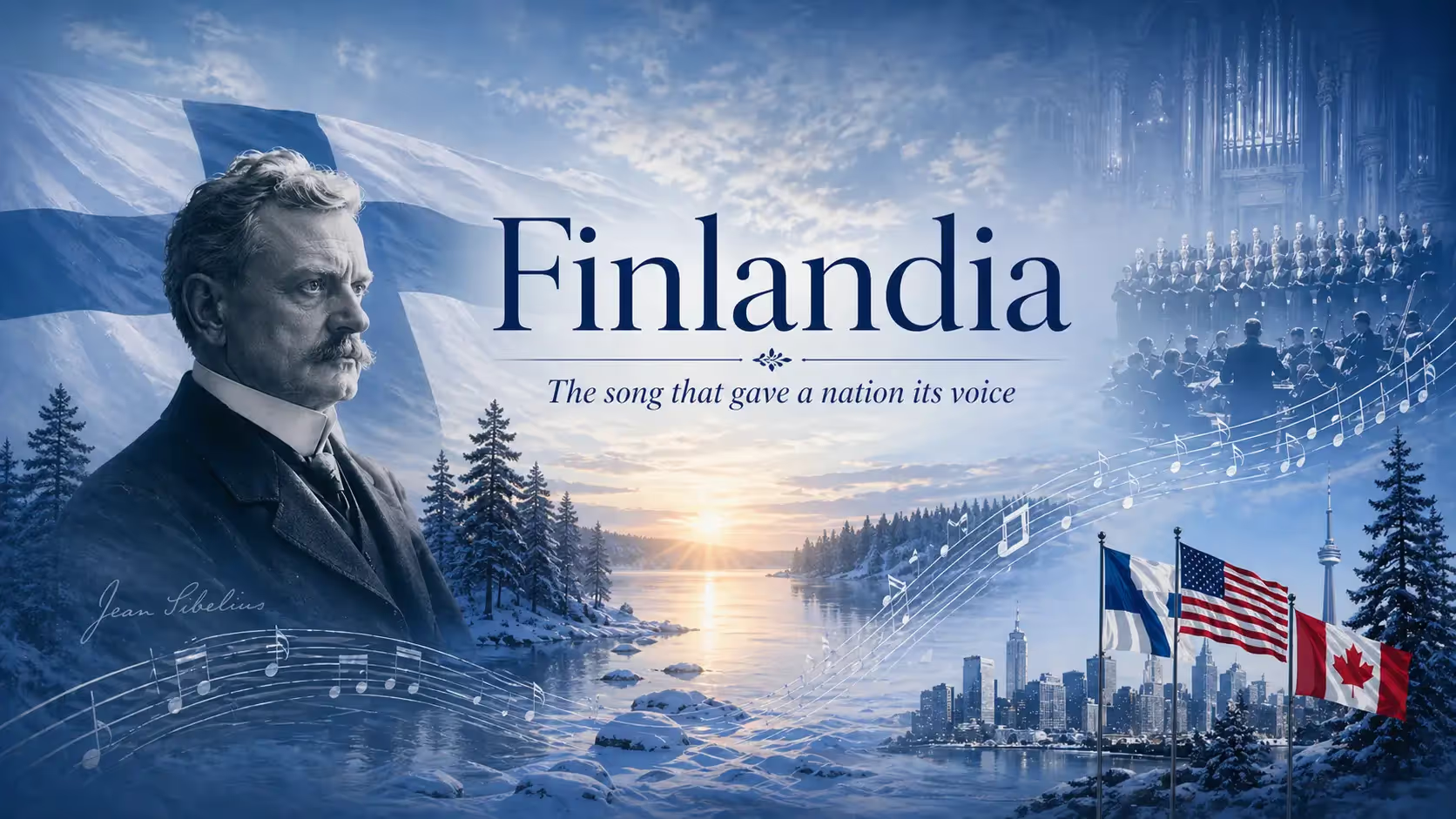
There are pieces of music that are admired, and there are pieces of music that are lived with. Jean Sibelius’s Finlandia belongs to the second category. For Finns in Finland, and for Finnish communities across the United States and Canada, it is more than a symphonic poem, more than a concert-hall staple, and more than a patriotic hymn. It is a memory of pressure, dignity, silence, defiance, and survival — compressed into roughly nine minutes of music.
To understand why Finlandia still feels so personal to so many Finns, one has to return to 1899, when Finland was not yet an independent country. It was an autonomous Grand Duchy within the Russian Empire, and that autonomy was increasingly under threat. The February Manifesto of 1899 declared that the Russian tsar could legislate for Finland by imperial edict, reducing the authority of Finland’s own institutions and accelerating what Finns experienced as Russification.
That same year, Sibelius composed music for the Finnish Press Celebrations, an event presented publicly as a cultural fundraiser but understood by many as a carefully coded act of resistance. The Finnish press was under pressure from imperial censorship, and the event used historical tableaux — staged scenes from Finland’s past — to tell a national story without saying too openly what could not be safely said.
The finale of those tableaux was called “Finland Awakes.” It was this closing music that would soon become Finlandia.
From the beginning, the work carried a double meaning. On the surface, it was art: a tone poem by a rising Finnish composer. Underneath, it was a declaration that Finland was not merely a province to be administered, but a people with its own history, language, laws, and soul. Breitkopf & Härtel, Sibelius’s publisher, describes the original work as the closing piece of Music for the Press Celebrations, where the Finnish intelligentsia protested the Russian government’s tightening censorship laws. In its final form, the piece premiered in Helsinki on July 2, 1900, under the title Suomi — “Finland.”
The music itself explains part of its enduring power. Finlandia begins in darkness: brass and timpani create a tense, almost oppressive atmosphere. The early sections are turbulent and martial, full of struggle and forward motion. Then, after the storm, the famous hymn-like melody emerges — calm, broad, and deeply human. Britannica describes this emotional arc as moving from ominous tension into martial energy and finally toward a serene, expansive melody.
That hymn section is often mistaken for an old folk melody, which says something about how completely it entered Finnish emotional life. But it was Sibelius’s own creation. It sounded ancient because it touched something ancient: the longing for freedom, the ache of endurance, and the hope that a nation’s day would come.
The work quickly became too recognizable to be politically innocent. During Finland’s years as a Grand Duchy under Russia, performances inside the empire sometimes had to use disguise titles such as “Impromptu” to avoid censorship. This is one reason Finlandia became so beloved: it was not simply music about freedom. It had itself been forced to hide.
Its international life began almost immediately. After its 1900 Helsinki premiere in final form, the orchestra took it on a European tour that included the Paris World’s Fair, after which Finlandia gained lasting international fame. For a small nation still fighting to preserve its autonomy, that mattered. Finlandia allowed Finland to be heard abroad before Finland was fully sovereign at home.
The hymn’s later history deepened its emotional reach. The Finnish words most commonly associated with the Finlandia Hymn were written by poet V. A. Koskenniemi after the Soviet attack on Finland in 1939, during the Winter War. Earlier Finnish words had been written by opera singer Wäinö Sola in 1937, but Koskenniemi’s wartime text became the version used ever since. Sibelius later arranged the hymn for mixed choir in 1948.
This matters because Finlandia came to belong to more than one historical moment. It was born amid the Russification crisis of 1899. It later echoed through Finland’s independence, its wars of survival, and its national commemorations. Today, Finland’s Independence Day traditions still include church services and choral interpretations of the Finlandia Hymn.
For Finns abroad, especially in North America, the song has carried another layer of meaning. Finnish migration to the United States and Canada from the late nineteenth century onward created communities where music played a major role in daily life, celebrations, churches, temperance societies, workers’ halls, homes, and village associations. The Migration Institute of Finland notes that Finnish immigrant music included songs of hardship, homesickness, defiance, and communal memory.
That is precisely the emotional world in which Finlandia could thrive. For immigrants and their descendants, it was not only a national symbol from across the ocean. It was a bridge. To hear it in a church basement, community hall, Independence Day gathering, or choir concert was to feel Finland made present — even in Michigan, Minnesota, Ontario, Thunder Bay, New York, or the Pacific Northwest.
The melody also traveled through English-language hymnody. The hymn tune became widely known through texts such as “Be Still, My Soul” and other Christian hymns, giving the melody a life beyond Finnish ethnic communities while preserving its solemn, consoling character. ThisisFINLAND notes that soon after publication the Finlandia Hymn was performed with various words as far away as the United States, while Hymnary traces the tune’s broad use in hymn traditions.
That wider religious and cultural adoption helps explain why Finlandia can feel familiar even to listeners who do not know its Finnish history. Its melody carries a rare emotional balance: grief without surrender, grandeur without arrogance, patriotism without bombast. It is not triumphalist in the simple sense. It does not merely shout victory. It first remembers the darkness.
This is why many Finns find it so dear to the heart. Finlandia gives musical shape to a national temperament often described through restraint, endurance, and inner resolve. It allows emotion to rise, but not cheaply. Its power lies in the way it moves from pressure to breath, from turmoil to stillness, from threat to dawn.
It is also why the piece remains, unofficially, one of Finland’s most important national songs. Finland’s official national anthem is Maamme, but the Finlandia Hymn has often been proposed as an alternative national anthem. The reason is not hard to hear. Maamme names the country. Finlandia seems to reveal its inner weather.
Sibelius himself may not have intended every layer of meaning later attached to the piece. Great works often outgrow their creators. But Finlandia became what Finland needed it to become: a shield, a prayer, a memory, a public statement, and a private consolation.
For Finnish people in Finland, it recalls the struggle to become and remain a nation. For Finnish Americans and Finnish Canadians, it carries the added ache of distance — the feeling of belonging to a homeland that may be inherited through stories, names, food, language fragments, family photographs, and songs. In that sense, Finlandia does what only the most enduring cultural works can do: it turns history into feeling.
More than a century after its birth in a censored empire, Finlandia still rises from darkness into light. That is its story. That is why it endures. And that is why, when the hymn begins, so many Finns — whether in Helsinki, Hancock, Thunder Bay, Toronto, Duluth, or New York — do not simply hear a song.
They hear home.

)%20(1).avif)