Fifty-Four Works, Twenty-Four Artists, and a Living Argument About Nordic Folk Art
There is a version of Nordic folk art that lives permanently in the past tense. It is the version in which rosemaling was something your great-grandmother's neighbor did, weaving is a technique recovered from a museum catalog, and the job of a heritage institution is to keep the objects safe from the present.
An exhibition running at Vesterheim in Decorah, Iowa, through December 31 sets out to argue the opposite.
“Nordic Echoes: Tradition in Contemporary Art,” organized by the American-Scandinavian Foundation, is a traveling show of contemporary Nordic folk arts and cultural traditions from the Upper Midwest — North and South Dakota, Iowa, Minnesota, Wisconsin and the Upper Peninsula of Michigan. It brings together 54 works by 24 living artists: paper cutting, rosemaling, weaving, sculpture, ceramics, and decorated sheepskin coverings known as skinnfell.
The framing is the point. The exhibition presents these works as living, malleable forms grounded in traditional skills — rather than as static objects rooted in an imagined past.

Testing the boundaries
Vesterheim's chief curator, Laurann Gilbertson, put the case for the show in terms that acknowledge it is not entirely comfortable:
It's wonderful to have these artworks, some of which test the boundaries of Scandinavian folk art, at Vesterheim. Come see why the exhibit is titled, “Tradition in Contemporary Art!”
That phrase — test the boundaries — is doing real work. A folk art tradition that cannot be tested is not a tradition; it is a style guide. The interesting question a show like this raises is where a curator draws the line between a practice that has evolved and a practice that has simply been borrowed.
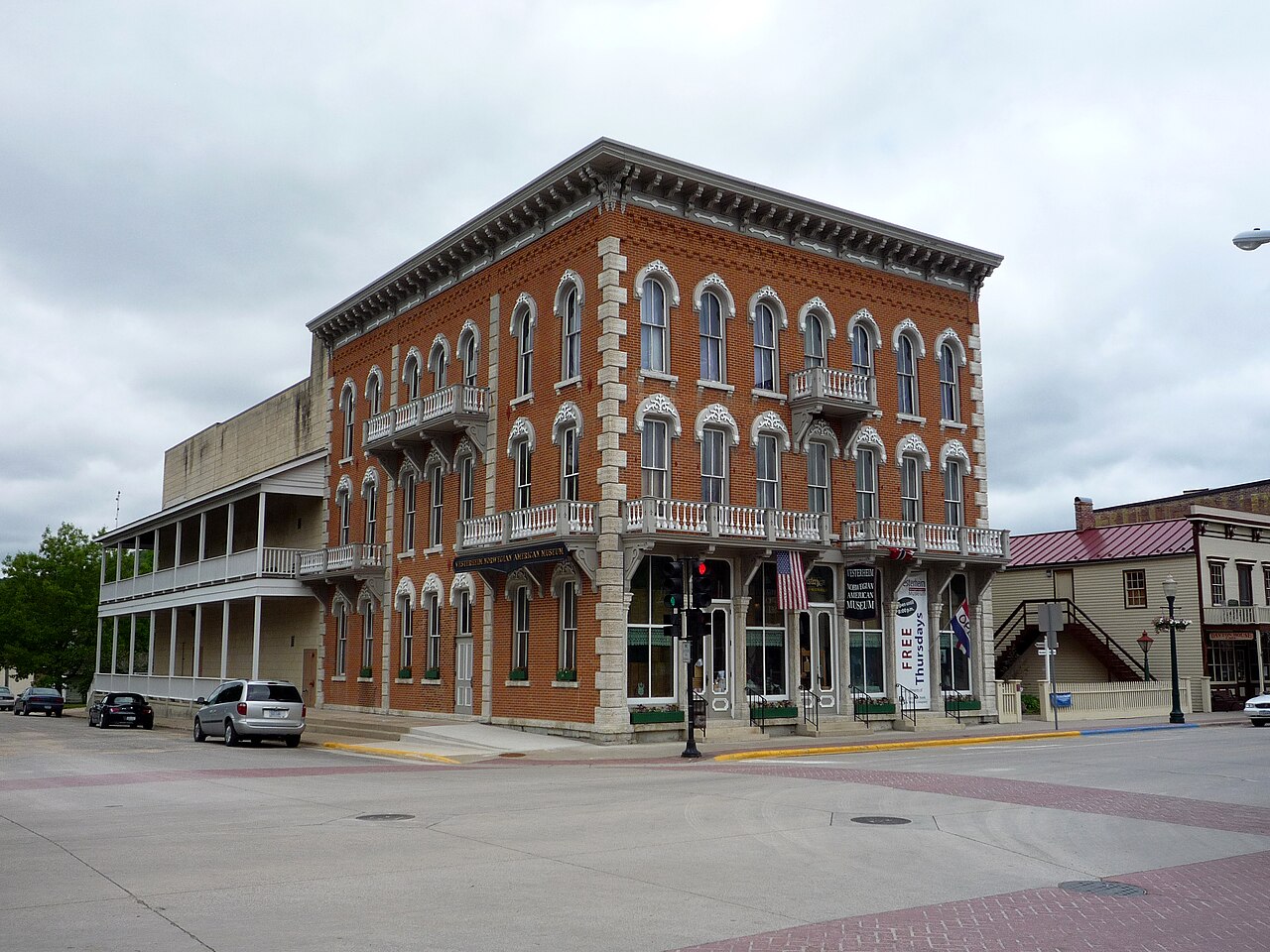
It is a question Vesterheim is unusually well placed to host. Norwegian Americans began collecting and preserving objects at Luther College in Decorah in 1877, and the collection that grew out of it now runs to some 33,000 artifacts, 11,000 books and 14,000 archival photographs and documents — by the museum's own description, one of the most comprehensive museums in the United States devoted to a single immigrant group. It is also not only a museum: the Folk Art School attached to it teaches the same techniques as working skills, to anyone who signs up.
The artists are also the teachers
The detail that ties the exhibition to the institution is that several of the artists in it teach there.
Pieper Blomquist and Tara Austin, both presenting upcoming online webinars on decorative painting, are Folk Art School instructors — as are KJ Groven, Jerry Johnson, Lucy and Gene Tokheim, Karen Rebholz, Beth Homa Kraus, Elizabeth Belz and Christine Novatny. Teresa Faris's work has appeared in earlier Vesterheim exhibitions, and a piece by Bill Amundsen is in the museum's collection.
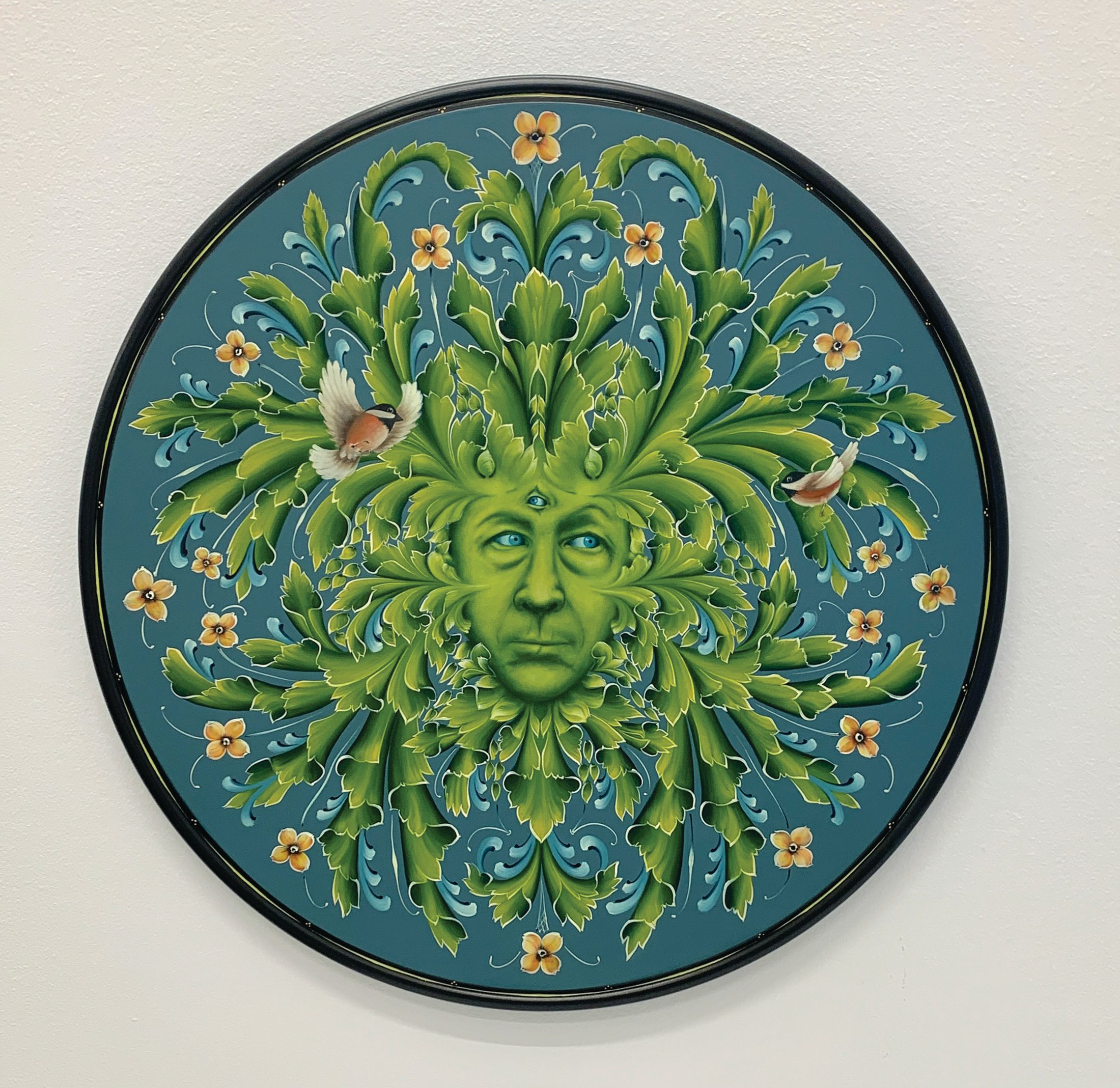
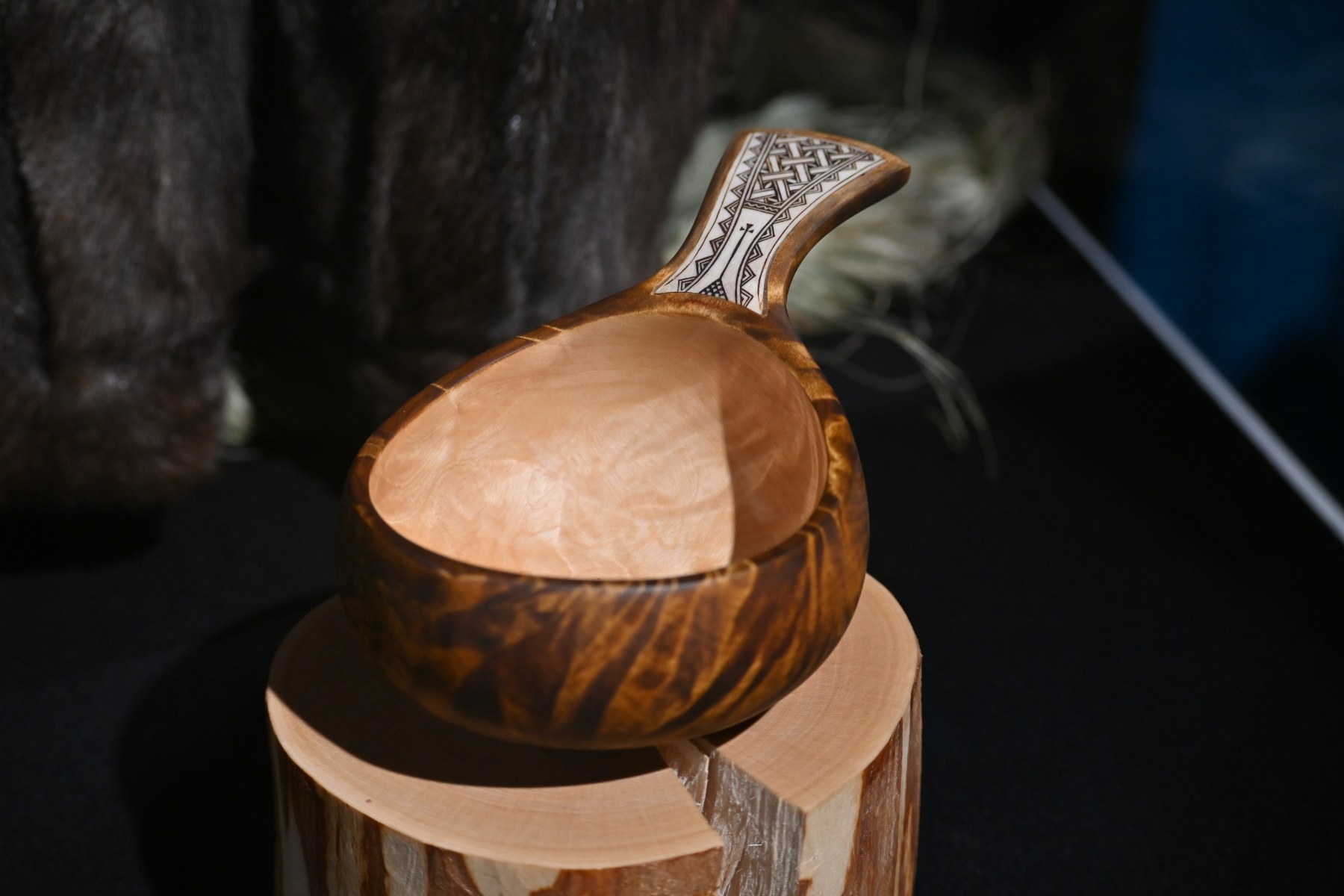
The plate at the top of this page is Johnson's. It is worth holding it beside the Faris piece above: a rosemaled green man, painted in a technique with a documented lineage, and a brooch made in collaboration with a bird. Both are in the same exhibition, under the same heading.
That overlap is worth noticing. In most museum contexts, the people in the vitrine and the people running the workshop are different populations separated by a century. Here they are the same people, on the same site, in the same year. Whatever else it is, that is a working definition of a tradition that has not stopped.

What else is coming
Sally Yerkovich of the American-Scandinavian Foundation will give a gallery talk, joined by several of the artists, at Vesterheim's Norwegian Christmas celebration on December 5. Further online and onsite programs are being announced as the run continues.
The exhibition closes on December 31. Details, opening hours and the current program are on Vesterheim's own exhibition page.
“Nordic Echoes” at Vesterheim is supported by a gift to the annual fund from Dr. James and Christine Tuve Burris. The exhibition is a program of the American-Scandinavian Foundation with support, in part, from the National Endowment for the Arts and from the ASF's Bonnier Family Fund for Contemporary Art, F. Donald Kenney Fund for the Visual Arts, and Centennial/Second Century Fund. Mid-America Arts Alliance / Exhibits USA is facilitating the Upper Midwest tour, which is supported by Margaret Cargill Philanthropies.
This piece was prepared from material submitted to The Northern Voices by Vesterheim. The exhibition dates, the count of works and artists, the list of participating instructors and the quotation from the chief curator are as supplied by the museum; the collection figures and the 1877 date are from Vesterheim's own published description. Readers planning a visit should confirm current hours directly with the museum. The Teresa Faris image and the cover plate were supplied by Vesterheim with the submission and are reproduced by permission; no photographer credit was provided with them, and the artist attributions follow the museum's own file names. Cover image: Jerry Johnson, Greenman (2024). Remaining photographs are credited in their captions.

)%20(1).avif)