A Small Language Can Also Be Stubborn and Dangerous

A conversation with Kristjan Haljak about EstLit, translation and the international life of Estonian literature
Estonian literature has long faced a problem familiar to smaller-language cultures. Within Estonian, it is active, varied and often difficult in the best sense; outside the language, much of that life appears only in fragments. Individual translations and festival appearances help, but they do not give international readers a regular place to return to.
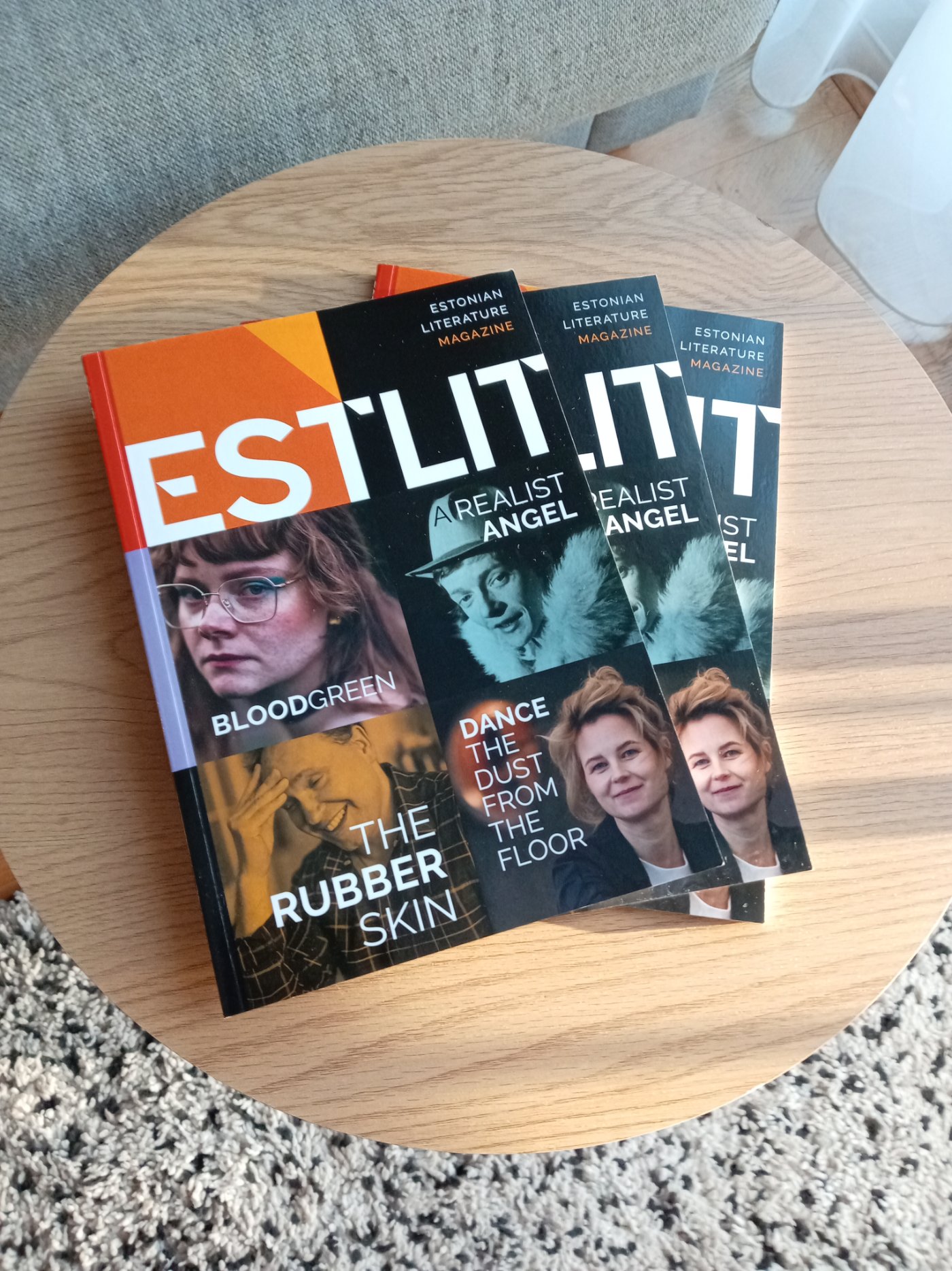
EstLit, or Estonian Literature, is one such place: a magazine published by the Estonian Literature Centre, which promotes Estonian writing abroad. The magazine appears twice a year: a spring issue online and an autumn issue both online and in print. The spring issue can reach readers quickly; the autumn issue gives the year’s work a physical form that can travel to book fairs, libraries and publishers’ offices.
EstLit also continues an earlier English-language tradition. When the Estonian Literary Magazine (ELM), published by the Estonian Institute, came to an end, the Estonian Literature Centre took up the work quite quickly, launching EstLit in 2025. The new magazine began with a slightly different editorial program, giving more room to the texts themselves and to the experience of reading them.
As the new autumn issue appears in print and online — with its public presentation at the Frankfurt Book Fair, October 6–9 — The Northern Voices spoke with editor-in-chief Kristjan Haljak about the magazine, its new number and the international life of Estonian writing.
On EstLit and Literary Visibility
What first made EstLit feel necessary as a publication? Why does an English-language platform matter specifically for Estonian literature?
The immediate background was practical. For many years, the Estonian Literary Magazine (ELM), published by the Estonian Institute, had given Estonian literature a regular English-language presence. When ELM ended, the Estonian Literature Centre took up the work quite quickly and began publishing EstLit, or Estonian Literature. The change was nevertheless real. EstLit could be shaped as a magazine with its own selection, tone and rhythm.
The larger reason is the language. About a million people can read Estonian. In a sense, they have access to a room that is closed to most of the world. That makes me think of an image by the Estonian surrealist poet Andres Ehin: a door standing alone in an open field. EstLit is something like that – an improbable entrance into that otherwise closed room.
For writers, this also matters. A poem, story or excerpt in English can reach agents, publishers, editors, critics and festival curators who may have some awareness of Estonian literature, but need concrete texts before any further conversation can begin.
What kind of literary or cultural gap is EstLit trying to respond to?
The first need is simple: a regular place for Estonian writing in English. The editorial need is to make that place more than a noticeboard.
Catalogs and author profiles have their role. EstLit gives more space to the works themselves: poems, prose, criticism, interviews and excerpts. The reader should meet the literature itself.
Estonia’s political position also matters. The country carries post-Soviet memory and lives next to an autocratic neighbor that has made history violently present again. That pressure is part of the context in which the literature now travels.
How would you describe EstLit to someone completely unfamiliar with Estonian literature?
It is a literary magazine in English. It publishes Estonian prose, poetry, essays, interviews and excerpts from longer works. That is the basic description, and I think it is the right one.
The first issues have shown an interest in darker and more experimental writing. That partly reflects my own background as a poet and scholar. Still, the program is broader than any single temperament. The aim is to bring forward strong writing and to let different Estonian voices stand next to one another.
The new autumn issue appears in print as well as online. What does the paper issue make possible?
EstLit has two issues a year: spring online, autumn online and on paper. The online issue gives the magazine reach. The paper issue gives the magazine a more stable presence. It can be handed over at a fair, mailed to a publisher or kept in a library.
The autumn issue also works as a curated object. The order of texts and images is easier to feel on paper, and the reader meets the issue as a whole rather than as separate links.
The new issue includes prose by Andrei Ivanov, Jüri Kolk, Aliis Aalmann, Mehis Heinsaar, Nikolai Baturin, Carolina Pihelgas and Kairi Look. The poetry section includes Juhan Viiding, Mirjam Parve and Maimu Berg.
The paper issue should not feel ceremonial. It is a working object, made to move around and be read.

On Translation and Literary Culture
How do you think about translation: as access, interpretation, literary creation, cultural diplomacy, or something else?
Translation is access and interpretation, of course. For EstLit, the literary result comes first.
A translation has to work as literature in English. If it only transfers information, it has not done enough. Rhythm, humor, awkwardness and deliberate ugliness also have to move.
Translators are part of the magazine’s authorship. EstLit has worked with translators such as Adam Cullen, Ian Gwin, Miriam McIlfatrick-Ksenofontov, Tiina Otema and others, whose work gives many readers their first real encounter with these texts in English. Our British copy editor Simon Smith has also been essential to the magazine’s English-language voice, helping to ensure clarity, consistency and stylistic precision across the issue.
At the same time, EstLit is not only a magazine of translations. Some Estonian authors also write directly in English: Triin Paja’s poems in the 2025 issue were an example, and the new autumn issue includes English-language prose by Andrei Ivanov. We have also tried to include foreign perspectives on Estonian literature. Maximilian Murmann and Sebastian Guggolz, for instance, have written for EstLit about Mati Unt’s Autumn Ball and Karl Ristikivi’s The Night of Souls. The autumn issue also includes a conversation with Guillaume Gibert and Aurélie Charron about the French edition of Nikolai Baturin’s The Heart of the Bear. These pieces matter because they show Estonian literature being read, translated and discussed within other literary contexts.
What makes Estonian literature difficult, or exciting, to carry into English?
The language itself is the first challenge. Estonian has its own rhythm, syntax and possibilities for compounds. English often needs other solutions.
Many texts also carry forms of local knowledge: historical layers, Soviet and post-Soviet experience, familiar literary references, rural and urban codes. A translation cannot explain all of this without killing the text.
The aim is to keep enough pressure. The English text should not become smoother than the original wants to be.
Are there particular writers or literary tendencies in the new issue that international readers should notice?
One way of reading the autumn issue is as a movement from intrauterine life and the first moments of being in the world towards death, with chaos and destruction already present in birth itself. Kairi Look’s prose is important here, with its attention to the strangeness of entering the world. Around it, the issue gathers very different kinds of pressure: Andrei Ivanov’s estrangement and dark comedy, Jüri Kolk’s linguistic sharpness, Aliis Aalmann’s bodily intensity and Mehis Heinsaar’s metaphysical story logic.
Nikolai Baturin gives the issue a larger, almost mythic scale, while Carolina Pihelgas works in a more inward register, with precise, atmospheric prose that can become genuinely unsettling. In poetry, Juhan Viiding stands as one of the central twentieth-century voices, and Mirjam Parve and Maimu Berg open different contemporary registers.
I do not want each issue to function only as a selection of names. Ideally, every issue of EstLit should feel like a composed whole, with the texts speaking to one another across their differences. In the autumn issue, this also takes the form of a thematic and almost metaphysical arc: a journey through different themes and registers, from intrauterine life and the first moments of being to death, chaos and destruction.
How do you avoid flattening the local specificity of Estonian literature while still making it internationally legible?
I think you have to trust the reader. You give enough context for entry, then let the text keep its local charge.
Introductions and translator notes help when they are precise. Over-explanation can make a text harmless. Some references should remain slightly foreign.
I try to be careful with ready-made frames such as ‘Nordic content’ or ‘post-Soviet material’. They may offer a point of entry. The work itself should extend beyond them.
On Readers and International Conversation
What kinds of readers do you imagine when editing EstLit?
I imagine several kinds of readers. There are translators, agents, publishers and editors looking for work that might travel further. There are also students and scholars who need access to Estonian writing in English. For The Northern Voices, the North American reader with an Estonian, Baltic or Nordic connection is especially relevant.
But I also imagine a reader with no prior connection to Estonia. Someone who simply wants strong writing from a place they may not know much about. EstLit should be able to meet that reader too.
Heritage can bring someone to the magazine. Literature has to make them stay.
How do you see Estonian literature relating to broader Baltic, Nordic or European literary conversations?
Estonian literature is often placed in several frames at once: Baltic, Nordic, European, post-Soviet. All of these make some sense, but none of them should become too comfortable.
Estonian literature is border literature in more than a geographical sense: different histories have passed through the language – German, Russian, Baltic, Nordic, Finno-Ugric and European. These traces do not form a clean identity. They create friction, and friction is usually good for literature.
The smallness of the language is real, but I would not make it sentimental. A small language can also be stubborn and dangerous.
What role can digital literary publications still play in a fragmented cultural environment?
Digital publication matters a great deal for smaller literatures. It lets texts move before a larger institution has decided to notice them. The danger is that everything online can become temporary. A magazine needs memory: an archive, a rhythm, a sense that someone is choosing and arranging the material.
Both EstLit issues are curated as complete wholes. The spring issue appears online, where it can circulate quickly and remain accessible as part of the archive. The autumn issue appears both online and on paper, which gives the same editorial work another kind of presence: it can be handed to someone, taken to a book fair or placed on a shelf.
For Readers in North America
Where can a reader in North America actually find EstLit?
For readers in North America, the easiest way at the moment is online. The full magazine is freely available on our website. We also hope to get print copies to Estonian diplomatic representations in North America. Unfortunately, there is no direct ordering option for individual copies yet, but if that changes, we will announce it on our website and social media.
For someone who finishes the issue and wants more, which three or four Estonian books already available in English would you point them to next?
I would certainly recommend A. H. Tammsaare’s Truth and Justice. Four volumes are now available in the new English edition, and the fifth is on its way. Jaan Kross’s The Czar’s Madman is another obvious choice, if you haven’t read it already.
For poetry, I would suggest Jaan Kaplinski’s Selected Poems and Doris Kareva’s Days of Grace.
Many of our readers are second- or third-generation Estonians who read a little Estonian. Does EstLit ever publish originals alongside translations, and would you want to?
Not regularly at the moment. EstLit is primarily an English-language magazine, so in print we usually publish just the translation. But I can certainly see the value of having the original alongside it, particularly with poetry. It is something we could do more often online.
Are you open to hearing from translators or writers in North America, including those of Estonian heritage writing in English?
Absolutely. We already work with Tiina Otema, a translator based in Toronto, whose translations also appear in the latest issue. I would be very happy to hear from other translators and writers in North America, including writers of Estonian heritage who write in English. The easiest way is simply to write to me directly at kristjan.haljak@estlit.ee.

Why Literature Matters
What would success look like for EstLit five years from now?
I would like EstLit to be a trusted place for reading Estonian literature in English: regular, useful and alive. But real success would mean that it is also read as a good English-language literary magazine in its own right, not only as a channel for information about one national literature.
Success would mean that texts published or excerpted in EstLit lead to further translations, reviews, invitations, teaching opportunities and new contacts. It would also mean that translators are more visible, and that the magazine has a recognizable editorial voice.
I would be happy if someone could say: I began with EstLit and then entered Estonian literature more deeply. But I would be just as happy if someone first came simply because they found a strong poem, story or essay there.
What continues to make literature feel culturally necessary to you personally?
For me, literature has an existential and almost metaphysical importance. It is strange when you think about it: black marks on a screen or on paper begin to produce emotions, images, memories, fears, desires, whole inner weather systems. In that sense literature is a magical phenomenon, and perhaps even a psychedelic one. It considerably widens the room inside the reader – and, hopefully, it can have a similar psychoactive effect on society as a whole.
Writing, reading and translating all mean entering a labyrinth of language and trying to find a path through it. Literature helps the psyche discover its own forms. That is what makes it necessary to me: it opens places in language and consciousness that would otherwise remain closed. Its value extends beyond any narrow sense of usefulness.
The autumn 2026 issue of EstLit is free to read online at estonianliterature.ee. Kristjan Haljak is a poet and scholar, editor-in-chief of EstLit, and teaches at Tallinn University. Portraits: Dirk Skiba.

)%20(1).avif)