The Man Who Argued Estonia Was Nordic Grew Up in New Jersey

On 14 December 1999, at the Swedish Institute of International Affairs in Stockholm, Estonia's foreign minister gave a speech called “Estonia as a Nordic Country.” It is the founding document of a national argument that has now run for twenty-seven years, and almost everything most people think they know about it is slightly wrong.
It is routinely attributed to President Lennart Meri. It was not his. The speaker was Toomas Hendrik Ilves, then foreign minister, who would not become president for another seven years. It is routinely placed in Helsinki. It was Stockholm.
And the word “Nordic” is not really the point of it. Ilves invents his own category instead — Yuleland, “the area where one and the same word signifies both the birth of Christ as well as the solstice” — and he draws its borders from “Iceland and Britain through the Scandinavians to the Finnic lands that include Estonia.” Britain is inside it. He was not applying to join an existing club. He was proposing a new one, with different walls, and with Estonia already inside.
That distinction matters, because everything that has happened since turns on it.
What the speech actually says
It opens with Kundera. “Where a country lies is a subjective decision and only in part a product of its own desire. Much if not most is determined by what others believe about it… Prague is 300 kilometers to the West of Vienna. Yet Prague was East, Vienna West.”
What follows is not, for the most part, an argument about heritage. Well over half of it is a catalogue of Western condescension toward post-communist applicants, delivered by a man who was plainly furious. The sharpest moment is an ambassador at the Council of Europe, dismissing an Estonian question about why certain rules applied only to formerly communist states by saying that the rules “do not apply to real countries.” Ilves's comment: “We should applaud his honesty.”
He is equally blunt about the word he wants to escape. The people who first called themselves Balts in the region, he points out, were the Germans: “Neither Estonians nor Latvians were Balts, but Germans.” And then: “There is no Baltic identity with a common culture, language group, religious tradition.” He concedes Lithuania's separate case — “Lithuania has been correctly pointing out that it is a Central European country” — and asks that the three be treated as three.
The load-bearing analogy is Finland. “Today, no one thinks of Finland as a Baltic country, but as a self-evident member of Yule-land.” The claim is not that Estonia has always been Nordic. It is that categories move, that Finland's did, and that Estonia's can.
The date is the argument
The speech is usually read as an identity claim. Read the calendar instead.
Estonia had been in the EU's “Luxembourg group” since December 1997 — the six states invited to open accession negotiations first, which began in March 1998. Latvia and Lithuania were not among them. Then, at the Helsinki European Council in December 1999, the second wave was invited, and Estonia's two-year head start over its neighbours vanished.
Ilves is speaking in the same month. His own line: “The countries that chose a less dramatic reform course are the ones who did not get invited to the first round of EU negotiations.” And, on the EU generally: “We Estonians will do what is necessary to join the European Union. No matter how arbitrary…”
This was not a meditation on ancestry. It was an attempt to get out of a category that was being used to set the terms of entry — delivered at the precise moment the category had reasserted itself.
There is no door
Here is the fact that resolves the whole question, and it is almost never reported.
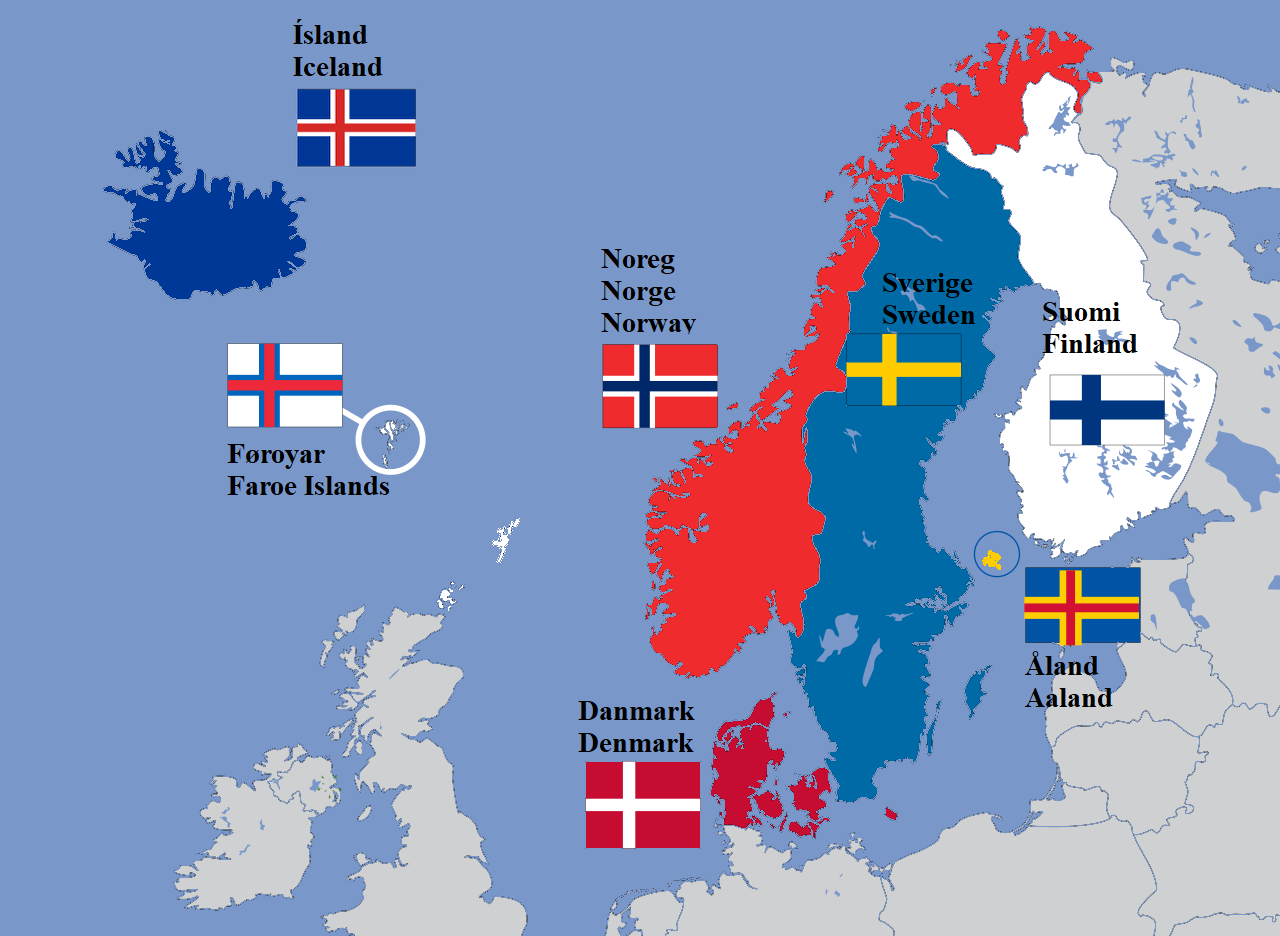
The Nordic Council rests on the Helsinki Treaty of 1962. The treaty has five contracting parties. It contains no accession clause. There is no procedure by which any state, on any evidence, could ever join.
Estonia has not been rejected. Estonia has not failed a test. There is no test, because the category was closed by drafting sixty-four years ago and nobody has reopened it.
The corollary is sharper still. Under Article 47, the Faroe Islands, Greenland and Åland — none of them sovereign states — hold guaranteed seats. A self-governing archipelago of 30,000 people has a place at the table. A sovereign EU and NATO member of 1.3 million does not, and cannot acquire one.
The evidence, both ways
On one side, the integration is real and it is not sentimental. Some 7.3 million passengers crossed between Tallinn and Helsinki in 2025 alone. Finland and Sweden together account for roughly 30 percent of foreign direct investment into Estonia — far short of the three-quarters that circulates online, but still the largest single bloc by a distance. Estonia has been a full, equal-voting member and owner of the Nordic Investment Bank since 1 January 2005, which is a real Nordic institution with real money in it, and not the sort of place a branding exercise gets admitted to.
On the other side, the numbers are unkind.
Social protection spending in 2023: Estonia 17.3 percent of GDP; Finland 31.8; Denmark 29.3. Estonia sits with Latvia (17.9) and Lithuania (17.0), about ten points below the EU average. Trade union density in 2018: Estonia 4.3 percent; Iceland 91.8; Sweden 68.0; Denmark 66.5; Finland 60.3. Estonia is the lowest in the Nordic-Baltic Eight — below Latvia and below Lithuania. GDP per capita, 2024, indexed to EU=100: Estonia 79; Finland 102; Sweden 112; Denmark 127; Norway 166.
And the religious claim, which gets repeated most confidently, is the one that collapses hardest. Estonia is frequently described as Lutheran like the Nordics. In the 2021 census, the largest religious body in Estonia is Orthodox at 16 percent — double the Lutheran 8 percent, which has fallen from 14 percent in 2000. Fifty-eight percent report no affiliation at all.
The scholar's verdict, and the better counter-argument
Mart Kuldkepp, a professor of Estonian and Nordic history, asked the question directly in Estonian, for Estonians, and answered no. Not out of political mistrust, which he thinks has largely dissolved, but because of a mismatch of centuries: for present-day Nordics, he argues, Nordicism means a specific social model and its associated values of equality and solidarity, derived from post-war prosperity and extensive reform — while Estonian Nordic identity remains, in his reading, stuck in nineteenth-century romantic nationalism. The claimant and the club are describing two different things and using one word.
But there is a sharper version, and it comes from inside the Nordic academy. Johan Strang at the University of Helsinki argues that the Nordic brand has quietly replaced the Nordic welfare state as the thing under discussion — that politicians, researchers and media “rarely discuss the welfare state or the welfare society,” but talk instead about “the Nordic brand.” His worry is that this recasts a set of hard political choices made in the 1930s as something closer to a cultural inheritance.
Applied here, it cuts both ways at once. If Strang is right, Estonia is bidding for a label that its own proprietors have hollowed out. And Estonia's bid is itself evidence for his thesis: 4.3 percent union density is no obstacle, because the brand no longer tests for it.
The most honest statement of the case, in the end, comes from someone arguing for it. Writing in Estonian World in 2016, Adam Garrie made the point that shaking the “Eastern European” label would be politically useful and that, quite simply, “the Nordic brand name sells better.” He described the whole exercise as political strategy and salesmanship, approvingly.
Which is the giveaway. No Norwegian has ever had to argue that Norway is Nordic.
The other two, and the idea Lithuania got there first
Latvia and Lithuania make no Nordic claim at all, and they are not visibly resentful of Estonia's. Lithuania's foreign ministry describes the Nordic-Baltic Eight as an informal format of equal partners and consistently distinguishes “three Baltic States” from “five Nordic countries.” Latvia's equivalent page is titled “Co-operation among the Baltic and Nordic countries” — Baltic first, where Estonia and the joint statements put Nordic first. It is a small thing, and it is a real one. The NB8 leaders' statement of June 2026 still reads “Nordic-Baltic” throughout: a hyphen, twenty-seven years on.
The buried irony is that the most sustained attempt to fuse the two regions was Lithuanian. The concept of Baltoscandia was coined in 1928 by the Swedish geographer Sten De Geer, who ran nine indicators of regional homogeneity and produced a region consisting of the Nordic countries plus Estonia and Latvia — with Lithuania qualifying only on the physical measures. It was the Lithuanian geographer Kazys Pakštas who took the idea up and spent years arguing his own country into it, travelling to Scandinavia in 1934 and winning a Swedish geographical medal for his trouble. The Soviet occupation ended the project. An Academy of Baltoscandia then operated in Panevėžys from November 1991 until it closed in 2009 for want of municipal funding — eighteen years of institutional work, while Estonia was giving speeches.
Where an Estonian-American actually sits
For readers in North America, the question stops being abstract, because the institutions have already answered it — comprehensively, and in the other direction.
The National Nordic Museum in Seattle defines its scope as Denmark, Finland, Iceland, Norway, Sweden, the Faroe Islands, Greenland, Åland and the cultural region of Sápmi. Note that this scope has expanded over the years, to take in three autonomous territories and a transnational Indigenous region. It has never reached Estonia.
The American-Scandinavian Foundation, founded in New York in 1910, commits itself to exchange between the United States and “the Nordic countries—Denmark, Finland, Iceland, Norway, and Sweden.” Five, closed. The American Scandinavian Association in Washington lists exactly five Nordic embassies on its site; the Estonian embassy, a few streets away, is not one of them. Norsk Høstfest in Minot, the largest Scandinavian festival on the continent, makes no reference to Estonia anywhere.
Now the other column. JBANC, the Joint Baltic American National Committee, was established in 1961 and is sponsored by exactly three parent organisations, of which the Estonian American National Council — founded 19 July 1952 — is one, with equal standing. The Estonian American National Council's own listed partners are the Baltic American Freedom League, the Central and East European Coalition and JBANC. Not one Nordic body. And the CEEC groups Estonians with Armenians, Belarusians, Georgians, Poles, Ukrainians and eight others. In Canada the arrangement is identical and older: the Baltic Federation in Canada, founded in 1949, unites the Estonian, Latvian and Lithuanian central councils.
So the institutional answer is not close. An Estonian-American is placed in the Baltic world by default, completely, and has been since before Ilves was born.
With one exception, and it is a good one.
ScanFest, the Scandinavian festival held each Labor Day Sunday at Vasa Park in Budd Lake, New Jersey, lists its countries as “Norway, Sweden, Finland, Denmark, Iceland, Estonia.” Six flags. It is run by a volunteer-staffed New Jersey non-profit on a county fairground, and it has done what the Helsinki Treaty, the Nordic Council, the National Nordic Museum and the American-Scandinavian Foundation have not.
Toomas Hendrik Ilves was born in Stockholm to Estonian refugee parents, moved to the United States as a small child, and grew up in Leonia, New Jersey, where he was valedictorian of the high school in 1972. Budd Lake is an hour's drive away. There is no evidence whatsoever that the two facts are connected, and it would be a better story if there were.
But it is still the shape of the thing. The man who wrote the case for a Nordic Estonia was formed inside the Baltic-American world, in a New Jersey suburb, and the only institution on this continent that has ever taken him at his word is a volunteer festival forty minutes down the road from where he went to school.
Quotations from the 1999 speech are taken from the text published by the Estonian Ministry of Foreign Affairs, which appears to be an unproofed transcript and contains several typographical errors; anyone quoting it at length should check against the original. Comparative figures are from Eurostat, the OECD and Statistics Estonia as cited; the widely repeated claim that three-quarters of Estonian FDI comes from the Nordic countries does not match Estonia's own current investment data and is not used here.

