Valev Laube: The Night Came Back, and I Had Forgotten What It Was For
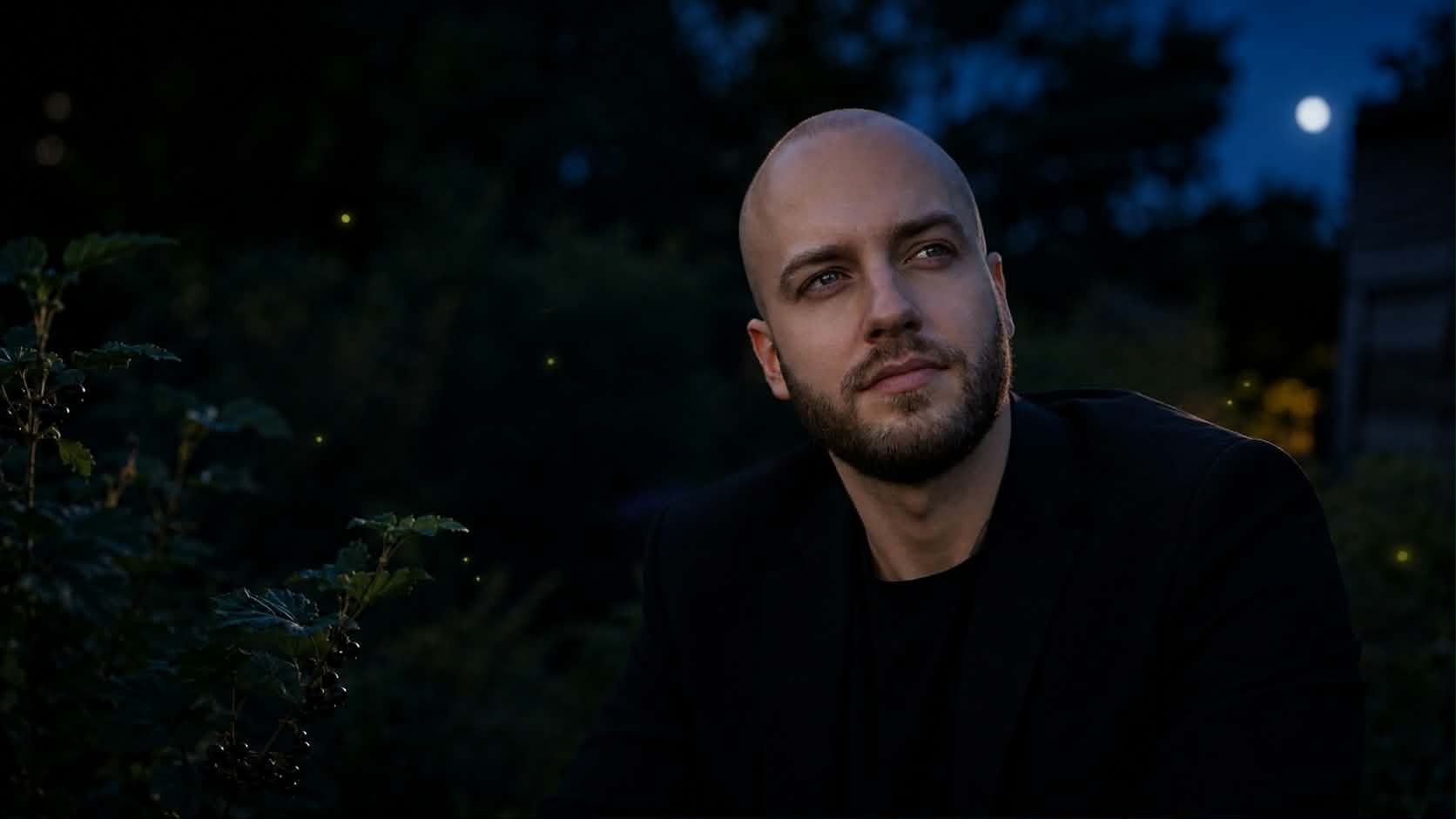
The dark came back last week.
Not gradually, the way the calendar suggests, but as an event. I walked outside at eleven in the evening in Estonia and could not see the far edge of the garden. I stood there for a while trying to work out what had changed, and then understood that nothing had changed except that it was, finally, night.
For about ten weeks it had not really been night here. In June the sun sets in Tallinn and then loiters just below the horizon, keeping the sky a bruised pale blue until it comes up again. The Estonian word for it is valged ööd, white nights. Finns and Swedes and Norwegians know the same thing further north, in stronger form. You stop needing lamps. You lose track of when to go to bed. Children negotiate ferociously and win.
Then in the middle of August the darkness returns, and it always feels like an arrival rather than a departure.
This year it came with a small piece of theatre. The Perseid meteor shower peaks around the twelfth of August every year, and every year in this part of the world we mostly miss it, because in early August the sky is still too bright at the hour the meteors are best. The first genuinely dark nights and the tail of the Perseids overlap by a few days. You get a narrow window in which the sky is both dark enough to show you something and still busy enough to have something to show.
I lay on the grass and watched for a while and saw four.
And then, being the sort of person who cannot leave a pleasant experience alone, I went and read about darkness, and found that we have spent a century treating it as a problem to be solved and are now, belatedly, discovering that it was a resource we were spending.
What We Removed
Artificial light is one of the most successful technologies ever deployed. It extended the working day, made cities navigable, reduced accidents, and untethered human activity from the rotation of the planet. Nobody sensible wants it undone.
But the deployment was not careful. Most outdoor lighting is not aimed. It spills upward and sideways, illuminating the sky and the neighbor's bedroom along with the intended pavement. The switch to LEDs, which was sold as an environmental good and genuinely reduced energy use per lamp, had an awkward second-order effect: because light became cheap, we installed a great deal more of it, and much of it emits strongly in the blue part of the spectrum, which scatters more in the atmosphere and is the part the human circadian system is most sensitive to. As someone living with chronic anxiety this impact me more than some.
The result is that the night sky over inhabited regions has been getting measurably brighter for decades. Researchers now describe artificial light at night as a pollutant in the ordinary sense — something released into a shared environment, at scale, with effects on the organisms in it.
What I find most striking in this literature is a finding from social science rather than physics: people who live under heavily light-polluted skies have more difficulty recognizing light pollution as pollution at all. If you have never seen the Milky Way, its absence is not a loss. It is simply what the sky looks like.
You cannot miss what you have no memory of.
The Body Keeps Its Own Clock
Nearly every organism on this planet evolved under a reliable twenty-four-hour cycle of light and dark. That cycle is not merely a schedule we follow; it is a signal our physiology is built to read. In humans, specialized receptors in the eye — separate from the ones we see with — detect light and use it to set the internal clock. Darkness triggers the release of melatonin, which does considerably more than make you sleepy: it participates in the timing of a wide range of biological processes.
Light at the wrong time suppresses it. Not dramatic light. Ordinary evening light.
The consequences for other species are starker, because they cannot draw the curtains. Migrating birds navigate by the sky and are pulled off course and into buildings. Newly hatched sea turtles move toward the brightest horizon, which used to be the ocean. Insects, whose collapse in numbers is one of the more alarming stories of the last decade, are drawn to lights and exhausted at them. Recent work suggests artificial light may be interfering with insect hibernation cycles and even with how ecosystems cycle carbon, by extending the hours in which plants and soil respire.
We did not decide to do any of this. We decided to be able to see at night, and this came along with it.
Darkness as Something Rather Than Nothing
What interests me philosophically is the grammatical position we have assigned to darkness.
We treat it as an absence. Dark is what you get when light is missing, the way silence is what you get when sound stops, the way rest is what you get when work stops. In each case the positive term is the activity and the other term is defined by subtraction.
This is convenient and, in my opinion, misleading.
Darkness is not the absence of a signal. It is itself a signal, and organisms read it. The night is not the day with something removed; it is a distinct environment with its own inhabitants, its own chemistry and its own function. Roughly half the species on Earth are nocturnal. For them, our correction of the darkness is not an improvement to their working conditions. It is the destruction of their habitat.
Once you notice these pattern you find it everywhere in how we organise modern life.
Joking I myself tend to say that I'm a "night owl" and get the most inspired by life at night but there might be some scientific proof to that, even though we use the term jokingly.
Rest is treated as the absence of productivity, which is why it must be justified — framed as recovery, as an input to future output, as something you have earned. Boredom is treated as the absence of stimulation, and has been almost entirely eliminated from ordinary life by the device in your pocket. Solitude is treated as the absence of company. Silence in a conversation is treated as a failure of the conversation, which is why so many people rush to fill it. Unavailability is treated as the absence of responsiveness, which is why not replying for a day now requires an explanation.
In every case we have taken something with its own positive function and defined it as a deficiency, and then, quite logically, set about fixing it.
We have lit up the night. We have filled the silence. We have made everyone reachable at all hours. Each of these was, locally, an obvious improvement.
And each of them removed a condition that turns out to be load-bearing.
The Northern Case
People here have a specific relationship with this, and it is not the one usually described in travel writing.
The romantic version is that Nordic and Baltic people love darkness — the candles, the hygge, the cozy interior against the black outside. There is something in that, but it flattens the actual experience, which is much more ambivalent. The winter here is genuinely hard. By December in Tallinn the sun rises after nine and is gone before four, and the effect on mood and energy is real and well documented and not charming. Nobody who has lived through a Baltic January romanticizes the dark.
What people here do have is a working relationship with it. There is an assumption, built into the year, that the conditions of life change substantially and that you change with them. Summer is for being outside until two in the morning. Winter is for being inside, going slowly, and not expecting the same output from yourself. The sauna, the long lunch in the dark, the acceptance that January is not the month for launching things.
This is not wisdom, particularly. It is what you learn when the environment refuses to be constant and you have no ability to override it.
The rest of the world has spent a century acquiring the ability to override it — climate control, artificial light, global connectivity, the twenty-four-hour supply chain — and has used that ability to hold the conditions of life constant. The same output in December as in June. The same availability at midnight as at noon. The same brightness at three in the morning as at three in the afternoon.
We have made the environment stop varying.
And then we wonder why we feel like machinery that has not been switched off.
What the Dark Is For
I do not want to overclaim here. Reading a few papers about melatonin does not make me qualified to tell anyone how to live, and there is a genre of writing that takes a modest scientific finding and inflates it into a philosophy of everything. I have no interest in producing more of it.
But I keep returning to one specific thing.
The reason the Perseids matter is not that meteors are inherently significant. Small pieces of a comet are burning up in the atmosphere whether or not anyone is watching. The reason it matters is that seeing them requires a set of conditions — real darkness, a clear sky, an hour with nothing else in it, and a body lying still on cold ground looking up.
Those conditions have to be available.
You cannot decide to see a meteor. You can only put yourself somewhere dark and wait, and accept that you may see four, or none, and that the waiting is most of it.
Almost everything worth having has this structure. You cannot decide to have an idea. You can only create conditions in which one might arrive — usually conditions involving boredom, walking, or a shower, which is to say conditions in which you are unreachable and doing nothing. You cannot decide to sleep. You can only stop doing the things that prevent it. You cannot decide to be close to someone. You can create the silence in which they might say the thing they have been not saying.
These are all dark conditions. Not metaphorically — structurally. They are states defined by the absence of input, which is precisely why they are the first things eliminated when we optimise a life for input.
The lesson of light pollution is that you can destroy something valuable without ever deciding to, simply by adding more of a good thing without noticing what it displaces. Nobody set out to abolish the Milky Way. They set out to light a car park.
Eleven O'Clock
The nights will get longer now, quickly. By late September we will be past the equinox and heading toward the winter I just described as genuinely hard, which it is, and which I will complain about like everyone else.
But for these few weeks in late August there is a version of the dark that is unambiguously a gift. Warm enough to lie on the grass. Long enough to see something. Not yet long enough to be oppressive.
It is the part of the year when the dark is at its most obviously useful, and I suspect that is why it makes such an impression — because for a short window we get to experience darkness as an addition rather than a subtraction.
Something came back. The sky acquired depth it had not had since May. There were, briefly, four meteors in it.
None of that would have been visible in a brighter world, and none of it would have been visible to a person with something more productive to do.
I have been thinking since then about what else in my life I have been treating as an absence.
The unanswered messages. The evening with nothing scheduled. The long silence in a conversation that I usually rush to fill. The month when nothing was produced.
Maybe those are not gaps in the work.
Maybe they are the conditions under which anything gets seen at all.
-
Selected reading
DarkSky International, Artificial Light at Night: State of the Science (2026 edition).
Fabio Falchi et al., “The New World Atlas of Artificial Night Sky Brightness,” Science Advances 2, 2016.
Kevin J. Gaston et al., “The Ecological Impacts of Nighttime Light Pollution: A Mechanistic Appraisal,” Biological Reviews 88, 2013.
Christopher C. M. Kyba et al., “Citizen Scientists Report Global Rapid Reductions in the Visibility of Stars from 2011 to 2022,” Science 379, 2023.
Paul Bogard, The End of Night: Searching for Natural Darkness in an Age of Artificial Light (Little, Brown, 2013).

.jpg)