A School Forbidden by Law to Give You a Grade
There is a category of Danish school that is forbidden by law from giving you a grade.
Not discouraged. Forbidden. The Folk High School Act — consolidated act number 280 of 25 March 2019 — states at section 15 that these schools må ikke afholde prøver og eksamener: may not hold tests or examinations. Section 1 sets out what they exist for instead, in three words that survive translation badly: livsoplysning, folkelig oplysning og demokratisk dannelse — enlightenment for life, popular enlightenment, and formation for democracy.
There are 71 of them. You can be seventeen or seventy. There are no entrance requirements and no qualifications at the end. You live there.
This is the most successful educational idea the Nordic world has exported, and it has been exported for a hundred and fifty years, and the question of whether it survived the crossing to North America has a stranger answer than either yes or no.
What Grundtvig actually wanted, and did not get
The idea is attributed to N.F.S. Grundtvig (1783–1872), and the attribution is loose in every particular.
He did not publish a single proposal. He argued the case across a cluster of writings between roughly 1836 and 1840 — The Danish Cloverleaf, an address to the Norwegians, and above all the 1838 tract on a “school for life” at Sorø. The contrast he was drawing was with the Latin schools of his day, which he considered dead: places that trained young men to handle a classical language nobody spoke rather than to think in the one they lived in.
And what he actually proposed was a royal academy at Sorø — a state institution, funded from above. It was never built. The liberal government abandoned the plan after 1849.
The first folk high school opened at Rødding in 1844, founded by Christian Flor — not, as a surprising number of English-language sources say, by Christen Kold, who opened his own at Ryslinge in 1851 and whose model is the one that actually spread. Kold's version was smaller, poorer, less institutional and built around a charismatic principal living alongside his students. It worked.
So the movement that bears Grundtvig's name was built from below, on somebody else's pattern, against the design he proposed, at schools he did not found. He was its theorist, and its theorist lost the architectural argument.
One more correction, because it recurs in almost everything written about Denmark in English. The slogan “what is lost without shall be won within” — Hvad udad tabes, skal indad vindes — is routinely credited to Enrico Dalgas and the reclamation of the Jutland heath after the 1864 defeat. It is by the poet H.P. Holst, written in 1872 for a medal at a Nordic industry and art exhibition. It has nothing to do with heathland, and nothing to do with schools. The Danish national history encyclopaedia's verdict on the Dalgas attribution is three words long: it is not true.
Twelve students in an Iowa winter
Danish immigrants began building these schools in America almost immediately. The first was at Elk Horn, Iowa, in 1878.
A county history published in 1918 preserves the details, and they are humbling. Winter 1880–81: twelve students. Summer 1881: about twelve women. Winter 1881–82: thirty. Kristian Østergaard taught for twenty dollars a month with room and board. The curriculum was “lectures and the common life of students and teachers.” And the line that tells you the transplant was real: “Textbooks saw little use and there were no exams.”
Five more followed. Ashland, in Grant, Michigan, in 1882 — founded by a pastor who had left Elk Horn and taken Østergaard with him. Nysted, Nebraska, 1888. Danebod, at Tyler, Minnesota, 1888, three years after the colony itself. Atterdag, at Solvang, California, 1911. And schools at West Denmark, Wisconsin, and in Alberta whose records I could not verify.
Each of them died differently, and the differences are the story.
Nysted simply ran out of students and closed in 1937. The buildings are still there.
Atterdag was founded by three Danish immigrants partly as a device to attract fellow countrymen to a new settlement — a school as a land-sales instrument — and served as meeting hall, church, theatre, gymnasium and boarding house. It closed in 1952 and was demolished for termite damage. Solvang, meanwhile, became one of the most successful themed tourist towns in California. The school died; the half-timbering lived.
Ashland has the strangest afterlife. It closed in the anti-immigrant climate after the First World War, then reopened in 1928 under a new director who deliberately de-ethnicised it — no longer a Danish school but an American one, open to anyone interested in progressive education. Under Chester Graham it went further, into cooperative economics and social justice, drawing farmer unions and cooperative leagues. In 1938 it was condemned under the fire code. The research on this is careful: the board's decision to move preceded the formal condemnation, and Graham's politics had already generated enough local hostility to explain the inspection campaign. It became Circle Pines Center, a cooperative camp, which is what it still is.
A Danish folk school in Michigan, de-ethnicised, radicalised, and closed by a fire marshal. That is the American folk school story compressed into one building.
The escalator
The other route out was upward, and it was more common.
Grand View in Des Moines was the Grundtvigian faction's institution, founded in 1896. Watch the credentialing escalator operate, one step at a time: a high school academy department added in 1912; junior college instruction from 1924; Grand View Junior College until 1975; Grand View College with baccalaureate programmes from 1975; Grand View University in 2008, with graduate degrees. It has around 1,900 students and it is a perfectly good institution. It is also, in exam terms, the precise opposite of the thing its founders set out to build.
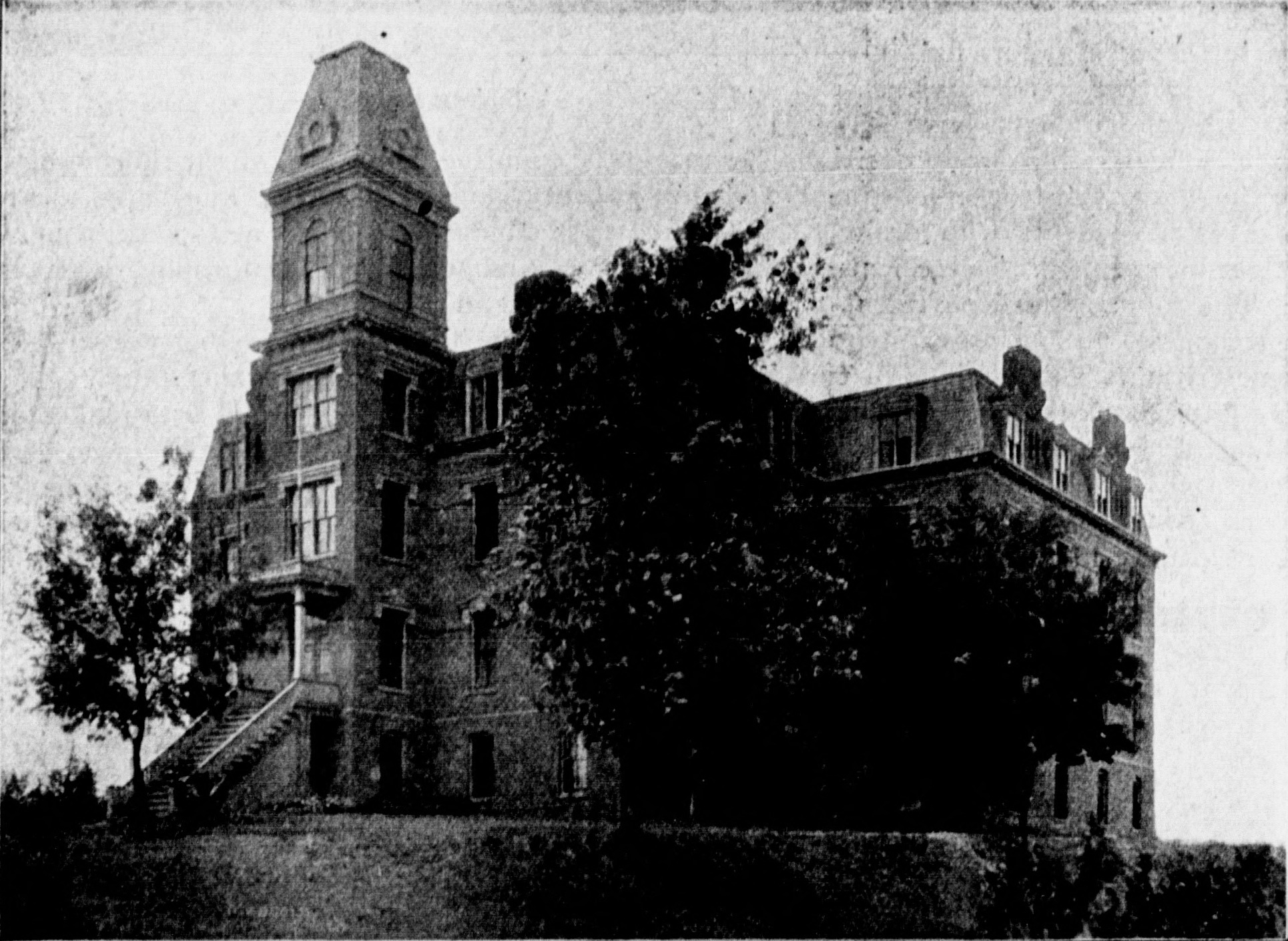
Dana College in Blair, Nebraska belonged to the other faction — the Inner Mission pietists, the “Sad Danes,” against the Grundtvigian “Happy Danes” of Des Moines and Tyler. It was founded in 1896 out of a merger with Trinity Seminary, and one of its first presidents was Kristian Anker, the same man who had run the Elk Horn folk school in 1882–83.
Dana closed in 2010, with about six hundred students and deficits that had climbed from $7.17m in 2005 to over $12.55m in 2009. The proximate cause is the detail worth keeping. A private equity purchase would have converted Dana to a for-profit institution, and the accreditation committee refused to transfer the accreditation to the new owners. The college could not be sold, so it closed.
Set that next to the Danish statute forbidding examinations, and the century between them stops feeling like drift and starts feeling like a verdict.
Why it failed, stated by someone who studied it
Jindra Kulich, the leading Anglophone scholar of Nordic adult education, was blunt in 1988. The North American folk schools, he wrote, “all failed within a few years, as they were destined to fail in the two societies based on assimilation (in the U.S.A.) and acculturation (in Canada) of immigrants.” Transplanting them, in his word, was foolhardy.
There is a structural point underneath that, and it is worth naming because it is usually missed. The folk schools were never the institution of “Danish America.” They belonged to one faction of one immigrant church. The Blair pietists built a seminary and a college instead, and thought the Grundtvigians frivolous. A movement that was a minority position inside a minority denomination inside a small immigrant group had roughly the odds you would expect.
What crossed over instead
And yet the idea did cross. It simply arrived in other people's luggage.
Myles Horton visited Denmark in 1931 and founded the Highlander Folk School in Tennessee in 1932, bringing back peer learning, group singing, freedom from state regulation and an education that trained nobody for a job. Highlander became one of the most consequential institutions of the American labour and civil rights movements. Rosa Parks attended a two-week desegregation workshop there in August 1955, four months before she refused to move; Septima Clark led it, Virginia Durr found her the scholarship, and her handwritten notes survive.
Since the story is nearly always told wrong: “We Shall Overcome” was not written at Highlander. It descends from Charles Tindley's hymn of 1903, and the change from “I” to “We” was made by Lucille Simmons on a Charleston picket line in 1945–46. Zilphia Horton carried it to Highlander; Pete Seeger changed “will” to “shall”; Guy Carawan took it to SNCC in 1960. Highlander transmitted and amplified it. Leaving Simmons out is the commonest version and the least excusable.
The John C. Campbell Folk School in North Carolina, founded in 1925 after its founders went to Denmark, still says on its own website that “there are no credits, no grades, no pitting of one individual against another,” and still calls its method “The Living Word” — Grundtvig's phrase, intact, a century and an ocean away. It also teaches more than sixty crafts. Stubblefield's assessment is that it survived by becoming a mountain handicraft centre, and that is fair: what endured was the pedagogy, attached to a different curriculum.
That is the pattern across the American revival generally. North House in Grand Marais, the Finnish American Folk School in Hancock, the dozens of others: the no-grades residential week survived, and Grundtvig's civic formation quietly became woodworking and blacksmithing. Whether that is a translation or a hollowing-out is the honest argument to have.
One footnote with a nice symmetry: the Finnish American Folk School, founded in Hancock in 2017, outlived Finlandia University, which closed in 2023. A century after the Danish folk schools turned themselves into colleges and the colleges then failed, a folk school outlasted the university it sat beside.
The week in August
So what survived the transplant, in unbroken form?
Not a school. A week.
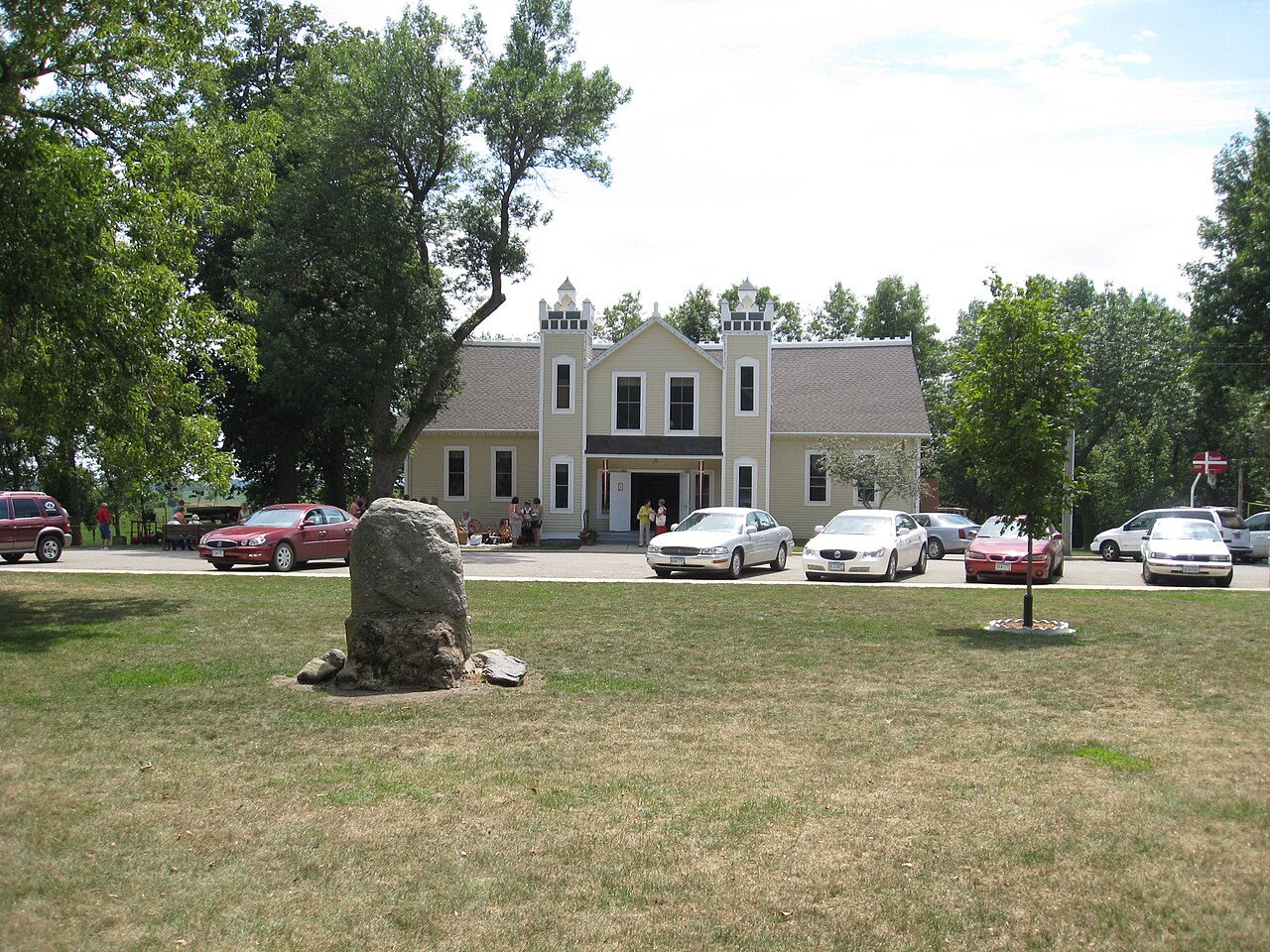
The Danebod Folk Meeting in Tyler, Minnesota held its eightieth consecutive annual gathering from 19 to 23 August 2026, and it was fully booked. It describes itself as a folk school experience affirming the joy of living — enlightenment, fellowship, song and dance, faith and worship, in a Danish-American tradition. A separate Danebod Family Camp already has dates in the calendar for 2027.
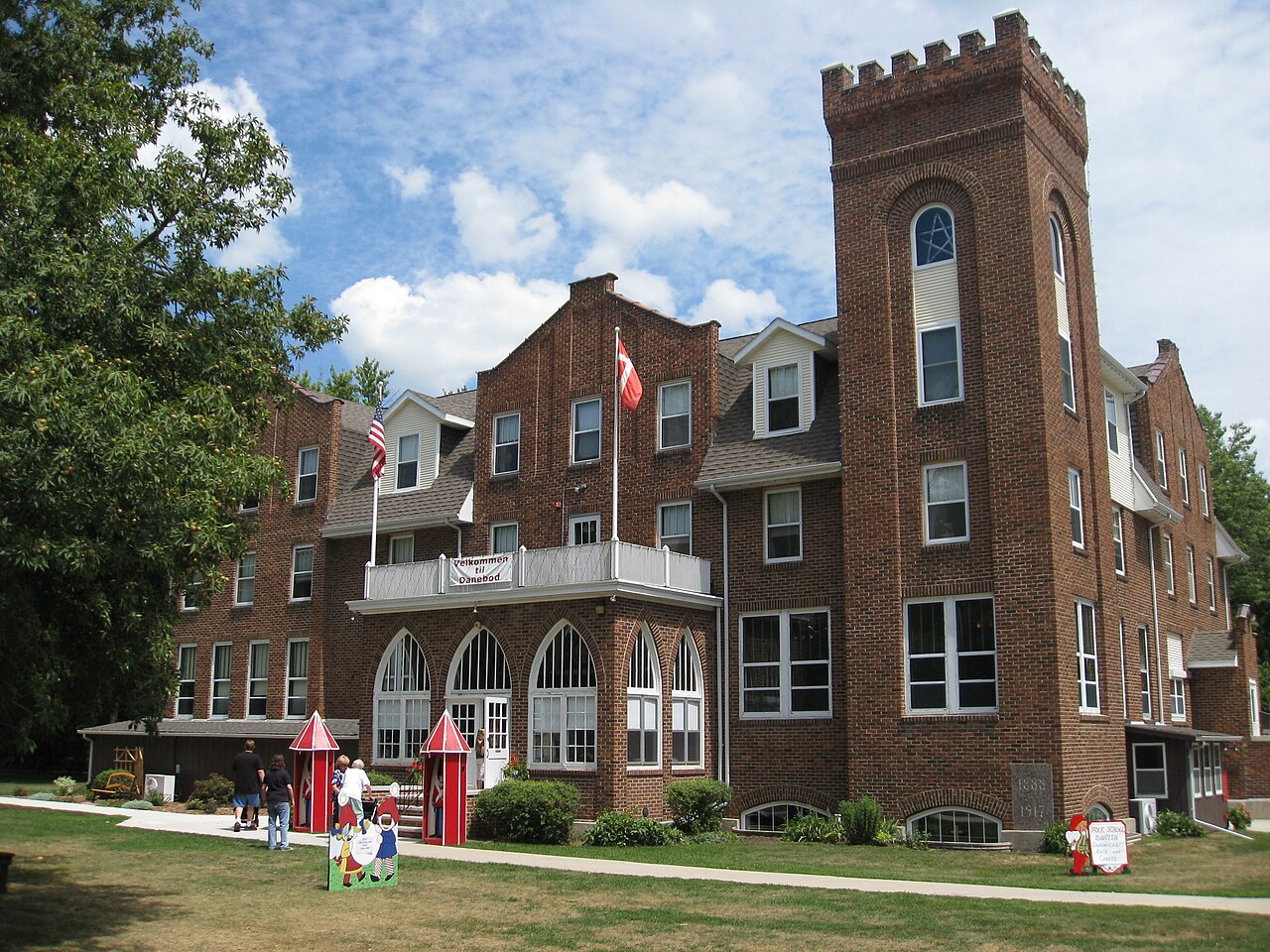
The Danebod campus itself is on the National Register: the folk school of 1888, rebuilt within months of burning down in February 1917; Stone Hall of 1889; the Cross Church of 1895, with a votive ship hanging in the nave; the Gym Hall of 1904. The school closed in the 1930s. The buildings stayed. In 1946, five hundred Danish-American young people came for the reopening, and something has run there every year since.
The case against, taken seriously
Two objections deserve to be on the record.
The first is that folk is not an innocent word. Ove Korsgaard, the leading Grundtvig scholar and a defender, concedes it outright: the term carries what he calls deeply racist and nationalist connotations, the ethnic component has to be deliberately stripped out of Grundtvig's nationalism before it is usable, and “the word itself will remain a battleground.” The folk high school was a nation-building project in a country that had just lost a third of its territory. That is not a smear; it is the historical record, and the American schools inherited it — which is exactly why Ashland had to de-ethnicise itself in 1928 in order to keep going.
The second is that nobody knows whether it works. Denmark spends around 726 million kroner a year on these schools, and the assessment in the scholarly literature is that there is no data available on how folk high school students fare once they enter the workforce or enrol at university. Statistics Denmark counts participation, not outcomes. A hundred and eighty years in, the most beloved institution in Danish education has never been evaluated.
And the model is drifting even at home. Denmark has 71 schools, down from 77 in 2021. Sweden, which let its folkhögskolor award university-entrance credentials, has 152. In Denmark in 2024 there were roughly 40,000 short-course participants against about 11,000 on the long residential courses — four out of five are now doing something under twelve weeks. The Grundtvigian stay is the minority product; the week away is what is growing.
Which, if you have been following the American half of this, is a familiar sound.
On 31 August 2026 the Danish culture minister nominated the folk high schools for UNESCO intangible cultural heritage listing, after nearly 60,000 Danes voted them onto the national register in April 2025 — alongside hot dog stands and handball. It is a fine tribute and it is also the tell. You nominate a thing for heritage protection at the point where it has stopped being simply how you do things.
Meanwhile, in a Minnesota town of a few hundred people, a week in August has sold out for the eightieth year running, and nobody involved has to describe it as heritage at all.
The Danish statutory text is consolidated act no. 280 of 25 March 2019. Elk Horn enrolment figures come from a 1918 Shelby County history; several founding dates for the smaller American schools rest on a single secondary source with known errors and are flagged in the text where they could not be confirmed. The frequently repeated claim that the Danish cooperative movement was built by folk high school graduates could not be documented and is not made here.

