One Lawyer in Atlanta Is the Consular Presence of Two Kingdoms
In the autumn of 2017, after Hurricane Irma had finished with the American South, an official at the Swedish embassy in Washington telephoned a partner at an Atlanta law firm.
Tom Rosseland had been Sweden's honorary consul in Georgia for some time. The question was whether he would also take on Norway's, the previous Norwegian honorary consul having retired. Rosseland's mother was Swedish and his father Norwegian. He said yes.
His description of the job, given to a local business paper the following year, is the most useful summary of this subject anyone has published: processing passports, verifying that pensioners are still alive, conducting interviews for residency and work permits that can run over an hour, handling citizenship applications, sorting out social security paperwork.
One lawyer in Atlanta is the consular presence of two kingdoms across the American South.
What an honorary consul actually is
The instrument is Chapter III of the Vienna Convention on Consular Relations of 1963 — eleven articles, 58 to 68, governing consular posts headed by honorary officers.
Three things in it are routinely misreported, and all three matter if you are ever going to need one.
First, an honorary consul does not have diplomatic immunity. The phrase is wrong twice over — consular is not diplomatic, and honorary is not career. They have functional immunity for official acts only. They have no personal inviolability; Article 63 is drafted on the explicit assumption that an honorary consul can be arrested and detained.
Second, their families have nothing. Article 58(3) says so in terms.
Third, and most telling: under Article 61 the archives of an honorary consular post are inviolable only so long as they are kept separate from the consul's own professional and commercial papers. The legal protection of a country's consular records depends, literally, on a filing cabinet.
What they are not is decorative. A Danish honorary consul in America can take a full passport application. A Finnish one is expressly forbidden to accept any passport application at all. Sweden's can issue emergency passports and the life certificates that keep a pension flowing. Estonia's have powers defined individually, post by post, by ministerial directive — which is why no general statement about what an Estonian honorary consul can do is possible.
The powers are national policy, not international law, and they vary more within the region than between the Nordic and Baltic halves of it.
The ratios
Iceland publishes the numbers about itself and they are extraordinary: around 240 honorary consuls in more than 90 countries, against 26 diplomatic missions in 21 countries. Roughly nine to one.
Sweden's own 2010 review of its foreign service recorded the trend that produced this. Over twenty years the Swedish state closed 25 career consulates and opened 8 — while the honorary network of around 400 stayed flat. The career presence contracted; the volunteers did not.
In October 2021 Sweden said it had 27 honorary consulates in the United States. Its own directory lists 16 today. Neither figure came with an announcement, and the ministry should be asked to confirm the gap before anyone builds a thesis on it — but that is rather the point. Posts in this system do not close with a press release. They vanish from a directory. Norway currently lists Fredericton and Victoria as closed. Estonia's Ottawa embassy describes an honorary consul in Halifax who does not appear in its own contact list.
The map follows the migration, not the money
Look at where these posts are and the diaspora function stops being a theory.
Finland's honorary consulates in the United States include Hancock, Michigan — the Keweenaw Peninsula, the old Finnish-American heartland — and Virginia, Minnesota, on the Iron Range. Iceland's include Mountain, North Dakota, the Icelandic settlement in Pembina County, population under a hundred.
No trade-promotion logic puts a consulate in Mountain, North Dakota. Only a diaspora does.
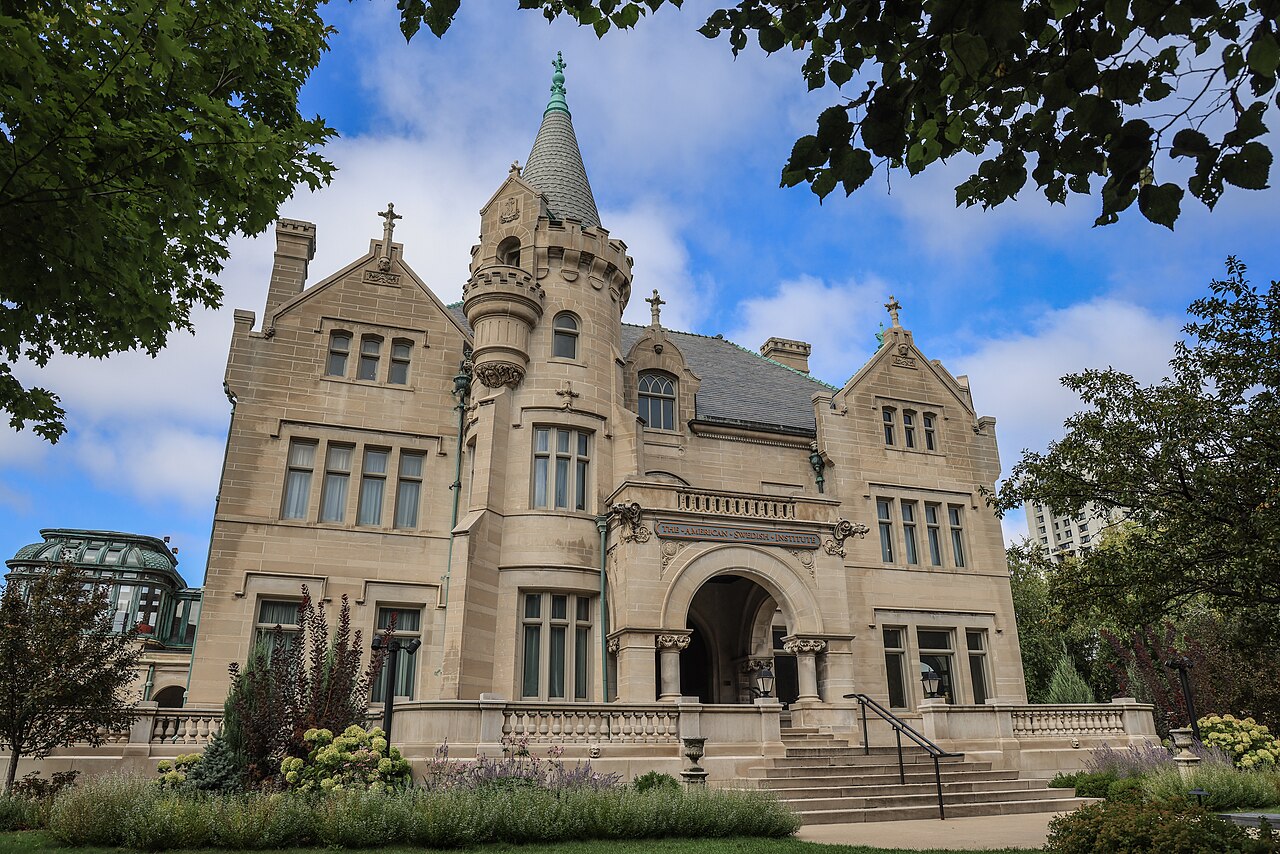
And the people match the map. The honorary consul general of Norway in Minnesota is the former chief executive of Sons of Norway, the largest Norwegian-American fraternal organisation in the world, and a past president of the Norwegian American Chamber of Commerce for the Upper Midwest; he moved the consulate's office into Norway House, the Minneapolis Norwegian-American cultural centre. The Consulate of Sweden in Minneapolis is a room at the American Swedish Institute — the state's representation housed inside the community's own museum. Sweden's honorary consul in Los Angeles chairs the Swedish-American Chamber of Commerce there. When Latvia opened its honorary consulate in Minnesota, its ambassador thanked the appointee for his previous work in diaspora activities: he had been president of the Minneapolis–St Paul Latvian Lutheran church council and a regional director of the Latvian American Chamber of Commerce before he was ever a consul.
Lithuania is the only one of the eight that writes this down. Its published criteria for selecting honorary consuls assess a candidate's capacity to organise state festivals and presentations of culture and business. Lithuania is, on paper, hiring somebody to throw the national day party.
Lithuania also publishes the part nobody else does: its honorary consuls finance their activities and maintain their offices at their own expense.
Los Angeles: twelve years, then a volunteer
Sweden's consulate-general in Los Angeles closed in 2009. For roughly twelve years, the second-largest metropolitan area in the United States had no Swedish consular presence of any kind.
On 20 October 2021 Sweden opened an honorary consulate on Wilshire Boulevard. In the same announcement it closed the honorary consulate in San Diego and redirected all of southern California to the new post.
What that post can do, from its own published list: emergency passports, certification of original documents and identity papers, life certificates for pensioners, and forwarding passports issued elsewhere. What it cannot do: ordinary passports and Schengen visas.
And one line, stated plainly on its website, that every reader in California should know: the Honorary Consulate of Sweden has no role in evacuations or rescue operations.
A career consulate-general, a twelve-year gap, a volunteer in an office suite, and a written warning that she cannot help you in a wildfire.
Houston: the community that fought and lost
On 9 September 2022 Norway's foreign ministry announced it would close its consulate-general in Houston, open since 1977, along with embassies in Bratislava, Colombo and Pristina. The capacity was redirected to Bucharest, Kyiv, Vilnius, the EU Mission and NATO. Foreign Minister Anniken Huitfeldt noted that closures affect posted diplomats and have even greater consequences for locally employed staff.
The Norwegian-American community in Texas did something unusual: it organised. Two weeks later the Norwegian-American Chamber of Commerce's Southwest chapter launched a petition, which closed with 1,515 signatures. Its arguments were substantive — the consular district covered a quarter of the US population across several states and territories, and Houston was an emerging hub in aerospace, health, sustainability, shipping and energy, which were Norway's own stated priorities. The Norwegian Society of Texas and the chamber drafted a joint open letter, described by the president of the society's Houston chapter as unprecedented cross-organisational cooperation among Norwegian-Americans in the state.
The consulate closed anyway.
And here is the part that complicates the tidy version of this story. Norway did not open an honorary consulate in Houston. There is none on its list. The nearest Norwegian post in Texas is the honorary consulate in Dallas. The ministry's own announcement said functions would move to nearby embassies, not to a volunteer.
The honorary network does not automatically absorb what the career service gives up. Sometimes the honorary post is simply what was already there when the professionals left. Sometimes nothing arrives at all.

The risk nobody had counted
In 2022 a consortium of newsrooms led by ProPublica and the ICIJ published Shadow Diplomats, the first systematic look at the honorary consular system worldwide. It identified at least 500 honorary consuls accused of crimes or implicated in controversy, 57 of them convicted while in office. It counted roughly 1,100 honorary consuls operating in the United States, found that only 42 of more than 180 countries published up-to-date information about who theirs were, and reported the State Department's position that it was not able to run background checks on them. One official's summary: it is on the honour system.
The one finding that touched this region came through Finland, where the public broadcaster Yle obtained records showing seven convictions and two live court cases among honorary consuls accredited in the country — tax fraud, bribery, a suspended sentence after a fatal traffic accident. The Finnish foreign ministry said it would review its vetting. To be precise about it: those were honorary consuls of other states posted in Finland, not Finland's own people abroad.
The dissent comes from inside
The sharpest criticism of the honorary system in this region is made by the longest-serving honorary consul in it.
Jaak Treiman has been Estonia's honorary consul in Los Angeles since 26 March 1986 — five years before Estonia's independence was restored, when the post was an act of political defiance rather than administration. He is, by some distance, Estonia's longest-serving honorary consul anywhere.
And he argues publicly that honorary consuls are not a substitute for career diplomats, on national-security grounds. Local Estonians and honorary consuls can do a certain amount of the work, he has written; but for the security relationship that actually matters to a small Baltic state, nothing is as effective as a career official of the Estonian government.
Iceland has, once, gone the other way. It had an honorary consul in Winnipeg from 1942. In 1999 it sent a professional diplomat to head a new career consulate-general there, for what its own foreign ministry describes as the tens of thousands of people of Icelandic descent in Manitoba and Western Canada. The diaspora function was strong enough, in one place, to pull a career diplomat across the Atlantic.
A former Icelandic foreign minister once put the relationship to a gathering of his honorary consuls in a single sentence: you are our extended foreign service in your home countries. It is meant as a compliment and it is also an admission. These people are not an adjunct to the state's presence. In most of North America, most of the time, they are the state's presence.
What this means if you need one
Three practical conclusions, and they are not the ones people assume.
Check what your particular post can do before you need it, not after. The variation is national and it is wide: Denmark's honorary consuls are among the most empowered in the region, Finland's among the most restricted, Estonia's individually defined. The rule of thumb that Baltic honorary consuls have narrower powers than Nordic ones is not reliable.
Do not plan an emergency around one. Several of these posts say in writing that they have no role in evacuation or rescue. In a genuine crisis the relevant number is the embassy's, and for four of these countries that means Washington or Ottawa.
And notice the succession problem before it arrives. The Atlanta post changed hands because one man retired and the embassy made a phone call to a lawyer who happened to have one Swedish parent and one Norwegian one. That is not a system with depth. When a long-serving honorary consul in a mid-sized American city steps back, what usually happens is not a replacement. It is a directory entry quietly disappearing, and a community discovering, some months later, that the nearest place to renew a passport is now four states away.
Honorary consulate counts in this piece were made from each foreign ministry's own published directory and are ours rather than the ministries'; ministry sites list career and honorary posts together and several honorary posts carry the title “consulate general,” so counts that read titles rather than status will differ. Several closures noted here are recorded only by absence from a current directory and merit confirmation from the ministry concerned.


)%20(1).avif)