The Commemoration That Travelled East: How Toronto Invented Black Ribbon Day
Featured News · Baltic Stories
On August 23, government buildings in Ottawa and a number of provincial capitals will mark Black Ribbon Day. Estonian, Latvian and Lithuanian communities across Canada and the United States will gather at monuments and consulates. In Brussels, Strasbourg and the three Baltic capitals, the same date will be observed as the European Day of Remembrance for Victims of Stalinism and Nazism.
Most people who attend these ceremonies assume the tradition came from Europe — that it was carried west by refugees, the way commemorations usually travel.
It went the other way.
Black Ribbon Day was invented in Toronto. It was proposed in 1985 by a man working out of the Estonian Central Council in Canada, launched in 1986 in twenty-one cities across the Western world, and run for years by a committee headquartered in Ontario. It existed for three years before the Baltic Way — the human chain that most people now think of as the origin of the date — and the organisers of that chain were, in part, responding to it.
This is one of the few instances in modern history where a diaspora did not merely preserve a memory of the homeland. It manufactured a commemoration abroad and then exported it back.
The Secret That Was Not Secret
To understand why the date matters, you have to understand what was being denied.
On August 23, 1939, in Moscow, the foreign ministers of Nazi Germany and the Soviet Union signed a treaty of non-aggression. The public text was unremarkable. Attached to it was a secret additional protocol that divided Northern and Eastern Europe into spheres of influence, placing Estonia, Latvia, Finland and eastern Poland in the Soviet sphere, with Lithuania added in a September amendment.
Within a year the three Baltic states had been occupied and annexed. Mass deportations followed in June 1941 and again after the war.
The Soviet Union denied for fifty years that the secret protocols existed. This was the official position, maintained in diplomacy, in textbooks, and in the historical scholarship of the states it controlled. The Baltic republics had, according to this account, voluntarily joined the USSR in 1940 following spontaneous popular demand.
Nobody inside the Baltic states could publicly say otherwise. The people who could say otherwise were living in Toronto, Chicago, Melbourne, Stockholm and New York.
That asymmetry is the whole story.
Toronto, 1985
The proposal came from Markus Hess, of the Estonian Central Council in Canada. His idea in 1985 was a coordinated international day of protest built around a single, portable symbol: a black ribbon, worn on the lapel, mourning the victims of both totalitarianisms at once.
David Somerville, who became vice president of the committee Hess formed, suggested pegging it to the anniversary of the Molotov–Ribbentrop Pact. The committee adopted the date in February 1986.
The choice was tactically shrewd in a way worth pausing on.
Western opinion in 1986 had a comfortable moral architecture: the Second World War was a war against Nazism, and the Soviet Union was on the right side of it. A protest about Soviet occupation of the Baltics could be filed as a grievance of one small group among many.
But the pact was a problem the architecture could not absorb. It was a documented agreement between the two regimes, signed before the war, that carved up small nations between them. Choosing that date forced a single question: what happened to the countries the two dictatorships agreed to divide?
The first Black Ribbon Day, on August 23, 1986, was observed in twenty-one cities — Ottawa, New York, Washington, Seattle, Los Angeles, London, Stockholm, Perth and others. By 1991 the campaign had reached fifty-six.
These were not large demonstrations by the standards of the era. They were persistent, coordinated, and aimed at press coverage and legislators rather than at crowds.
What Came Back Across the Atlantic
Then, in 1989, the environment changed. Glasnost created just enough space for the popular fronts that had formed in Tallinn, Riga and Vilnius to organise publicly.
What they organised on August 23, 1989 — the fiftieth anniversary of the pact — was the Baltic Way.
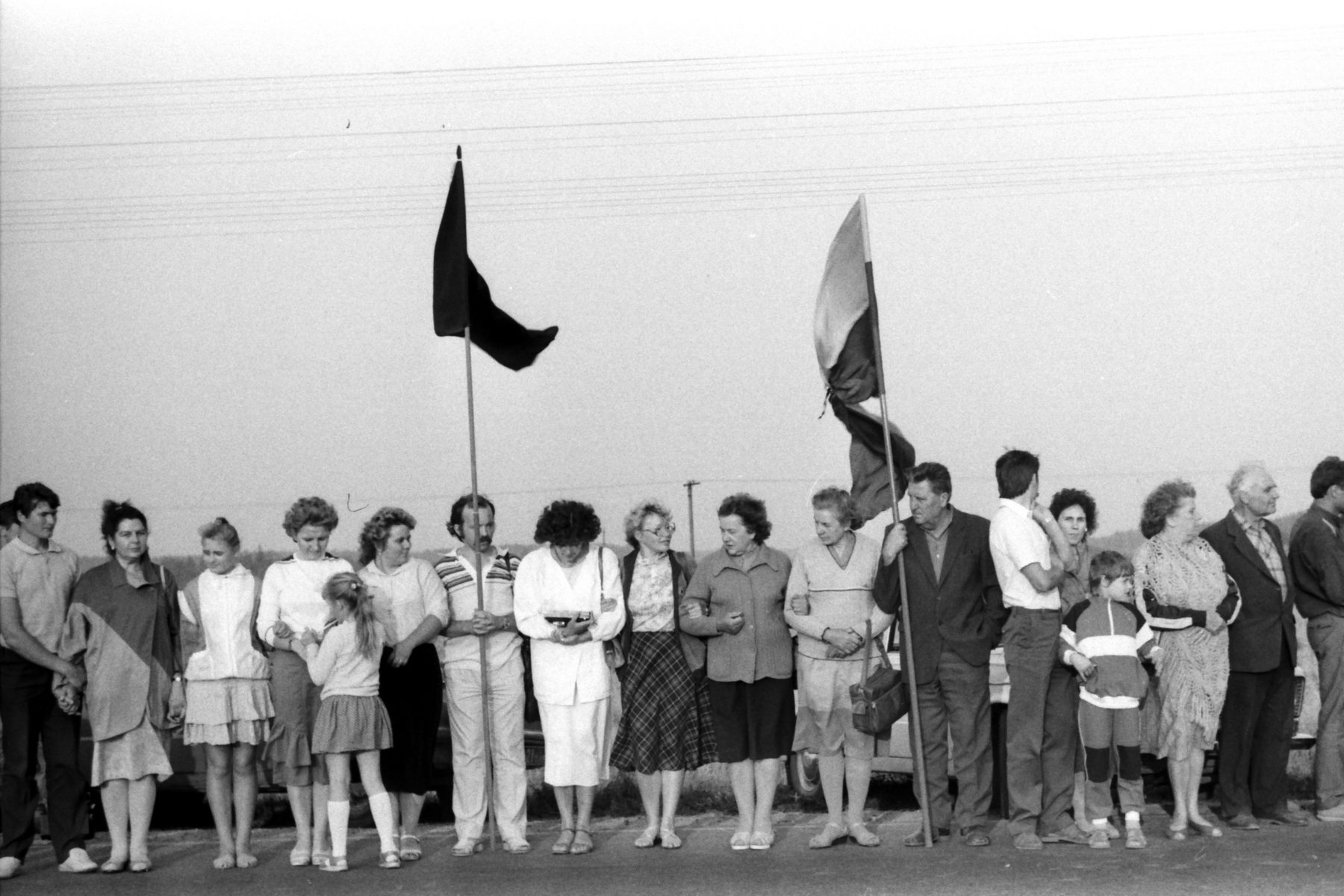
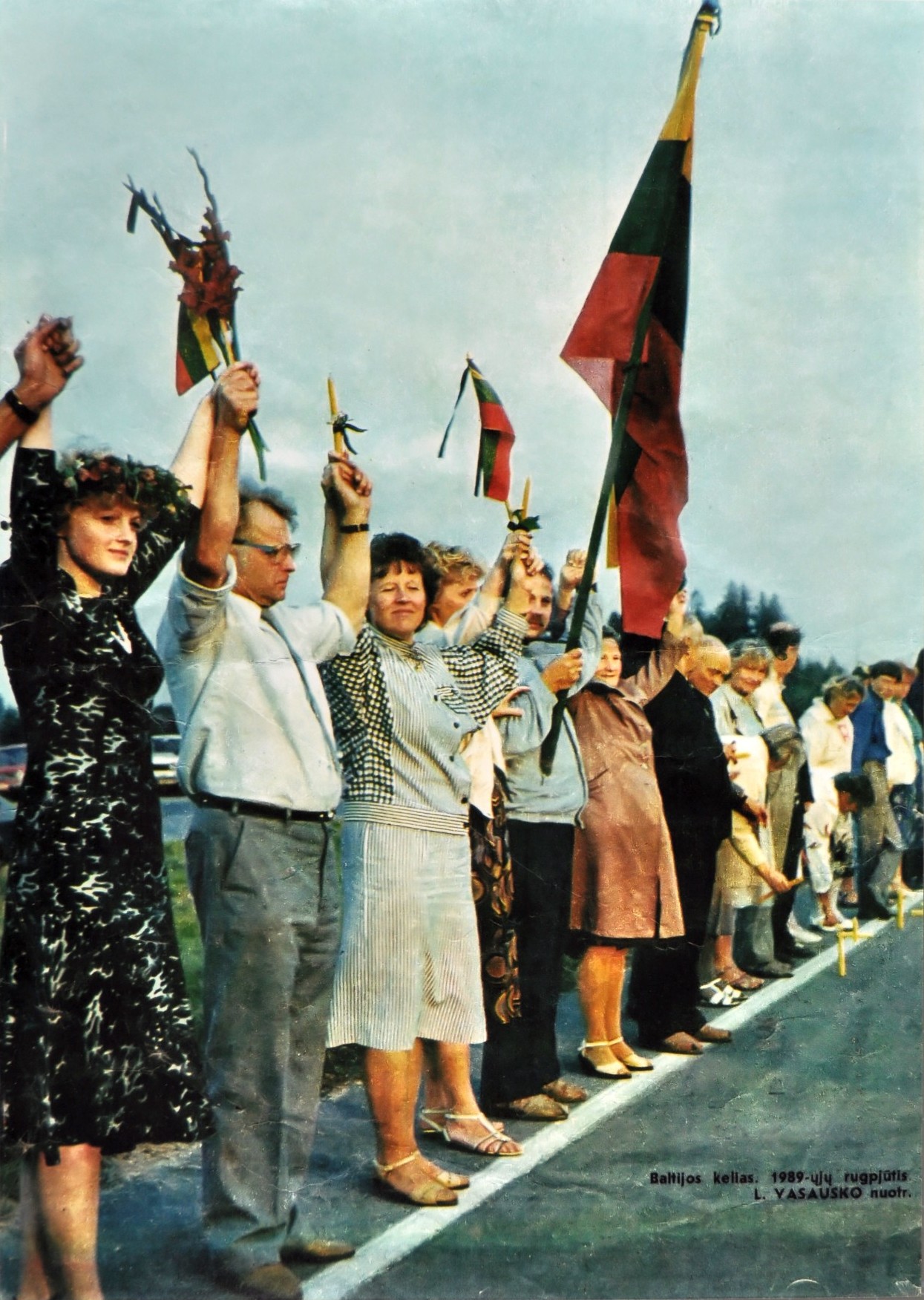
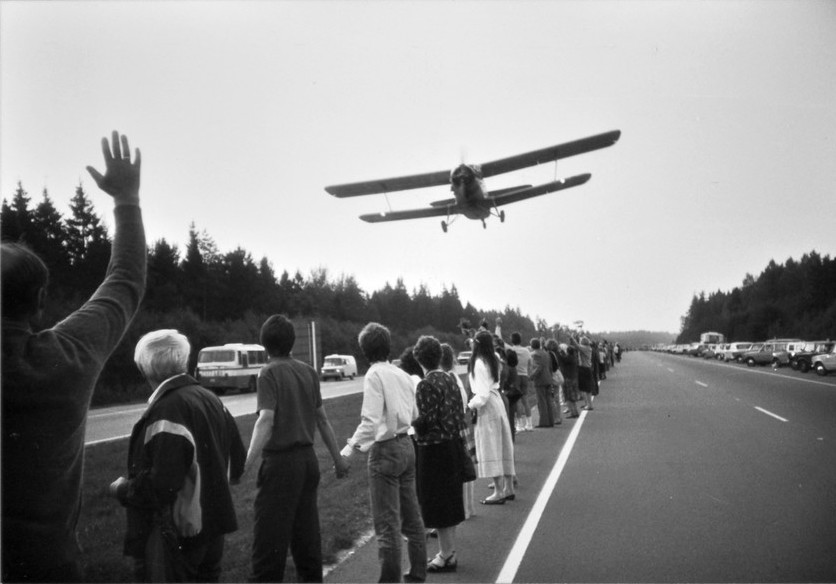
At seven o'clock in the evening, roughly two million people joined hands in an unbroken chain running 675 kilometres from Tallinn through Riga to Vilnius. They held it for fifteen minutes. The popular fronts had mapped the route, assigned towns to specific stretches, laid on free buses, and coordinated the moment by radio broadcast.
People carried candles and pre-war national flags.
The flags were tied with black ribbons.
That detail is the thread. The symbol that had been devised in Canada three years earlier, for lapels in Ottawa and Seattle, appeared on the flags of a two-million-person chain across the Baltic states.
Within seven months Lithuania declared independence. By the end of 1991 all three states were free and recognised.
The Soviet Union, meanwhile, had done the thing it had refused to do for half a century: in December 1989 the Congress of People's Deputies formally acknowledged and condemned the secret protocols.
The denial was over. It had been broken by a combination of a diaspora that would not stop talking about a document, and two million people who stood in a line.
From Protest to Statute
The commemoration then did something unusual for a protest tradition: it became law.
In September 2008, 409 members of the European Parliament signed a declaration designating August 23 as a European day of remembrance for the victims of Stalinism and Nazism. A fuller resolution passed in April 2009 by 533 votes to 44. The OSCE Parliamentary Assembly endorsed the date at its Vilnius session in July 2009.
And on August 23, 2009, the Canadian House of Commons unanimously adopted a motion recognising Black Ribbon Day, introduced by the Liberal MP Bob Rae.
Canada was the first country in the world to designate it nationally.
That is not a coincidence of geography. It is the direct institutional consequence of the fact that the Estonian, Latvian and Lithuanian communities in Canada had been organising around this date for twenty-three years by the time Parliament voted.
The United States has never adopted a comparable federal designation, though numerous states and municipalities issue proclamations, and successive administrations have marked the date with statements.
The Argument About the Date
It would be dishonest to present the commemoration as universally accepted, and readers should know that it is contested.
The central criticism is that pairing Nazism and Stalinism on one remembrance day risks a false equivalence — that it can shade into relativising the Holocaust by presenting it as one of two comparable catastrophes. This objection has been raised by Holocaust scholars, by some Jewish community organisations, and by historians who argue the two systems, however brutal both were, differed in kind as well as degree.
Supporters answer that the day commemorates victims rather than ranking regimes, that the pact was a specific historical event with specific consequences for specific countries, and that the experience of nations occupied first by one power and then the other is not adequately described by either history alone.
There is also a live political dispute. Russia's official position continues to treat the 1940 incorporation of the Baltic states as lawful, and treats commemorations built on the pact as historical revisionism.
None of this is settled, and a publication that pretended otherwise would not be doing its job. But the historical record of the secret protocols themselves is not in serious dispute — the Soviet Union itself conceded it in 1989.
Why It Reads Differently in 2026
For most of its existence, Black Ribbon Day was a commemoration of something safely concluded. The occupations ended. The states are independent, in NATO, in the European Union. The date was history.
It does not feel entirely like history at the moment.
The specific thing the day is about — large powers negotiating over the sovereignty of small nations without the small nations in the room — is not a closed historical category. Baltic officials have spent the past several years making precisely this argument in Washington and Brussels, and the argument is fundamentally the one Markus Hess was making in Toronto in 1985.
Which is perhaps the more useful thing to take from the anniversary.
The people who invented Black Ribbon Day were not, in 1986, expected to accomplish anything. They were a small group of exiles in a foreign country, insisting on the existence of a document that the government controlling their homeland said did not exist, at a moment when almost no serious analyst believed the Soviet Union would end within a decade.
They organised anyway, for three years, before anything moved.
Then a great deal moved very quickly, and when it did, the symbol they had made in Canada was already tied to two million flags.

Sources and further reading
European Parliament declaration of September 23, 2008, and resolution of April 2, 2009, on European conscience and totalitarianism.
OSCE Parliamentary Assembly, Vilnius Declaration, July 3, 2009.
Canadian House of Commons motion on Black Ribbon Day, August 23, 2009.
The documents of the Baltic Way were inscribed on the UNESCO Memory of the World Register in 2009.
The Estonian Central Council in Canada, the Latvian National Federation in Canada and the Lithuanian Canadian Community maintain records of the commemoration and organise annual events.
