The Finnish Hobby That Ended Up Running the World
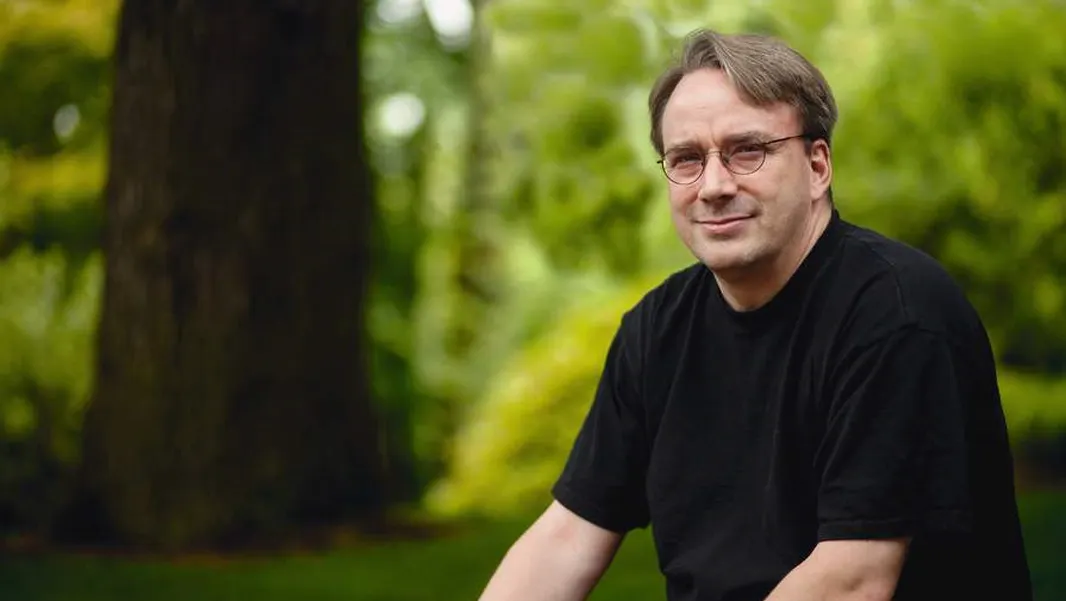
On August 25, 1991, a twenty-one-year-old computer science student at the University of Helsinki sent a message to an internet newsgroup used by enthusiasts of a small teaching operating system called Minix.
He was working on something, he explained.
“I'm doing a (free) operating system … just a hobby, won't be big and professional like gnu.”
There are inaccurate predictions, and then there is this.
Thirty-five years later, the hobby project Linus Torvalds announced from Helsinki sits underneath an astonishing amount of modern life. Linux and Linux-derived systems dominate high-performance computing. The kernel forms the foundation of Android. It is embedded in servers, cars, televisions, routers, industrial equipment and an enormous share of the cloud infrastructure most of us use without ever seeing. The Linux Foundation itself describes it as having spread into virtually every industry and form factor.
The remarkable thing is how little most people think about any of this.
You can live your entire digital life surrounded by Linux without knowingly using a “Linux computer.” You can carry it in your pocket, stream through it, bank through it and ask an artificial-intelligence service a question on machines that depend on it, while the laptop on your desk remains stubbornly Windows or Mac.
But something interesting has begun to change there, too.
For years, “the year of the Linux desktop” was one of the technology world's longest-running jokes: always arriving, never actually here. In 2026, nobody sensible should declare victory. Windows still overwhelmingly dominates ordinary PCs.
What has changed is more modest, and arguably more important.
Putting Linux on an everyday laptop is no longer an eccentric act.
And the reason has as much to do with Microsoft as it does with Linux.
The Boy From Helsinki Who Gave It Away
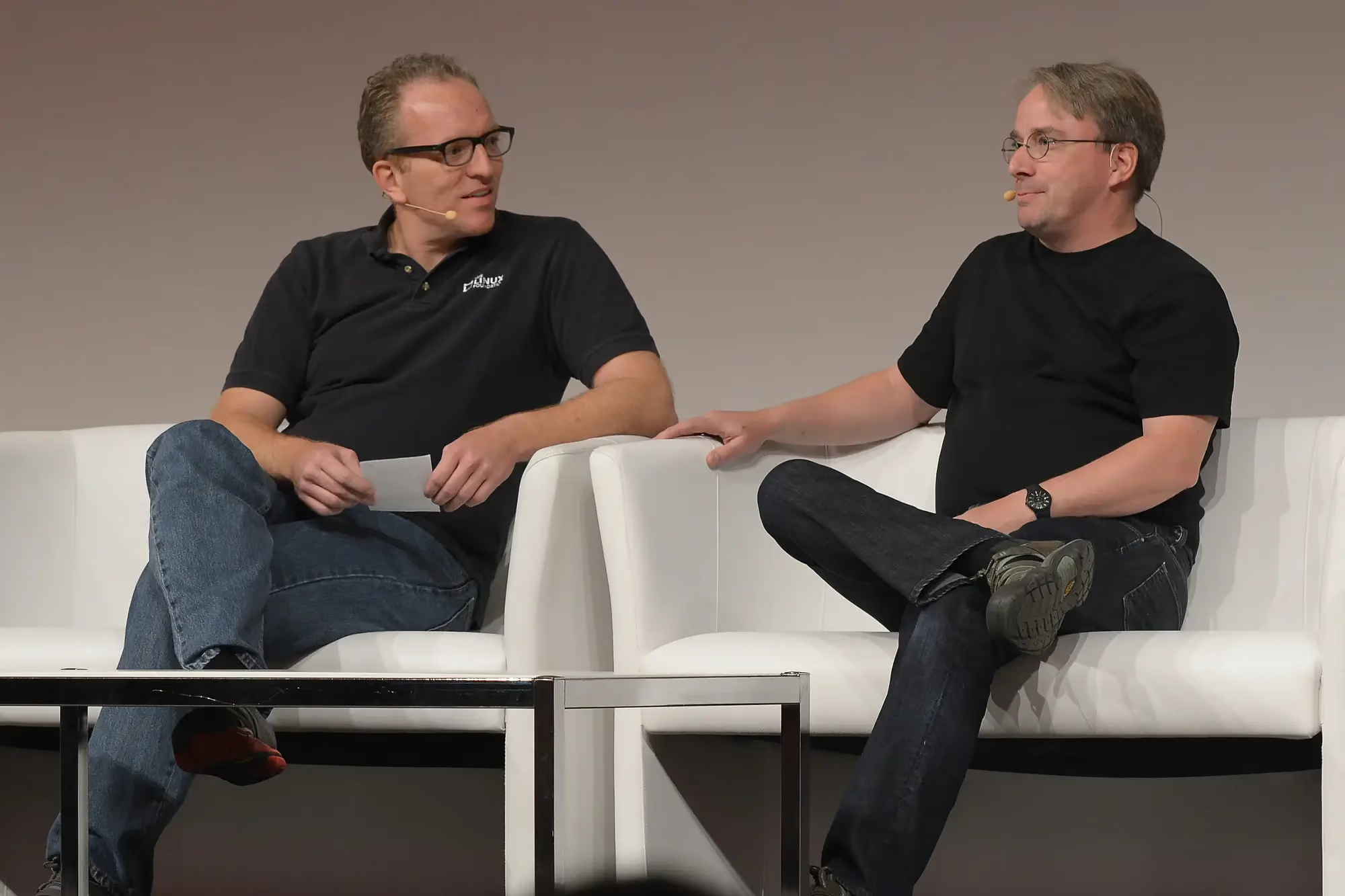
For readers of The Northern Voices, Torvalds is worth pausing over as a person, because his biography gets flattened surprisingly quickly once the computers enter the story.
Linus Benedict Torvalds was born in Helsinki on December 28, 1969, into Finland's Swedish-speaking minority. His parents were journalists. His grandfather, University of Helsinki statistician Leo Törnqvist, owned a Commodore VIC-20 and let his grandson work with it. The fascination came early, and by Torvalds's own telling it was much closer to mathematics and problem-solving than to entrepreneurship.
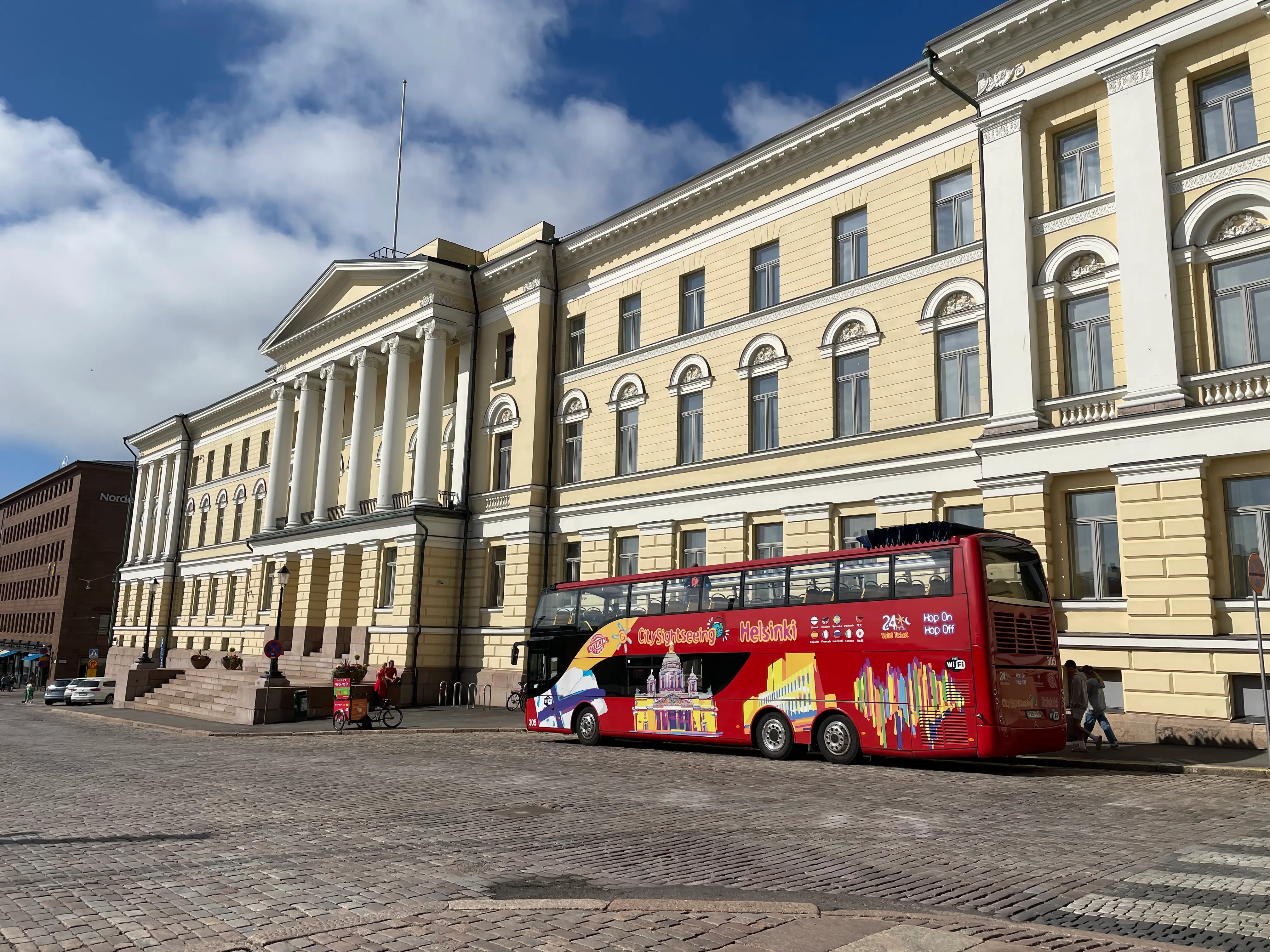
He entered the University of Helsinki in 1988, interrupted his studies for military service, and eventually returned to computer science. The university's department still rather delightfully advertises the fact with three words: “Linux was invented here.”
In early 1991, Torvalds bought an Intel 386 computer. He wanted more control over it than the available software gave him, so he began writing the beginnings of his own operating-system kernel.
This is one of those origin stories that has acquired so much mythology that the smallness of the original act is easy to lose. There was no startup. No venture round. No product launch. No branding agency preparing a reveal.
There was a student, a computer bought on credit, and a message sent to other people who liked messing around with operating systems.
The Linux Foundation dates the public beginning of the project to that August 25 announcement; the first kernel release followed later that autumn.
Then Torvalds made the decision that mattered at least as much as the code.
Linux was eventually released under version 2 of the GNU General Public License. The idea behind the GPL is straightforward but radical in its consequences: you are free to use the software, study it, alter it and distribute it. But if you distribute your modified version, you must pass those freedoms along.
The door stays open behind you.
.avif)
Torvalds did not begin with the GPL. He later explained that his original home-made license was far more restrictive, including a prohibition on charging money. By 1992, he had concluded that the GPL better expressed what he wanted: other people could build on his work, including commercially, but improvements distributed to others would remain available under the same terms. He has repeatedly described the decision as one he remains happy with.
That choice altered the trajectory of Linux.
Plenty of technically impressive software from the early 1990s disappeared into acquisitions, abandoned products and obsolete corporate strategies. Linux could not disappear in quite the same way because no company owned the code in the ordinary sense. Companies could build businesses around it. They could hire its developers, package it, support it, run billion-dollar services on top of it.
They could not simply buy the commons and lock the gate.
Torvalds himself never turned Linux into a proprietary fortune. He remains a Linux Foundation Fellow and still occupies the peculiar position he has held for decades: the person with final authority over what enters the main Linux kernel, presiding over one of the largest collaborative software projects ever attempted.
He didn't even get his preferred name.
Torvalds had considered calling the project “Freax,” a mash-up of free, freak and Unix's X. Ari Lemmke, who administered the Finnish university server where the early files were stored, apparently had better taste and put them in a directory called “linux.”
The name stuck.
There is something appropriate about that. Even the name of one of the most consequential pieces of software ever written emerged through collaboration.
-Custom_2000x2000.avif)
Why 2026 Feels Different
Desktop Linux has spent most of its life requiring an explanation.
Why would you install it? Are you a programmer? Are you angry with Microsoft? Do you enjoy spending Sunday afternoons trying to persuade a printer to exist?
Those questions were not entirely unfair.
Linux on servers became ordinary decades ago. Linux on personal computers remained a world of trade-offs: missing commercial applications, uneven hardware support, poor gaming compatibility and the occasional problem that sent an ordinary user into a terminal window copying commands from a forum.
A lot of those problems have not vanished.
Enough of them have, however, that the calculation has changed
The first pressure came from Windows.
Microsoft ended standard support for Windows 10 on October 14, 2025. The computers did not stop working the following morning, of course, but ordinary security support ended unless users moved to Windows 11 or enrolled eligible machines in Microsoft's Extended Security Updates program.
The problem is that Windows 11 has stricter hardware requirements, including TPM 2.0 and supported processor generations. That leaves a category of computers in an odd position: perfectly functional laptops whose owners are being told, officially, that they are not suitable for Microsoft's current operating system.
A ten-year-old ThinkPad does not understand that it has become obsolete by policy.
It still turns on.
It still has a screen, keyboard, processor and perfectly usable solid-state drive.
That has made Linux's old promise — your computer belongs to you; keep using it — newly practical rather than merely philosophical.
At the same time, desktop Linux has become less troublesome.
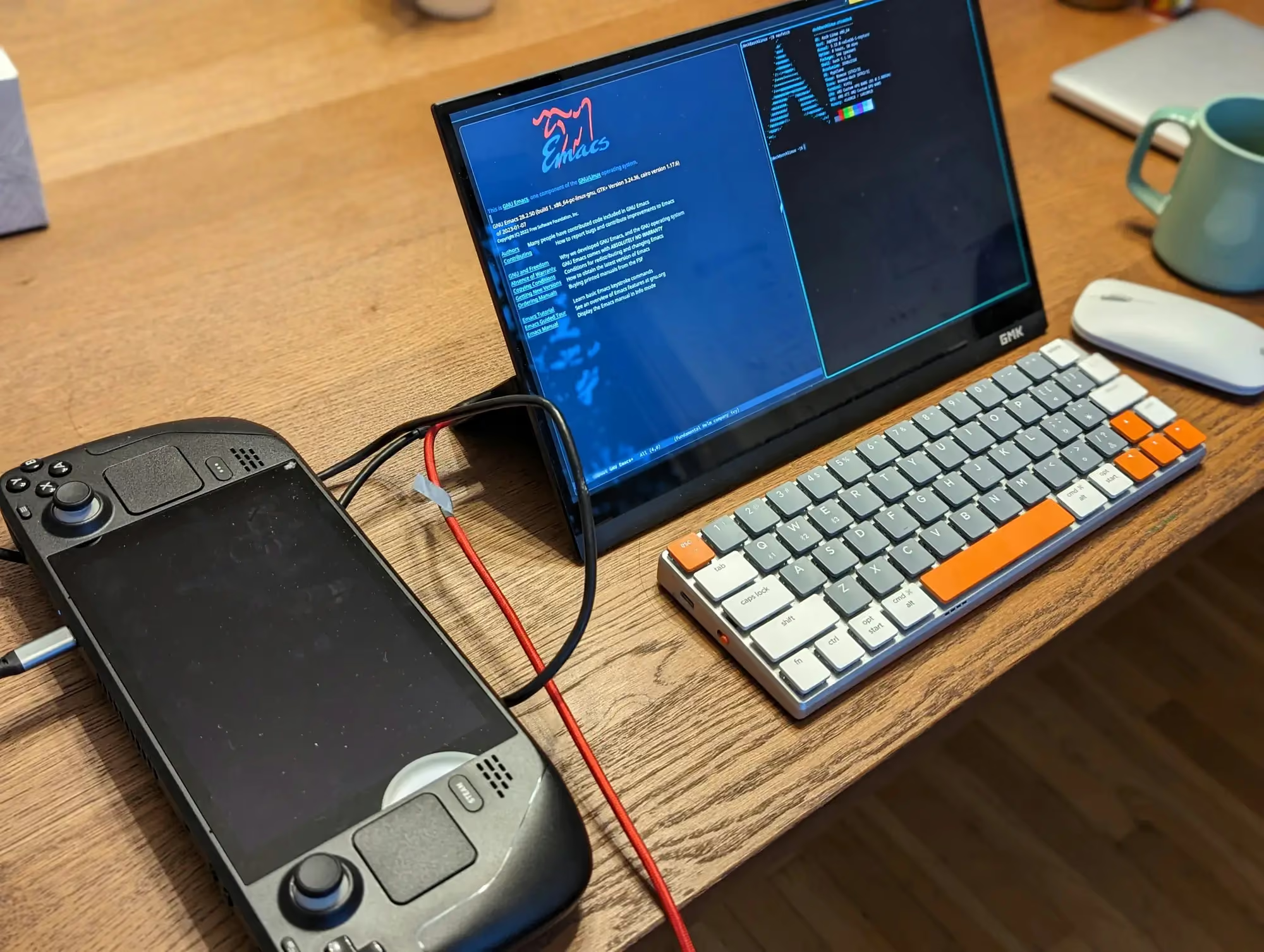
Gaming is the clearest example. Valve built the Steam Deck around Linux and invested heavily in Proton, the compatibility technology that allows a large catalogue of Windows games to run on Linux. The device has done something years of Linux evangelism never quite accomplished: demonstrated, at consumer scale, that someone can use a Linux computer without making Linux itself the hobby.
And much of everyday computing has moved into the browser anyway. Email, banking, streaming, Google Docs, Microsoft 365 on the web, social media, news, video calling — the operating system matters less when the application is a tab.
Desktop Linux remains a minority. StatCounter's worldwide measurement was 4.36 percent in June 2026, with the United States somewhat higher in the same dataset. Those statistics should not be mistaken for a census, and recent monthly measurements have been volatile enough that the exact number deserves caution. The broad point is simpler: Linux remains small, but no longer invisible.
The old question was, “Why would a normal person use Linux?”
The newer question is, “Why couldn't they?”
What Trying It Actually Looks Like
If you have an older Windows laptop in a drawer, this is the part worth knowing: you do not have to commit.
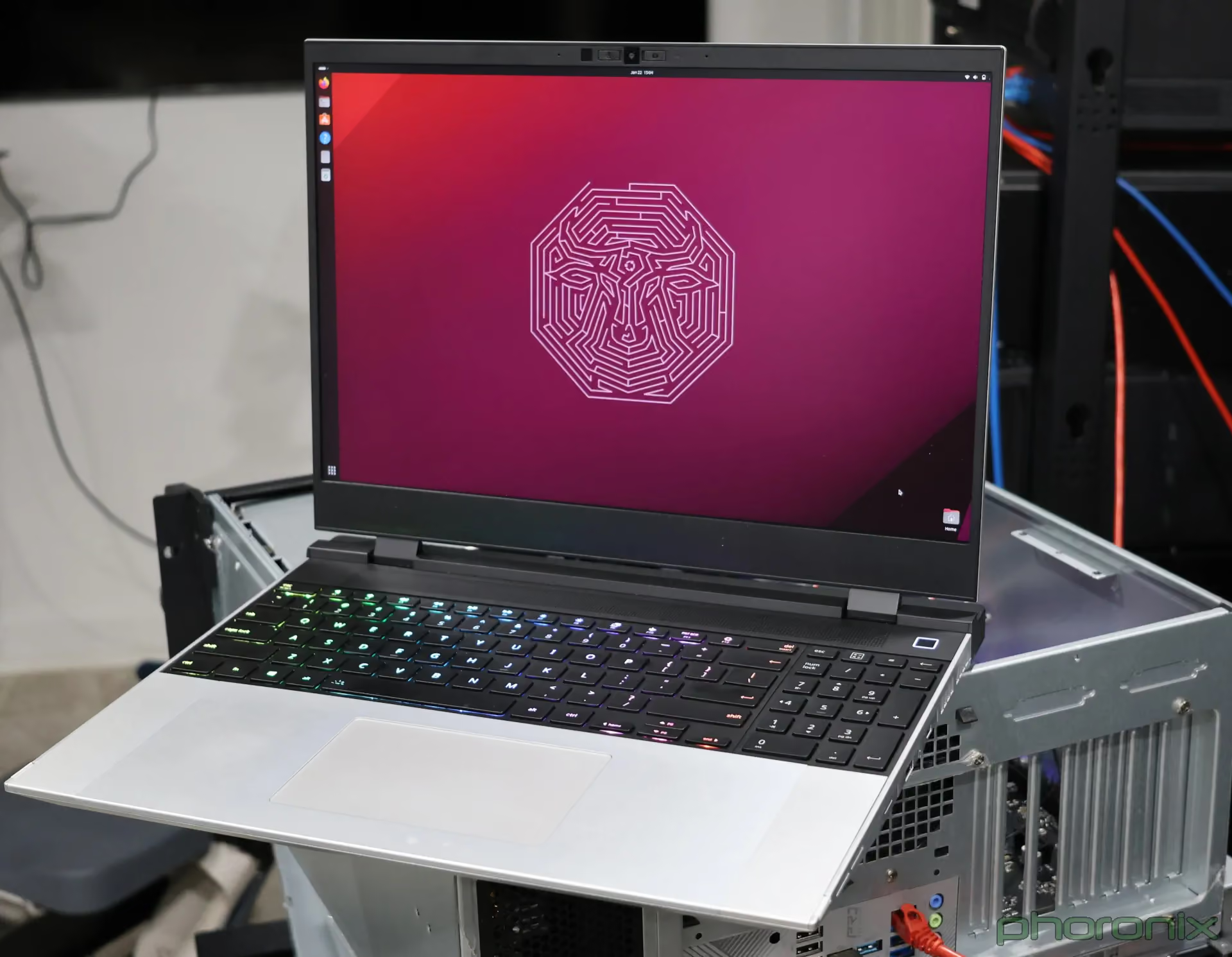
For someone coming from Windows, Linux Mint remains one of the gentlest introductions. It deliberately looks familiar. There is an applications menu where you expect one, a panel across the bottom, folders that behave like folders and very little pressure to learn an entirely new visual language on the first afternoon.
Ubuntu is another obvious starting point, with enormous community support and a vast amount of documentation. Fedora Workstation is slightly closer to the leading edge and particularly popular among developers.
All are free.
And all can be tried from a USB stick before they are installed.
That remains Linux's best-kept consumer secret. You can put a distribution onto a USB drive, start the computer from it and run the operating system without erasing your existing Windows installation. Test the Wi-Fi. Open the browser. Play a video. Make sure the sound works. See whether you hate it.
Then turn off the computer, remove the USB stick, and you are back where you started.
The important question is not whether Linux is “good enough.” That question is far too broad to be useful.
The question is what you need your computer to do.
If your life is browsing, email, writing, spreadsheets, video calls, streaming and ordinary home use, Linux has become almost boringly capable.
If your livelihood depends on the desktop version of Adobe InDesign, Photoshop, AutoCAD or some specialized corporate application written twelve years ago for Windows, the answer may be completely different. Microsoft Office's desktop applications and Adobe Creative Cloud still do not have native Linux versions. There are alternatives, and some are excellent, but “alternative” does not mean “identical.”
Anyone telling a professional designer that GIMP is simply Photoshop with a different logo is not doing that designer a favor.
This is not a conversion campaign.
It is an argument for knowing that you have a choice.
Back up your files. Try the operating system from USB. Check the software you genuinely depend on. If you want to move slowly, a dual-boot installation can keep Windows and Linux on the same machine while you decide.
That is a much less dramatic proposition than Linux used to be.
And that is precisely why it matters.
The Part That Isn't Really About Computers
There is another reason this story belongs here rather than only in a technology publication.
Over the past fifteen years, the personal computer has gradually become less personal.
Operating systems increasingly behave as storefronts, account systems and distribution channels. They suggest subscriptions, promote services, collect diagnostic information, synchronize data to corporate clouds and, increasingly, add artificial-intelligence features whose usefulness and privacy implications users are still trying to understand.
Linux does not magically make a computer private.
Badly configured free software can be insecure. Browsers can track you on Linux just as happily as they can on Windows. Commercial companies contribute enormous amounts of code to Linux, and “open source” is not another word for virtuous.
The difference is structural.
The code can be inspected. A mainstream community Linux distribution does not need to turn your desktop into advertising inventory because there is no single owner whose business model depends on making the operating system a sales channel.
That distinction feels familiar in Northern Europe.
Estonia's digital state was built around the idea that access to public information should itself be visible and accountable. Finland and its Nordic neighbors have long traditions of treating essential infrastructure as something that should answer to the people who depend on it.
The GPL comes from a different history and a different country, but there is a family resemblance in the underlying instinct.
Do not depend on goodwill.
Build the accountability into the system.
Torvalds would probably dislike this interpretation.
That may be the funniest part of the story.
For thirty-five years, other people have wanted Linux to mean something grand: freedom, rebellion, democracy, resistance to monopoly, the triumph of collaboration over corporate ownership.
Torvalds has usually sounded much more interested in whether the code works.
The Linux Foundation's own biography still quotes the young student who announced that his project “won't be big and professional.”
He has spent most of the years since demonstrating exactly how wrong he was.
There are more famous Finnish exports. Nokia put Finland into the pockets of the world for a while. Marimekko made it visible. Aalto gave it a design language. Sibelius gave it a soundtrack.
But very few Finns have made something that disappears so completely into the machinery of ordinary life.
Linux is successful precisely because most people never notice it.
It sits in the background doing its job.
Thirty-five years after that message left Helsinki, perhaps the most surprising development is not that Linux runs supercomputers and phones and enormous data centers.
It is that the old laptop on your kitchen table may finally be part of the story too.
Where to Start
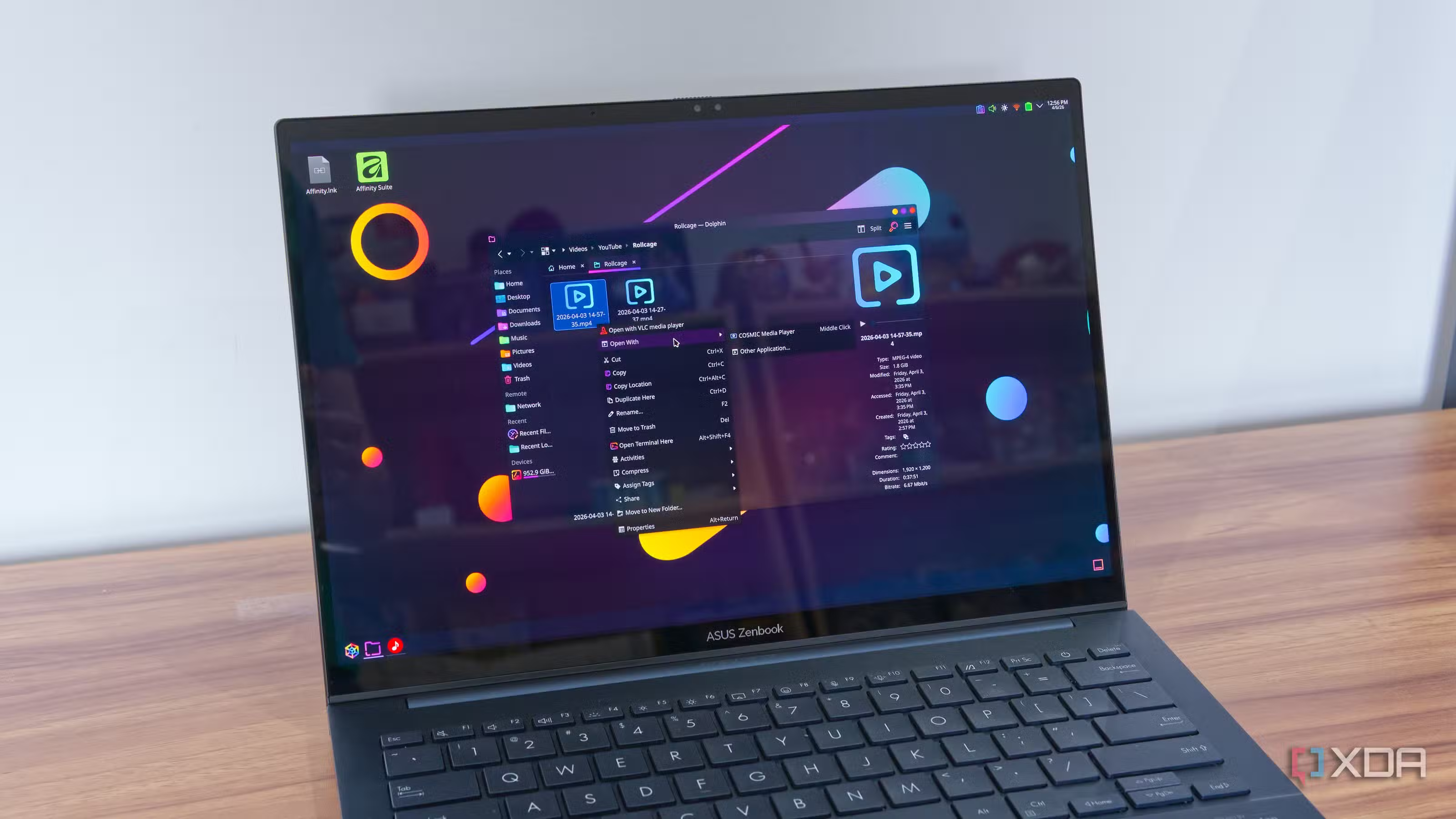
For a Windows user curious about Linux, Linux Mint is the easiest first stop. Ubuntu has the broadest ecosystem and support base, while Fedora Workstation is an excellent choice for people who want newer software and do not mind being a little closer to the front edge of development.
Before installing any of them, try the live USB version first.
Linus Torvalds and David Diamond's Just for Fun: The Story of an Accidental Revolutionary remains the most readable book-length introduction to the person behind the project.


)%20(1).avif)