The Last Ninety Minutes Home: What the airBaltic Crisis Means for the Diaspora

For anyone in North America with family in Riga, Tallinn or Vilnius, the trip home has a familiar shape. You fly the Atlantic to somewhere large — Frankfurt, Helsinki, Amsterdam, Warsaw, Copenhagen — and then you get on a much smaller aircraft for the last ninety minutes.
For a very large share of those journeys, the smaller aircraft belongs to airBaltic.
That last leg is now in question, and there is a date attached to it. The Latvian state lent the airline 30 million euros on short-term terms, and the repayment is due on August 31, 2026 — a little over two weeks from now.
The stakes are higher than one airline's balance sheet. This is a story about how a diaspora stays connected to a place, and about what happens when the connection turns out to have been resting on a single company.
The Numbers
airBaltic is 88.37 percent owned by the Latvian state, with Lufthansa holding 10 percent and the remainder split among smaller shareholders — a stake structure that already tells you this is a national infrastructure question rather than a purely commercial one.
The 2025 results were mixed in a way that is easy to misread. Revenue rose 4.2 percent to 779.3 million euros. Passenger numbers rose about one percent to 5.2 million. Those are not the numbers of a collapsing business.
The loss was 44.34 million euros.
The problem is not that nobody is flying. The problem is the cost structure underneath the flying — a fleet financed on terms set in a different interest rate environment, and a long-delayed public share offering that has not yet arrived to recapitalise the company.
Hence the state loan, and hence the deadline. If airBaltic cannot repay by August 31, the European Commission is likely to treat the money as state aid — and unlawful state aid at that, since it was not notified and approved in advance. That triggers a separate and considerably more painful process.
Why It Matters Beyond Latvia
The instinct is to file this as a Latvian problem. It is not.
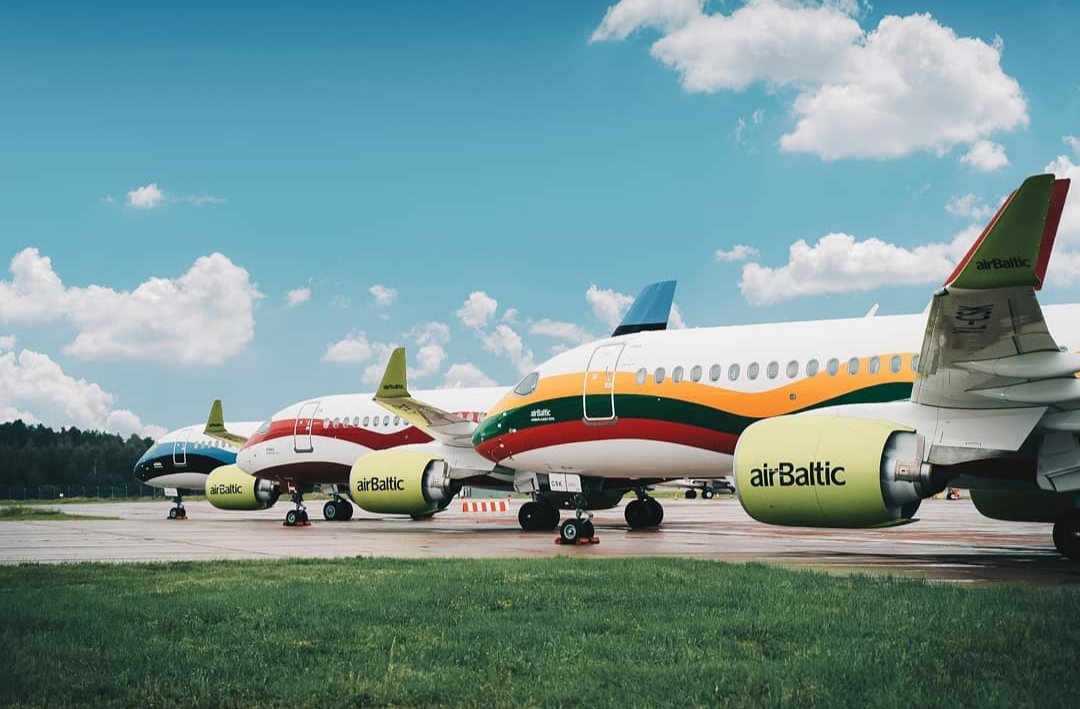
airBaltic operates roughly 30 routes from Tallinn and holds about one third of that airport's passenger traffic. From Lithuania it runs 21 direct routes out of Vilnius, two from Palanga, plus service from Kaunas. It is, functionally, the regional carrier for all three Baltic states, headquartered in one of them.
Officials in both neighbouring countries have been publicly calm. Tallinn Airport's Eero Pärgmäe said the airport sees “no major reason for panic,” pointing to 15 regular carriers and route-support incentives for airlines willing to take on new services. Lithuania's transport minister Juras Taminskas said there is “no need to panic in advance,” and noted that LOT and Finnair could expand if airBaltic withdrew.
Both are almost certainly right about the profitable routes. Riga–Frankfurt and Vilnius–London will be flown by somebody.
The exposure is elsewhere. The Estonian aviation analyst Erki Urva put it plainly: if the carrier exits, “marginal routes will disappear” — the thin services to smaller destinations that no hub airline has any commercial reason to pick up.
Those marginal routes are, disproportionately, the ones the diaspora uses. The connection that lets you reach Palanga rather than Vilnius. The frequency that makes it possible to fly out on a Thursday for a family event and be back by Monday. The schedule that means a summer visit to grandparents is a manageable trip rather than a two-day expedition each way.
Trunk routes survive on business demand. The routes that hold a scattered community together survive on volume that is seasonal, sentimental and thin.
The Wider Squeeze
This is happening alongside two other pressures on Baltic connectivity, and the combination matters more than any single item.
Russian airspace has been closed to European carriers since 2022, which lengthens Asian routings and removes a category of traffic the region's airports used to carry.
And GPS interference over the Baltic Sea has become a persistent operational fact rather than an occasional incident, forcing carriers to plan around degraded satellite navigation in a corridor that includes some of the region's busiest approaches.
Neither of these is going to be resolved by a share offering.
What This Means If You Have a Trip Booked
Practical, without alarmism:
Nothing has been cancelled. As of mid-August 2026, airBaltic is operating a normal schedule. This is a financing deadline, not a grounding.
Know how you paid. If a European airline ceases operations, EU passenger rights offer limited protection against insolvency itself. A credit card chargeback is often the more effective route, and travel insurance covering carrier insolvency — which many policies exclude by default — is the reliable one. Check your policy wording rather than assuming.
Beware the separate-ticket trap. This is the one that catches people every year. If your transatlantic flight and your Baltic connection are booked on one ticket, the operating carriers are responsible for getting you to your final destination. If they are two separate bookings, and the second airline stops flying, you are on your own with a useless coupon and an unplanned night in Frankfurt. Booking through a single itinerary costs more and is worth it right now.
Know the alternatives. Finnair via Helsinki serves all three Baltic capitals and connects to North America. LOT via Warsaw does the same. Ryanair and Wizz Air fly to all three from across Europe on a low-cost basis, though not on a single ticket with an intercontinental leg. And overland matters more than North American readers expect: Lux Express and Ecolines run comfortable long-distance coaches between the capitals, and the Tallinn–Helsinki ferry is a two-hour crossing that makes Helsinki a practical gateway to Estonia.

Rail Baltica, and the Longer Horizon
There is a larger project standing behind all of this.
Rail Baltica is the European-gauge railway intended to connect Tallinn, Riga, Vilnius and Warsaw to the rest of the European network — the first standard-gauge link between the Baltic states and Europe, replacing an inherited Soviet-gauge system that pointed east.
It has been slower and more expensive than promised, which has drawn a great deal of criticism, some of it deserved. But it is the only piece of infrastructure on the table that would give the region a connection not dependent on the finances of any single airline.
If airBaltic recapitalises successfully — and the state clearly intends it to — this passes as a difficult year. If it does not, the region will spend the next decade discovering how much of its connection to the world was resting on one company's balance sheet.
For a community that measures its relationship to a homeland in flight segments, that is worth watching. The next signal comes at the end of this month.

