Baltics NOW Brings Indie, Jazz, Folk, and Kanklės to New York
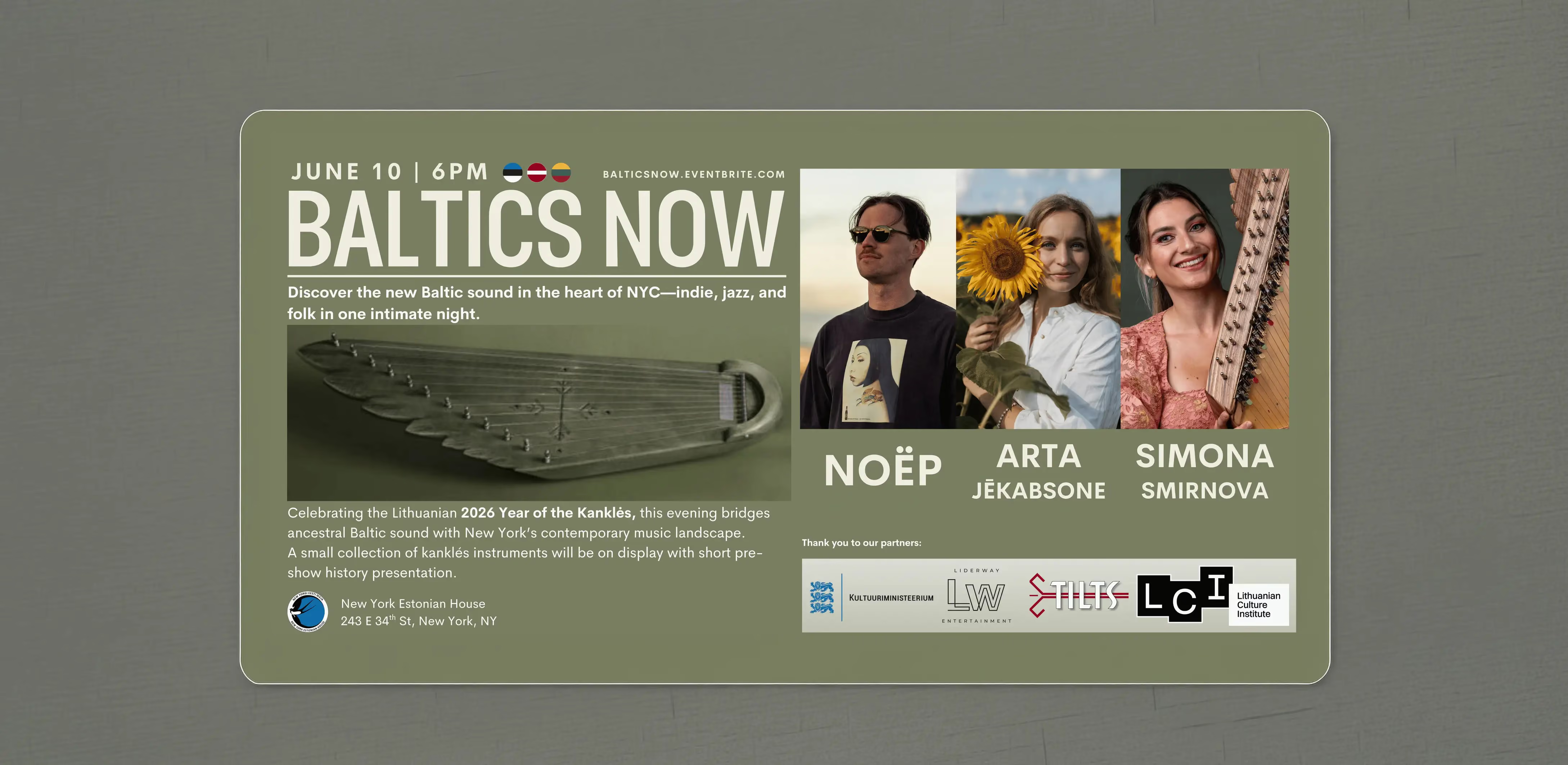
On June 10, New York Estonian House will become something more than a venue. For one evening, it will be a small map of the contemporary Baltic sound: Estonian electronic pop, Latvian jazz, Lithuanian folk-jazz, and the resonant wooden body of the kanklės sharing the same room.
The event, titled Baltics NOW, brings together three artists with roots in Estonia, Latvia, and Lithuania: NOËP, Arta Jēkabsone, and Simona Smirnova. On paper, the lineup reads like a concise three-country cultural showcase. In practice, it points to something more interesting: a Baltic musical language increasingly comfortable moving between indie production, improvisation, folk memory, global jazz, and diaspora space.
For Baltic communities in the United States and Canada, that matters. Cultural programming in diaspora life is often asked to do two jobs at once: honor inheritance and prove that inheritance is still alive. A concert like this does not solve that tension by choosing between old and new. It lets the tension become the music.
NOËP, the Estonian indie and electronic-pop artist, represents one version of contemporary Baltic visibility: digitally fluent, exportable, and unafraid of pop’s broad reach. His live performances blend electronic production, guitar, and vocals, while his wider musical world has included collaborations and crossovers that place modern indie sound in conversation with regional roots.
That kind of movement matters. Baltic music abroad is still often filtered through older reference points: song festivals, folk dance, choral tradition, and the memory work of postwar exile communities. Those traditions remain foundational. But they are not the only way Baltic sound travels now. It can also arrive through loops, samples, electronic production, festival stages, and the immediacy of a pop chorus.
Arta Jēkabsone brings another route into view. A Latvian vocalist, composer, and arranger based in New York, she works in jazz, a form that has always depended on movement: between cities, languages, teachers, standards, improvisers, and personal histories. For a Baltic artist in North America, jazz offers a particularly flexible frame. It does not require tradition to appear in costume. It allows memory to enter through phrasing, breath, harmony, storytelling, and tone.
Jēkabsone’s work has been described through its warmth, clarity, and storytelling, with Latvian folk melodies often informing her contemporary jazz language. In a city like New York, where jazz is both a local tradition and a global meeting ground, her presence in Baltics NOW points to the way Baltic identity can be carried not only through repertoire, but through sensibility.
Then there is Simona Smirnova, a Lithuanian vocalist, composer, and kanklės player based in New York. Her presence gives the evening its deepest heritage thread, especially because Lithuania has designated 2026 as the Year of the Kanklės. The observance marks the 120th anniversary of the first kanklės ensemble in Skriaudžiai and has prompted renewed public attention to the instrument in Lithuania and among Lithuanian communities abroad.
The kanklės is often described in English as a Lithuanian zither. That is technically useful, but emotionally insufficient. For Lithuanians, the instrument carries associations with folk music, national revival, domestic music-making, exile, and continuity. Its sound is intimate rather than monumental. It does not announce itself like brass or surround a listener like a massed choir. It seems to ask people to lean in.
That intimacy may be exactly why it works so well in diaspora. Large festivals, song celebrations, and dance gatherings give Baltic identity scale. They make culture visible in public space. The kanklės does something quieter. It makes heritage audible at close range, through wood, string, hand, and vibration.
In Lithuania, recent attention to the Year of the Kanklės has emphasized both authenticity and renewal. Instrument makers speak of wood selection, craft knowledge, and teacher-to-student transmission. Cultural institutions have treated the instrument as a marker of identity, while younger musicians and contemporary composers continue to test what it can do outside expected folk settings.
That is where a New York concert becomes more than a local listing. It places the kanklės in conversation with electronic production, jazz improvisation, and Baltic artists who are already working across borders. It suggests that a heritage instrument does not have to be protected from the present in order to survive. It may need the present: new rooms, new collaborators, new listeners, and the confidence to sound slightly unfamiliar.
The setting matters too. New York Estonian House is not a neutral stage. Like many ethnic houses, halls, churches, and community centers across North America, it carries decades of meetings, concerts, language classes, commemorations, and informal gatherings. These buildings are often asked to hold more memory than their walls can reasonably bear. Yet when they work, they do something rare: they give culture a physical address.
For younger Baltic Americans and Baltic Canadians, that address can be complicated. Some grew up in these spaces. Others arrive later, through music, food, language study, politics, genealogy, or curiosity. Some speak Estonian, Latvian, or Lithuanian fluently. Others know only fragments: a song refrain, a holiday greeting, a grandparent’s pronunciation of a place name. A contemporary concert can meet all of them without turning partial inheritance into a deficiency.
Music is especially good at that kind of welcome. It does not require every listener to understand every word in order to feel form, rhythm, humor, melancholy, or lift. It can make a language present even when comprehension is incomplete. It can let the unfamiliar remain unfamiliar without shutting the listener out.
That may be one reason Baltic music has traveled so well in recent years. Eurovision has introduced wider audiences to acts willing to mix folk instruments, regional languages, irony, and pop spectacle. Jazz scenes in New York, Boston, Toronto, and elsewhere have made room for musicians whose cultural references do not fit neatly into American categories. Folk and experimental artists from the region have found listeners who are less interested in purity than in texture, energy, and point of view.
Baltics NOW sits inside that larger shift. The title is simple, but the word “now” is doing real work. It refuses the idea that Baltic culture in North America belongs mainly to anniversaries, commemorations, or postwar memory, important as those remain. It points instead to artists making choices in the present tense.
That present tense does not erase history. It depends on it. The kanklės has weight because people carried it, built it, taught it, and heard themselves in it before it arrived in a New York showcase. Latvian jazz carries meaning because a voice formed by one language and landscape can enter another musical tradition without disappearing into it. Estonian indie-pop carries meaning because a small-language culture can move through global platforms without surrendering all its specificity.
For editors, organizers, and community leaders, the lesson is worth noticing. Baltic cultural life in North America does not need to choose between the festival field and the experimental stage, between the folk costume and the downtown club, between the old song and the new arrangement. The healthiest cultural ecosystems make room for all of them.
A single concert cannot represent Estonia, Latvia, and Lithuania in full. No lineup can. But it can offer a useful glimpse of where things are going: toward collaboration, stylistic confidence, and a looser understanding of what it means to sound Baltic outside the Baltics.
For those who attend, the evening may be memorable because of a beat, a voice, a melody, or the unexpected shimmer of strings. For the wider diaspora, its significance is broader. It shows that Baltic music in North America is not only being remembered.
It is being rehearsed, revised, and played forward.

)%20(1).avif)