Lithuania’s Dagilėlis Boys’ Choir Brings a Living Choral Tradition to Ontario
-topaz-sharpen%2520(1).avif)
In July, a Lithuanian boys’ choir will step into two Ontario performance spaces and carry with it something larger than a concert program.
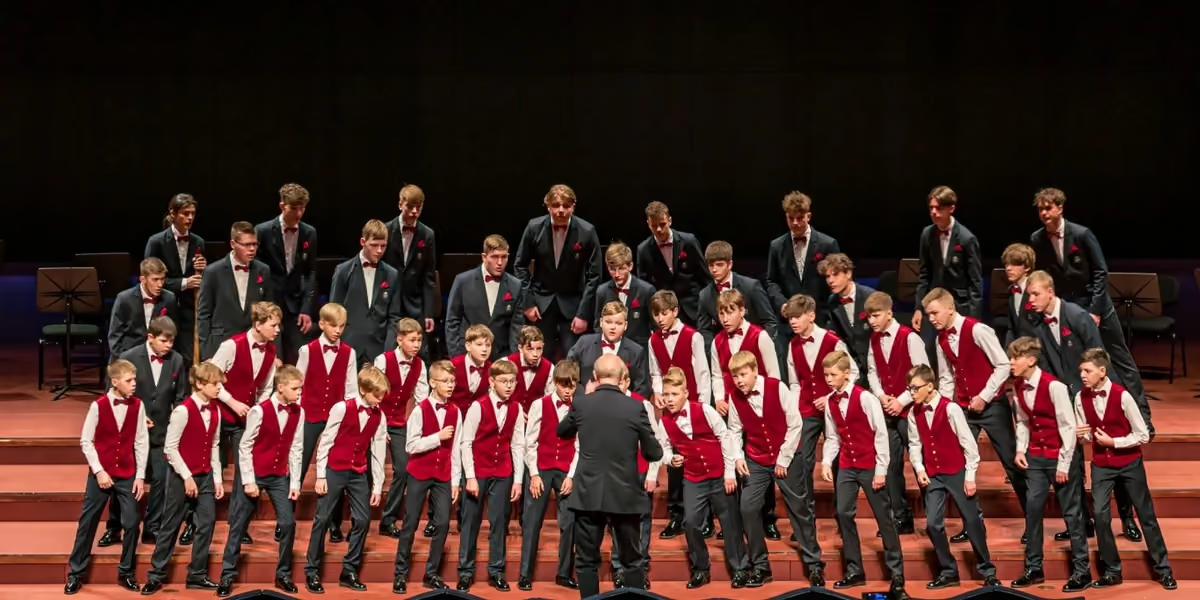
The Dagilėlis Boys’ Choir of Šiauliai is scheduled to appear at the Collingwood Music Festival on July 11, 2026, and at Music Niagara in Niagara-on-the-Lake the following day. On paper, these are classical summer festival dates: polished young singers, church acoustics, and audiences ready for beauty. But for Lithuanian Canadians, Baltic communities, and anyone who understands how song can hold a people together, the arrival of Dagilėlis also feels like a small cultural crossing.
Lithuanian choral music has never been only about performance. It is bound up with language, civic memory, religious sound, school discipline, amateur culture, and the extraordinary public force of song festivals. In Lithuania, singing has long carried both artistry and social meaning. In the diaspora, that meaning changes shape but does not disappear. A choir from Šiauliai singing in Ontario can become, for one afternoon, a reminder that culture is not preserved only by archives, monuments, or family stories. Sometimes it arrives in breath.
Dagilėlis is a particularly fitting ensemble for that work. Founded in 1990 by conductor and educator Remigijus Adomaitis, the choir has grown into one of Lithuania’s prominent children’s and youth choral groups. The year of its founding matters. Lithuania restored independence in 1990, and while the choir should not be reduced to a political symbol, its life has unfolded alongside a renewed national public culture.
Its singers have represented Lithuanian choral art across borders, performing internationally and earning major competition honors. Since 1999, Dagilėlis has also had its own singing school in Šiauliai, which points to the deeper structure behind the sound: young voices are not found by accident. They are trained, gathered, rehearsed, and given a community in which music becomes a way of growing up.
That may be why a boys’ choir can move audiences so directly. Youth choirs ask listeners to hear two things at once: the refinement of a serious musical tradition and the vulnerability of voices still changing, still becoming. There is discipline in the blend, but also a kind of openness. The sound is not yet fixed into adulthood. It suggests inheritance in motion.
For diaspora audiences, that quality can be especially powerful. Many Lithuanian families in Canada and the United States know what it means for culture to be carried unevenly from one generation to the next. Some inherit fluent Lithuanian. Others inherit only phrases, foods, parish memories, summer camps, dance groups, or a surname that asks to be explained. Choral music has a way of crossing those gaps. A listener does not need to understand every word to recognize that language is present as texture, rhythm, and emotional weight. The sung syllable can reach people who might feel intimidated by the spoken one.
That does not make language secondary. Quite the opposite. In song, language becomes embodied. It is held in posture, vowel shape, timing, and collective listening. For communities whose heritage languages often survive under pressure from English, that matters. A choir gives the language a room.
The Ontario settings also matter. Collingwood’s presentation places Dagilėlis within the festival’s Rising Stars Series, a frame that emphasizes youth, discipline, and artistic promise. The concert will take place at First Presbyterian Church, where the choir’s program moves across sacred, contemporary, Baltic, and international repertoire. Music Niagara’s performance the following day places the ensemble in St. Mark’s Church in Niagara-on-the-Lake, as part of the festival’s Young Virtuoso Series.
These are not necessarily Lithuanian community halls. They are broader Canadian arts spaces. That distinction gives the concerts another layer of meaning: Lithuanian culture is not appearing only for itself, but entering a shared public stage.
For Baltic communities in North America, that public visibility can feel quietly important. Much diaspora culture happens in rooms built by the community: churches, houses, camps, language schools, museums, and festival grounds. Those spaces remain essential. But there is also value in moments when Baltic art appears before mixed audiences, not as a token of “heritage,” but as serious contemporary cultural work.
Dagilėlis does not need to be translated into a generic world-music curiosity. It can stand as what it is: a Lithuanian choir with a Baltic choral tradition behind it, a high musical standard, and young performers capable of making that tradition present.
The announced Collingwood program itself tells a story about artistic range. It includes international sacred and contemporary works alongside Lithuanian and Baltic repertoire, moving from John Rutter, Alessandro Scarlatti, Ola Gjeilo, César Franck, Karl Jenkins, Keith Hampton, and Christopher Tin to composers such as Vytautas Klova, Vaclovas Augustinas, Donatas Zakaras, Algirdas Martinaitis, Vytautas Kernagis, and Estonia’s Urmas Sisask.
That combination is important. It resists the idea that a national choir must perform only national music in order to represent its culture. A strong tradition proves itself partly through what it can hold. Dagilėlis can sing Lithuania outward, but it can also bring the world into Lithuanian vocal discipline. The result is not a museum display. It is a living repertoire.
Lithuania’s larger choral context gives that repertoire additional force. The Baltic song and dance celebrations, shared by Lithuania, Latvia, and Estonia, have been recognized by UNESCO as part of humanity’s intangible cultural heritage. These mass celebrations assemble thousands of singers and dancers and are rooted in amateur performance traditions, civic participation, and collective memory. For Lithuanians, song festivals are not simply concerts at scale. They are public acts of continuity.
A touring youth choir operates differently, of course. It does not reproduce the scale of a song festival. It offers intimacy instead. But the connection remains. A song festival makes a nation audible in the open air. A boys’ choir makes that same commitment legible in rehearsal discipline, breath, diction, and the careful formation of young singers.
The concerts also arrive in a North American cultural moment when many heritage communities are asking how to keep younger people involved without making culture feel like obligation. Choirs offer one answer. They require commitment, but they also create belonging through practice. A singer learns where to breathe because everyone else is breathing there too. A rehearsal teaches not only music, but attention, patience, humor, and responsibility to the group. That is a form of cultural education even before any history is explained.
This is something Nordic and Baltic readers across the United States and Canada will recognize. Whether in Latvian choirs, Estonian song traditions, Finnish language camps, Norwegian folk art classes, Swedish children’s programs, or Lithuanian dance groups, heritage often survives through repeated activity. Not grand declaration, but showing up. Not identity as an abstract label, but identity as something done together.
Dagilėlis’ Ontario performances will likely be heard differently by different listeners. Some will come for refined choral music. Some will come because Lithuania is part of their family story. Some may bring children under 16 to the Collingwood performance, where youth admission is available with a paying adult, and find themselves watching young people from Lithuania model a kind of artistic seriousness that does not feel distant or old-fashioned. Others may simply sit in the acoustic glow of a church and hear a Baltic sound they did not know they needed.
That is the gift of a touring choir. It turns distance into presence. Šiauliai, Collingwood, Niagara-on-the-Lake, Vilnius, Toronto, Chicago, and all the smaller places where Baltic families have gathered over generations are not made identical by song. But for the length of a concert, they can be placed in relation.
When Dagilėlis sings in Ontario, the most important thing may not be that Lithuanian culture has arrived from elsewhere. It may be that listeners in North America are reminded it has been here all along, waiting for rooms where the next generation can hear it clearly.

)%20(1).avif)