Kaspars Groševs Opens Solo Exhibition Live With/Think About at Kim? Contemporary Art Centre in Riga
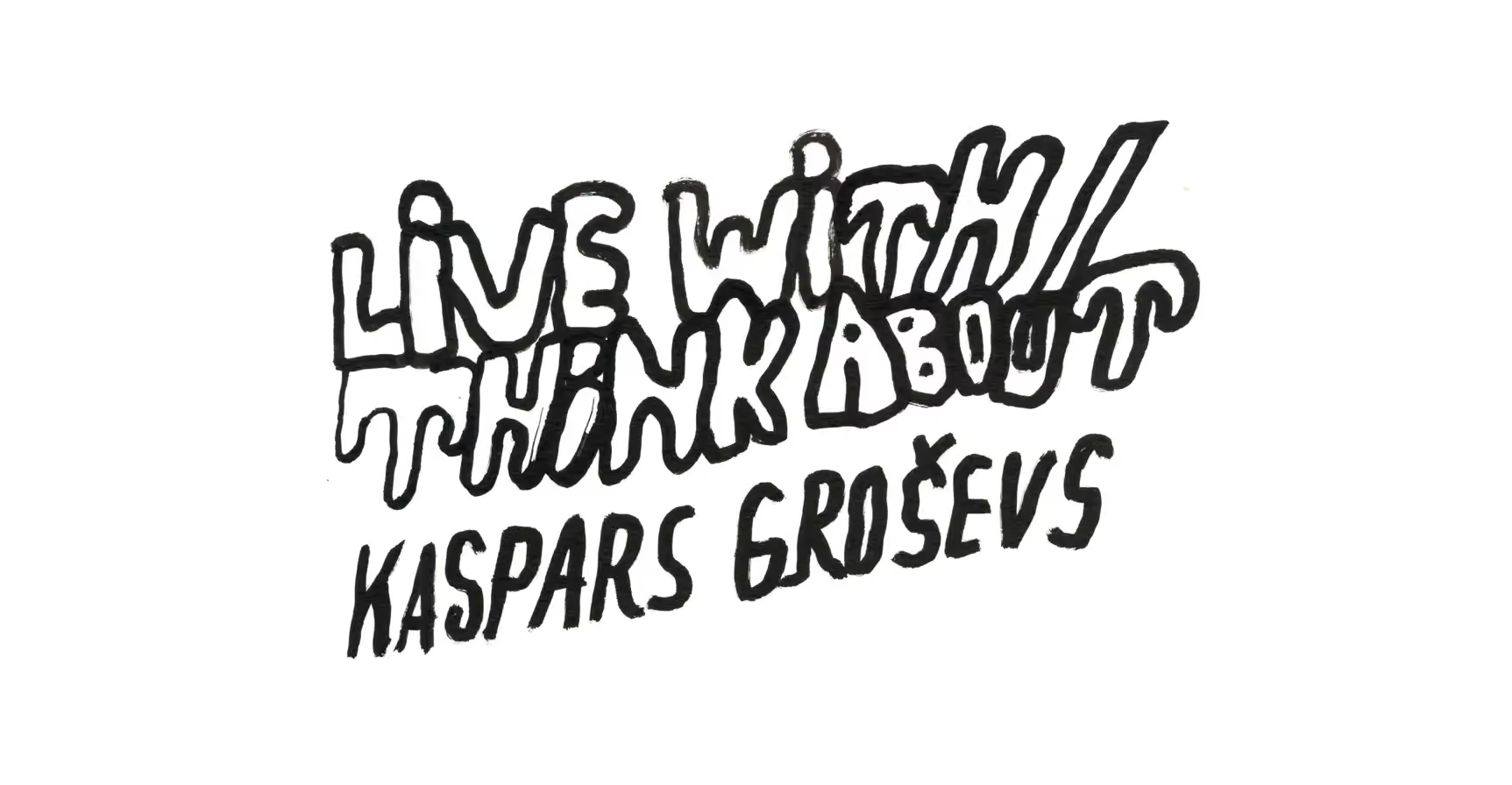
Kim? Contemporary Art Centre will present Live With/Think About, a solo exhibition by Latvian artist Kaspars Groševs, opening April 30, 2026, from 6 to 10 pm at Kim?, Sporta iela 2 in Riga.
Curated by Zane Onckule, the exhibition runs from May 1 through June 7, 2026. The opening evening will include a performance by interdisciplinary performance artist 011668 from the United States.
For Groševs, Live With/Think About begins as a temporary condition of presence. “From 30 April 2026 to 7 June I will mostly be found at Kim? Contemporary Art Centre in Riga — for a while I will be ‘living and working’ here,” the artist writes.
The exhibition is described not as a fixed exhibition, performance, or action, but as “a small sketch of life.” For a while, Groševs’ apartment is available for short-term rent. For a while, he sleeps and walks here, sits on the internet and paints. For a while, he listens to music and plays music, thinks about art and creates art, exhibits works, sells art, exchanges art, makes mistakes, and opens his living and working space to the public.
At Kim?, Live With/Think About functions simultaneously as proposition and condition: a way of remaining within perception while examining how perception is produced and sustained. Marking Groševs’ return to Kim? thirteen years after his last solo presentation at the centre, the exhibition brings together sound, image, display, and social infrastructure in a continuous environment where the separation between discrete mediums begins to dissolve.
Rather than presenting a collection of finished works, Live With/Think About unfolds as a situation that is actively shared and persistently reconfigured through use.
“Living with” and “thinking about” operate as interlacing modes of attention. Experience is held at the point of ongoing formation, where repetition gathers weight, attention drifts and returns, and fatigue or small intensities become part of the material itself. Thinking moves within this field slightly out of phase, while what is perceived remains legible but never fully stabilizes.
This logic becomes concrete through the exhibition’s spatial and procedural setup. Production and display are deliberately entangled. A small shop at the entrance extends the system outward through T-shirts, zines, tapes, and printed matter produced both on and off-site. A workshop area keeps the creative process exposed, allowing objects to remain visible as unfolding operations rather than closed outcomes.
A shared room functions as a space for listening, jamming, performing, tattooing, getting one’s nails done, and informal exchange. In this setting, private reference and collective attention continually intersect. Elsewhere, rehearsals are held as a working condition within the same continuum of activity, while a sleeping zone constructed from reused materials folds rest back into the exhibition’s operational rhythm.
Groševs’ practice extends beyond the exhibition itself into the infrastructures that sustain it. His work as an artist, curator, musician, and co-founder of an independent gallery is interwoven across a shared continuum. A quieter pedagogical dimension also runs through the project, grounded in proximity and in the circulation of knowledge through doing.
The economic and material conditions surrounding the work remain close to the surface. Making, organizing, and sustaining blur into one another, shaping a practice formed under the continual pressure of self-maintenance.
Analogue forms such as tapes and materially grounded processes serve as working tools, introducing duration, resistance, and friction into a present often oriented toward speed and resolution. Tactility, imperfection, inconvenience, and ambiguity become structural conditions, shaping how things are produced, circulated, and encountered.
At the level of infrastructure, Live With/Think About shifts attention away from broadcast-scale distribution toward smaller, embedded constellations of exchange. Proximity becomes a method. Relations, objects, and actions share the same field, allowing direct mutual influence across layers of mediation.
The exhibition ultimately stages a continuous state of working-through rather than resolution. It unfolds as a live system — a life livestream of sorts — shaped by use, co-presence, and ongoing adjustment. Within it, persistence, production, and reflection circulate in the same loop: an ongoing negotiation with the conditions of making and staying afloat.
Artist Biography
Kaspars Groševs, born in 1983, holds bachelor’s and master’s degrees in visual communication from the Latvian Academy of Arts. Since 2014, he has been a co-founder and curator of the artist-run gallery 427.
Since 2006, Groševs has participated in Latvian and international exhibitions, performances, and cultural events. His practice moves across art, curatorial work, sound, process, and the dissolving boundaries between creative communities. He has worked with experimental electronic music since the late 1990s, and sound in his exhibitions often appears as an extension of visual methods, with painting also playing a significant role.
Groševs has exhibited at institutions and spaces including the Latvian National Museum of Art, the Latvian National Library, Riga Smallest Gallery, Noass, TUR space, Kim? Contemporary Art Centre, Cēsis Contemporary Art Centre, Medūza, the Radvila Palace Museum of Art, CAC and Editorial in Vilnius, darkZone in New Jersey, Harkawik, No Moon, Art in General in New York, Futura in Prague, BOZAR, Shanaynay in Paris, and SIC in Helsinki.
He has curated exhibitions at Garage Gallery and City Surfer Office in Prague, Skulptur Institut in Vienna, Kim? Contemporary Art Centre, P////AKT in Amsterdam, and Polansky Gallery in Brno, among others. Since 2003, he has produced radio programs on Radio NABA. In 2017, together with Labais Dāma, he co-founded the cassette label No Sex Just Talk.
His works are included in the collection of the Latvian National Museum of Art and in numerous private collections in Latvia and abroad. He was nominated for the Purvītis Prize in 2020 and 2022.

)%20(1).avif)