After Vienna, the Baltic Pop Story Feels Bigger Than the Scoreboard
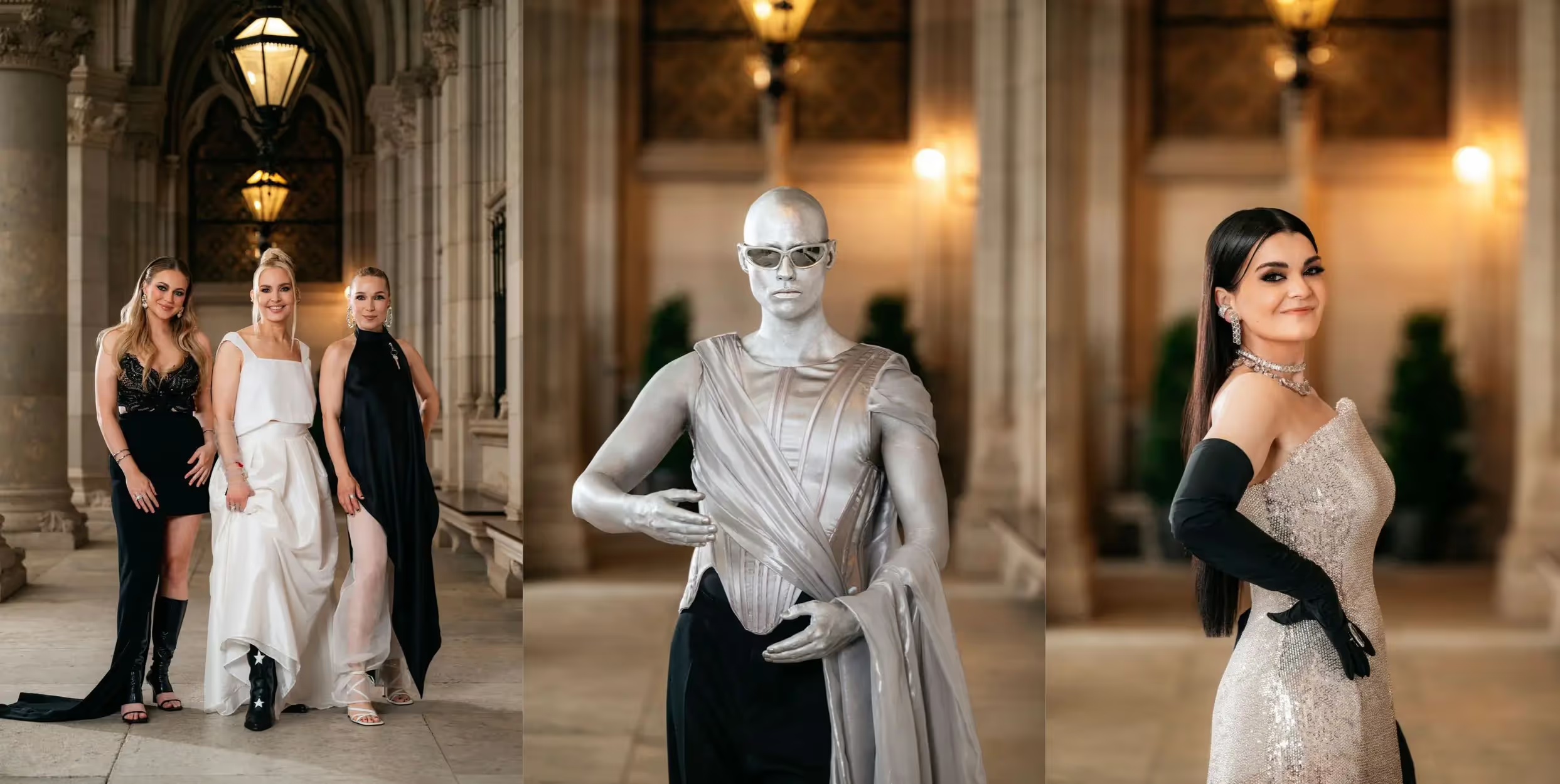
The song finished with 516 points, well ahead of Israel in second place with 343, in a Grand Final that mixed pop spectacle, political tension, and the usual Eurovision collision of sincerity and absurdity.
Yet for many Estonian, Latvian, and Lithuanian viewers watching from the United States and Canada, the deeper story was not only who won. It was what the Baltic entries said about the region itself. Estonia, Latvia, and Lithuania arrived in Vienna with three very different pop languages: nostalgic rock spectacle, Latvian-language emotional shadow work, and multilingual theatrical pop. Together, they suggested a Baltic music culture that no longer needs to introduce itself apologetically, translate away its edges, or choose between local identity and international scale.
That matters in diaspora communities, where Baltic culture is often presented in two familiar registers. One is historical, solemn, and dutiful: songs of occupation, exile, endurance, memory, deportation, and survival. The other is folkloric and communal: dance festivals, choir concerts, midsummer gatherings, embroidered shirts, rye bread, folk costumes, Saturday schools, and the stubborn miracle of keeping small languages alive an ocean away.
Both registers are real, and both deserve their place. But pop culture does another kind of work. It shows whether a culture feels contemporary in its own voice. It tells younger audiences, especially those raised in English-dominant North America, that belonging does not have to arrive only through reverence. Sometimes it arrives through the chorus you cannot stop replaying, the staging you send to a cousin, the lyric you look up because you almost understand it, or the national final you watch at an unreasonable hour because it feels, in some small way, like checking in with home.
That is part of what made the Baltic presence around Eurovision 2026 feel unusually vivid, even when the scoreboard itself was mixed. Lithuania’s Lion Ceccah reached the Grand Final with “Sólo Quiero Más,” finishing 22nd with 22 points after qualifying from the first semi-final. Estonia’s Vanilla Ninja, returning with “Too Epic To Be True,” placed 11th in the first semi-final with 79 points, narrowly outside qualification. Latvia’s Atvara placed 13th in the second semi-final with “Ēnā,” earning 49 points.
Those numbers matter, but they do not exhaust the meaning of the moment. If anything, they sharpen it. Eurovision is a contest, but it is also a yearly test of cultural presentation: What does a country choose to sound like when it knows millions are watching? What does it risk? What does it assume foreigners can understand? What does it refuse to simplify?
Estonia’s answer was memory with volume. Vanilla Ninja’s return carried a particular charge because the band is already part of Baltic Eurovision history. The group represented Switzerland in 2005 with “Cool Vibes,” a strange and revealing footnote in Eurovision memory: an Estonian rock band becoming internationally visible through another country’s entry. In 2026, appearing under the Estonian flag with “Too Epic To Be True,” the band offered something different — not discovery, exactly, but reclamation. The entry folded early-2000s pop-rock nostalgia into a self-aware Eurovision register, turning familiarity into spectacle.
For older viewers, Vanilla Ninja’s return carried the pleasure of recognition. For younger ones, it offered something just as valuable: proof that Baltic pop history is not frozen in sepia. It can be revived, exaggerated, joked with, and staged at full volume. Estonia did not qualify for the Grand Final, but its choice still said something important about how the country understands Eurovision. Estonia often treats the Contest not merely as a promotional platform, but as a space for tonal intelligence — a place where irony, craft, eccentricity, and strong visual identity can coexist.
That instinct has made Estonia one of the region’s most interesting Eurovision countries. The country’s modern Eurovision imagination has room for sincerity and oddity, polish and prankishness. Whether through 5MIINUST x Puuluup’s gleeful eccentricity in 2024, Tommy Cash’s continental absurdism in 2025, or Vanilla Ninja’s return in 2026, Estonia has repeatedly shown that small countries can use Eurovision not to look larger, but to look more specifically themselves.
Latvia’s case was quieter, and perhaps more moving. Atvara’s “Ēnā,” whose title translates as “In the Shadow,” was performed in Latvian and came through Latvia’s Supernova selection after winning both the jury and public vote. Eurovisionworld lists the entry as Latvian-language, with Liene Atvara — real name Liene Stūrmane — as the artist and co-writer.
That linguistic choice matters. For diaspora readers, Latvian is often a language of inheritance: learned in Saturday school, heard from grandparents, sung in choirs, spoken imperfectly at camps, or carried in fragments across generations. A Latvian-language Eurovision entry places that language in a different emotional register. It is not only a heritage object, not only the language of folk song or ceremony, but a vehicle for contemporary pop feeling.
The lyrics of “Ēnā” carry a domestic and psychological heaviness unusual for Eurovision’s more export-ready pop entries. The song’s English translation includes images of warmth given to “cold people,” emotional depletion around those closest to you, silence, and remaining “in the shadow.” That is not the language of tourism branding. It is not an attempt to make Latvia easier for outsiders. It asks listeners to enter a more intimate emotional space, one shaped by ambiguity, family pain, and the slow erosion of voice.
For Latvian communities in North America, that may be the entry’s deeper resonance. Latvian cultural life abroad has long depended on institutions that work hard, and often quietly, to hold continuity together: schools, choirs, camps, churches, dance groups, summer festivals, literary circles, and family networks. Those spaces matter enormously. But they can also make culture look heavier than it feels in everyday life. A contemporary artist like Atvara changes that picture. She suggests a Latvian identity that is not only inherited but current, not only preserved but produced in real time.
Lithuania’s Lion Ceccah offered a different but equally important signal. “Sólo Quiero Más” was multilingual, moving through Lithuanian, Spanish, English, French, German, and Italian phrases, with the title translating as “I Just Want More.” Eurovisionworld lists the performer as Lion Ceccah, real name Tomas Alenčikas, also known as Alen Chicco, and places Lithuania 22nd in the Grand Final after qualifying from the first semi-final.
The entry’s multilingualism was not a gimmick. It was the point. One of its most revealing lines — “Maybe it would be easier with subtitles?” — felt almost like a wink at the condition of smaller-language pop in a global arena. Eurovision is built on translation, but the translation is never neutral. Countries constantly decide how much of themselves to explain, how much to leave intact, and how much to turn into style. Lithuania’s choice suggested a culture comfortable with hybridity: Lithuanian enough not because it stayed within a narrow definition of national sound, but because it trusted a Lithuanian artist to move freely across language, theatre, pop, queer-coded performance vocabulary, and continental self-invention.
That matters for Lithuanian diaspora life in the United States and Canada, where cultural continuity often carries a familiar tension. There is deep pride in language, Catholic and civic institutions, folk dance, song, literature, basketball, history, and the long memory of occupation and independence. At the same time, younger Lithuanian North Americans often experience identity through mixture: mixed households, imperfect language fluency, global media, queer communities, international friendships, and a sense that modern Lithuania is far more urban, playful, and stylistically fluid than heritage programming sometimes allows.
Lion Ceccah’s performance did not resolve that tension. It ignored the premise. It made visible a Lithuania that many younger people already know: multilingual, art-school adjacent, theatrical, ironic, emotionally direct, and unafraid of being difficult to categorize.
This is where Eurovision still matters more than its skeptics admit. Yes, it is camp. Yes, it is absurd. Yes, it turns national feeling into a three-minute lighting cue. But it is also one of the rare stages on which countries of radically different sizes are asked to be maximally legible to one another through music. For smaller-language cultures, that is no minor thing. Eurovision creates a public test of confidence: Can you sound like yourself and still travel? Can you make a local language feel immediate to strangers? Can you stage national identity without reducing it to costume?
The Baltic answer this year was not uniform, and that is precisely why it was interesting. Estonia reached backward through pop memory and made it theatrical. Latvia went inward, choosing language, shadow, and emotional specificity. Lithuania went outward, into multilingual performance and stylistic excess. Three countries, three energies, three different arguments against the idea that Baltic culture abroad must be packaged mainly as memory.
For Baltic communities in the United States and Canada, this may be the most useful way to think about Eurovision: not as a guilty pleasure detached from cultural life, but as a recurring public referendum on whether the old countries still look alive to their people abroad. A strong entry does more than entertain. It refreshes the archive. It gives cousins and grandparents, fluent speakers and half-speakers, regular festival-goers and casual YouTube scrollers, something contemporary to point to and say: that is ours too.
This is especially important for second-generation and mixed-background households, where heritage often survives less as doctrine than as atmosphere. A choir tour, a midsummer bonfire, a grandmother’s recipe, a phrase remembered imperfectly, a folk dance rehearsal, a summer camp friendship, a national final watched late at night on a laptop — these are not equivalent experiences, but they accumulate into identity. Pop music belongs in that list. It can be frivolous, but frivolity is not the opposite of meaning. Quite often, it is the vehicle that carries meaning across generations without making it feel like homework.
Eurovision also offers diaspora audiences something that traditional heritage spaces sometimes struggle to provide: simultaneity. When a Lithuanian American watches Lion Ceccah qualify, when a Latvian Canadian hears “Ēnā” in Latvian on a European stage, when an Estonian family debates whether Vanilla Ninja should have made the final, they are not only remembering culture. They are participating in it at the same time as people in Tallinn, Rīga, Vilnius, Toronto, Chicago, New York, Los Angeles, Vancouver, and beyond.
That shared present tense is powerful. Diaspora culture often lives with a delay. News arrives after the fact. Traditions are preserved from a version of the homeland that may no longer fully exist. Children inherit songs their relatives abroad sing more faithfully than cousins back home. Eurovision interrupts that delay. For one week, everyone is watching the same stage, arguing over the same lighting choices, defending the same lyrics, and feeling the same strange mix of pride and embarrassment that national pop can provoke.
The scoreboard, of course, will be what Eurovision history keeps most neatly. Bulgaria won. Lithuania placed 22nd in the Grand Final. Estonia and Latvia remained in the semi-finals. Fans will continue to argue over juries, televotes, staging, running order, and whether Europe understood what each Baltic country was trying to do.
But the more lasting Baltic takeaway from Eurovision 2026 may be simpler. Estonia, Latvia, and Lithuania arrived in Vienna sounding contemporary, particular, and unafraid of style. They did not offer one tidy Baltic identity, and they did not need to. They offered something better: proof of range.
For a region that is still too often packaged abroad as pure memory, that matters. And for diaspora readers across North America, it is a welcome reminder that cultural continuity is not only about what we preserve. It is also about what we can still make — loudly, awkwardly, beautifully, bilingually or multilingually, under bright lights, in the present tense.



)%20(1).avif)