Why KAJ’s Sauna Song Traveled So Far

Sweden’s 2025 Eurovision entry was funny, local, and deeply specific. That may be exactly why Nordic communities far from Vörå heard something familiar in it.
There are songs that travel because they have been polished into international sameness. Then there are songs that travel because they refuse to do that at all.
KAJ’s “Bara Bada Bastu,” the sauna-loving, dialect-rich entry that represented Sweden at the 2025 Eurovision Song Contest, belonged firmly to the second category. On paper, it could have been too local to become a continental obsession. It was cheerfully specific. It was funny in a way that did not pause to explain itself. It leaned into the rhythms of Swedish as spoken in a particular Finland-Swedish context. It treated sauna not as exotic Nordic branding, but as ordinary joy.
And that may be exactly why it landed so hard.
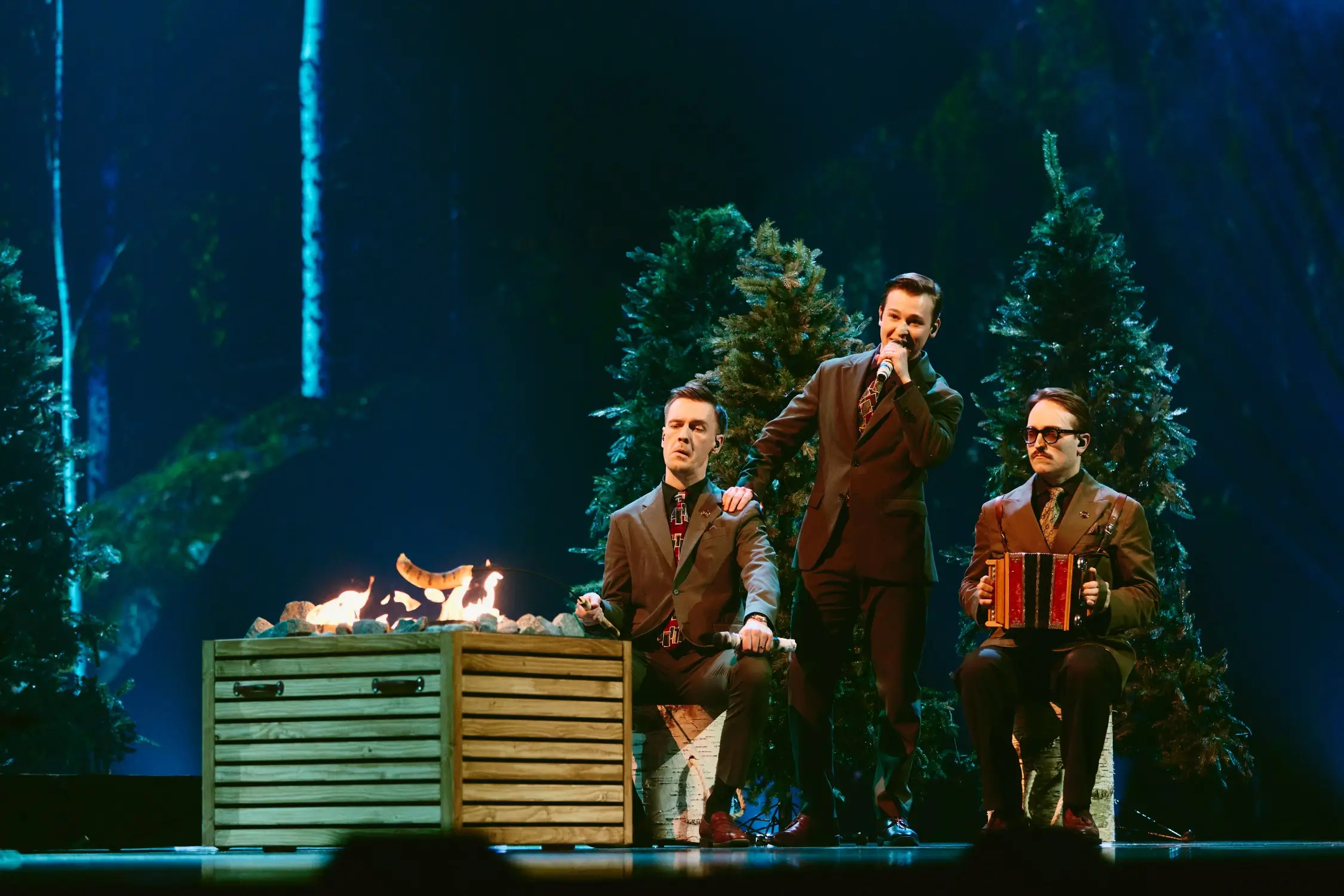
For readers of The Northern Voices, especially across the United States and Canada, KAJ’s breakthrough carried a familiar emotional charge. The trio, formed in Vörå, Finland, had long built its reputation on songs and comedy rooted in Finnish and Swedish cultural life. When they stepped onto one of Europe’s biggest pop stages, they did not arrive as a generic Scandinavian export. They arrived sounding like somewhere.
That matters more than it may first appear.
Diaspora life often trains people to translate themselves before they even speak. You simplify the family joke. You flatten the accent. You skip the reference that would take too long to explain. You learn, sometimes without noticing, which parts of your background read as charming and which parts feel too strange, too intimate, or too hard to carry into public space.
The result is that many people with Nordic or Baltic roots in North America grow up with a version of heritage that is sincere, but slightly pre-edited. Certain foods survive. Holiday customs survive. A few songs survive. But tone, local humor, and the feeling of how a place sounds can be harder to hold onto.
“Bara Bada Bastu” pushed in the opposite direction. It suggested that the local texture is not an obstacle to connection. It is the point.

The song’s success was not only about camp, though it had plenty of that. It was not only about sauna, though sauna was its engine, image system, and punch line. It was about the deep recognizability of a cultural world that does not need to explain why sauna can be funny, social, comforting, absurd, and entirely serious at once.
In Nordic life, sauna is not merely wellness content. It is atmosphere. It is routine. It is family memory. It is hospitality, awkwardness, steam, silence, teasing, towels, and the strange democracy of everyone sitting in the same heat. KAJ did not need to turn that world into a lecture. They turned it into a chorus.

That layered familiarity is part of what made the song feel bigger than a gimmick. KAJ were not dressing up a stereotype for export. They were letting a regional truth keep its own proportions.
For North American listeners with Swedish, Finnish, or Finland-Swedish family ties, that kind of performance can feel surprisingly moving. Even when fluency is partial, even when one no longer lives inside the language, people can hear when a song carries social knowledge. They can hear when a joke belongs to a real place. They can hear when cultural life is being performed from the inside rather than displayed from the outside.
That recognition is one reason certain songs move so quickly through diaspora communities. They do not simply entertain. They restore texture.
KAJ’s Eurovision moment also opened a more interesting conversation about language than the usual one. Too often, minority or regional language visibility gets framed in defensive terms: how to preserve it, how to save it, how to keep it from disappearing. Those questions matter. But “Bara Bada Bastu” offered another model. A language variety does not stay alive only because institutions protect it. It also stays alive because people use it playfully, publicly, and without apology.
Humor helps. Catchiness helps. Repetition helps. A chorus people want to shout back definitely helps.
That is one reason the song resonated beyond Eurovision’s core audience. It made linguistic specificity feel social rather than solemn. It reminded listeners that language is not only a curriculum or an inheritance object. It is also mischief, timing, intimacy, and shared absurdity.
There is something especially meaningful about that for Nordic communities in North America. Many families are living with partial retention: a grandparent fluent, a parent conversational, a child able to recognize more than they can say. In that world, culture often survives through fragments. A phrase at the dinner table. A summer song. A place-name pronounced the family way. A custom no one translates because everyone understands it bodily before they understand it verbally.
Music can gather those fragments and make them feel communal again.

KAJ’s success also complicated the tidy national boxes that outsiders often prefer. Here was a Finland-Swedish group representing Sweden with a song drawing its energy from shared regional culture rather than a narrow nation-brand. For diaspora readers, that border-crossing reality may feel truer to northern life than any simplified map.
Identity in the Nordic region has always contained overlaps: language borders, coastal crossings, minority cultures, old routes of movement, and forms of belonging that do not line up neatly with passport logic. North American descendants often understand that instinctively, even when they do not always have the vocabulary for it. A family story may be Finnish and Swedish at once. A song may belong to one language, one region, and several emotional geographies. A ritual may cross borders long before anyone tries to classify it.
That is part of what made “Bara Bada Bastu” feel so alive. It did not ask listeners to choose between joke and heritage, between entertainment and meaning, between local and international. It let those things sit together in the same heat.
So yes, the song was catchy. Yes, it was funny. Yes, it proved that a sauna chorus can conquer a room.
But its deeper appeal was that it let locality stay local and still become huge.
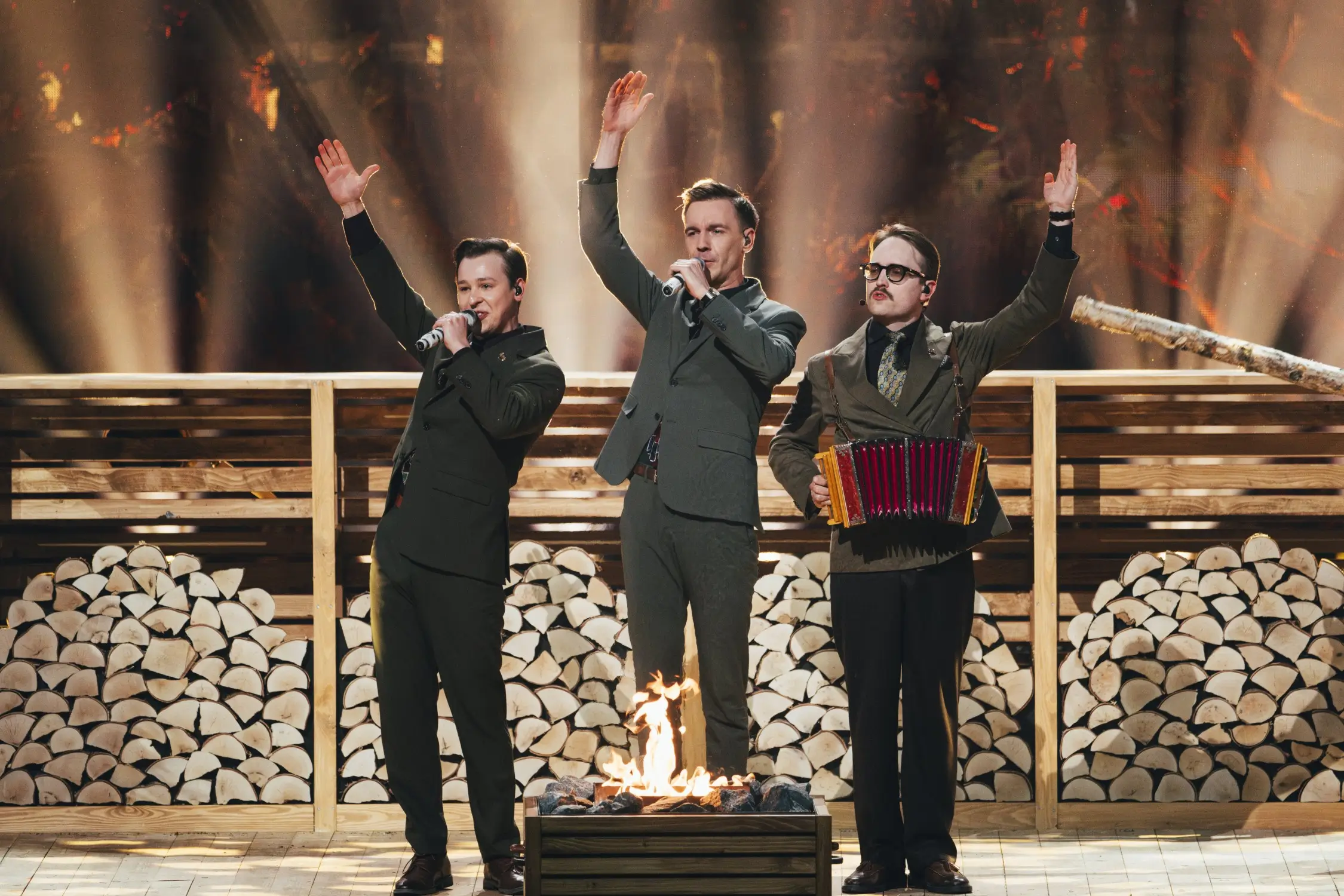
That is a lesson worth holding onto. In diaspora culture, there is often pressure to make heritage legible by making it simpler. KAJ offered a better possibility: that the more grounded, specific, and unembarrassed thing can sometimes travel farther. Not despite its accent, but because of it.
For Nordic and Baltic communities in the United States and Canada, that is more than a Eurovision takeaway. It is a small cultural encouragement. Keep the odd phrase. Keep the regional reference. Keep the humor that only fully works at home. Keep the rituals that seem too ordinary to explain. Those are often the very things that make a culture feel alive when it crosses an ocean.
KAJ’s sauna song did not become memorable by acting universal first.
It became memorable by sounding unmistakably like its own place.
That is why it traveled. And that is why people so far from Vörå could hear something of their own in it.

)%20(1).avif)