Queer Belonging Has Always Been Part of Nordic and Baltic Diaspora Life

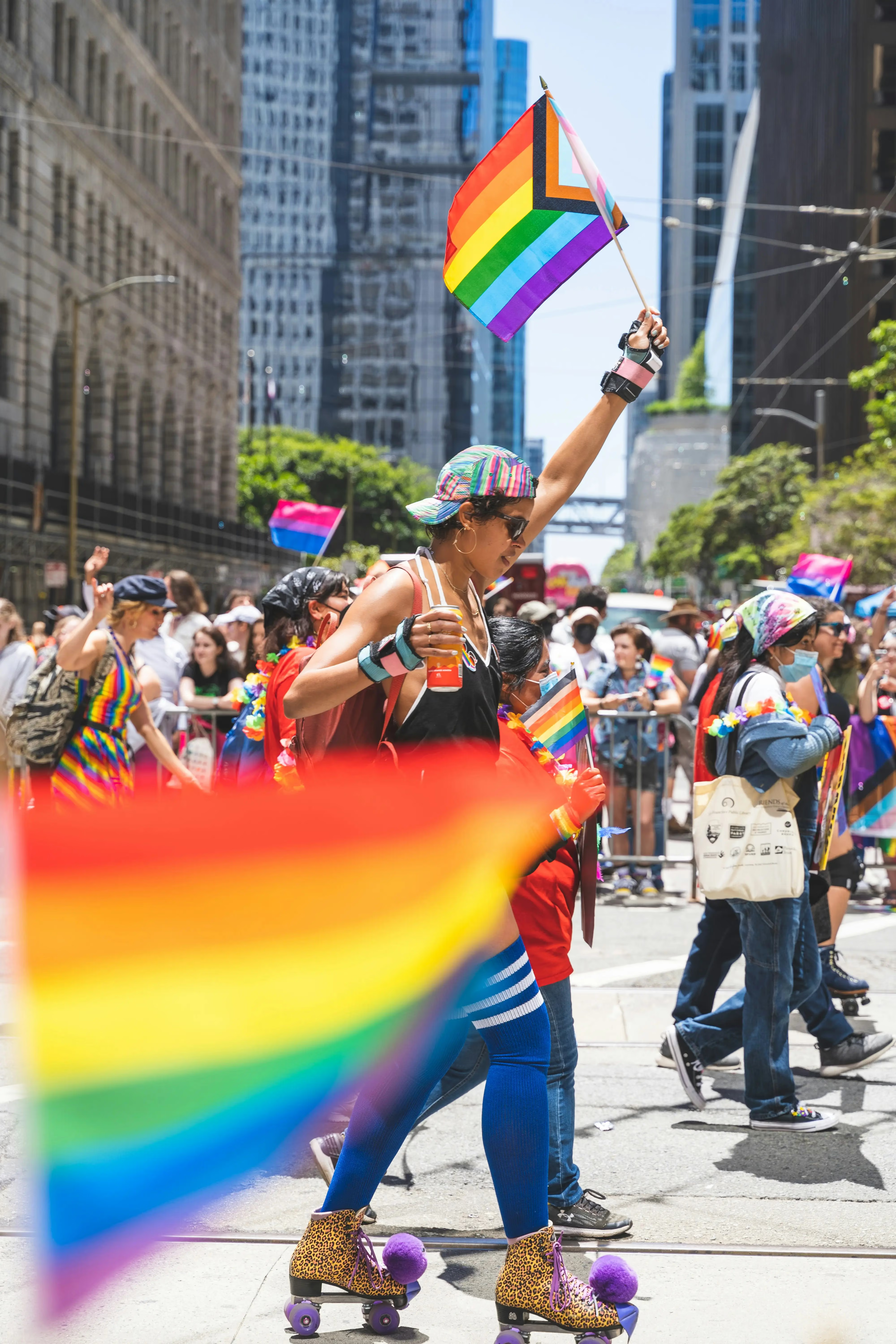
Every June, Pride arrives in North America with familiar public images: rainbow crosswalks, city parades, museum programs, concerts, storefront flags, and crowded streets. For Nordic and Baltic communities in the United States and Canada, it can be tempting to see Pride as something that happens elsewhere — in the broader city rather than in the heritage hall, the language school, the church basement, the folk-dance rehearsal, the choir, the summer camp, or the cultural center.
But that separation has never been true.
LGBTQ+ Nordic and Baltic people have always been part of diaspora life. They have baked for fundraisers, sung in choirs, translated for grandparents, danced at midsummer, volunteered at museums, attended Estonian, Latvian, Lithuanian, Finnish, Swedish, Norwegian, Danish, and Icelandic community events, and carried complicated family histories across generations. Some have done so openly. Many have done so quietly. Some stayed close to their heritage communities. Others stepped away because those communities did not seem to have room for the fullness of their lives.
That is why Pride Month offers a useful question for readers in 2026: not only what is happening in Tallinn, Riga, Vilnius, Helsinki, Stockholm, Oslo, Copenhagen, Reykjavík, or Amsterdam, but what kind of belonging is being built in Nordic and Baltic North America.
The timing is meaningful. Baltic Pride 2026 is taking place in Tallinn from June 1 to 7 under the message “Silence won’t defeat hate.” Its program includes public discussions, cultural events, a march, and a concert. In Lithuania, Lithuanian Pride 2026 runs June 2 to 6 in Vilnius, with a conference on rainbow families and a March “For Equality!” on Gediminas Avenue. Riga Pride follows on June 13, framing its march around diversity, visibility, and human rights. Later this summer, Amsterdam will host WorldPride from July 25 to August 8, as the Netherlands marks 25 years since becoming the first country to open civil marriage to same-sex couples.
.avif)
Those events matter. They show a Nordic and Baltic Sea region in motion: unevenly, imperfectly, but visibly. Estonia’s gender-neutral marriage law, passed in 2023 and effective from January 1, 2024, is one sign of that change. So are the Pride marches, choirs, conferences, public discussions, exhibitions, and cultural programs that continue in places where legal recognition and social comfort do not always move at the same pace.
Yet for readers in the United States and Canada, the deeper question is closer to home.
What does Pride Month ask of a diaspora community?
It asks whether cultural preservation is only about language, food, costume, music, holidays, and archives — or whether it also includes the people who inherit those things. It asks whether a young queer Lithuanian Canadian, a trans Finnish American, a gay Latvian American, a bisexual Swedish Canadian, or a nonbinary Estonian American can see a future inside the community spaces that taught them where their family came from.
It asks whether heritage is treated as something fragile that must be protected from difference, or something living enough to include the actual lives of its descendants.
Diaspora communities often understand silence better than most. For Baltic families especially, silence could be a survival strategy under occupation, exile, and displacement. For Nordic immigrant families, silence could mean modesty, privacy, religious restraint, or the old habit of not making trouble. Many families crossed the Atlantic carrying griefs they did not fully explain to their children. Many built new lives through restraint.
But inherited silence can become complicated. What once protected one generation can isolate another.
That is why Pride Month does not need to be imported into Nordic and Baltic cultural life as a foreign political symbol. It can be understood through values these communities already claim: dignity, truthfulness, mutual responsibility, hospitality, education, and care for the next generation.
A heritage language school does not have to become a political battleground to be welcoming. It can make sure families of different shapes are reflected in examples, invitations, and assumptions. A choir does not have to change its repertoire to make clear that LGBTQ+ singers belong. A museum does not have to abandon tradition to include queer artists, writers, designers, performers, and community members in its storytelling. A festival does not lose its cultural identity by making safety and welcome visible.
In many cases, these gestures are not dramatic. They are simply the difference between a person bracing themselves at the door and a person feeling expected.
The cultural argument matters because Nordic and Baltic diaspora life is built on participation. These communities survive because people keep showing up. Someone teaches the children’s dance group. Someone fries the pancakes. Someone organizes the film screening, edits the newsletter, leads the song, sets up the chairs, applies for the grant, stores the costumes, scans the old photographs, and remembers who used to do it before.
Faces, Places, and Memory in North American LGBTQ+ History
A small visual companion to Pride Month: public-domain and Creative Commons images that trace organizing, visibility, public memory, and the long work of making LGBTQ+ lives part of the historical record.
These images remind us that visibility was built by people — often before it was safe to be seen.
This gallery is not a complete history. It is a curated starting point: organizers, public figures, trans and queer elders, and collective memorial work that helped reshape public life in North America.

Bayard Rustin before the March on Washington
Bayard Rustin, a key strategist of the Civil Rights Movement and an openly gay organizer, appears with Cleveland Robinson shortly before the March on Washington for Jobs and Freedom.
Credit: Orlando Fernandez, New York World-Telegram & Sun / Library of Congress. Public domain / no known restrictions. Source

Marsha P. Johnson in the 1970s
Marsha P. Johnson became one of the most recognizable figures in New York’s queer and trans liberation history, remembered for activism, mutual aid, and radical public presence.
Credit: Hank O’Neal. Public domain in the United States via Wikimedia Commons. Source

Harvey Milk at Mayor Moscone’s desk
Harvey Milk, one of the first openly gay elected officials in the United States, is photographed in 1978, the year his political life became part of national LGBTQ+ memory.
Credit: Daniel Nicoletta. CC BY-SA 3.0 / GFDL via Wikimedia Commons. Source

Del Martin and Phyllis Lyon
Longtime lesbian activists Del Martin and Phyllis Lyon, co-founders of the Daughters of Bilitis, are shown during their 2008 marriage ceremony in San Francisco.
Credit: NickGorton. CC BY-SA 3.0 / GFDL via Wikimedia Commons. Source

The AIDS Memorial Quilt on the National Mall
The AIDS Memorial Quilt transformed grief into public testimony, naming lives lost during the AIDS crisis and forcing a national audience to confront the scale of the epidemic and the communities it devastated.
Credit: National Institutes of Health. Public domain via Wikimedia Commons. Source
If LGBTQ+ people are made to feel peripheral, the community loses not only moral credibility but also memory, labor, imagination, and future leadership. Inclusion is not a favor granted to outsiders. It is a recognition of who is already here.
This does not mean every Nordic or Baltic organization in North America must mark Pride Month in the same way. A small rural heritage society, a city museum, a church-linked community, a student group, a choir, a summer camp, and a national cultural foundation will all have different capacities and audiences. But each can ask the same basic question: when LGBTQ+ people from our own community look at us, do they see a place where they can belong without translation or apology?
The answer will not come from one rainbow graphic in June. It will come from patterns.
.jpg)
Who is invited to speak? Which artists are profiled? Which family structures are assumed? Which young people are protected when jokes are made at their expense? Which elders are allowed to tell the truth about lives they once had to hide? Which stories are treated as part of Nordic and Baltic culture, rather than as a special-interest sidebar?
This is where the Pride events across the Atlantic can offer inspiration without becoming the whole story. When LGBTQ+ choirs sing at Pride events in the Baltic region, they are not only making music in Tallinn, Riga, or Vilnius. They are reminding diaspora choirs in Toronto, Seattle, Chicago, Minneapolis, Vancouver, New York, and beyond that singing has always been a way of deciding who belongs in the public voice.
When Baltic Pride says silence will not defeat hate, it is not only speaking to Estonian politics. It is speaking to every community where people have learned to avoid difficult conversations in the name of peace.
For Nordic and Baltic North America, Pride Month can be less about adopting someone else’s language and more about telling the truth in our own. Queer people are not new to these communities. They are not a modern complication. They are part of the families, archives, songs, migrations, love stories, volunteer lists, and private courage that made the communities possible.
The work now is to make that belonging visible enough that the next generation does not have to choose between heritage and honesty.

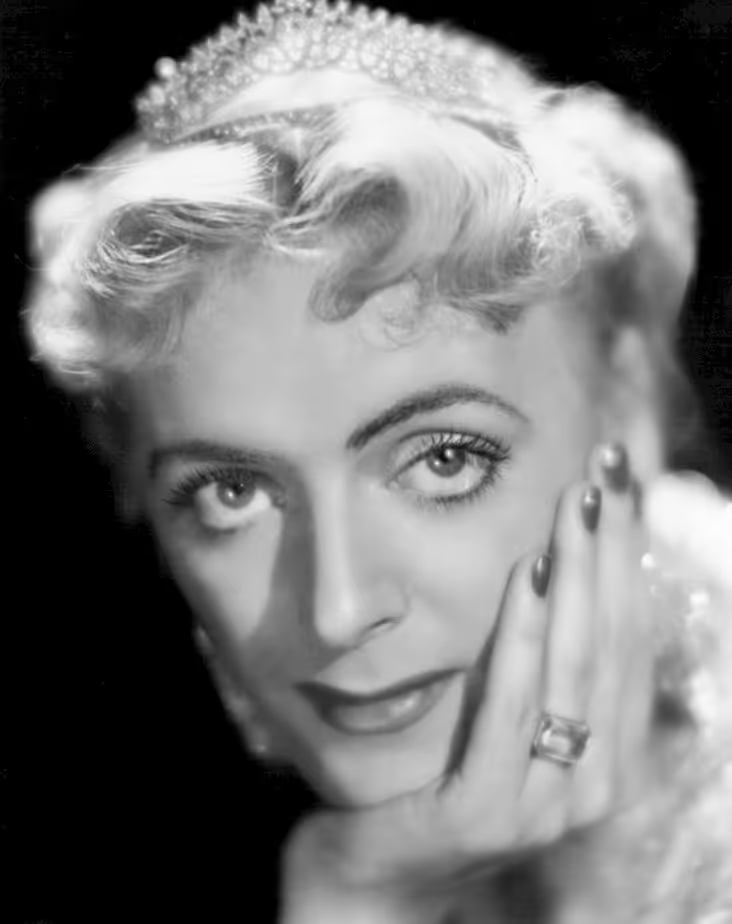

Read last year’s deep dive: Love Across Latitudes
From secret glances in Nordic fishing villages to defiant dances on New York’s Christopher Street, this historic overview traces a century-long story of queer Nordic and Baltic lives shaped by exile, migration, love, loss, and liberation.
Preview images are drawn from the original TNV archive article and should remain credited on the linked page.
