At 50, Chicago’s Swedish American Museum Is Asking a Bigger Question About Heritage
%20(Custom)%20(Custom).avif)
Anniversaries can flatten a cultural institution if we let them.
They can turn living places into timelines: founded here, moved there, expanded then, celebrated now. They can reduce a museum to a sequence of names, dates, donors, and sepia-toned reassurance about what has been saved from disappearance.
But the most interesting heritage institutions resist that temptation. They use a milestone year not only to look back, but to ask what deserves to keep growing.
That is what makes the Swedish American Museum’s 50th anniversary in Chicago feel larger than a local celebration. Founded in 1976 and rooted in Andersonville, the neighborhood long known as Chicago’s “Little Sweden,” the museum has spent half a century preserving immigrant stories, hosting exhibitions, teaching language, supporting genealogy, creating public programs, and giving Swedish America a civic address in one of the country’s great immigrant cities.
For Swedish Americans, and for many other Nordic and Baltic readers across the United States and Canada, places like this are familiar in the deepest sense. They are where the old country becomes community space. They are where memory gets a front door. They are where family stories, holiday rituals, language fragments, handwork, food, maps, photographs, and migration histories become visible not only to insiders, but to neighbors.
What feels especially timely in 2026 is that the museum’s anniversary year is not simply being framed as a commemoration of what Swedish America used to be. The more urgent question running through the moment is this: what does heritage look like when it is still being made?
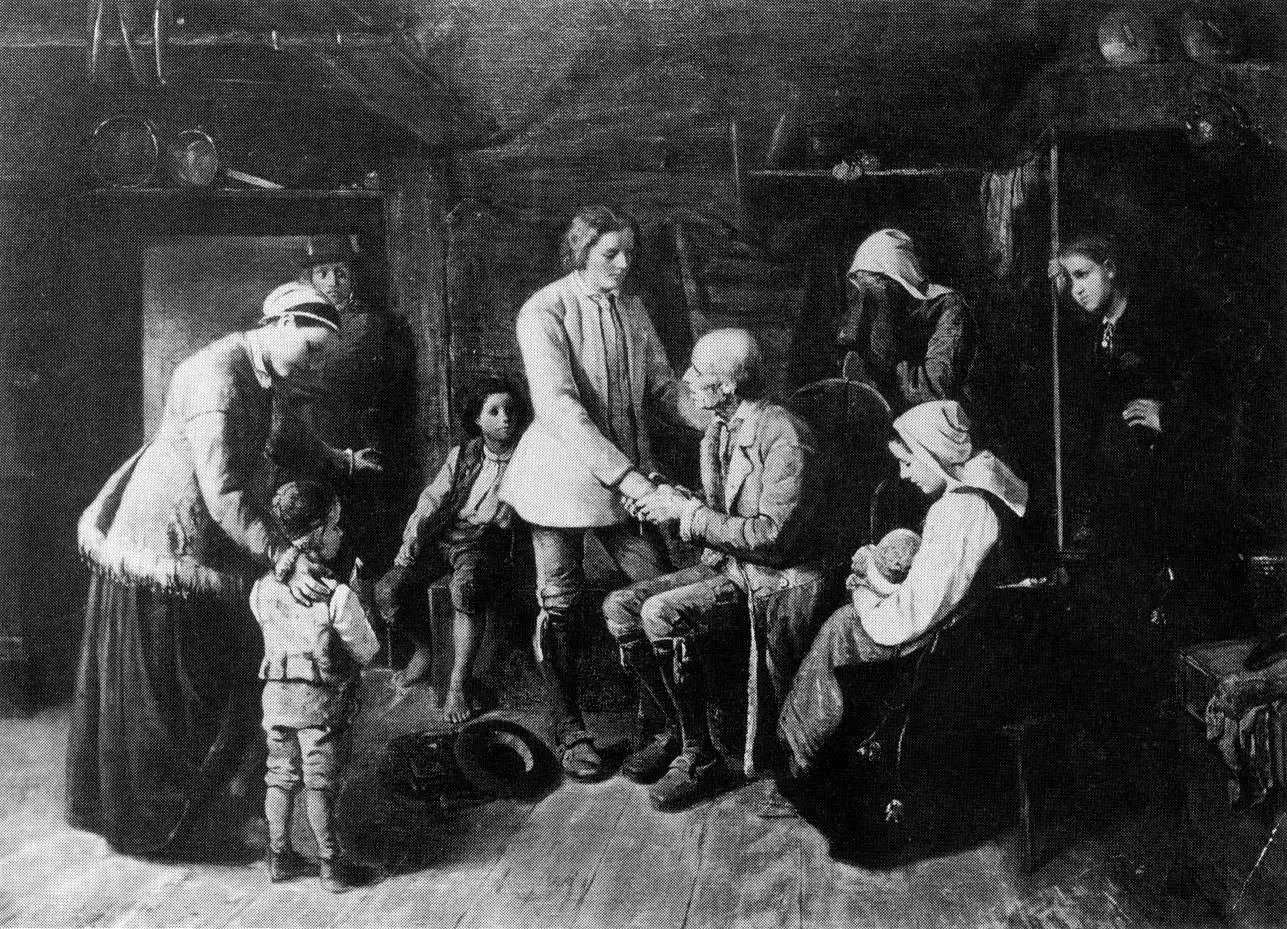
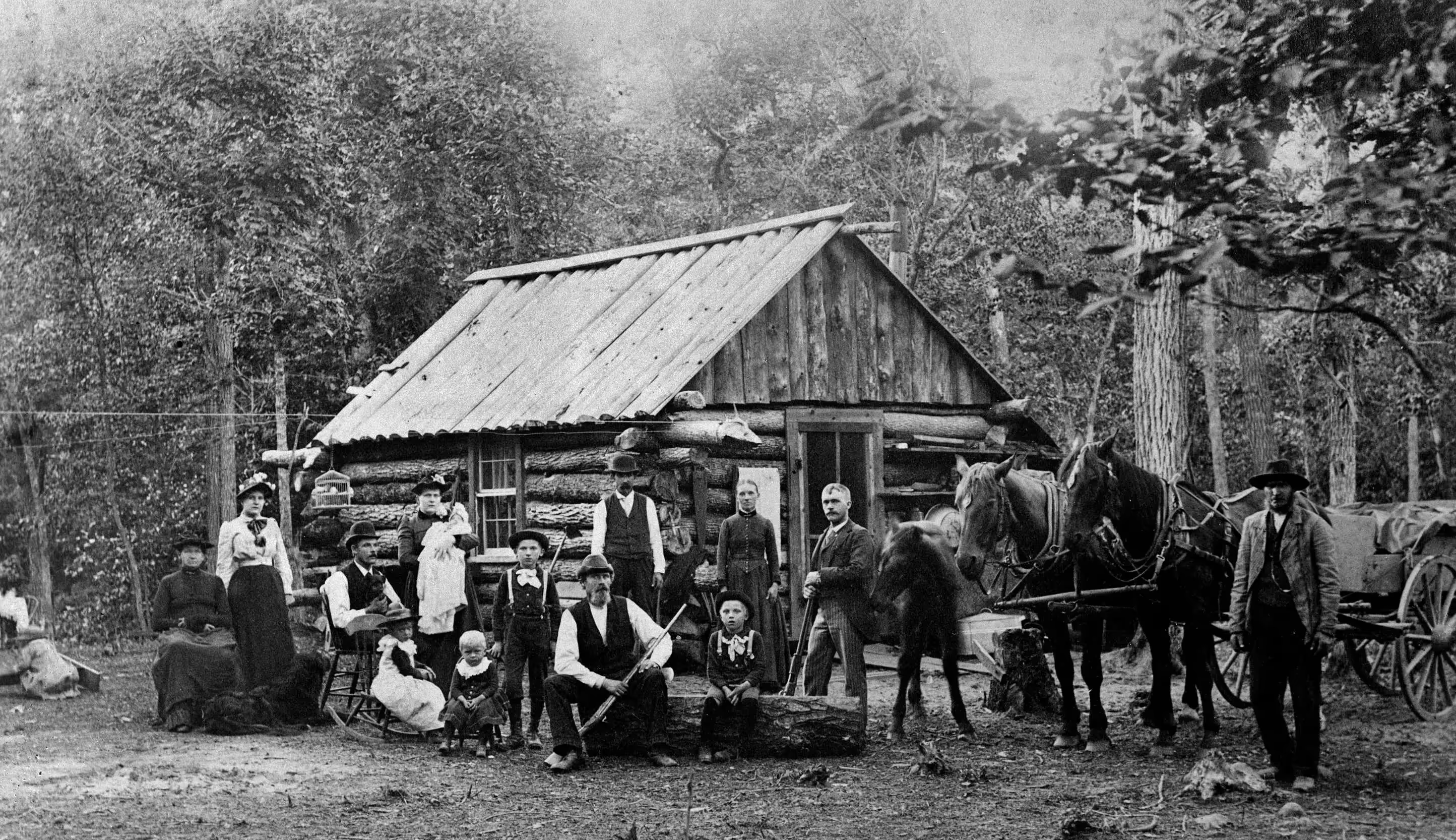
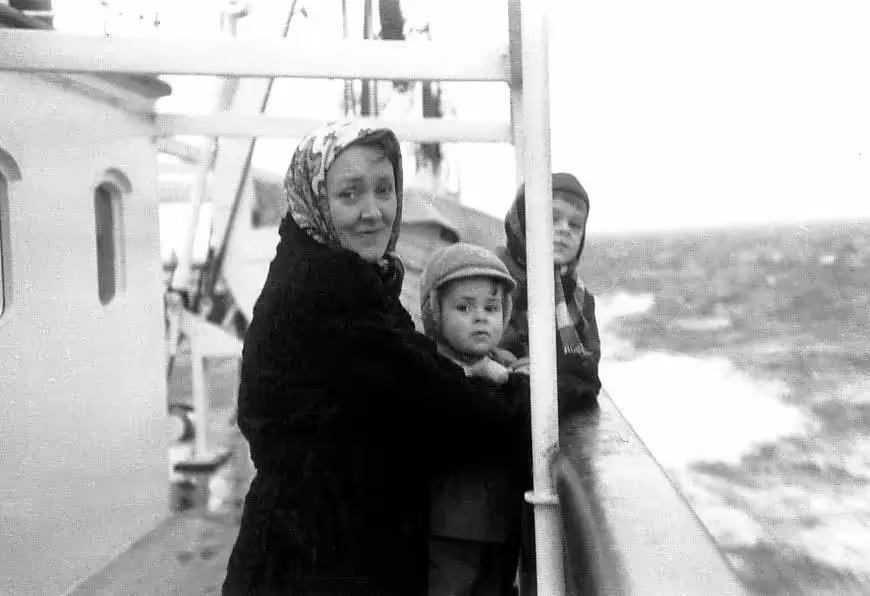
That question matters because Swedish America is not a small historical footnote. In the nineteenth and early twentieth centuries, roughly 1.3 million Swedes left Sweden for the United States, part of one of the great Nordic migration movements to North America. Many settled across the Midwest, forming churches, newspapers, schools, businesses, mutual-aid societies, and cultural organizations that shaped local life for generations.
.jpg)
Chicago became one of the central cities in that story. By 1900, it was often described as having more Swedes than any city in the world except Stockholm, and Swedish immigrants helped build enduring institutions including North Park University, Swedish Covenant Hospital, and the Evangelical Covenant Church. The phrase “the Swedes built Chicago” has survived because many Swedish immigrants worked as carpenters, contractors, builders, and architects, especially in the decades after the Great Chicago Fire.
Andersonville grew out of that history. After the Great Chicago Fire of 1871, many Swedish immigrants moved north, beyond the old city limits, where building wooden homes was still possible and where a Swedish commercial and religious life gradually took shape. Over time, Clark Street became lined with Swedish businesses, churches, bakeries, delis, hardware stores, and community gathering places. The neighborhood eventually became one of the country’s most recognizable Swedish American districts.
But Andersonville’s importance today comes from something more complicated than nostalgia. The neighborhood is no longer a frozen ethnic enclave, nor should anyone wish it to be. It has changed, as cities do. It has become known not only for Swedish heritage but for independent businesses, LGBTQ+ community life, restaurants, bookstores, and a commercial corridor whose appeal rests partly on its ability to absorb change without losing all memory of what came before. The Andersonville Commercial Historic District, running along North Clark Street, was added to the National Register of Historic Places in 2010.
That is the setting in which the Swedish American Museum’s 50th anniversary should be understood. The museum is not simply preserving Swedishness in isolation. It is helping interpret how an immigrant neighborhood becomes a pluralistic urban place while still carrying traces of its founding communities.
The museum itself was founded in 1976, during a remarkable Swedish American moment. King Carl XVI Gustaf’s 1976 visit to the United States — the first state visit by a reigning Swedish monarch to the country — was tied to the American Bicentennial and included visits to Swedish American communities across the country. In Chicago, the King visited Andersonville and dedicated the new Swedish American Museum on April 19, 1976.
That royal dedication gave the museum a symbolic beginning, but its deeper significance has always been local. The Swedish American Museum was founded by Kurt Mathiasson, moved to its current North Clark Street location in 1987, and has grown into a major heritage institution housed in a three-story building with a collection often described as numbering around 12,000 objects.
Those facts matter. But they are not the whole story.
A museum is not only a building, a collection, or a calendar of exhibitions. It is a social promise: that a community’s experience is worth remembering, studying, displaying, arguing over, and reinterpreting. For immigrant and diaspora communities, that promise carries particular weight. Without institutions, memory can become private and fragile. With institutions, memory can become public culture.
That is why the museum’s current anniversary-year framing feels so important. According to the draft package, one of the strongest threads in the museum’s present programming is textile artist Sofia Hagström Møller’s exhibition My Future Heritage, on view through early August. The exhibition, as described in the source material, explores weaving as a carrier of memory, tradition, transformation, inherited Scandinavian textile knowledge, personal lineage, and contemporary digital processes.
The title alone carries a quiet challenge. Heritage is often treated as something received whole: handed down, fixed, finished, and protected from change. My Future Heritage begins from a different premise. It suggests that inheritance is not only behind us. It is also something being prepared, altered, woven, and imagined for those who come next.
That idea is especially powerful in textile art.
Textiles occupy a distinctive place in Nordic cultural memory because they move easily between household labor, artistic expression, regional identity, and family history. A woven pattern can be practical and symbolic at the same time. It can belong to the domestic sphere and the museum gallery. It can hold repetition, patience, technique, beauty, and social memory in one object.
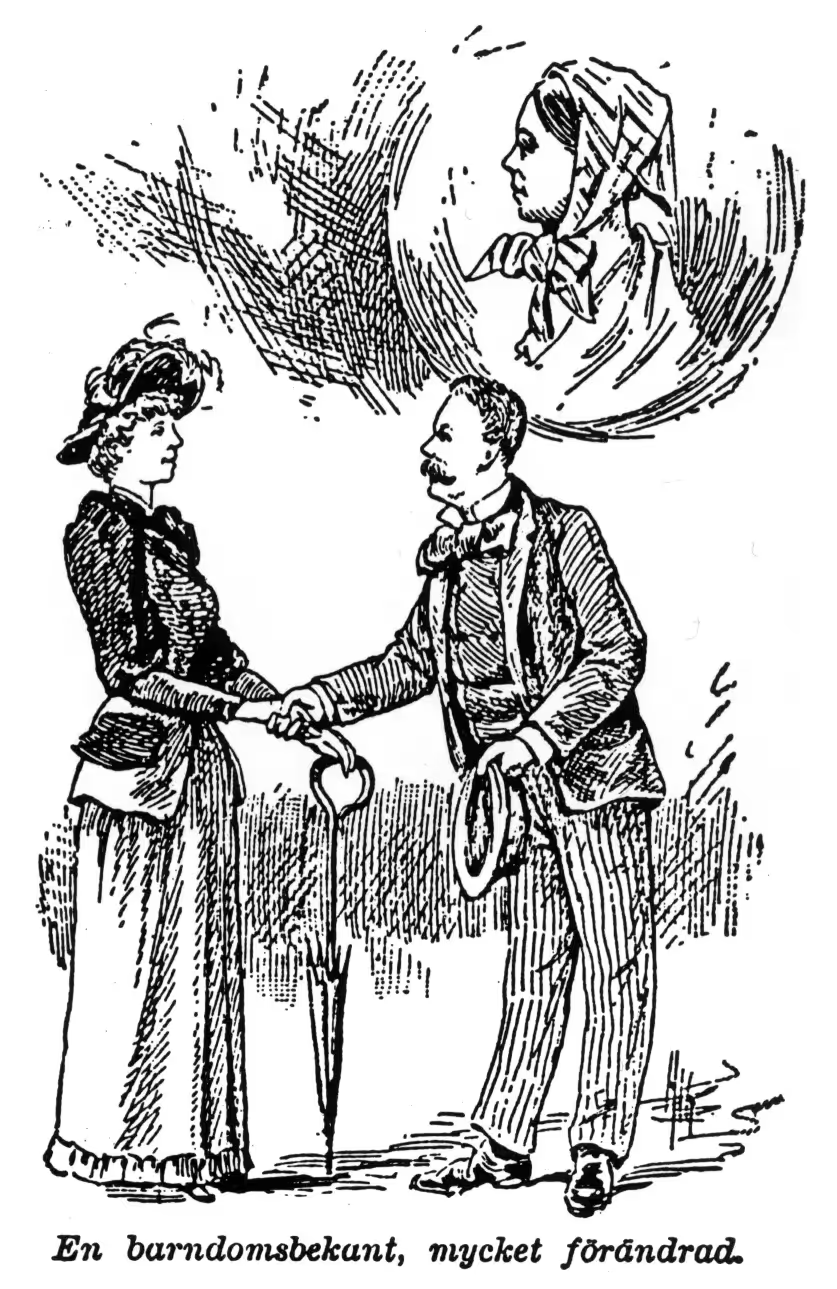
In a North American diaspora setting, that matters. Descendants of immigrants often inherit culture in fragments: a table runner, a Christmas ornament, a recipe card, a trunk, a language phrase, a photograph, a folk costume, a song, a pattern whose meaning has partly slipped away. Textiles can speak across that gap because they do not require culture to be purely verbal. They allow memory to be touched.
That is why weaving is such a fitting metaphor for heritage institutions themselves. A museum like the Swedish American Museum is constantly working with threads that do not automatically belong together: homeland and host country, immigrant past and urban present, language fluency and language loss, family pride and historical complexity, cultural specificity and broader public relevance.
At their best, heritage institutions do not simply guard the old fabric. They repair it, extend it, and sometimes let new colors enter.
For Nordic and Baltic communities across North America, this is likely to feel less abstract than it sounds. Much of diaspora life works exactly this way. A recipe survives because someone adjusts it to local ingredients. A language survives because children learn it imperfectly but keep using it. A folk song survives because it moves from formal performance into family ritual. A pattern survives because a younger artist decides it can live in a new material, a new room, a new century.
Culture is not diminished by being reworked. Often, it is rescued by it.
That lesson is especially useful now, when many heritage institutions face a generational question. The children and grandchildren of immigrants may not speak the old language fluently. They may have mixed ancestry. They may live far from the original ethnic neighborhoods. They may feel drawn to culture, but wary of being tested by it. They may want belonging without pretending to possess a complete inheritance.
The strongest institutions understand this. They make room for the family historian and the casual visitor, the fluent speaker and the beginner, the grandparent who remembers and the child who is only beginning to ask. They teach, exhibit, celebrate, translate, and invite. They create an environment where heritage is not a credential to prove, but a relationship to enter.
That is why the Swedish American Museum’s anniversary matters beyond Swedish America alone. Across the United States and Canada, Nordic and Baltic communities are wrestling with the same questions. How do you honor the immigrant past without reducing it to display? How do you make cultural spaces welcoming to younger generations who may inherit only part of the story? How do you preserve seriousness without hardening into exclusivity? How do you keep culture recognizable while allowing it to remain alive?
The answer cannot be nostalgia alone.
Nostalgia has its uses. It can comfort, orient, and reconnect. But nostalgia becomes limiting when it turns culture into a museum case before the museum has even done its work. A heritage institution should not merely tell visitors that people once arrived, struggled, built churches, opened shops, cooked traditional food, and kept the old holidays. It should also help them ask what those histories make possible now.
The museum’s setting in Andersonville deepens that question. The neighborhood’s Swedish identity has not survived by remaining unchanged. It has survived because it became part of a larger urban fabric: Swedish, American, LGBTQ+, immigrant, independent, commercial, residential, old, new, local, and global all at once. That is not a dilution of heritage. It is one of the ways heritage enters real life.
The museum’s ongoing exhibition Andersonville Through the Ages, highlighted in the draft package, appears to speak directly to that evolution: a neighborhood retaining Swedish heritage while absorbing newer forms of community life. That is a more honest account of diaspora than the fantasy of perfect preservation. Communities endure not because nothing changes around them, but because enough meaning survives the change.
The broader North American Swedish story has always been about adaptation. Swedish immigrants did not simply recreate Sweden in the Midwest. They built something new: Swedish American churches, newspapers, schools, businesses, political networks, labor traditions, farms, colleges, neighborhoods, and cultural societies. In doing so, they changed both America and their own sense of Swedishness.
The same is true today. Swedish American identity in 2026 is not identical to Swedish immigrant identity in 1900, nor should it be. It includes recent arrivals, descendants of nineteenth-century immigrants, adoptees, spouses, mixed-heritage families, language learners, artists, scholars, tourists, neighbors, and people who discover Swedish culture through food, design, music, genealogy, film, literature, or community events.
A museum that serves all of them cannot be only a vault. It has to be a meeting place.
.avif)
There is also a wider Nordic lesson here. In North America, Scandinavian identity is still often packaged through a narrow set of images: clean design, hygge-adjacent coziness, old-country nostalgia, holiday foods, midsummer flowers, maybe a little regional romance. Those things are not false, but they are incomplete. The more durable reality is cultural practice: a museum class, a language lesson, an exhibition that rethinks inherited forms, a midsummer celebration, a genealogy consultation, a children’s program, a neighborhood institution that helps people feel the line between past and present not as a break, but as a braid.

For Baltic readers, too, the Swedish American Museum’s anniversary may resonate even if the Swedish specifics are not their own. Baltic diaspora institutions face many of the same challenges of transmission: keeping language alive, sustaining choirs and dance groups, teaching history without turning it into burden, creating spaces for mixed families, and helping younger generations see heritage as a living resource rather than a set of obligations.
In that sense, a Swedish American museum in Chicago is not only a Swedish American story. It is part of a broader immigrant and diaspora question: how does memory become public culture?
At 50, the Swedish American Museum is doing something more valuable than celebrating longevity. It is making a case for cultural continuity as active work. Not museum work alone, but community work. Artist work. Family work. Neighborhood work. The kind that requires both care and imagination.
That may be the real meaning of a title like My Future Heritage. Heritage is not only what we protect from the past. It is also what we prepare, deliberately, for the people coming next.
And if the Swedish American Museum’s anniversary offers a lesson for other Nordic and Baltic communities, it is this: preservation is not the opposite of change. Preservation is what makes meaningful change possible.
A museum survives 50 years not because it freezes culture in place, but because it keeps giving people reasons to return — to remember, to learn, to gather, to question, and to weave themselves into a story still unfinished.

)%20(1).avif)