Leif Erikson Day Was Invented in Wisconsin
On 9 October, as on every 9 October since 1964, the President of the United States will issue a proclamation naming the day Leif Erikson Day.
The proclamations are short, warm and interchangeable. They praise the Norse spirit of exploration, note the contributions of Nordic-Americans, and encourage appropriate observances. Almost nobody reads them.
What makes the day interesting is not the proclamation. It is that the whole thing was assembled, deliberately and over about ninety years, by a small immigrant community that wanted a different story about who got here first — and that it was assembled long before there was any physical evidence that the story was true.
The date is not his
Start with the most telling fact about Leif Erikson Day, which is that 9 October has no connection to Leif Erikson whatsoever.
Nobody knows what day he reached North America. Nobody knows the year with any confidence from the written sources; the sagas that describe the Vinland voyages were written down two centuries or more after the events, and they disagree with each other.
Nine October was chosen because on that date in 1825 the sloop Restauration arrived in New York Harbor carrying fifty-two Norwegians — the beginning of organised Norwegian emigration to the United States. The suggestion came from a Norwegian-American named Christian A. Hoen, and it was chosen precisely because the date already meant something to Scandinavian-Americans.
So the holiday honouring a Norse explorer of the year 1000 is dated to the arrival of a nineteenth-century emigrant ship. That is not a flaw in the design. That is the design. The day was never really about Leif Erikson.
The professor from Wisconsin
The central figure is Rasmus B. Anderson, a Norwegian-American who taught at the University of Wisconsin and who in 1874 published a book called America Not Discovered by Columbus.
Anderson's argument — that Norse voyagers reached North America around the year 1000, five centuries before Columbus — was not new. It had circulated among Scandinavian scholars for decades. What Anderson did was popularise it in English, for an American audience, at a moment when the Norwegian community in the Upper Midwest was numerous, literate, organised, and acutely aware of its own low standing.
The campaign took a long time and it worked from the bottom up. Wisconsin became the first state to adopt Leif Erikson Day officially in 1929. Minnesota followed in 1931. By 1956, seven US states and the Canadian province of Saskatchewan had recognised it.
In 1925, at the Norse-American Centennial marking the Restauration's hundredth anniversary, President Calvin Coolidge said publicly that Leif Erikson had discovered America — an extraordinary thing for a sitting president to say, and a measure of how effective the lobbying had become.
Federal recognition took another four decades. After repeated failures in the 1950s, the 88th Congress passed House Joint Resolution 393, and on 2 September 1964 Lyndon Johnson signed it as Public Law 88–566, authorising the President to proclaim 9 October annually. Johnson issued the first proclamation the same day. Every president since has issued one.
The part everybody is uncomfortable discussing
Leif Erikson Day was, in its origins, a claim staked against Columbus Day.
This should be said plainly rather than danced around, because the dancing makes the history less interesting than it is.
Columbus Day was itself an immigrant project. Italian-Americans, facing severe discrimination in the late nineteenth and early twentieth centuries, built Columbus into a founding figure who made their community indigenous to the American story rather than foreign to it. It worked: Columbus Day became a federal holiday in 1937.
Norwegian-Americans, facing their own version of the same problem in the same decades, ran the same play with a different figure — and with the additional advantage, as they saw it, of being right on the facts.
Two immigrant groups, both marginal, both seeking legitimacy through a claim on the continent's origin story, competing over which European got here first. Neither campaign was really an argument about the eleventh century.
And both, viewed from now, share the deeper problem: the framing of “discovery” at all. North America was inhabited. The Norse sagas themselves record the encounter — the people the Norse called Skrælingar, whom they traded with and fought, and whose presence is the most plausible single reason the Norse presence did not last. The Norse did not discover an empty continent. They arrived at an occupied one, briefly, and left.
Then the evidence turned up
Here is the twist that makes this more than a story about ethnic lobbying.
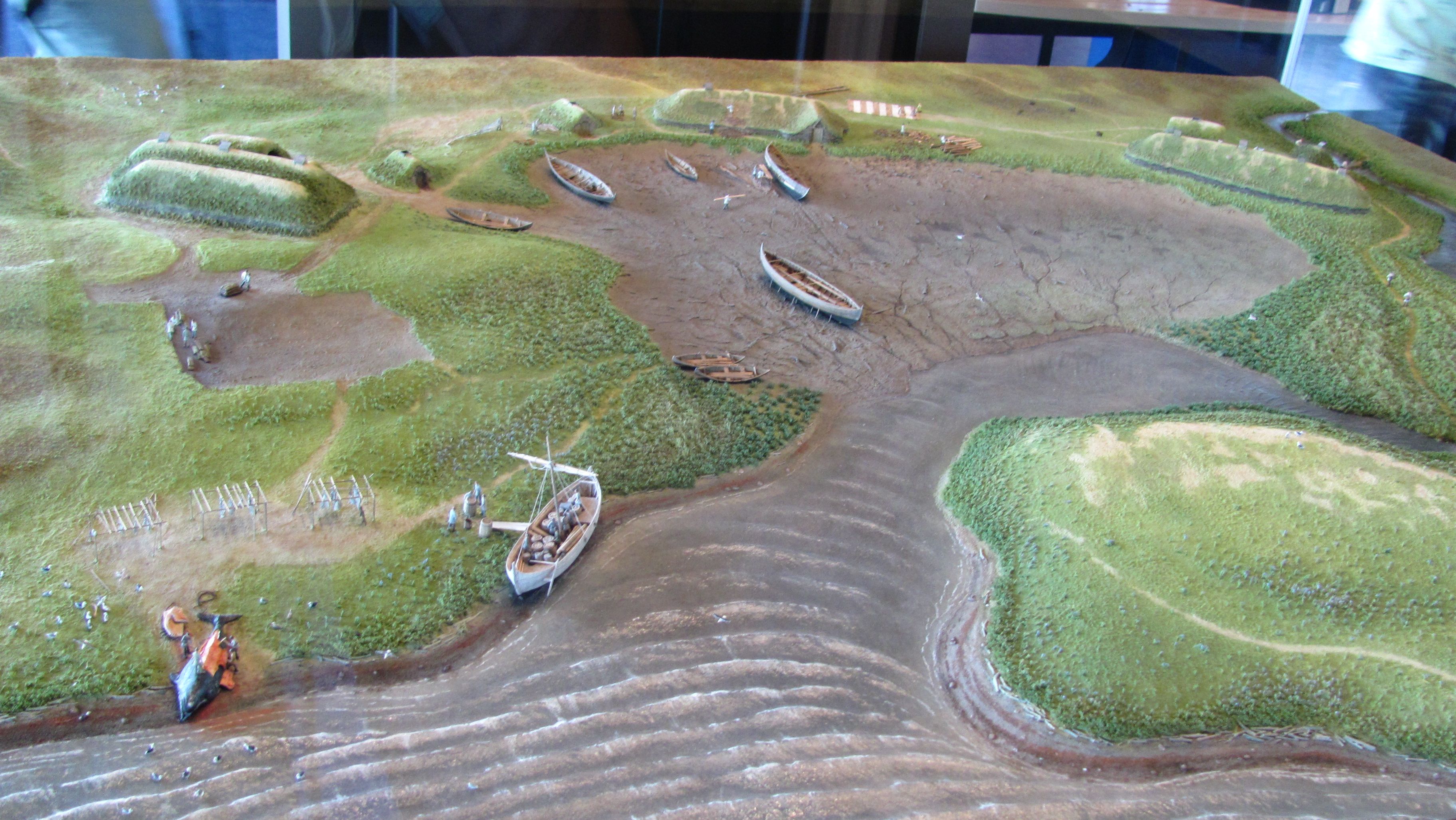
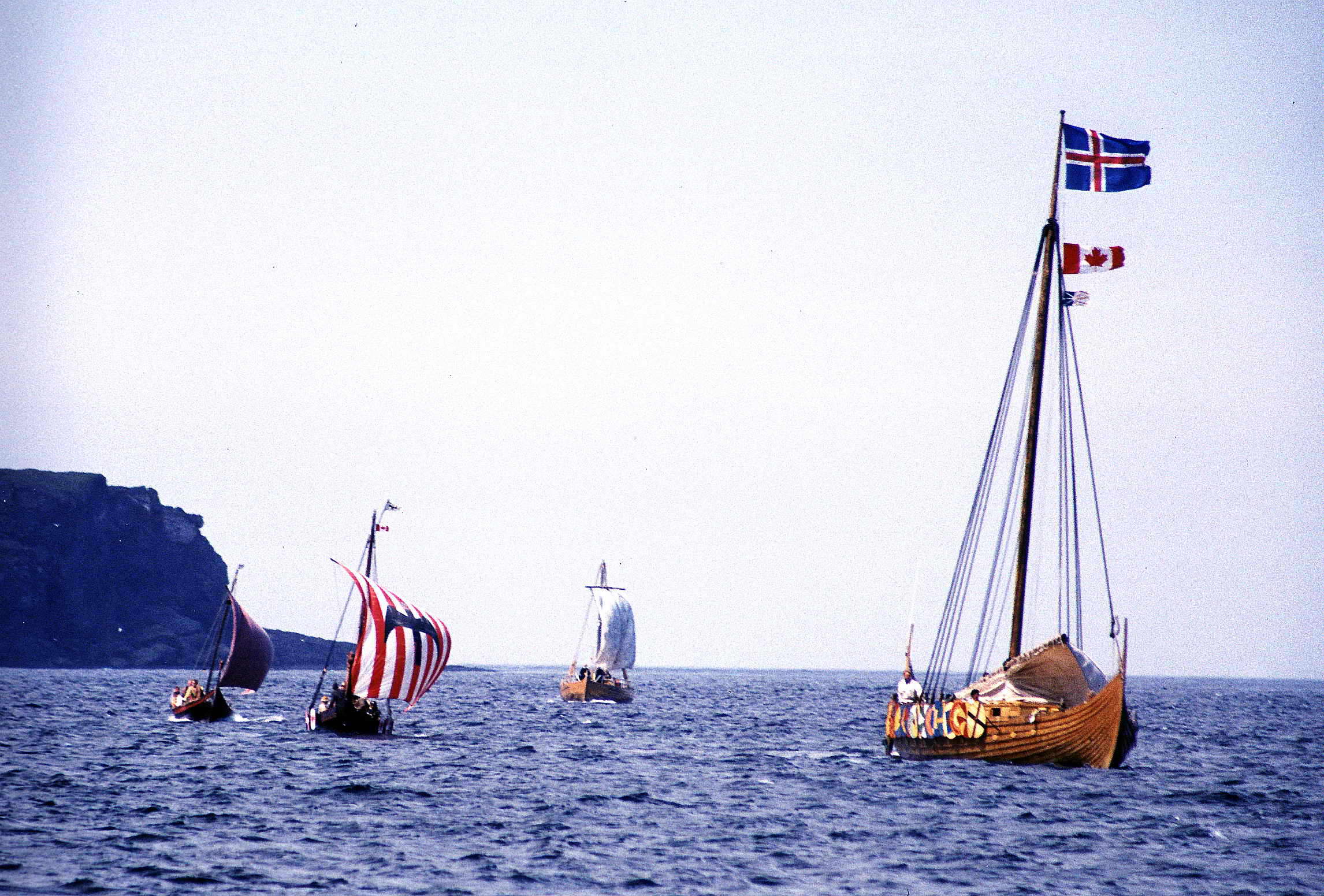
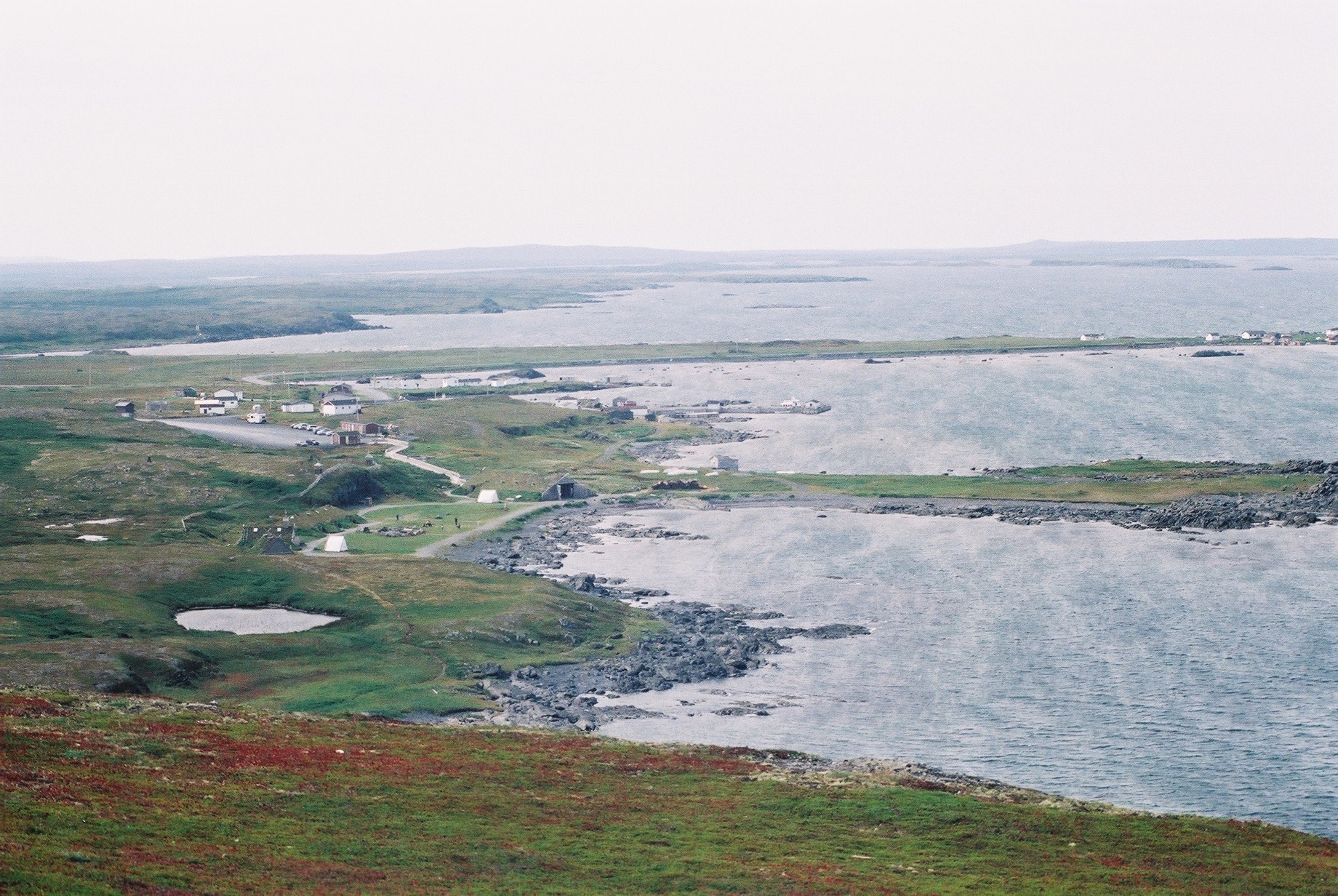
In 1960, the Norwegian explorer Helge Ingstad and the archaeologist Anne Stine Ingstad — working from the sagas, local Newfoundland knowledge, and a good deal of stubbornness — identified a set of turf mounds at L'Anse aux Meadows, on the northern tip of Newfoundland. Excavation over the following years established it as a Norse site: eight timber-and-sod buildings, a smithy that worked bog iron, a spindle whorl, boat rivets.
It was designated a UNESCO World Heritage Site in 1978. It remains the only confirmed Norse site in North America outside Greenland.
And then, in October 2021, a research team led by Margot Kuitems published a paper in Nature that dated the site with a precision almost unheard of in archaeology.
The method is worth understanding because it is genuinely beautiful. In the year 993, a cosmic-ray event — a burst of high-energy particles striking the atmosphere — left a sharp, globally synchronous spike of radiocarbon in every tree growing anywhere on Earth that year. It is a timestamp in the wood.
The team found that spike in three pieces of wood from L'Anse aux Meadows, then counted the growth rings outward to the bark edge — the year the tree was cut. All three gave the same answer: the trees were felled in 1021. And they were cut with metal blades, which no local population possessed.
Norse people were at L'Anse aux Meadows, cutting timber, in the year 1021. Exactly. Not approximately.
Rasmus Anderson had been dead for eighty-five years.
What the evidence does not support
The vindication is real and it is narrower than the holiday implies.
L'Anse aux Meadows is not a colony. There is no burial ground, no church, no sign of children, no agricultural field system — none of the marks of a community intending to stay. What the archaeology shows is a base: a place to repair boats, work iron, overwinter, and stage further exploration south into what the sagas call Vinland. Estimates of the occupation run to a decade or two at most.
Nor does the evidence establish that Leif Erikson personally stood there. The sagas name him as the first to reach Vinland; the site is consistent with the saga account; the two cannot be welded together with certainty.
So the honest version is: Norse people were demonstrably in North America in 1021, at a site on Newfoundland, briefly, and left. That is a genuinely remarkable fact about the reach of eleventh-century seafaring. It is not a discovery of America, and it is not a founding.
Whose Leif is he, anyway?
One more wrinkle, and it is a good one for a publication covering the whole North.
Leif Erikson is claimed enthusiastically by Norwegian-Americans, whose organisations built the holiday. He is claimed equally by Icelanders and Icelandic-Americans, on the reasonable grounds that he was born in Iceland. Greenland has a case too, since he was raised there after Erik the Red's exile. The Icelandic National League in North America marks 9 October as Leifur Eiríksson Day and has never conceded the point.
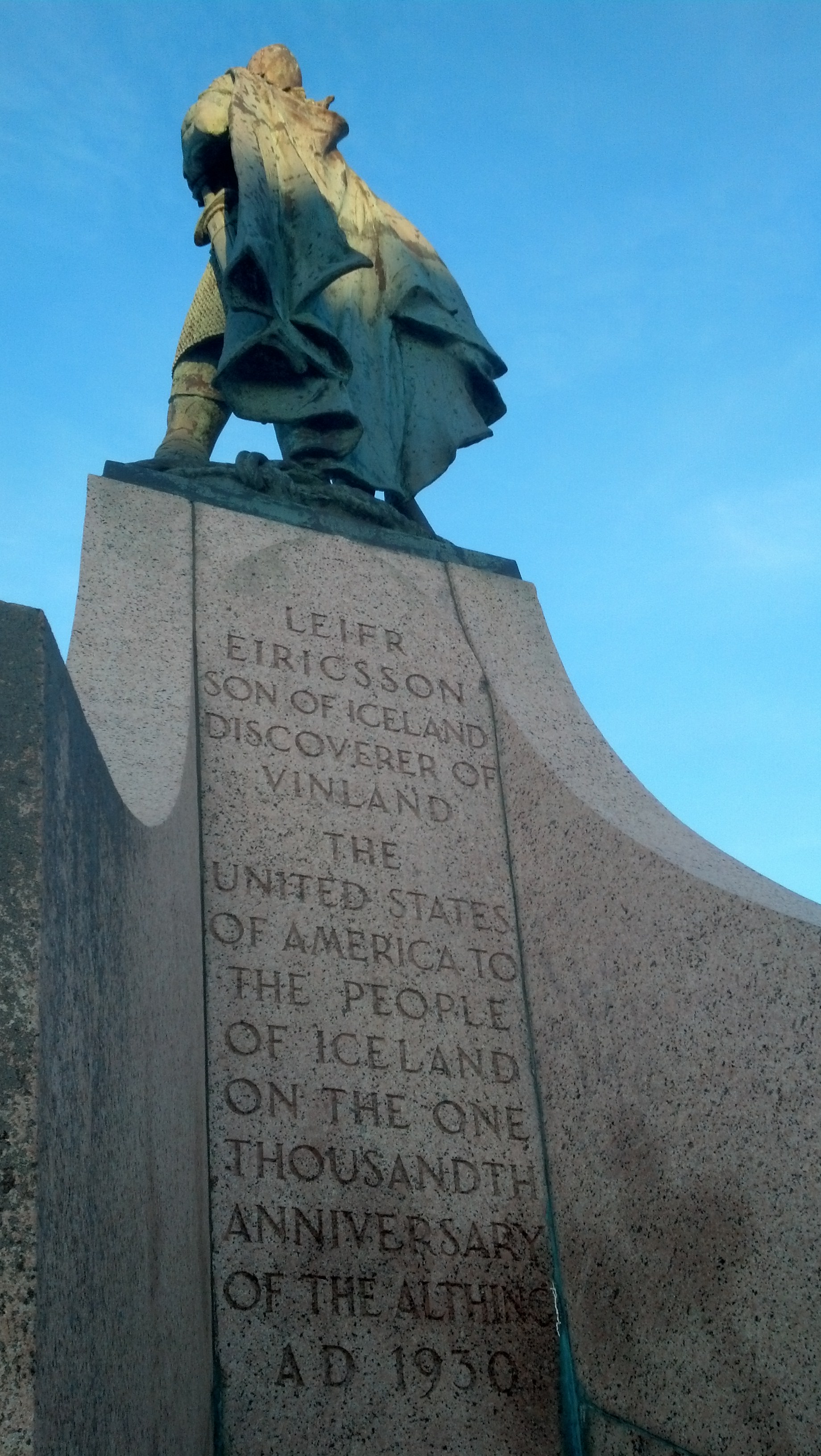
Meanwhile the best-known statue of him in the world stands above Reykjavík, in front of Hallgrímskirkja — and it is American. It was sculpted by Alexander Stirling Calder and presented by the United States to Iceland in 1930, to mark the thousandth anniversary of the Alþingi.
Which means the definitive image of Leif Erikson, in Iceland, is a gift from the country whose Norwegian-American community spent sixty years arguing that he mattered.
The lobbying went home.
What the day is good for
Leif Erikson Day is not a real holiday. Nothing closes. Most Americans have never heard of it.
But it is a useful one to know about, for two reasons.
The first is that it is an unusually clean case study in how immigrant communities manufacture belonging — not by asking to be admitted to the national story, but by rewriting the story so they were always in it. Rasmus Anderson understood that a community with a claim on the founding is harder to treat as foreign. He was not wrong, and every community that has done the same since has been running his play.
The second is that this particular claim happened to be true, and was proved true, sixty years after the first state adopted the holiday and forty-one years after Congress did — by a method nobody involved could have imagined, reading a solar storm in the rings of a felled tree.
That is not usually how these stories end.
Sources
Proclamation 3610 — Leif Erikson Day, 1964 (Lyndon B. Johnson, 2 September 1964), and Public Law 88–566; via the American Presidency Project.
Margot Kuitems et al., “Evidence for European presence in the Americas in AD 1021”, Nature, October 2021.
Parks Canada and UNESCO World Heritage Centre, L'Anse aux Meadows National Historic Site.
Rasmus B. Anderson, America Not Discovered by Columbus (1874).

)%20(1).avif)