Almost Nothing About Lucia Is Old
Culture · Nordic Stories
Of all the things the Nordic countries export, Lucia is the one that most reliably makes people who have no connection to the North go quiet.
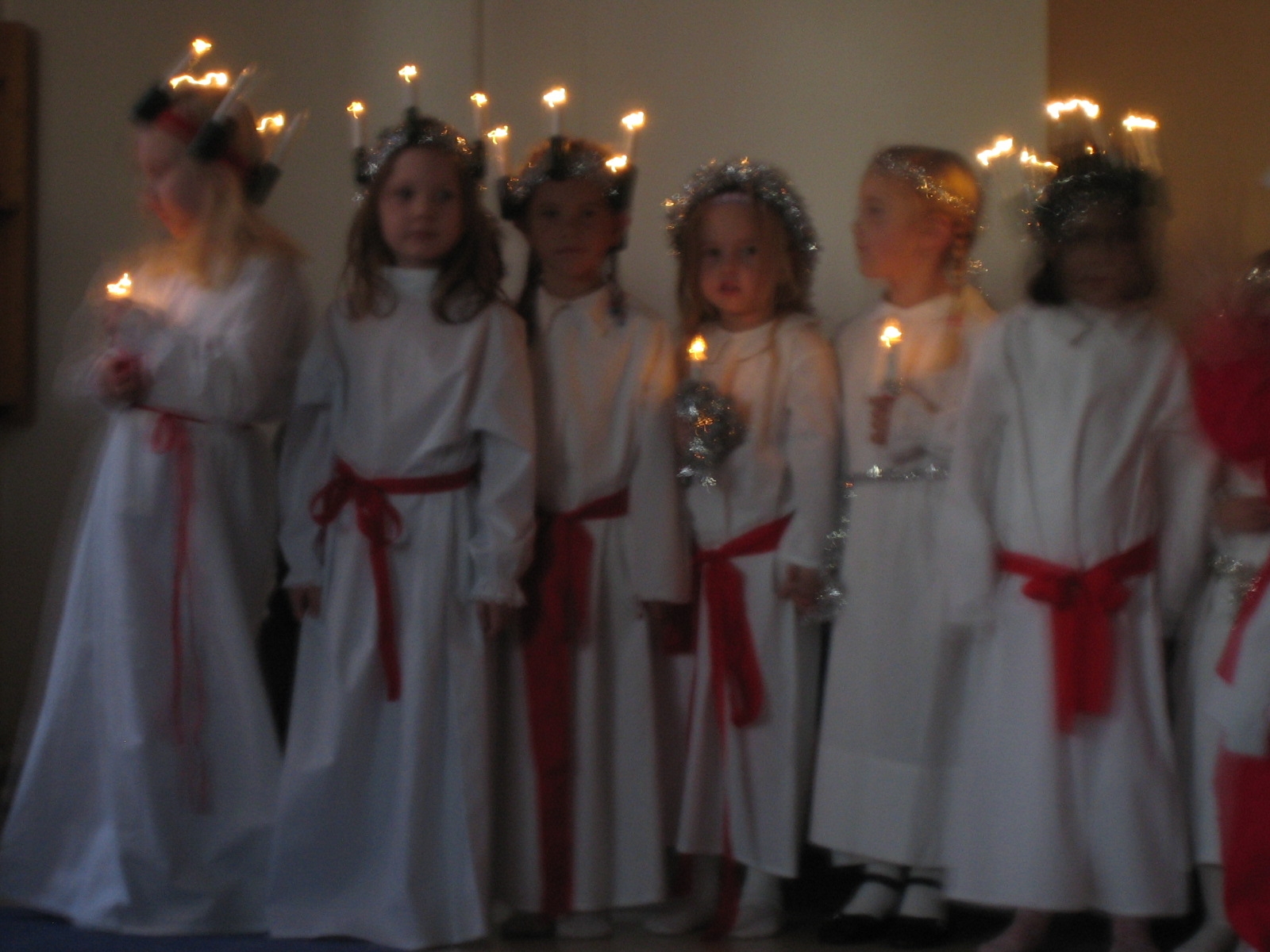
A dark hall. A line of children in white. One of them wearing a crown of live candles. And a song in a language most of the audience does not speak, sung slowly, in a minor key that is not actually a minor key.
It feels ancient. It feels like the oldest thing in the Nordic year.
Almost none of it is.
The saint, and the night
Two separate things got welded together, and neither is Swedish.
The first is Lucia of Syracuse, a Christian martyr executed in Sicily on 13 December in the year 304, during the Diocletian persecutions. The legend has her refusing a marriage and giving away her dowry. Her name comes from the Latin lux, light. The Church commemorates saints on the date of their death, and that is where 13 December comes from — which is what Sweden's Nordiska museet leads with when asked.
The second is the night itself. Under the Julian calendar, which Sweden used until 1753, the longest night of the year fell between 12 and 13 December. That is not folklore; it is arithmetic, and Swedish universities state it plainly.
So for several centuries the feast of a saint named for light landed, in the North, on the actual darkest night. That coincidence did most of the work.
What filled that night before Lucia arrived was not gentle. Norwegian and Swedish folklore records Lussi and lussinatt — a dangerous figure who came to inspect whether the Christmas preparations were done, with supernatural company abroad. People drew crosses over doors, kept steel to hand, left candles burning, and set out extra food for people and animals to get through it.
That is the layer underneath. It has nothing to do with a girl in a white dress.
The invention, dated
Here is the actual chronology, and it is much shorter than people assume.
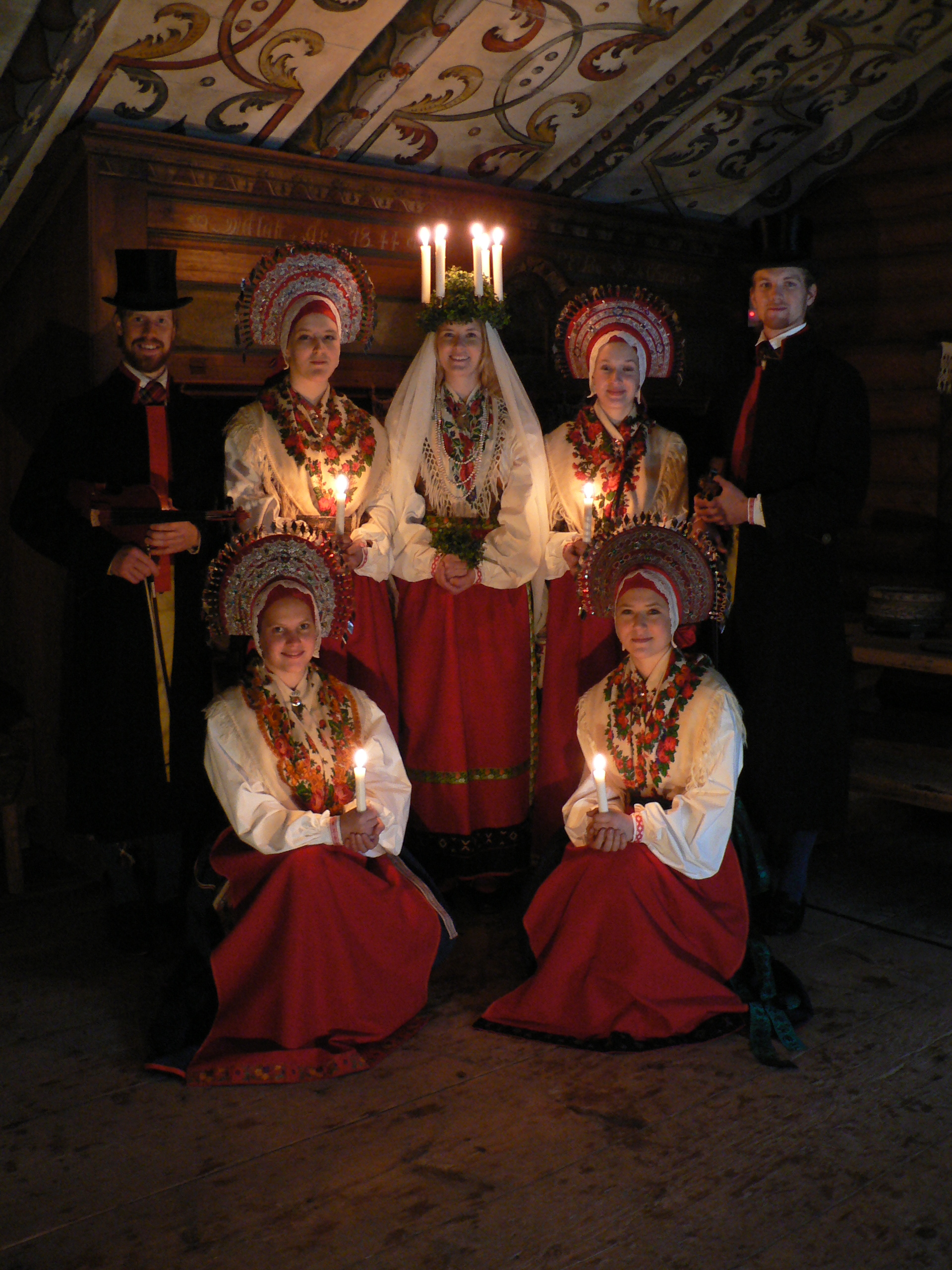
1764. The earliest documented white-clad Lucia in Sweden appears at Horn manor in Västergötland: a figure in white with angel wings, carrying candlesticks. A manor-house entertainment.
c. 1820. Nordiska museet records a figure with candles in the hair at Skinnskatteberg manor in Västmanland — and notes that this Lucia was a male farmhand. Swedish historians are clear that although Lucia and her attendants were female characters, they were frequently played by men.
The 1890s. Skansen, the Stockholm open-air museum, begins staging Lucia under Artur Hazelius as an exhibit of rural custom from western Sweden. Sources give 1892 or 1893 and disagree, so treat the year as approximate. Even then the elements were not yet a single thing: Lucia and the star boys had not begun appearing together.
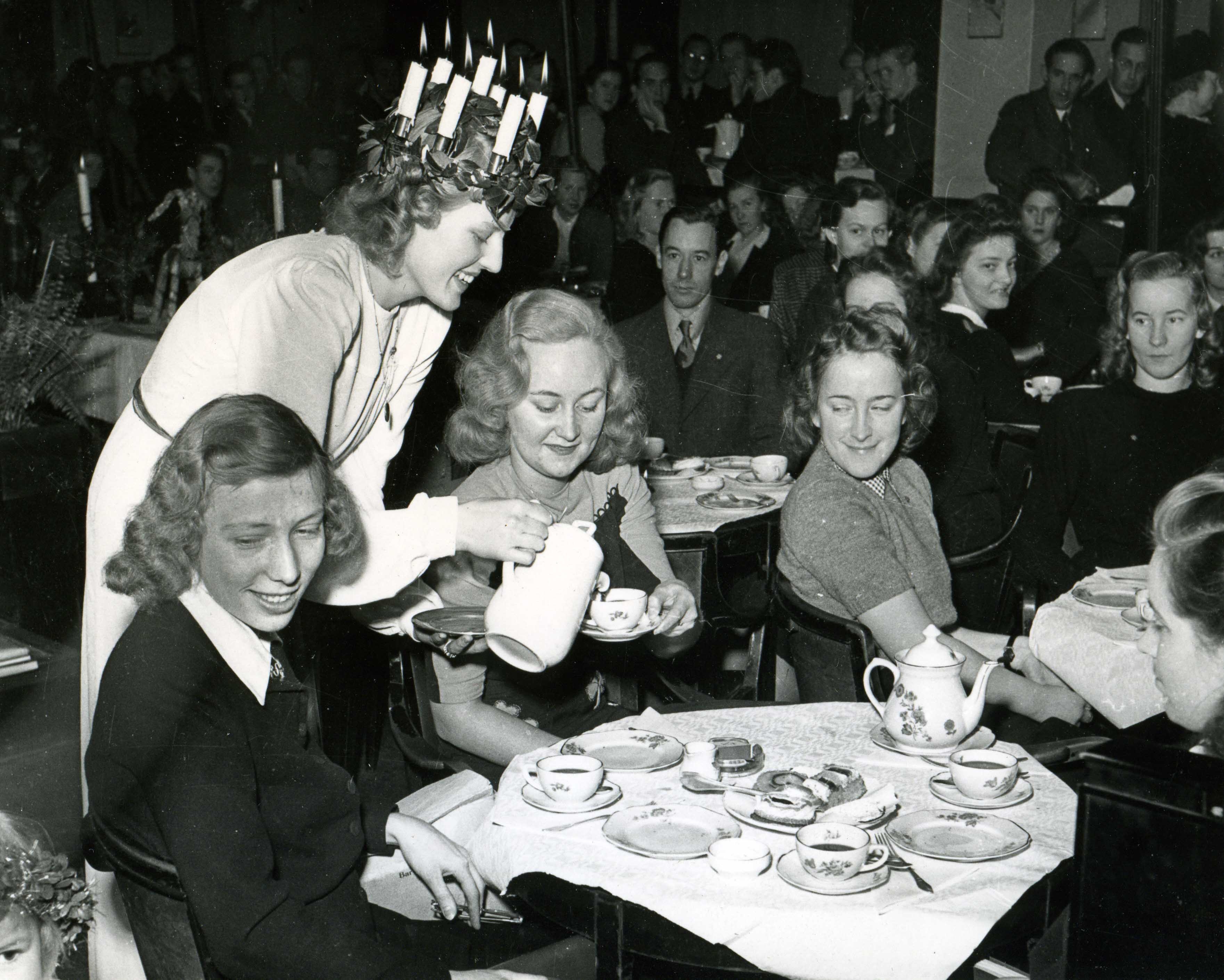
13 December 1927. The pivot. A Stockholm newspaper — most accounts say Stockholms Dagblad — organised the first Lucia competition and staged a procession through the centre of the city. It was about a hundred metres long: mounted heralds and torch-bearers, thirty boys in Staffan costume, thirty star boys, Lucia on horseback with ten mounted attendants, fifty people in folk dress. It set off from Gustav Adolfs torg at eight in the evening and worked its way through Drottninggatan, Kungsgatan and Stureplan. Afterwards Lucia and her attendants toured the city's restaurants raising money for Stockholm's poor at Christmas.
Nordiska museet dates this to 1928 rather than 1927, and one account names a different newspaper. The weight of the sources is with Stockholms Dagblad and 1927, but it is worth knowing the record is not unanimous.
What is not in dispute is the nature of the event: a circulation-building promotion by a daily paper, with a public vote and a charity angle.
The 1950s. The image everyone now pictures — white gown, red sash, crown of candles, a line of identically dressed attendants — becomes standard. Swedish heritage bodies date this to that decade, and note that voluntary organisations pushed it into family life particularly after 1960.
The song is Neapolitan
The tune everyone sings is Sul mare luccica — “Santa Lucia” — written down by Teodoro Cottrau in Naples in 1850.
Its Santa Lucia is not the martyr. It is a waterfront district of Naples. The song is a barcarolle: a boatman's song, about a warm bay, sung by people rowing.
Swedish words were fitted to it in the 1920s. There are three main sets, and Swedes switch between them without noticing:
Sigrid Elmblad, 1924 — Sankta Lucia, ljusklara hägring, the oldest.
Arvid Rosén, 1928 — Natten går tunga fjät, the one most sung today, written in deliberately archaic language to sound older than it is.
Halldis Ljungquist, 1958 — Ute är mörkt och kallt, the children's version.
The star boys, meanwhile, come from the Three Wise Men of Catholic Christmas plays, and were brought in to give boys something to do.
And the red sash — traditionally explained as the blood running down the martyr's gown — has no documented origin that I could trace. It is the kind of explanation a tradition generates after the fact to account for a detail nobody planned.
Sweden's own institute for language and folklore describes the whole thing, without embarrassment, as a relatively modern invention with vague connections to the Catholic saint.
Four countries, four different relationships
Sweden is the centre: universal, televised nationally, in every school and workplace.
Finland has the most formal version, and it belongs specifically to the Swedish-speaking minority. Finland's Lucia is crowned at Helsinki Cathedral on 13 December and processes through the city; the cathedral holds around 1,500 and thousands more watch on a screen in Senate Square. She is chosen by public vote organised by Folkhälsan, a Swedish-language welfare organisation, with the broadcaster Yle and the daily Hufvudstadsbladet. The tradition arrived in the 1890s; the associated charity drive dates from 1949 and now raises sums in the hundreds of thousands of euros for families in poverty or isolation.
That is a striking thing in itself: a linguistic minority of a few hundred thousand people running an annual national ritual that the whole country watches.
Norway took it late and did not much like it. The Swedish-style procession arrived gradually after the Second World War. A survey by the Norsk Folkemuseum in 1978 found considerable public scepticism — some respondents dismissed the custom outright as bland. Commerce and broadcasting normalised it anyway, and it is now mainly a kindergarten, school and church affair.
Denmark has the best origin story of the four. The first Danish Lucia procession was held at the National-Scala in Copenhagen in 1944, after persistent lobbying by Foreningen Norden, the Nordic association, which wanted to strengthen ties between the Nordic countries during the German occupation.
A borrowed Swedish ritual, staged in an occupied capital, as a deliberate act of Nordic solidarity. It stuck.
Iceland, for the record, has no comparable tradition.
What happened to it in North America
Now the part that concerns readers here, and the reason this is worth more than a seasonal curiosity.
The American Swedish Historical Museum in Philadelphia has held a Lucia celebration every year since 1939. That is eighty-seven consecutive years, in a city where everyday Swedish-speaking disappeared generations ago. This year's Lucia Fest and Christmas Market runs 5–6 December.
The American Swedish Institute in Minneapolis runs a Lucia Choir open to any member's child from kindergarten through high school — and its recruitment material says explicitly that no knowledge of Swedish is required. Rehearsals run through November for December performances.
Read that sentence again, because it is the whole argument in one line. The institution has decided that the ritual is worth maintaining even when the participants cannot understand the words they are singing.
The Swedish American Museum in Chicago's Andersonville does the most elaborate version on the continent: three performances on 13 December, beginning at midday at the Chicago Cultural Center, where a Chicago Lucia aged between sixteen and twenty-four is crowned, then a candlelit procession from the museum in the afternoon, and an evening service at Ebenezer Lutheran Church. Children join from age five. Rehearsals start in early November.
The Church of Sweden in New York, on East 48th Street, runs Lucia concerts with two choirs — adults and children — that begin rehearsing in October. Chapters of SWEA, the Swedish Women's Educational Association, founded in Los Angeles in 1979 and now with several thousand members across dozens of chapters, hold Lucia celebrations from California outward. The Swedish Club of Houston has done it since 1987. Lindsborg, Kansas, holds a St Lucia Festival on the second Saturday of December.
What I could not find, and looked for, was scholarly support for the claim I expected to be able to make: that Lucia is the Nordic tradition that outlasts the language. It may well be true. Nobody appears to have demonstrated it, and I am not going to assert it because it sounds right.
What can be said is narrower and better evidenced. Philadelphia has run it unbroken since 1939. Minneapolis recruits singers on the explicit understanding that they will not know what they are singing. Whatever else that is, it is durable.
Why the invention does not diminish it
There is a tempting conclusion here that I want to argue against.
The tempting conclusion is that Lucia is fake — a newspaper stunt from 1927 with a costume from the 1950s and an Italian tune, dressed up as folk memory.
Every fact in that sentence is true and the conclusion is still wrong.
Traditions are not authenticated by age. They are authenticated by use. A ritual that a newspaper invented in 1927 and that four countries and a diaspora have now performed annually for a century is not a fake tradition; it is a young one that worked. The test is whether people keep doing it when nobody makes them, and by that test Lucia is among the most successful cultural inventions of the twentieth century.
It also solved a real problem, which is why it spread. It gave the darkest week of the year a shape, put children at the centre of it, gave them something difficult to prepare, and ended with everyone in a room together in the dark with a light coming towards them.
You do not need a Sicilian martyr for that. You do not, on the evidence from Minneapolis, even need the language.
You need somebody to organise the rehearsals.
Sources
Nordiska museet and Isof (Institute for Language and Folklore), Sweden, on the history and dating of the Lucia tradition.
Store norske leksikon and Norsk Folkemuseum on lussinatt and on the Norwegian reception of the custom, including the 1978 survey.
Den Store Danske on the 1944 National-Scala procession and Foreningen Norden.
Lucia.fi and thisisFINLAND on Finland's Lucia, the Folkhälsan charity drive and the Helsinki Cathedral crowning.
Institutional information from the American Swedish Historical Museum, the American Swedish Institute, the Swedish American Museum, the Church of Sweden in New York, SWEA and Visit Lindsborg.

)%20(1).avif)