The Nordic Art Story Connecting Buffalo and Canadian Modernism

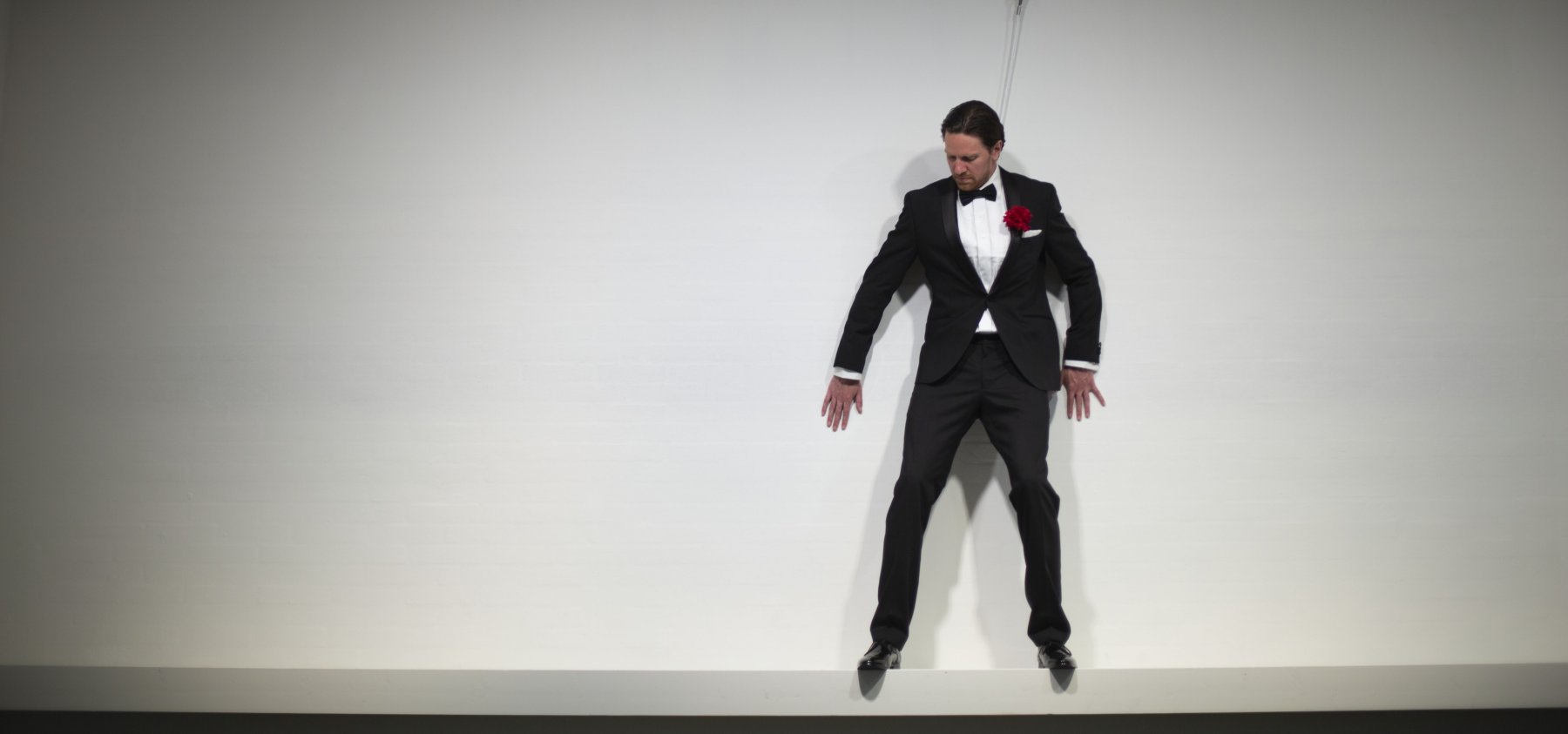
This September, a man in a tuxedo will spend the museum day inching along a narrow ledge high above a Buffalo gallery.
In Ragnar Kjartansson’s Bangemand/Scaredman, the familiar image of masculine confidence begins to unravel. The performer clings anxiously to the wall, caught somewhere between silent-film comedy, cinematic suspense, public spectacle, and genuine fear. No rescue arrives. The action continues throughout the museum’s opening hours, repeating a moment of vulnerability without allowing it to resolve.
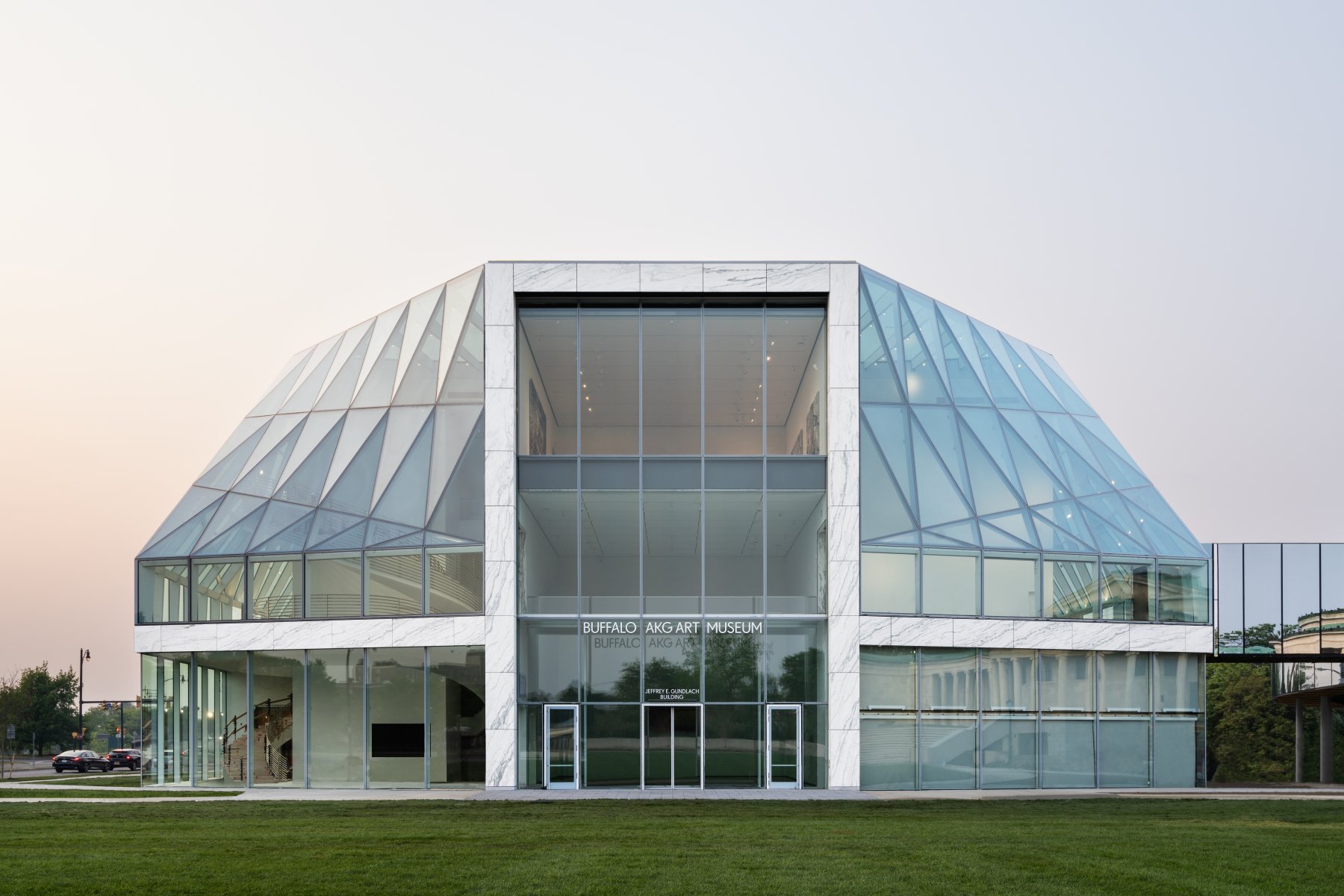
The live performance will form part of Politics of the Obvious, a major exhibition by the Icelandic artist opening at the Buffalo AKG Art Museum on September 3. Bringing together six immersive installations produced over more than two decades, the exhibition will be one of Kjartansson’s most ambitious presentations in the United States. Half of the works will receive their American museum debuts in Buffalo.
It may appear to be a striking new chapter in the city’s relationship with Nordic art. In reality, it belongs to a story that began more than a century ago—one that crossed the border into Canada, influenced artists who would help define Canadian modernism, and is now being extended through an institutional commitment designed to last another sixty years.
Buffalo may not be the first North American city associated with Nordic culture. Yet at the Buffalo AKG, art connected to the region is not being treated as an occasional heritage-season attraction. It is becoming part of the museum’s architecture, collection, scholarship, public programming, and long-term identity.
A Sixty-Year Commitment to Nordic Art
The Buffalo AKG launched its Nordic Art and Culture Initiative in 2021, during the extensive transformation that culminated in the museum’s reopening under its current name in 2023.
The initiative embraces artists and cultural producers connected to Denmark, Finland, Iceland, Norway, Sweden, Greenland, the Faroe Islands, and the Åland Islands. Its activities extend well beyond acquiring paintings and sculptures. The museum’s plans include exhibitions, performances, lectures, publications, educational programs, residencies, research, and public-art commissions throughout Buffalo and Western New York.
Its most arresting promise is also its longest-term one. Over sixty years, the museum says it intends to build North America’s leading collection of contemporary art from the Nordic region.
That statement should be understood as an institutional ambition rather than a ranking already achieved. But the timescale matters. Museums often announce programs around a particular anniversary, donor, exhibition season, or curatorial appointment. A commitment measured in generations suggests something different.
It asks what the collection should look like not only next year, but in the 2080s.
For Nordic communities in the United States and Canada, that horizon moves the conversation beyond the familiar language of cultural preservation. The goal is not simply to safeguard an inherited identity or occasionally celebrate it. It is to establish Nordic art as an active part of the public visual culture of North America.
The Exhibition That Crossed the Border
The initiative draws much of its historical authority from an exhibition staged in Buffalo in January 1913.
The institution was then known as the Albright Art Gallery. For just over three weeks, it hosted Contemporary Scandinavian Art, a traveling exhibition organized by the American-Scandinavian Society. The presentation brought work from Denmark, Norway, and Sweden together at a time when showing the three countries under one curatorial framework was still unusual.
The exhibition had already appeared in New York and later traveled to Toledo, Chicago, and Boston. Its accompanying catalogue ran to 176 pages and included biographical information and images of the participating artists.
Among the visitors who traveled to Buffalo were Toronto artists Lawren Harris and J.E.H. MacDonald.
They encountered Scandinavian painters using landscape not merely as scenery but as a vehicle for emotion, spirituality, national imagination, and modernist experimentation. According to the Art Canada Institute, the two returned to Toronto with intense enthusiasm for creating a similarly forceful visual language from the northern Canadian landscape.
The effects did not appear overnight, nor can one exhibition explain the formation of an artistic movement. Harris and MacDonald were already connected to other artists, ideas, and debates about what a distinctively Canadian art might look like. Yet the Buffalo visit became a recognized turning point.
A.Y. Jackson would later describe the Scandinavian exhibition as the “starting point” for the Group of Seven, the collective founded in 1920 by artists seeking a new visual language for the Canadian landscape.
The connection is remarkable partly because it complicates the usual geography of Nordic culture in North America.
This was not primarily a story of Scandinavian artworks arriving through an immigrant association in the Upper Midwest or a cultural institution on the East Coast. It was a museum exhibition in an American border city influencing artists from Canada, who then helped construct one of that country’s most recognizable visions of itself.
Nordic art entered North American culture not only through ancestry and memory, but through modernism.
.jpeg)
Canadian Modernism Viewed From Buffalo
The Group of Seven became closely associated with monumental images of forests, lakes, mountains, snow, rock, and the Canadian Shield. Their work helped establish a visual mythology of northern land as a source of national strength, spirituality, and independence.
The Scandinavian influence was visible in more than subject matter. Artists such as Harris and MacDonald found encouragement in the way northern European painters simplified forms, intensified color, and transformed difficult climates into something psychologically and symbolically charged.
The resemblance between works reproduced in the 1913 catalogue and later Canadian landscapes can be striking. Gustav Fjæstad’s snow scenes and Harald Sohlberg’s mountain paintings offered examples of how winter, isolation, and severe terrain could become modern pictorial languages rather than provincial subjects.
Yet this history should not be converted into an uncomplicated national origin story.
The Group of Seven’s landscapes have increasingly been reexamined for presenting land as empty wilderness, often erasing the longstanding presence and stewardship of Indigenous peoples. Canadian museums and artists now place those paintings within broader conversations about settler colonialism, extraction, national mythology, and who is permitted to appear within images of the land.
That reassessment does not erase the influence of the 1913 exhibition. It makes the relationship more useful to consider.
Cultural exchange is rarely neutral. An artistic language developed in one northern region was encountered in another, adapted to a different national project, and eventually questioned by later generations. The history connecting Scandinavia, Buffalo, and Canadian modernism is therefore not a straight line of inspiration. It is a continuing argument about landscape, identity, power, and belonging.
An Artwork Visitors Can Enter
The Nordic initiative is not only a historical research project or a promise for the distant future. It is already built into the physical experience of the museum.
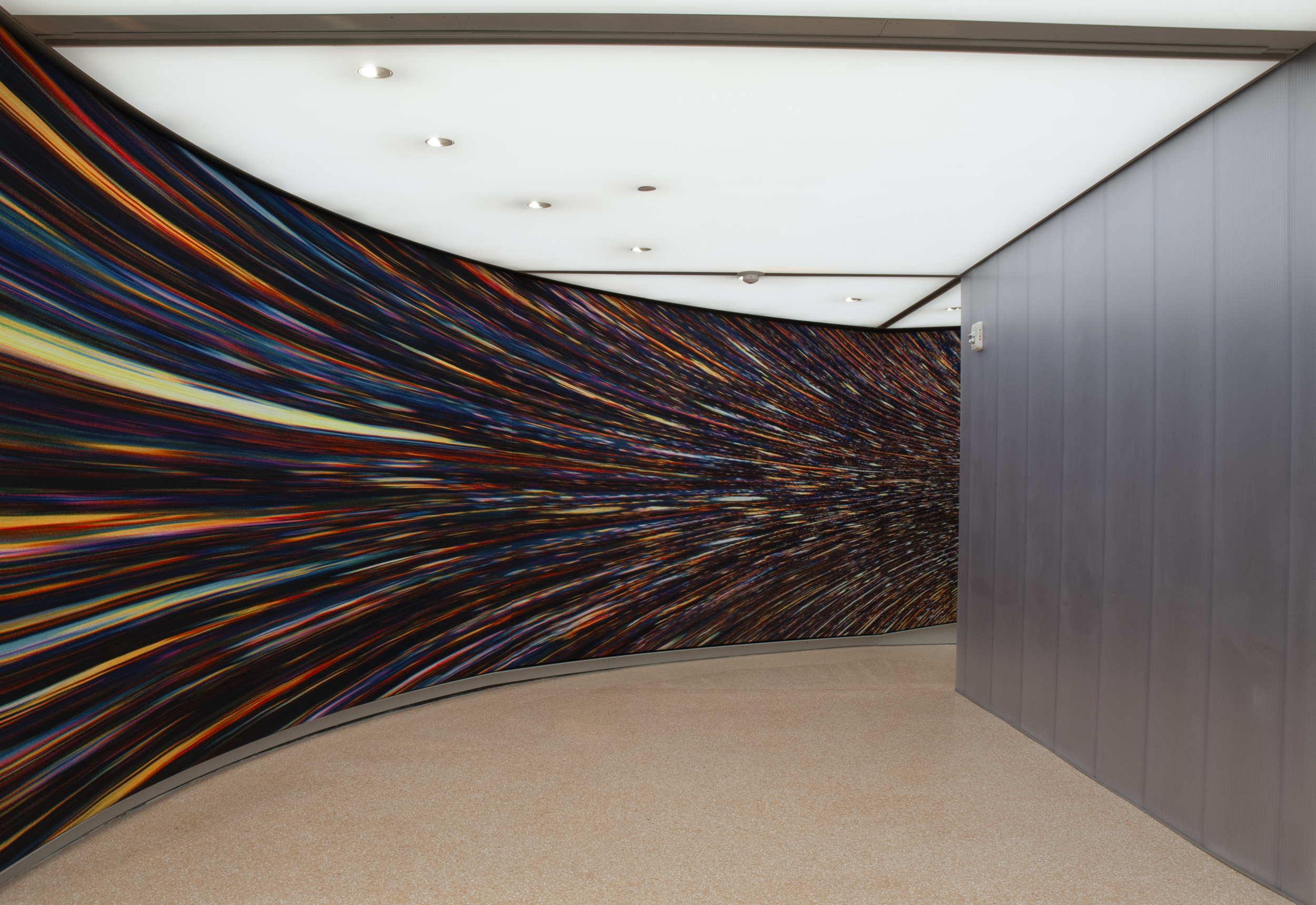
Swedish artist Miriam Bäckström’s Others Will Know curves around the lower-level lobby of the Jeffrey E. Gundlach Building. Measuring more than 38 meters across, the enormous jacquard tapestry turns the lobby into an environment of streaked color, reflected light, visual depth, and apparent movement.
The work began with something almost comically small: a fabric sample measuring no more than two inches square.
Bäckström photographed the swatch at high resolution and mapped its woven colors and reflective foil patterns onto a horn-like virtual sculpture created through three-dimensional software. Within the scale of the computer model, that imagined structure extended for more than half a mile.
She then placed a digital version of the museum lobby inside the virtual form. Panoramic views captured from that simulated space became the source material for the finished tapestry, translated back from digital imagery into woven thread.
The process moved from textile to photograph, from photograph to virtual architecture, and from virtual architecture back into textile.
Visitors do not simply stand before the result. They move through it.
That journey between material and digital space feels particularly relevant to diaspora culture. Inherited culture is often experienced through acts of translation: a place becomes a photograph, a language becomes a remembered phrase, a family account becomes an archive, and an object carries meanings accumulated far from where it was made.
Others Will Know turns such translation into architecture. An intimate fragment of fabric becomes an imagined world, and that world becomes part of a public building in Buffalo.
Nordic Art Is Not One Mood
The artists represented through the initiative also challenge the shorthand often used to describe Nordic culture.
In North American popular imagination, “Nordic” can quickly become a visual formula: pale wood, restrained interiors, snow-covered landscapes, minimal design, quiet melancholy, and a generally tasteful amount of emptiness.
The Buffalo AKG’s recent acquisitions point toward something far more expansive.
The museum lists artists including Finnish filmmaker and installation artist Eija-Liisa Ahtila; Greenlandic-Danish artist Pia Arke; Swedish artist Miriam Bäckström; Icelandic-Danish artist Olafur Eliasson; Norwegian photographer Torbjørn Rødland; Icelandic sculptor Ragna Róbertsdóttir; Danish-Vietnamese artist Danh Võ; and numerous others whose practices cross photography, moving image, architecture, sculpture, painting, installation, performance, and conceptual art.
The geography itself resists a single identity.
Greenland, the Faroe Islands, and Åland introduce political, linguistic, colonial, and Indigenous histories that cannot be reduced to the national narratives of Copenhagen, Stockholm, Oslo, Helsinki, or Reykjavík. Artists tied to the region may have been born elsewhere, live between several countries, or work directly with questions of migration, colonial power, environment, and cultural hybridity.
That broader approach matters. It allows Nordic art to appear not as a recognizable lifestyle aesthetic, but as a field of disagreement and experimentation.
Ragnar Kjartansson and the Familiar Made Strange
The forthcoming Kjartansson exhibition makes that complexity visible in a particularly accessible form.
The Icelandic artist works through performance, music, theater, repetition, and moving image. His pieces often begin with something deliberately familiar: a love song, a vacation image, a masculine pose, a mother-and-son relationship, or a phrase that sounds almost too ordinary to contain meaning.
Then he repeats it until the familiar becomes unstable.
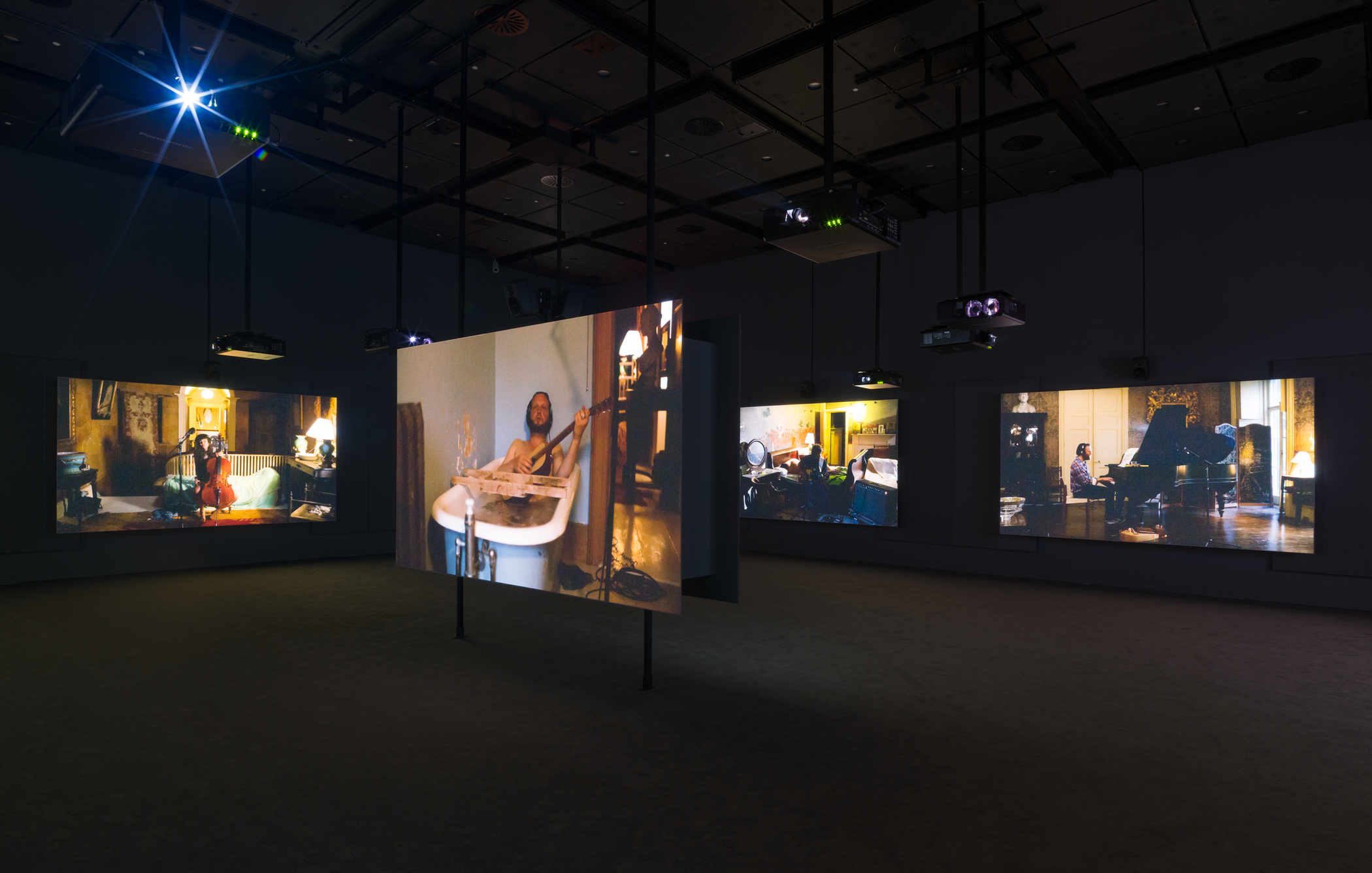
In The Visitors, nine musicians perform separately in different rooms of a decaying mansion in upstate New York. The performers are physically divided but joined through music, producing an experience that feels intimate and communal, melancholic and euphoric at once. The 64-minute installation will be included in the Buffalo exhibition.
In Scenes from Western Culture: The Boat, an elegantly dressed couple repeatedly moves into a tranquil seascape, embodying the polished fantasy that leisure and wealth might permanently resolve the pressures of modern life.
In Bangemand/Scaredman, the tuxedoed figure clinging to the wall turns authority into anxiety. The costume promises control; the body reveals fear.
Throughout the exhibition, Kjartansson allows irony and sincerity to occupy the same space. His work may initially seem comic or absurd, but repetition gradually exposes emotional need beneath the performance.
That sensibility offers another answer to what Nordic art can mean in North America. It need not arrive as an illustration of a nation, a climate, or an inherited tradition. It can enter through shared experiences—love, exhaustion, fear, longing, spectacle, and the uneasy performances through which people try to remain composed.
What Collections Can Do That Festivals Cannot
Diaspora communities often sustain culture through events.
A concert fills a hall. A film screening gathers an audience. A Midsummer celebration transforms a park for an afternoon. A song festival creates a temporary world in which language, memory, music, and belonging can become collective experiences.
Those gatherings are indispensable. They allow people to recognize one another.
A museum collection performs a different kind of work.
It creates durable public memory. It makes an artwork available beyond the date of a festival or the boundaries of an ethnic community. A visitor with no Nordic ancestry can encounter it on an ordinary museum day. A young person with partial or uncertain heritage can see that the culture associated with their family is not confined to the past.
The work is present because an institution has decided that future audiences should be able to see it.
That decision carries particular weight for cultures that are frequently treated as peripheral within larger North American narratives. Representation in a major collection does not automatically produce understanding, nor does it substitute for community-led cultural work. But it creates permanence, visibility, scholarship, and opportunities for future interpretation.
It says that Nordic art is not important only when Nordic people gather among themselves.
It belongs to the public world.
Why the Story Reaches Beyond Buffalo
Buffalo’s location makes the story especially fitting.
It is an American city whose cultural geography has always extended toward Canada. The Great Lakes, the border, the railways, migration routes, universities, industries, and cultural institutions have carried people and ideas across national lines for generations.
The 1913 exhibition demonstrates how easily artistic history can ignore those crossings when it is organized into separate national stories. Scandinavian works traveled to an American museum. Canadian artists traveled south to see them. They returned north with ideas that became part of a national art movement.
More than a century later, the Buffalo AKG is building a new structure for exchange—this time with a wider understanding of what the Nordic region contains and with a commitment extending far beyond a single exhibition season.
For Baltic readers, the initiative also carries a relevant, if indirect, lesson. Estonia, Latvia, and Lithuania are not included within the museum’s Nordic program, and the distinct histories of the Baltic and Nordic regions should not be collapsed into one another.
Yet Baltic communities understand the challenge of gaining sustained visibility for smaller cultural regions inside major North American institutions. A single successful event can create attention. A collection, research program, curatorial position, or long-term acquisition strategy can transform that attention into institutional memory.
The deeper question raised by Buffalo is therefore not limited to one region.
What changes when a culture is not presented as a sidebar, an occasional international feature, or a nostalgic remnant, but collected seriously over generations?
A Long Memory and a Longer Horizon
When Politics of the Obvious opens in September, Buffalo audiences will encounter an Icelandic artist whose work is already entangled with North American places, performers, emotions, and cultural images.
They may enter the separate rooms of an upstate New York mansion through The Visitors. They may watch a suited man cling to a gallery wall. They may hear familiar words and melodies repeated until certainty gives way to something stranger.
Outside those galleries, Bäckström’s woven digital world will continue to curve around the museum lobby. Within the institution’s archives, photographs and catalogues preserve the Scandinavian exhibition that Harris and MacDonald traveled to see in 1913.
These moments are separated by countries, media, and more than a hundred years. Buffalo brings them into the same story.
The result is not merely a Nordic program located in an unexpected American city. It is an example of how culture travels through institutions, crosses borders, changes meaning, and becomes part of histories that no single community can claim alone.
Buffalo’s Nordic art story belongs to North America because it has already helped shape North American art.
And because, after more than a century, it is still unfolding.

)%20(1).avif)