Latvian Song Festival Returns to Seattle, 65 Years After the First

Tickets for next summer’s West Coast Latvian Song and Dance Festival are on sale from today, Nov. 18, starting at 11:18 a.m. Pacific time. The date is Latvia’s Independence Day, and the time matches it.
The festival, the seventeenth of its kind, runs from July 1 to 5, 2027, in Seattle and Bellevue. It is the fourth held in Seattle, and the first anywhere on the West Coast in twelve years. It also marks an anniversary. The first West Coast Latvian Song Festival was held in Seattle in June 1962, sixty-five years earlier.
Where it began
That first festival ran from June 22 to 24, 1962, according to the history kept by the Latvian Song and Dance Festival Fund. Its committee was chaired by Pēteris Pētersons, and three conductors shared the podium: Pēteris Galiņš, Arvīds Grants and Valdemārs Ozoliņš. It carried no number. Only when Portland held the second, in 1965, did the series begin to count.
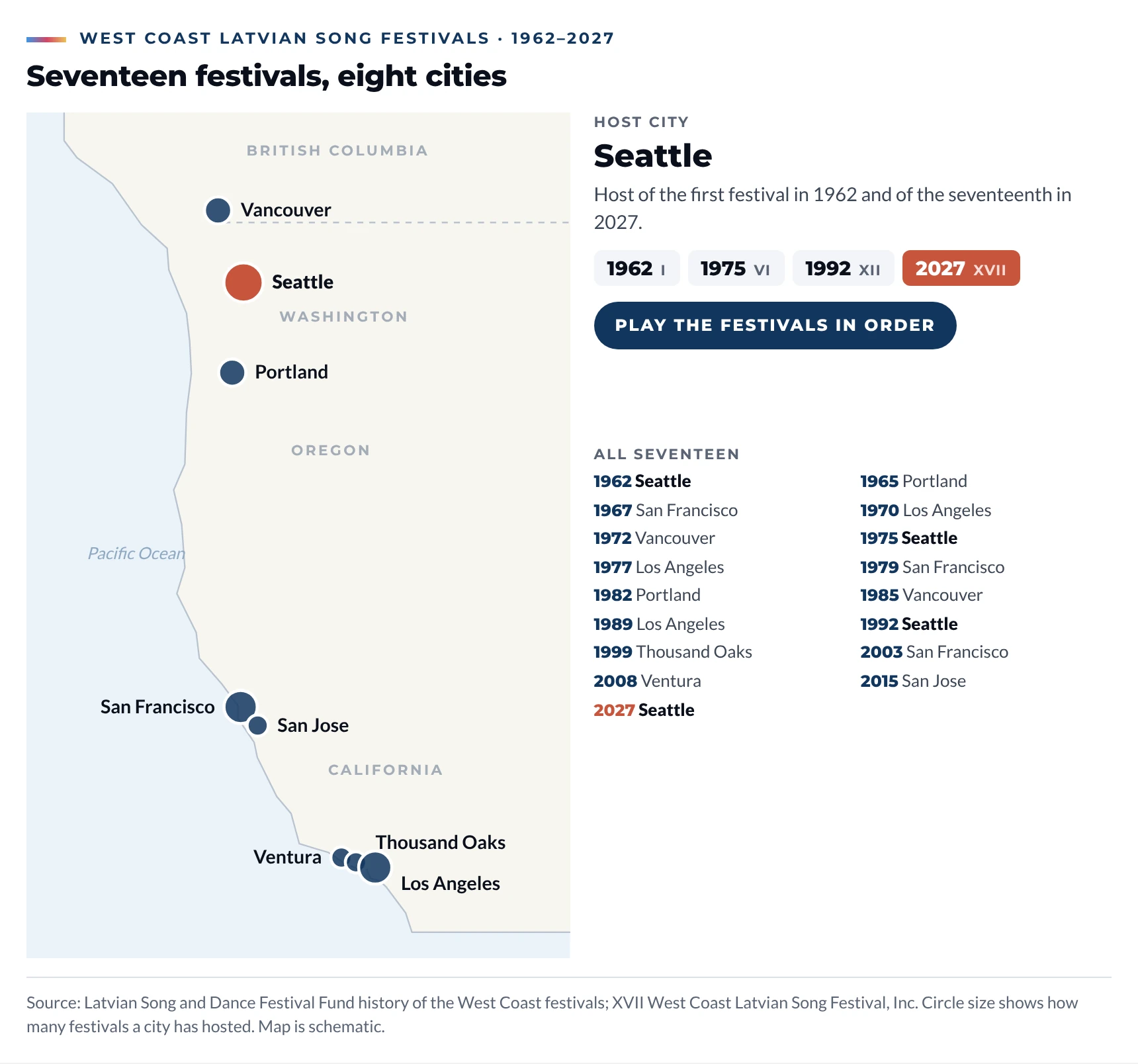
The West Coast festivals grew out of the same tradition as the great song celebrations in Rīga, which UNESCO recognized in 2003 together with those of Estonia and Lithuania. In exile, Latvian communities in the United States, Canada and Australia kept the custom going with festivals of their own. On the Pacific coast, the hosts rotated among Seattle, Portland, San Francisco, Los Angeles and Vancouver.
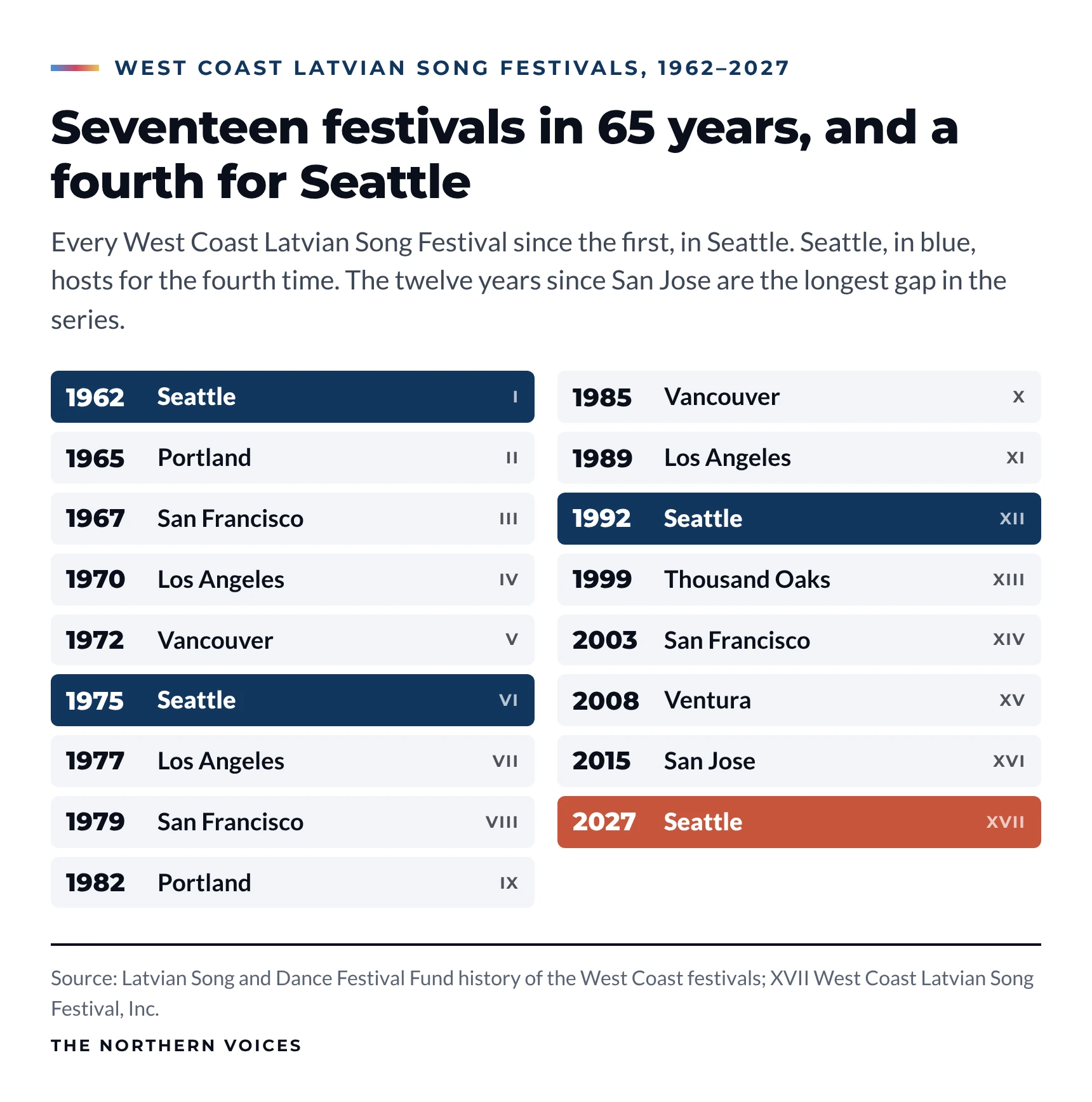
The records give a sense of scale. Seattle’s second festival, in 1975, brought nine choirs and eighteen folk dance groups with 320 dancers, and held its main choir concert at the Seattle Opera House. Vancouver in 1985 had sixteen choirs and ensembles. In 1989, in Los Angeles, a choir from Latvia took part for the first time: Ave Sol, conducted by Imants Kokars, two years before Latvia restored its independence. Up to 1999, attendance ran between about 2,300 and 3,700 people, with combined choirs of 250 to 350 singers.
After that, the festivals came less often. Thousand Oaks hosted in 1999, San Francisco in 2003, Ventura in 2008 and San Jose in 2015. The San Jose festival brought thirteen choirs and seven dance groups. The twelve years between San Jose and Seattle are the longest gap in the series.
Five days in July
The program published by the organizers starts on Thursday, July 1, with an opening ceremony and garden party at the Seattle Latvian Center in north Seattle. On Friday there is a folk dance concert at the Meydenbauer Center in Bellevue, a guest choir concert and a ball. Saturday’s main event is the grand folk dance performance, “In Step with Time,” also at the Meydenbauer Center.
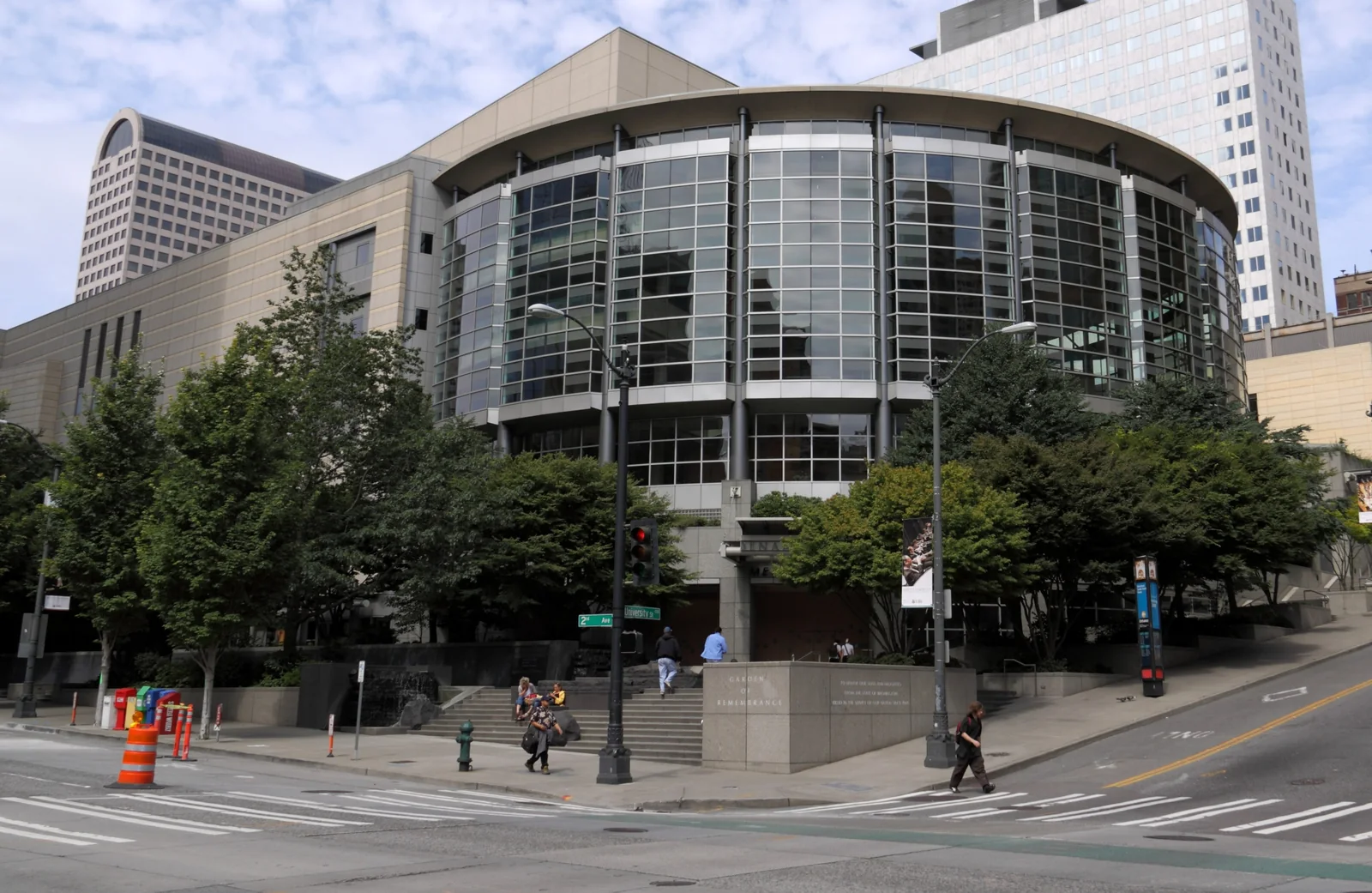
Sunday, July 4, is the center of the festival, on the day the United States marks its own independence. After a church service at the Latvian Center, the massed choirs perform the grand concert, “Child of the Coast,” at Benaroya Hall, the home of the Seattle Symphony. A Grand Ball closes the night.
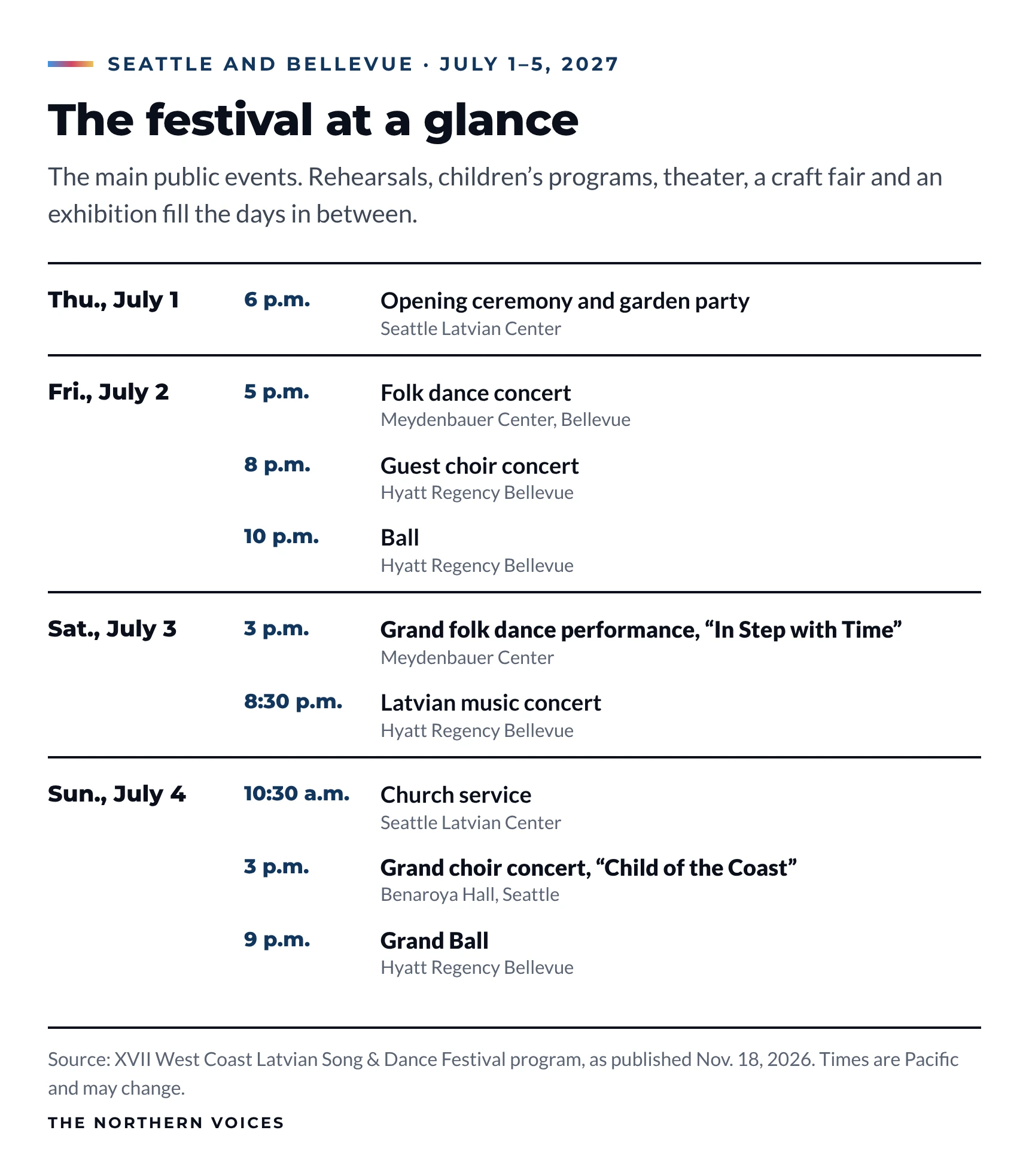
In between come rehearsals, a concert for children and families, theater, a dinner, a Latvian music concert and a party with a DJ. A craft fair, an exhibition and a pop-up pub run throughout at the Hyatt Regency Bellevue, the festival’s official hotel. The Baltic Times, reporting on the plans in April, said the program also includes a sacred music concert, a parade and a masterclass at the University of Washington.
Who is putting it on
The festival is organized by a nonprofit set up for the purpose, XVII West Coast Latvian Song Festival, Inc. Its committee is chaired by Egija Claire, who also directs the choir program. Ērika Currier directs the dance program, and Sanita Šūmane Karami the children’s and youth program. The working group includes the novelist Pauls Toutonghi and the artist Sinda Kārkliņa.
Its largest donors so far, listed on the festival’s site, include the Latvian Song and Dance Festival Fund, the American Latvian Association, the ladies’ committee of the Seattle Latvian Evangelical Lutheran congregation, and the Latvian Association of the State of Washington, which runs the Latvian Center on Third Avenue Northeast. Seattle’s folk dance group Trejdeksnītis is among the sponsors at the next level.

Why it matters now
Song festivals have outlasted most things that Latvian exiles built in North America. The sixteenth nationwide Latvian Song and Dance Festival in the United States was held in Grand Rapids, Michigan, this past July. Seattle’s is the West Coast’s answer, smaller and more intimate, and for Latvian communities from British Columbia to Southern California it is the one within driving distance.
A twelve-year gap is long enough for a generation of children who danced at San Jose to become the adults who now organize, rehearse and pay for the next one. Pauls Toutonghi, quoted on the festival’s site, describes the point of it as a chance “to remember why we do this.”
Tickets for individual events are sold through the festival’s ticketing page at westcoastlatviansongfest.simpletix.com. The program, hotel booking and registration for choirs and dance groups are on the festival’s website, rietumkrastadziesmusvetki.org.
Sources: XVII West Coast Latvian Song & Dance Festival website, home, program and tickets pages, as of Nov. 18, 2026; Latvian Song and Dance Festival Fund, pages on the XVII festival and on the history of the West Coast festivals (in Latvian; translations ours); The Baltic Times, April 9, 2026, citing LETA; Latvian Association of the State of Washington. Lead photograph: a singer holds a score at the closing concert of the Latvian Song and Dance Celebration in Rīga on July 8, 2018, by Ernests Dinka for the Saeima, CC BY-SA 2.0, via Wikimedia Commons.

)%20(1).avif)