Estonia Has One Consular Office Left in the United States. In March, the Polling Station Is a Phone.

On 29 October, Estonia’s National Electoral Committee decided that at the Riigikogu election on 7 March 2027, citizens will be able to cast an electronic vote from a smartphone or tablet as well as from a computer, through a voter application for iOS and Android.
It is the first time. Estonia has allowed internet voting since 2005, and every one of those votes has been cast from a computer. The Riigikogu wrote the possibility of a voter application for smart devices into law in 2024. The committee considered using it for the local elections of October 2025 and narrowly turned it down; its chair, Ingrid Kullerkann, said then that “the prevailing view is that it is too early to use the app.”
This year a majority of the committee found the risks sufficiently reduced. The State Electoral Office ran a public test of phone voting in 2025 with the Information System Authority, and commissioned an audit from KPMG, which found that the authenticity of a voter application distributed through the app stores can be verified. Kullerkann now says that, to her present knowledge, voting on a mobile device carries no greater risk than voting on a computer.
For most voters in Estonia this is a convenience. For Estonians in the United States and Canada it lands differently, and the reason is a map.
One embassy, one continent
Since 1 August 2024, the Embassy of Estonia in Washington has been, in its own words, “the only Estonian representation in the United States providing consular services.” The consulates general in New York and San Francisco closed that day. We covered the campaign to keep the New York consulate open; it did not succeed.
March will be the first parliamentary election since. Estonian law requires each foreign mission to offer voting on at least two days between the fifteenth and tenth day before the election, which this time means between 20 and 25 February. The days, hours and places for North America have not been published; as of 13 November the embassy pages in Washington and Ottawa say nothing about the election yet.
Unless the foreign ministry adds locations, an Estonian citizen in Los Angeles, Chicago or Seattle who wants to mark a paper ballot in person is looking at a trip to Washington in the last week of February.
Most of them were already voting online
The paper ballot was the minority choice abroad long before the consulates closed.
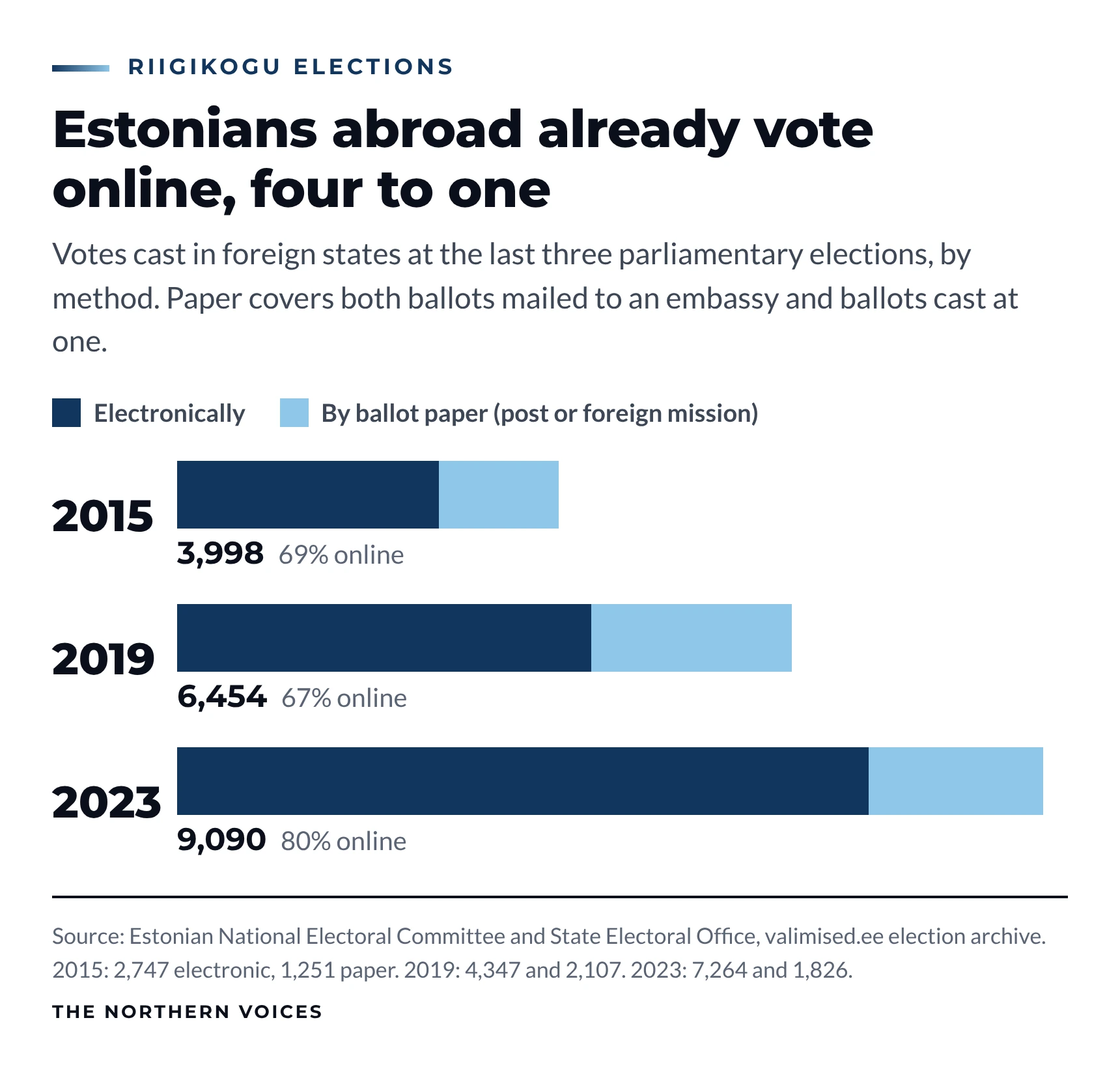
At the 2023 Riigikogu election, 9,090 votes were cast in foreign states. Of those, 7,264 were electronic and 1,826 were on paper, a figure that covers both ballots mailed to an embassy and ballots cast at one. Four in five.
The total has more than doubled in eight years. It was 3,998 in 2015 and 6,454 in 2019, and almost all of the growth is online.
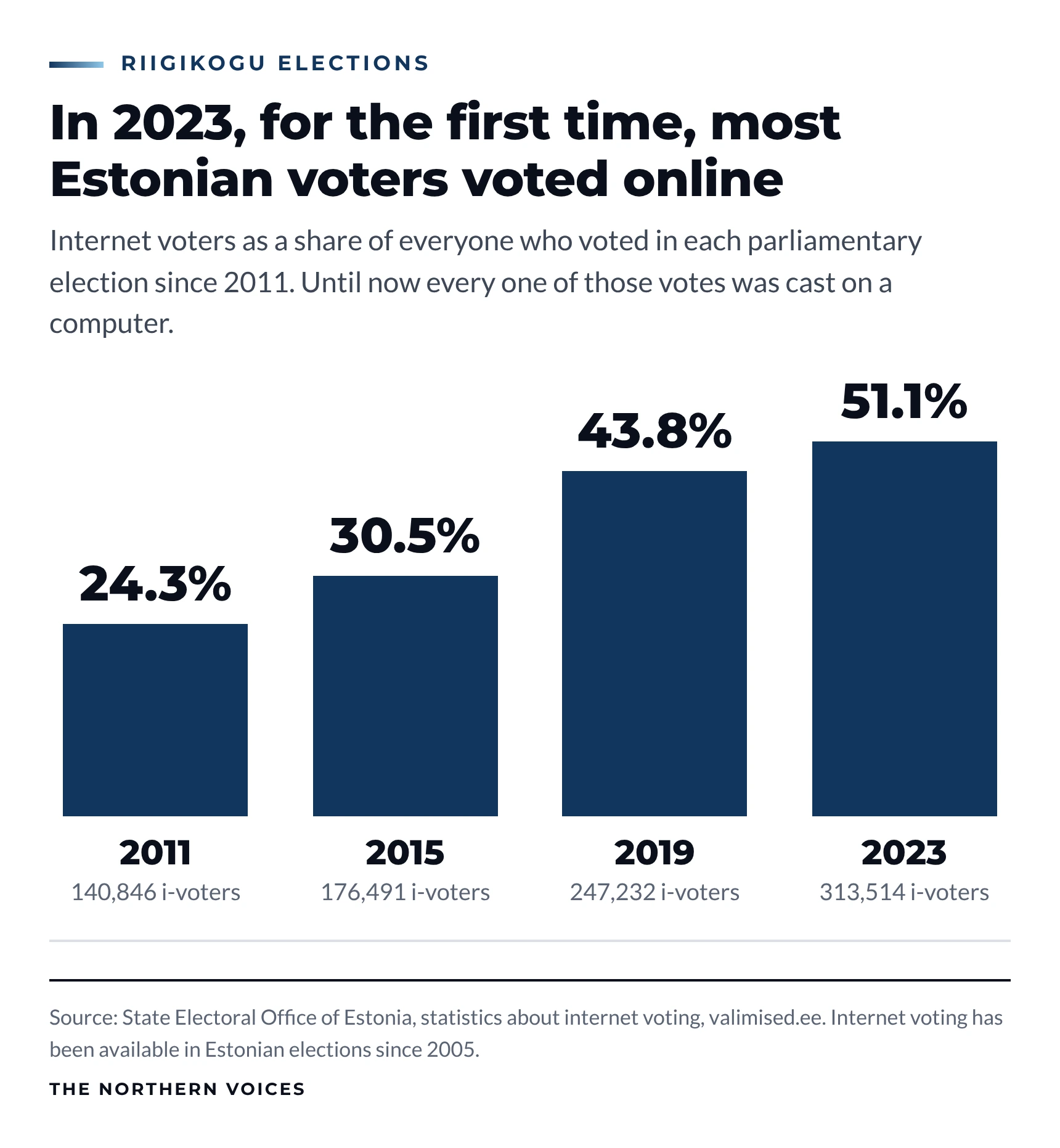
At home the line was crossed in 2023, when internet voters became a majority of all voters for the first time: 51.1 percent, up from 24.3 percent in 2011.
What the phone adds is the removal of the desk. Until now, voting online meant a computer, and for an ID-card, a card reader. From March the voter application will run on Windows, macOS and Ubuntu Linux, and on iOS and Android phones and tablets, and a separate application for iOS and Android lets a voter check, within fifteen minutes of voting and up to three times, that the vote reached the electronic ballot box and says what they meant it to say.
What you need, and what to check now
You need a working Estonian electronic identity. The election authority’s general guidance lists three: an ID-card with its PIN codes, Mobile-ID, or Smart-ID. Mobile-ID lives on a SIM card issued by a mobile operator. Smart-ID is an application tied to no SIM, and an account is created by verifying your identity with an ID-card.
One caution. The 29 October announcement does not say which of the three the phone application will accept, and we would not assume. That detail should come with the application itself.
The thing to check tonight is the expiry date on your documents. An expired ID-card votes nowhere, online or off. For Estonians in the western half of the United States, the embassy’s consul is traveling in the next four weeks, and a consular mission is, as the embassy puts it, “an alternative way to apply for documents and provide fingerprints”:
- Chicago: 21 November, 10 a.m. to 5 p.m., Chicago Estonian House, 14700 Estonian Lane, Riverwoods, Illinois
- Los Angeles: 5 December, 10 a.m. to 5 p.m., and 6 December, 10 a.m. to 2 p.m., Los Angeles Estonian House, 1306 West 24th Street
- San Francisco: 7 December, 10 a.m. to 5 p.m., and 8 December, 10 a.m. to 2 p.m., Two Embarcadero Center, Suite 1900
- Portland: 9 December, 10 a.m. to 2 p.m., 329 NE Couch Street
- Seattle: 10 December, 10 a.m. to 2 p.m., 950 North 72nd Street, Suite 100
Pre-registration by email is required, and the embassy sends the forms to fill in beforehand. If you are applying for a new card, ask how long delivery takes before you count on voting with it in March.
The calendar
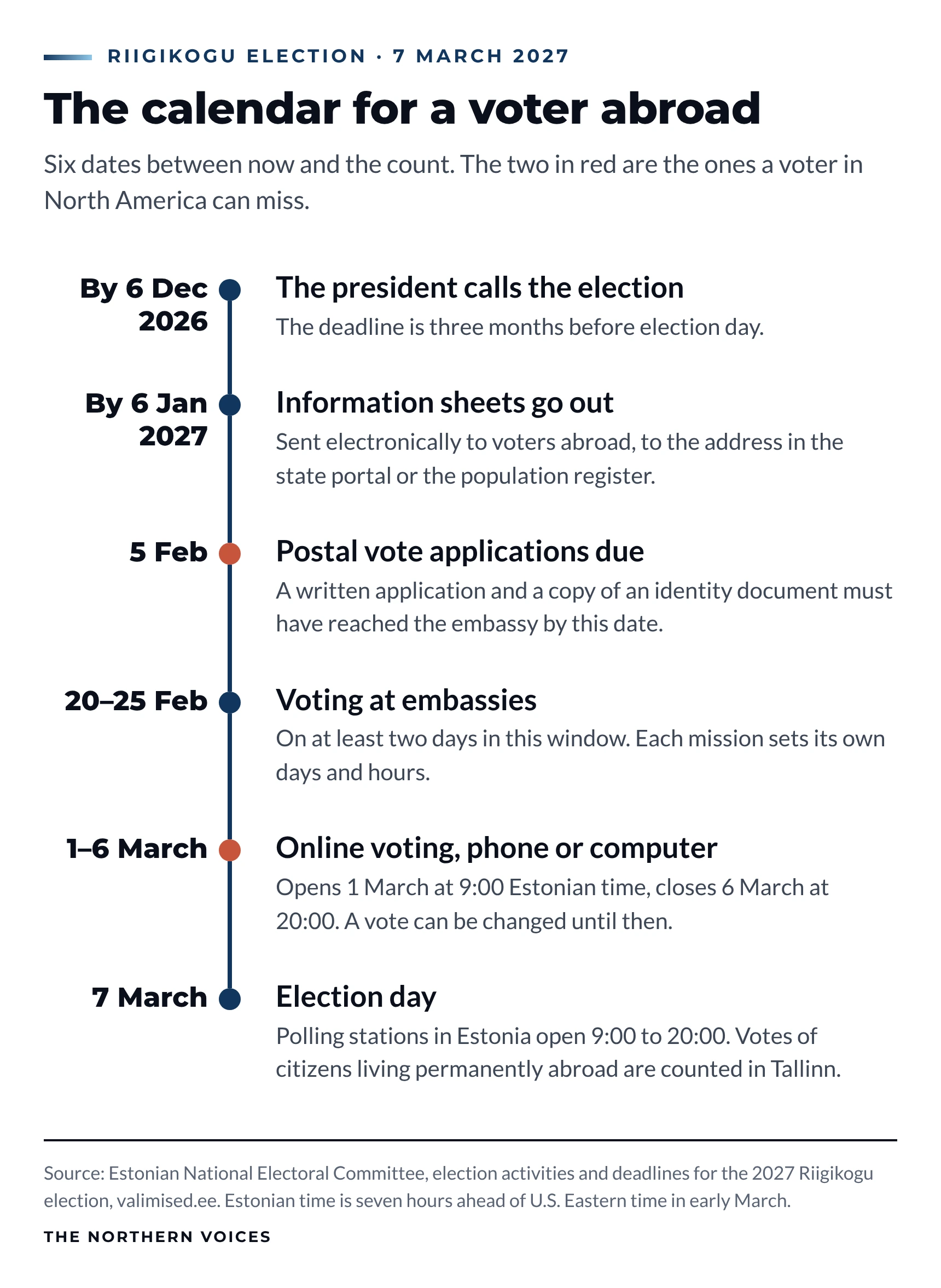
By 6 December. The president calls the election. That is now Ülle Madise, the former chancellor of justice, whom the Riigikogu elected on 2 September with 71 votes and who was sworn in on 12 October.
By 6 January. The interior ministry sends an information sheet to every voter registered abroad. It comes electronically, to the address in the state portal or the email in the population register. If neither is current, it will not reach you.
5 February. The deadline that closes first. A citizen who wants to vote by post must apply in writing to the foreign mission, with a copy of an identity document, and the application must have arrived by this date. The mission sends back a ballot, two envelopes and the candidate list. The voter pays the return postage, and the ballot has to be back by a day the mission sets, early enough to reach Estonia by election day.
20 to 25 February. Voting at foreign missions, on at least two days.
1 to 6 March. Electronic voting, around the clock, from 9 a.m. on Monday 1 March to 8 p.m. on Saturday 6 March, Estonian time. In North America that is 2 a.m. Eastern on Monday until 1 p.m. Eastern on Saturday; on the Pacific coast it opens at 11 p.m. on Sunday 28 February and closes at 10 a.m. on Saturday. An electronic vote can be cast again during that window, and the last one counts.
7 March. Election day in Estonia. There is no electronic voting on the day itself.
One more piece of the system matters to people who left a long time ago, or never lived there. A citizen who lives permanently abroad votes in the electoral district of their last residence in Estonia, or, failing that, the district where their parents or ancestors lived. Their votes are counted in Tallinn.

What is still argued about
The committee’s decision was by majority, not consensus, and electronic voting remains the most contested part of Estonian elections.
In February 2025 an expert team from the OSCE’s election office visited Estonia to assess it, at the request of Arvo Aller, a member of the Riigikogu’s board from the Conservative People’s Party. According to the Estonian Human Rights Centre’s annual report, the team recommended strengthening the secrecy and freedom of the vote, carrying out the post-election audits the law requires, and setting clear criteria for suspending or ending electronic voting. It also noted that “political disagreements persist.” After the 2024 European Parliament election the Supreme Court received fifteen complaints, most of them about the reliability of electronic voting; it upheld one, rejected ten and declined to review four.
Arne Koitmäe, who heads the State Electoral Office, answers that the new operating systems add devices without changing the system, which he describes as among the most thoroughly audited in the country, and that every voter stays free to choose paper. The office’s own advice for March is short: use only the official application, keep the phone’s software up to date, and check the vote with the verification application.
That is an argument for Estonia to have with itself. The arithmetic for a voter in Portland or Toronto is simpler. In 2023, four of every five Estonian votes cast abroad never touched paper. In 2027, with one consular office for a country of 340 million, the fifth vote has fewer places to go.
The decision on phone voting, the audit, the 2025 test, the supported operating systems and the verification application are from the National Electoral Committee’s announcement of 29 October 2026, published in Estonian on valimised.ee; statements by Ingrid Kullerkann and Arne Koitmäe in 2026 are paraphrased from it. Kullerkann’s 2025 remark was reported by Baltic News in June 2025. The election timetable, the rules for voting from abroad and all voting statistics are from valimised.ee. The embassy’s statement on consular services and the consular mission schedule are from the Embassy of Estonia in Washington’s website as it stood on 13 November 2026. Details of the presidential election are from bne IntelliNews and dpa. Guidance on Mobile-ID and Smart-ID is from id.ee. The OSCE visit and the Supreme Court complaints are as summarized in the Estonian Human Rights Centre’s report “Human Rights in Estonia 2026.” The share of internet voters in 2023 is from the authority’s statistics pages; its 29 October notice gives a marginally different count, 312,181 voters or 51.2 percent. Time conversions are ours: Estonia is seven hours ahead of U.S. Eastern time in the first week of March. Lead photograph: the Embassy of Estonia on Massachusetts Avenue in Washington, April 2026, by ajay_suresh, CC BY 4.0, via Wikimedia Commons. The in-text photograph is credited in its caption.

)%20(1).avif)