Latvia Gave the Progressives 8 Percent. Latvians in Toronto Gave Them 44.
On 3 October, 297 people voted at the Latvian centre on Credit Union Drive in Toronto. It was the busiest Latvian polling station in North America, and 130 of those voters chose the Progressives.
That is 44 percent. In Latvia as a whole the Progressives took 7.9 percent and finished fifth.
The Central Election Commission, CVK, confirmed the results of the 15th Saeima election on 16 October and published them station by station. We went through every table for the United States and Canada: twenty-two polling stations and the two postal voting commissions, in Washington and Ottawa. This is the follow-up to the voting guide we published in September, and it has three parts: what Latvia decided, what North America decided, and what happened to the ballots that went by mail.
What Latvia decided
Prime Minister Andris Kulbergs’s United List, Apvienotais saraksts, won 35.3 percent of the vote and 41 of the 100 seats. Latvian public broadcasting noted that no single list has ever held more; the previous record was 36, set by Latvijas ceļš in 1993.
Five other lists cleared the 5 percent threshold:
- Latvia First (Latvija pirmajā vietā): 13.1 percent, 17 seats
- Sovereign Power / New Latvians (Suverēnā vara / Jaunlatvieši): 11.7 percent, 15 seats
- National Alliance (Nacionālā apvienība): 8.9 percent, 10 seats
- The Progressives (Progresīvie): 7.9 percent, 10 seats
- New Unity (Jaunā Vienotība): 6.4 percent, 7 seats
New Unity, which led the government until May, went from the largest group in the Saeima to the smallest. The Union of Greens and Farmers, whose chairman was detained by anti-corruption investigators the day that government fell, took 4.4 percent and lost every seat it had.
Turnout was 51.79 percent: 806,648 voters. It was 59 percent in 2022, and the public broadcaster called this year’s figure a new low for a parliamentary election.
What North America decided
In the United States and Canada, 2,182 Latvian citizens voted. In the United States it was 1,558: 1,358 in person at sixteen stations and 200 by post through the embassy in Washington. In Canada it was 624: 578 in person at six stations and 46 by post through Ottawa.
Add the twenty-four tables together and the result looks like a different country’s election.
- The Progressives: 30.9 percent in North America, against 7.9 percent in Latvia
- New Unity: 24.2 percent, against 6.4
- United List: 23.2 percent, against 35.3
- National Alliance: 7.8 percent, against 8.9
- Latvia First: 3.3 percent, against 13.1
- Sovereign Power / New Latvians: 2.6 percent, against 11.7
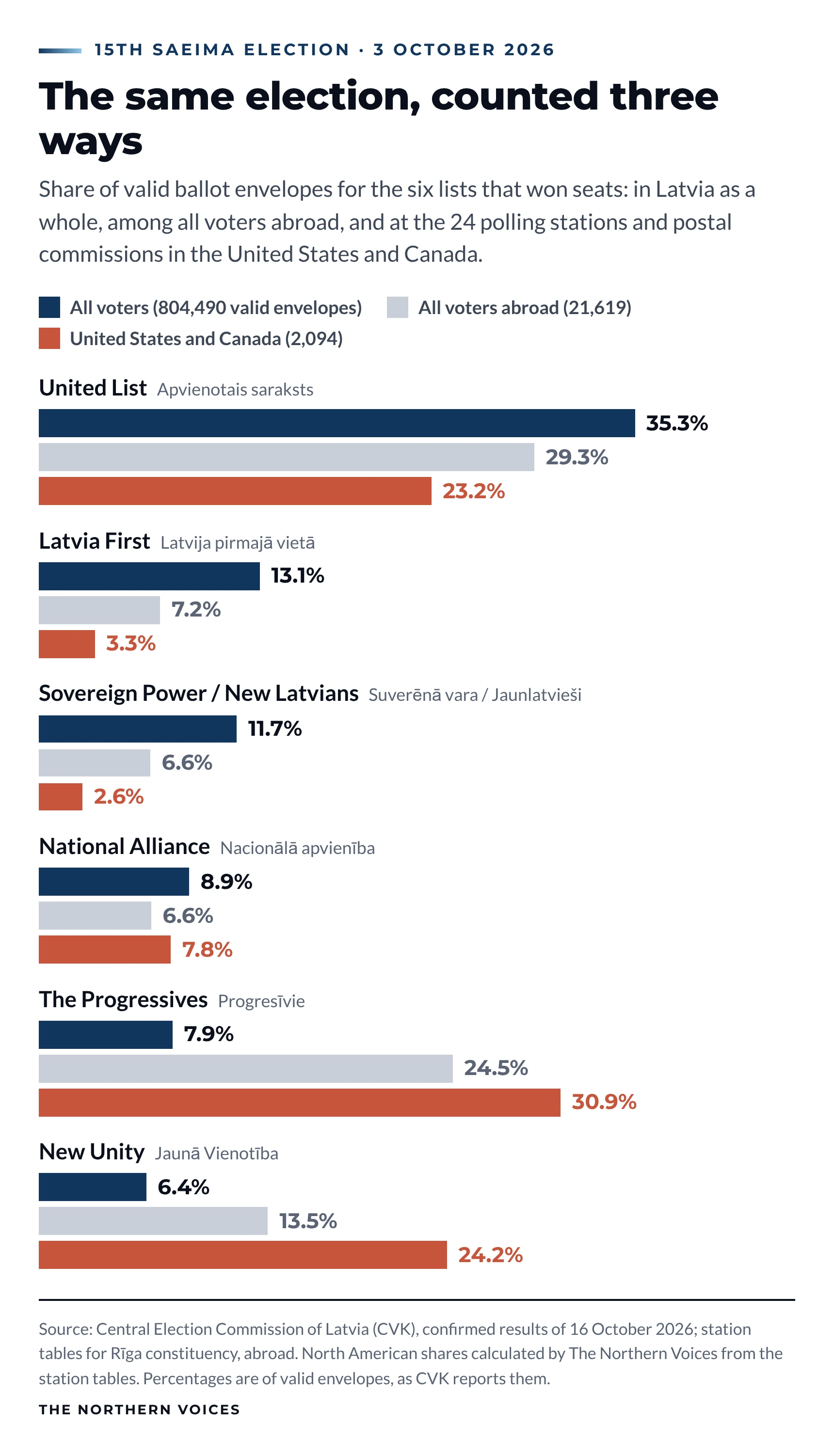
Two comparisons make the gap plain. Latvia First and Sovereign Power, the two lists Latvian public broadcasting describes as the new opposition, took 24.8 percent between them at home. In North America they took 5.9 percent. The Progressives and New Unity took 14.2 percent between them at home. In North America they took 55.1 percent.
Canada leaned further than the United States. The Progressives won 36.2 percent of Canadian envelopes and 28.7 percent of American ones.
The Progressives came first at thirteen of the twenty-four stations and commissions, from New York and Boston to Minneapolis, Seattle, San Francisco, Montreal and Vancouver. New Unity came first at four, including the embassy station in Washington. The United List came first at six: Chicago, San Diego, Edmonton, the Ottawa postal commission, and Atlanta and Houston, where it took exactly half the vote. Kalamazoo was a tie, eighteen votes each for New Unity and the Progressives.
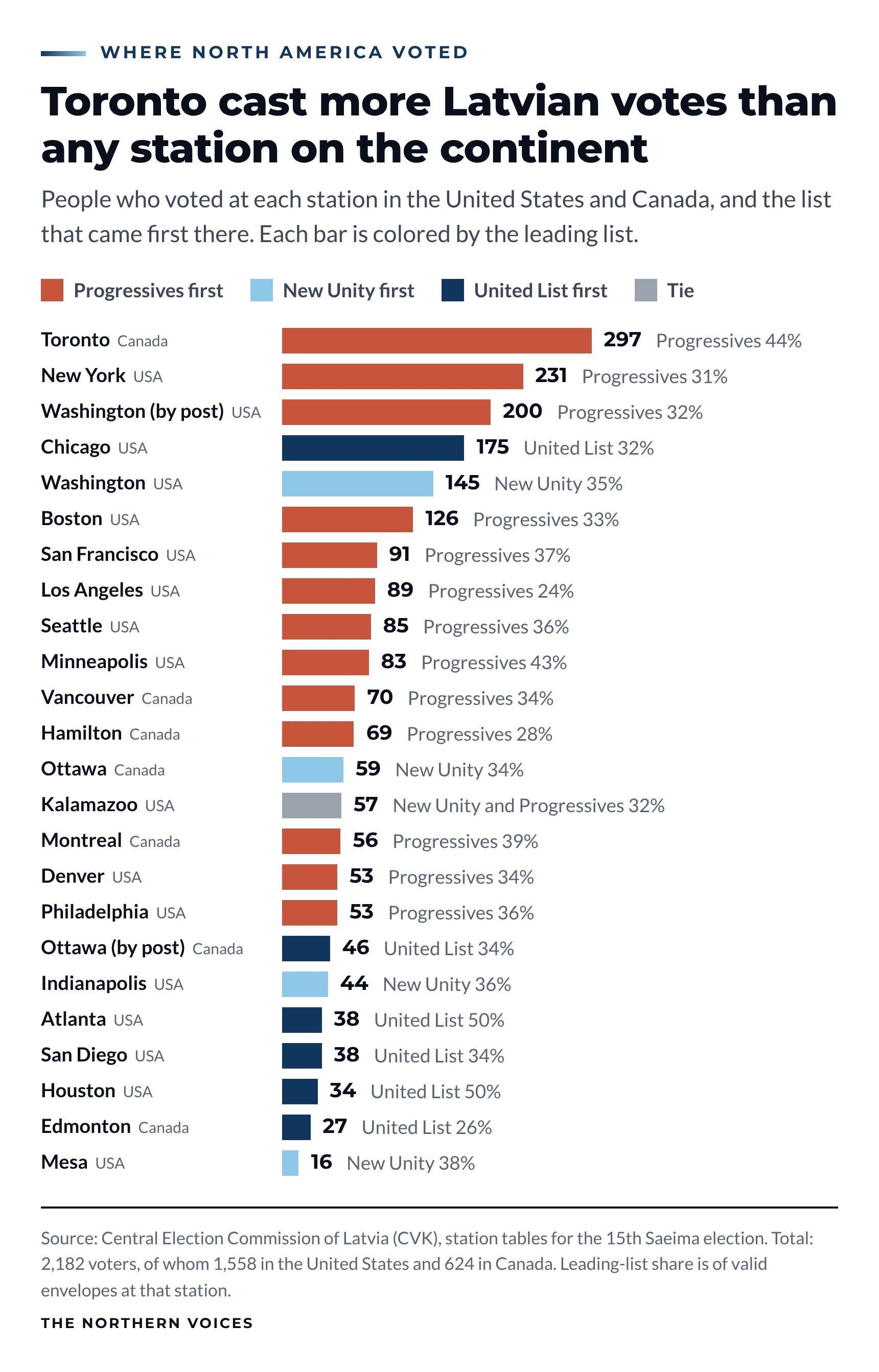
Some caution about size. These 2,182 voters are 9.4 percent of everyone who voted abroad, and everyone who voted abroad is 2.9 percent of the electorate. Every one of these votes was counted in the Rīga constituency, where it is one among hundreds of thousands. Nor is the pattern only North American: across all stations abroad the Progressives took 24.5 percent and New Unity 13.5. North America is the far end of a lean the whole diaspora shares.
The tables do not say why, and we are not going to say it for them.
Fewer people voted abroad than in 2022
Abroad as a whole, 23,196 people voted, which CVK puts at 11.63 percent of the 199,452 voters registered outside Latvia. In 2022 the figure was 26,146. That is a fall of 11 percent in four years.
The United Kingdom cast the most votes, 3,703, followed by Germany with 2,806. The United States was third.
One correction to a figure that has traveled. A widely shared article in early October said that “only one in a hundred” Latvian emigrants had voted, a turnout of 0.9 percent. The article’s own numbers, 23,627 voters among 257,373 citizens registered abroad, come to 9.2 percent. The official figure, measured against registered voters, is 11.63. Low, and lower than last time. Not one in a hundred.

The ballots that went by mail
In September we wrote that international mail to a volunteer-run polling station is not a service with a guarantee, and that anyone who could hand an envelope in should. The tables now show what that risk was worth.
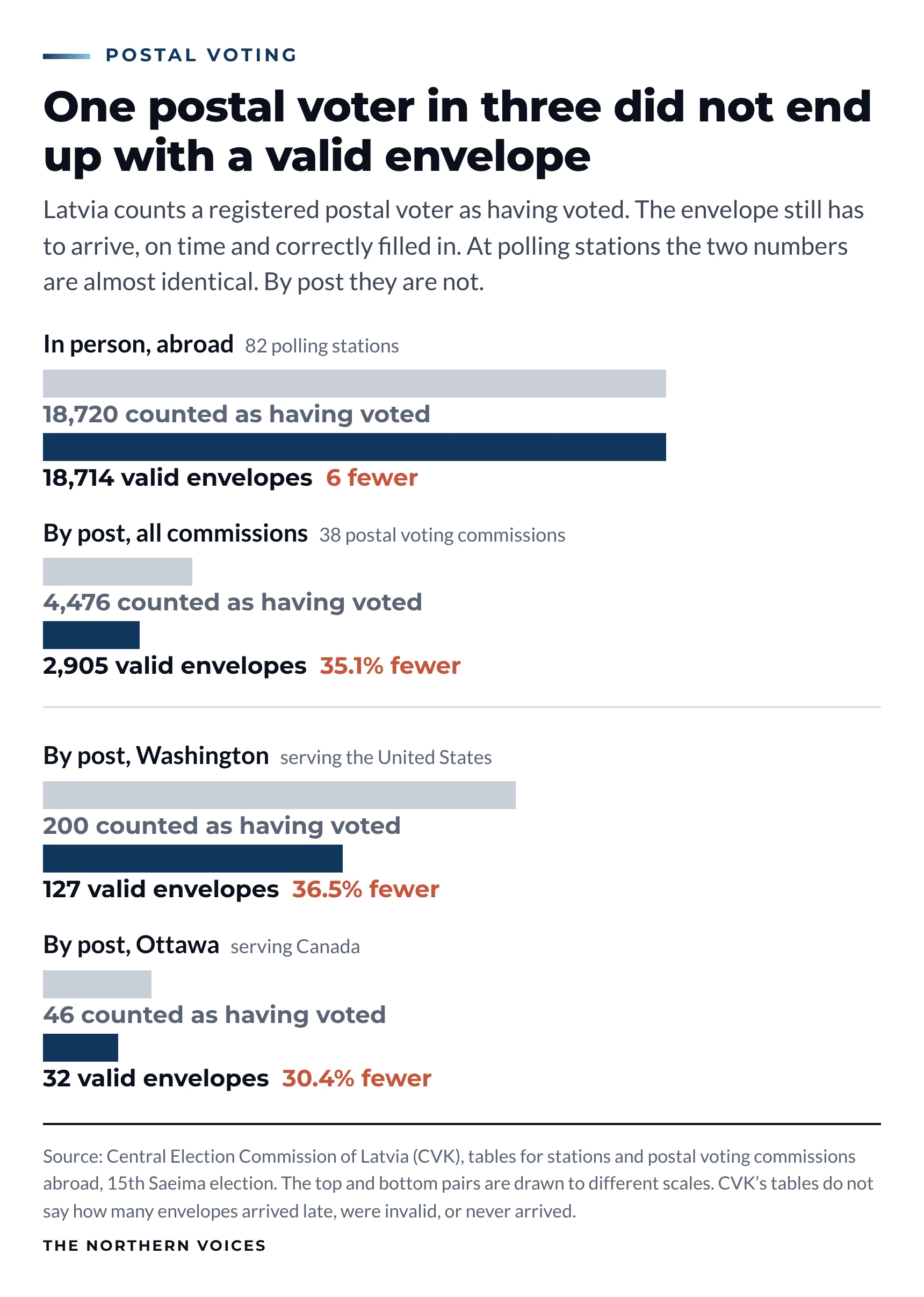
The foreign ministry says 4,907 people registered to vote by post and 4,476 used the option. CVK’s tables list those same 4,476 across thirty-eight postal voting commissions, and next to them the number of valid envelopes each commission ended up with. The total is 2,905.
At the eighty-two polling stations abroad, 18,720 people voted and 18,714 valid envelopes were counted. A difference of six.
By post, the difference is 1,571. More than one postal voter in three, 35 percent, did not end up with a valid envelope.
In Washington, 200 postal voters produced 127 valid envelopes. In Ottawa, 46 produced 32. That is 87 North American voters who registered, were counted in the turnout, and whose ballots are not in the result.
CVK’s pages do not explain the two columns, but one case does. On 8 October the commission told the news agency LETA that at the postal commission based in Latvia, 838 people had registered, 98 of them later voted in person and had their postal vote cancelled, 444 envelopes were received, and 118 of those were ruled invalid: the voter could not be identified, the signed certification was not enclosed, or the ballot was not inside the ballot envelope. Subtract 98 from 838 and you get 740, which is exactly the figure in CVK’s table for that commission’s voters.
So a postal voter is counted when they register and do not cancel. The envelope is a separate question, and it can fail three ways: it is never sent, it arrives after election day, or it arrives and is thrown out. CVK has not published how the missing 1,571 divide among the three, and we will not guess. The worst results were far from North America. Athens turned 125 postal voters into 17 valid envelopes, and Canberra turned 67 into 27.
The practical conclusion is the same one we offered before the vote, now with a number attached. At a polling station, six envelopes in 18,720 went missing. By post, it was one in three.
Who governs now
The 15th Saeima sat for the first time on 3 November and elected Edvards Smiltēns of the United List as speaker, with 79 of 100 votes. President Edgars Rinkēvičs formally nominated Kulbergs to form a government the next day.

As of Friday 13 November there is no government yet. Latvian public broadcasting reports that the likeliest outcome is a coalition of the United List and the National Alliance, with 51 seats between them, and that Latvia First’s leader Ainārs Šlesers has pledged his 17 members’ support. New Unity and the Progressives have not been invited to the next round of talks. Smiltēns has said the Saeima could vote as early as Tuesday 17 November, the day before Independence Day. Asked on Thursday about the pace, the president said: “I see no reason for any kind of anxiety.”
If that is the government Latvia gets, it will be one whose two parties won 44 percent of the vote at home and 31 percent in North America, led by a prime minister whose list took half the vote in Atlanta and Houston and 16 percent in Toronto and New York.
We will update this article when the Saeima votes.
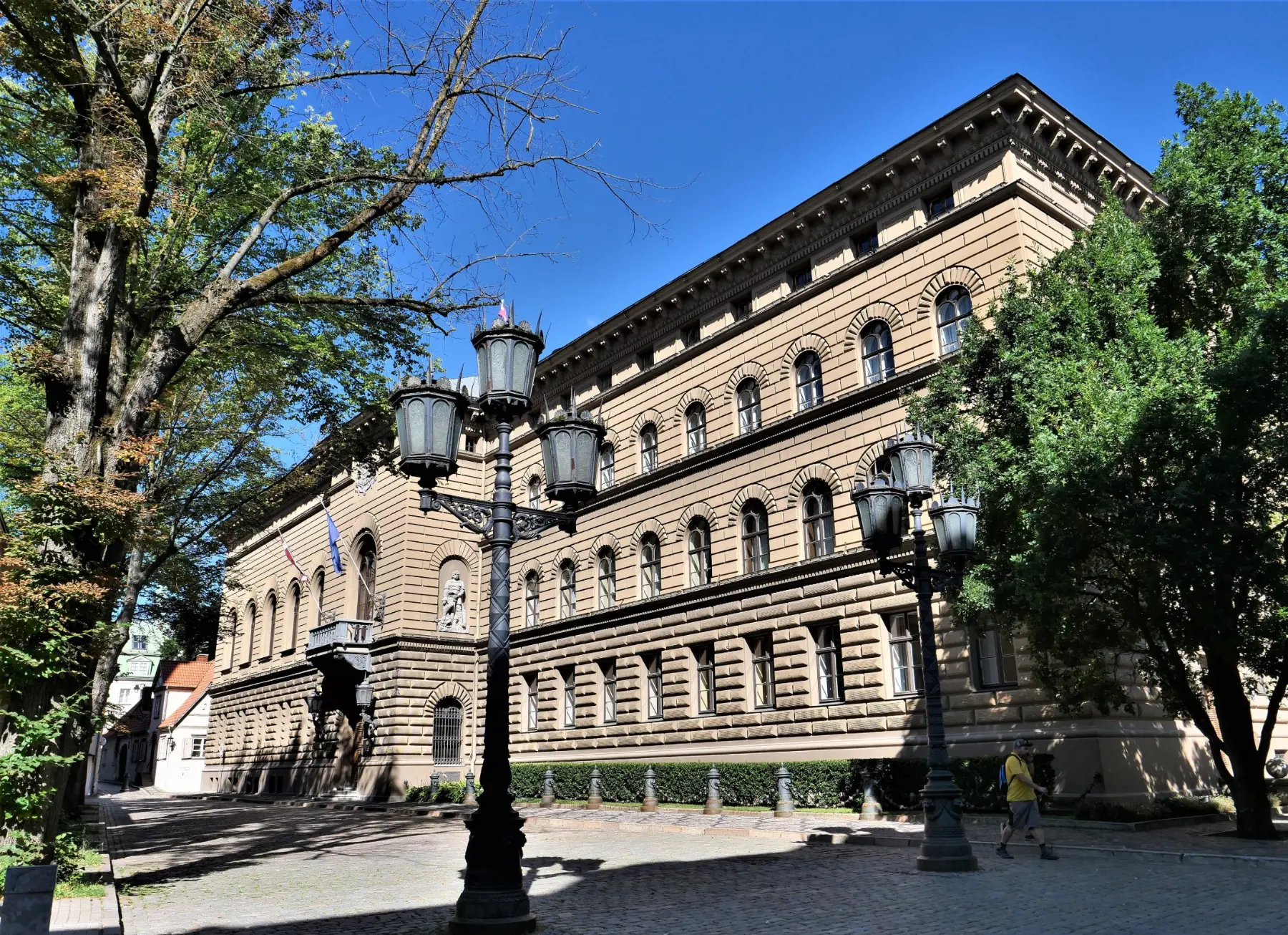
National results, turnout, and all figures for voters abroad, individual stations and postal voting commissions are from the Central Election Commission of Latvia (CVK): its confirmation of the results on 16 October 2026 and its published tables for the Rīga constituency, abroad. Totals and percentages for the United States, Canada and North America are our own arithmetic from those tables, calculated as CVK calculates them, as a share of valid envelopes. The number of people who registered for and used postal voting, the country totals for the United Kingdom and Germany and the 2022 figure for voters abroad are from the Ministry of Foreign Affairs as reported by LSM. Seat records, the first sitting, the speaker’s election, the nomination and the state of coalition talks are from LSM’s English service, 4 October to 13 November 2026; the president’s remark was made to journalists on 12 November. The postal figures for the commission in Latvia were given by CVK to LETA and reported by LSM on 8 October. The “one in a hundred” article was published by BB.LV’s English edition on 6 October. Lead photograph: the Saeima building in Rīga, by Barnos, CC BY-SA 4.0, via Wikimedia Commons. In-text photographs are credited in their captions.

)%20(1).avif)