A Century Ago, New York Heard Sibelius’s Last Masterpiece First

On Dec. 26, 1926, the Symphony Society of New York gave a concert at the Mecca Temple on West 55th Street. Walter Damrosch conducted Beethoven’s Fifth Symphony. George Gershwin sat down at the piano for his own Concerto in F. Then the orchestra played a new piece that nobody anywhere had heard: a symphonic poem by Jean Sibelius called Tapiola.
It was the last major work Sibelius completed. He lived for another thirty years and never published anything on its scale again. The piece now counted among his greatest was written on an American commission and first heard in Manhattan, a century ago next month.
A telegram in January
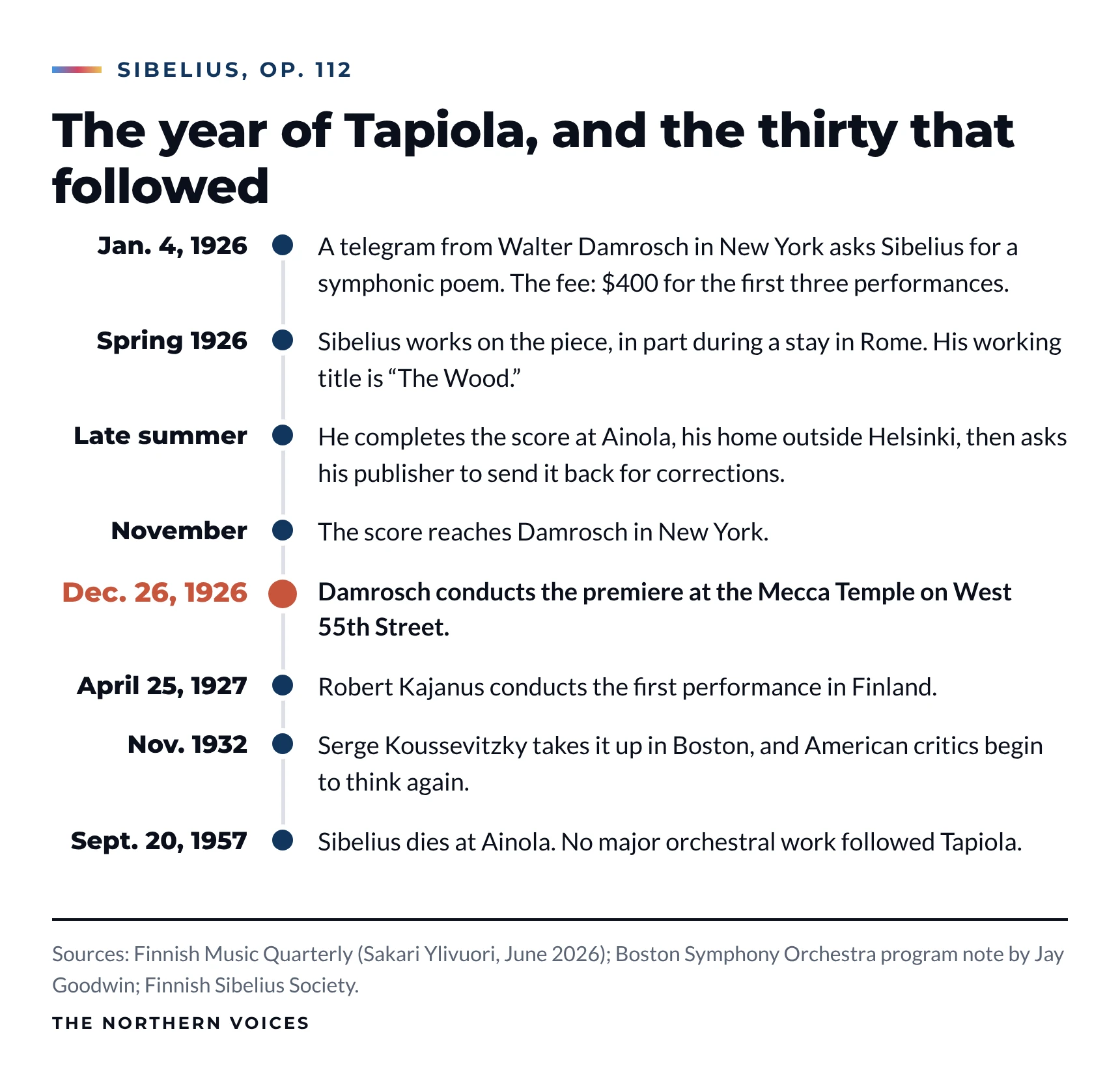
On Jan. 4, 1926, Sibelius received a telegram from Damrosch, according to an account published this year by Finnish Music Quarterly. Damrosch wanted a symphonic poem for performance later that year and offered $400 for the first three performances. Sibelius accepted.
He worked on it through the year, in part during a stay in Rome. His letters from there call it “The Wood”; his wife, Aino, corrected that to “The Forest.” By late summer he had a score at Ainola, the family’s house in Järvenpää, north of Helsinki. Then he asked his publisher, Breitkopf & Härtel, to send it back so he could make corrections. Damrosch did not receive it until November.
The commission was not a happy one. “I regret accepting this ‘commission,’” Sibelius wrote while he worked on the corrections, according to the Finnish Sibelius Society. “Am I made for this?”
The realm of Tapio
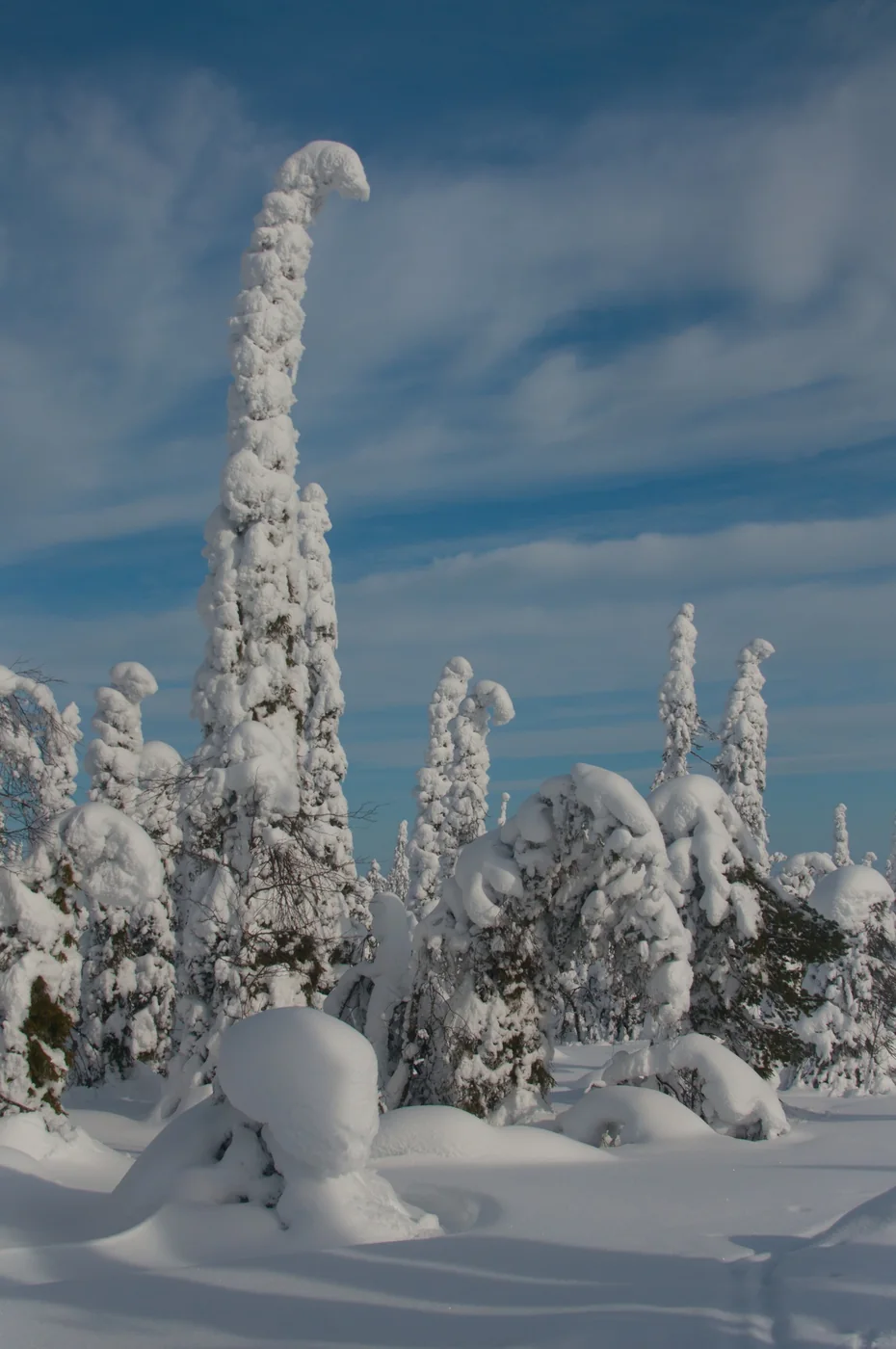
Tapiola means the realm of Tapio, the forest spirit who appears throughout the Kalevala, the Finnish national epic. When the publisher and Damrosch’s office asked whether it was a particular forest, Damrosch proposed a subtitle for New York audiences: “A wild northern forest, wherein dwell the God of the forests and his wood-nymphs.” Sibelius agreed.
The printed score carries four lines in English, based on Sibelius’s own description:
Wide-spread they stand, the Northland’s dusky forests,
Ancient, mysterious, brooding savage dreams;
Within them dwells the Forest’s mighty God,
And wood-sprites in the gloom weave magic secrets.
The music is almost entirely built from one short figure heard at the start in the strings. A Finnish critic, Karl Ekman, wrote in Hufvudstadsbladet that “Tapiola is a monothematic whole.” Over about fifteen to twenty minutes, Sibelius turns that figure into calm, into wind, into a storm in the brass, and finally into three soft pulses of a major chord that end the piece almost without warning.
The concert on 55th Street
Damrosch told his audience to expect “limitless dark-green forests, icy northern winds and ghostly woodland spirits.” Earlier, on receiving the score, he had been more direct: “No one but a Norseman could have written this work.” Sibelius was Finnish, not Norwegian, but the compliment was sincere.
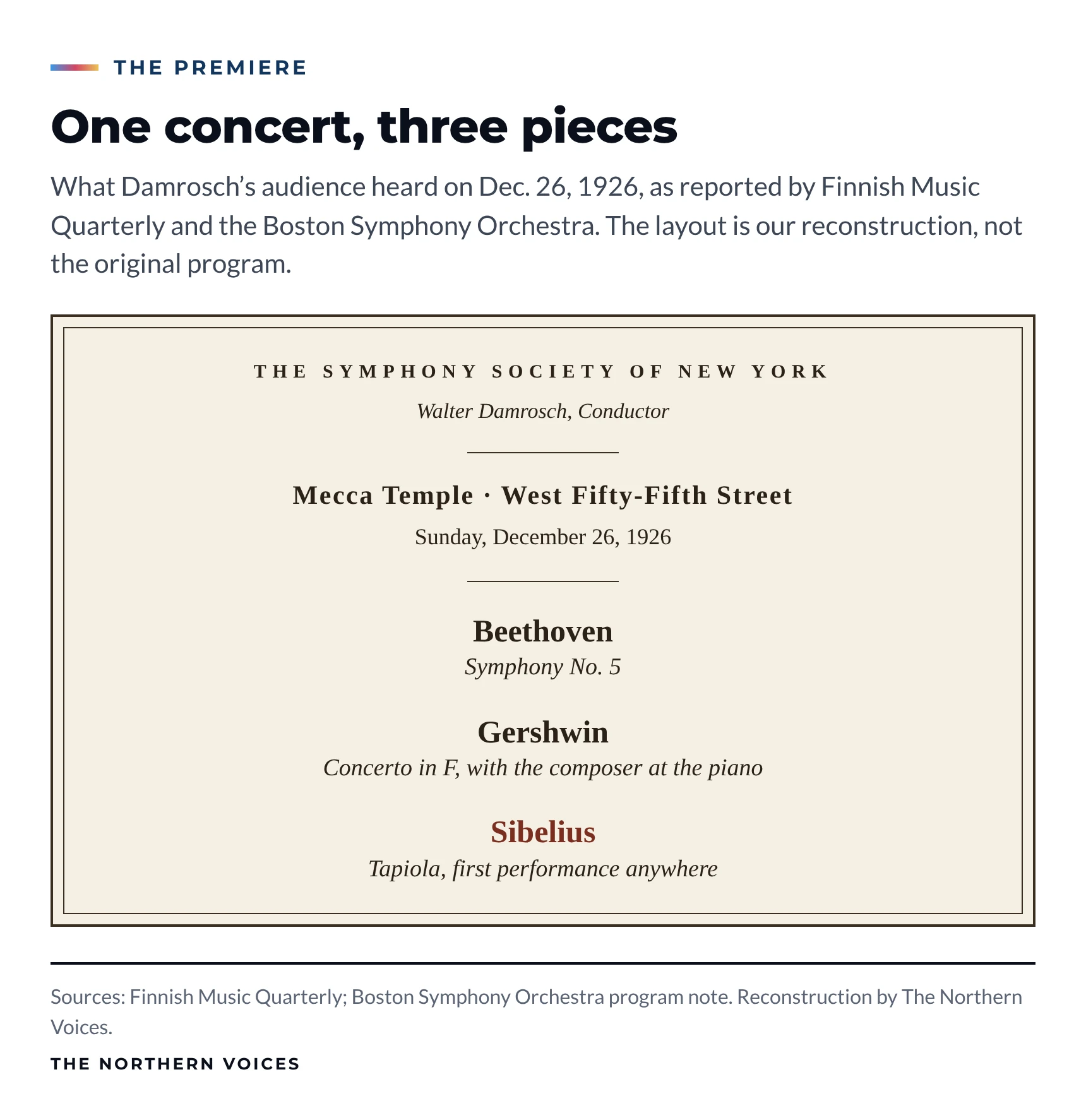
The building is still there. The Mecca Temple, built for the Shriners, is now New York City Center, a theater best known for dance and musicals. It was an odd home for a Finnish forest, and an apt one for a program that put Gershwin’s new American concerto in the middle.

New York shrugs
The critics were not converted. In Finnish Music Quarterly’s account, Lawrence Gilman of the New York Herald Tribune admired the program note more than the music. Samuel Chotzinoff of The World found the opening figure lacking in character. Olin Downes of The New York Times, Sibelius’s steadiest champion in America, was puzzled and treated it as a work of style rather than inspiration. Other reviewers said the material was too thin and stretched too far.
It took six years and another conductor. American critics began to reconsider Tapiola after Serge Koussevitzky led the Boston Symphony Orchestra in it on Nov. 4 and 5, 1932. That June, Robert Kajanus had made the first recording, with the London Symphony Orchestra. The conductor Artur Rodziński, troubled by passages without tempo markings, wrote to Sibelius for advice and received detailed instructions in return. He conducted the piece in New York on Nov. 29, 1934.
Finland heard it on April 25, 1927, under Kajanus, on the same program as the Finnish premiere of the Seventh Symphony.
The silence
Sibelius was sixty when he finished Tapiola. He died at Ainola on Sept. 20, 1957, at ninety-one. In between, he worked for years on an Eighth Symphony that he never finished. He is said to have burned the sketches; no score was found after his death.
His diary from the time of Tapiola is not the voice of a man at the summit. “I have suffered because of Tapiola … was I really cut out for this sort of thing? Going downhill,” he wrote.
The English critic Cecil Gray took the opposite view. “Even if Sibelius had written nothing else,” he wrote, “this one work would entitle him to a place among the greatest masters of all time.”
A hundred years on
Tapiola has since been recorded dozens of times; one discography lists 49. Recorded performances run from under fifteen minutes to more than twenty-one. Koussevitzky recorded it in Boston. Eugene Ormandy recorded it twice with the Philadelphia Orchestra. Thomas Beecham, Herbert von Karajan and Paavo Berglund each recorded it four times.
The house where it was finished is a museum. The theater where it was first played still has a stage, two blocks from Carnegie Hall. On Dec. 26, it will be a hundred years since an American conductor gave the world the last great orchestral work of Finland’s best-known composer, and New York, for a while, did not know what it had heard.

Sources: Sakari Ylivuori, “From the Archives: The Sibelius–Rodziński letter and the early reception of Tapiola,” Finnish Music Quarterly, June 2026 (the commission, fee, subtitle, premiere program and New York reviews); Jay Goodwin, program note on Tapiola, Boston Symphony Orchestra (the score’s motto, scoring, the premiere and Koussevitzky’s performances); the Finnish Sibelius Society’s account of Tapiola (composition, corrections and Sibelius’s letters); Composers Datebook, YourClassical, Dec. 26, 2025 (Damrosch’s remark and the diary entry); the English Wikipedia entry on Tapiola, which collects the Ekman and Gray quotations and the discography. Lead photograph: Jean Sibelius at Ainola, 1927, by Fredrik Runeberg, CC BY 4.0, via Wikimedia Commons.

)%20(1).avif)