Russia Is Out, Norway Is Back: The World Juniors Stay in Alberta

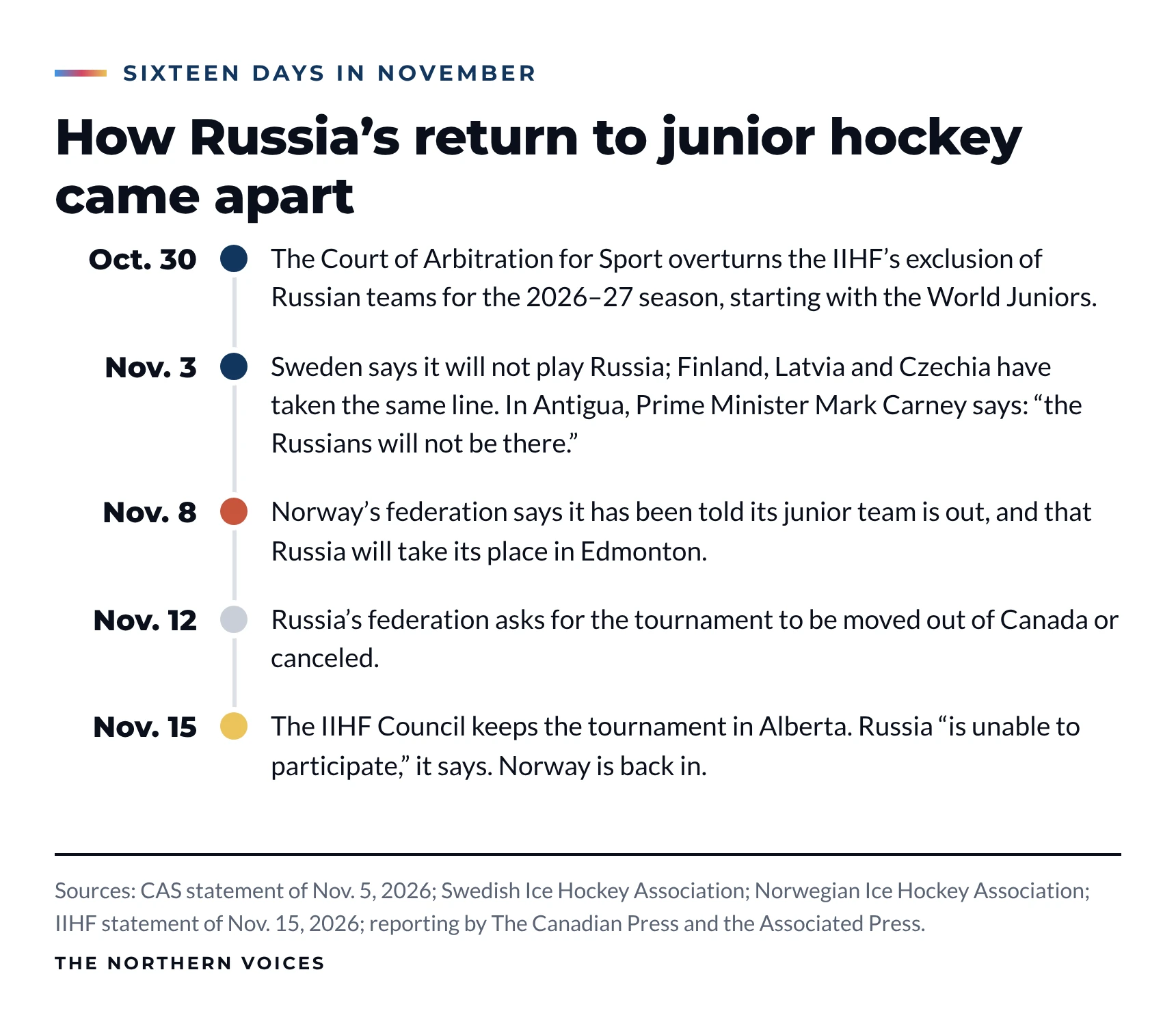
For sixteen days, a ruling by the Court of Arbitration for Sport put Russia back into the World Junior Championship, and for one of those weeks Norway was told it had lost its place to make room. On Sunday, Nov. 15, the International Ice Hockey Federation settled it. The tournament stays in Alberta, Russia stays home, and Norway plays.
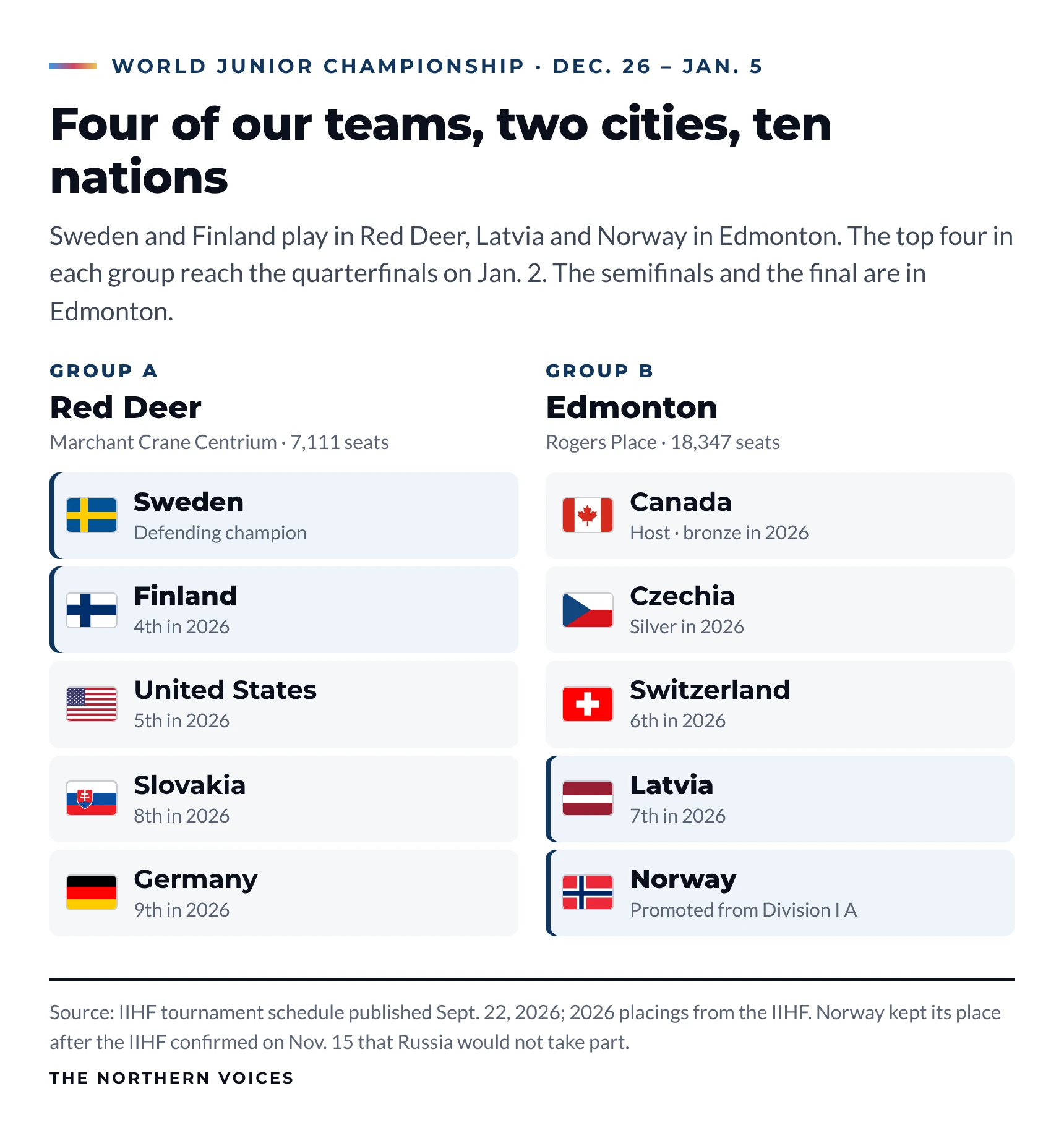
For four of our teams, that means the Christmas tournament goes ahead as drawn in September. Sweden, the defending champion, opens against Finland in Red Deer on Dec. 26. Latvia and Norway play in Edmonton, in a group with Canada. The final is at Rogers Place on Jan. 5.
How it got there is worth setting down. It also leaves questions for the spring that have not been answered yet.
What the court decided
The IIHF has kept Russian teams out of its championships since the full-scale invasion of Ukraine in February 2022. In July, it decided again not to bring them back for the 2026–27 season. The Russian Ice Hockey Federation appealed.
On Friday, Oct. 30, a CAS panel ruled for Russia. In a statement issued on Nov. 5, the court said the IIHF “did not present sufficient evidence to establish the legal requirements for the non-participation of Russian teams.” The federation’s worries about security and organization, the court said, were neither backed by enough evidence nor turned into a request for something less than a ban. A neutral-status arrangement of the kind used at the Olympics was never asked for, and “CAS cannot impose measures that have not been requested by the Parties.”
According to the Associated Press, the ruling covered the season’s main events: the World Juniors in Edmonton and Red Deer, the women’s world championship in Canada next year, the under-18 championships in Minnesota and the Czech Republic, and the men’s world championship in Germany in May. The court has not yet published its full reasoning.
The IIHF said it was disappointed. “While the IIHF respects the authority of CAS and will act in accordance with its ruling,” it said, “the outcome does not remove the concerns that informed its assessments.”
Canada’s answer, and the refusals
The countries that would have had to play Russia answered first. On Nov. 3, the Swedish Ice Hockey Association said: “Sweden will not play ice hockey matches against Russia in the situation we are in right now.” Finland said no player or official would be obliged to take part in a tournament with Russia or Belarus, and that the federation would support anyone who declined. Latvia and Czechia said their teams would refuse to face Russia. By the middle of the month, The Canadian Press counted Finland, Sweden, Czechia, Norway, Denmark, Latvia and Austria among the federations saying they would not play Russia in international tournaments.
The same day, the host country closed the door. Speaking at the Commonwealth summit in Antigua, Prime Minister Mark Carney said: “So if you’re asking specifically about the world juniors, the Russians will not be there.” The federal government said it would use its immigration powers to keep Russian and Belarusian athletes and officials from entering Canada “to compete under their national symbols,” a measure it said was meant to stop the two governments from using events hosted in Canada as platforms. Ottawa later made clear that Russian players would be barred from the tournament even with valid visas.
Carney noted the Nordic and Central European positions without leaning on them. “We respect the decisions of the Finns, the Czechs, the Swedes, other nations,” he said, “but this is a decision we take on our own.” Hockey Canada thanked the government for “today’s strong position.”

Norway, out and back in
The squeeze landed on the smallest team in the field. Norway earned its place by winning the second-tier Division I A tournament in Bled, Slovenia, last December, and was drawn into Group B with Canada, Czechia, Switzerland and Latvia.
On Sunday, Nov. 8, the Norwegian Ice Hockey Association said its junior team “has been officially removed” from the championship, and that Russia would take its place in Edmonton and Red Deer. Petter Salsten, the federation’s general secretary, said Norway would “await further information from the IIHF in the coming days.” If the decision had stood, Norway would have dropped to the Division I A tournament in Hungary in December.
Russia, meanwhile, asked for the championship to be moved out of Canada or canceled.
The IIHF did neither. On Nov. 15 it said: “The IIHF confirms that due to the position and restrictions formally communicated by the Canadian Government, the Russian U20 national team is unable to participate in the World Junior Championship.” After “carefully assessing the feasibility of alternative arrangements,” it said, its Council had decided Canada would stay as host and the tournament would run from Dec. 26 to Jan. 5 as planned. Norway said the same day that it would be there.
Russia’s sports minister, Mikhail Degtyarev, wrote that “the only legitimate decision would be to move the tournament out of Canada.” The Russian federation called the decision unlawful and said it was “made solely due to political reasons.” It has said it will pursue compensation and take its case to the International Olympic Committee, which recognizes the IIHF but does not run its tournaments.
Where our teams play
With the field restored, the schedule published on Sept. 22 holds. Sweden and Finland play their group games in Red Deer, about 95 miles south of Edmonton. Latvia and Norway play in Edmonton. The four best teams in each group reach the quarterfinals on Jan. 2. The semifinals, the bronze game and the final are all at Rogers Place.
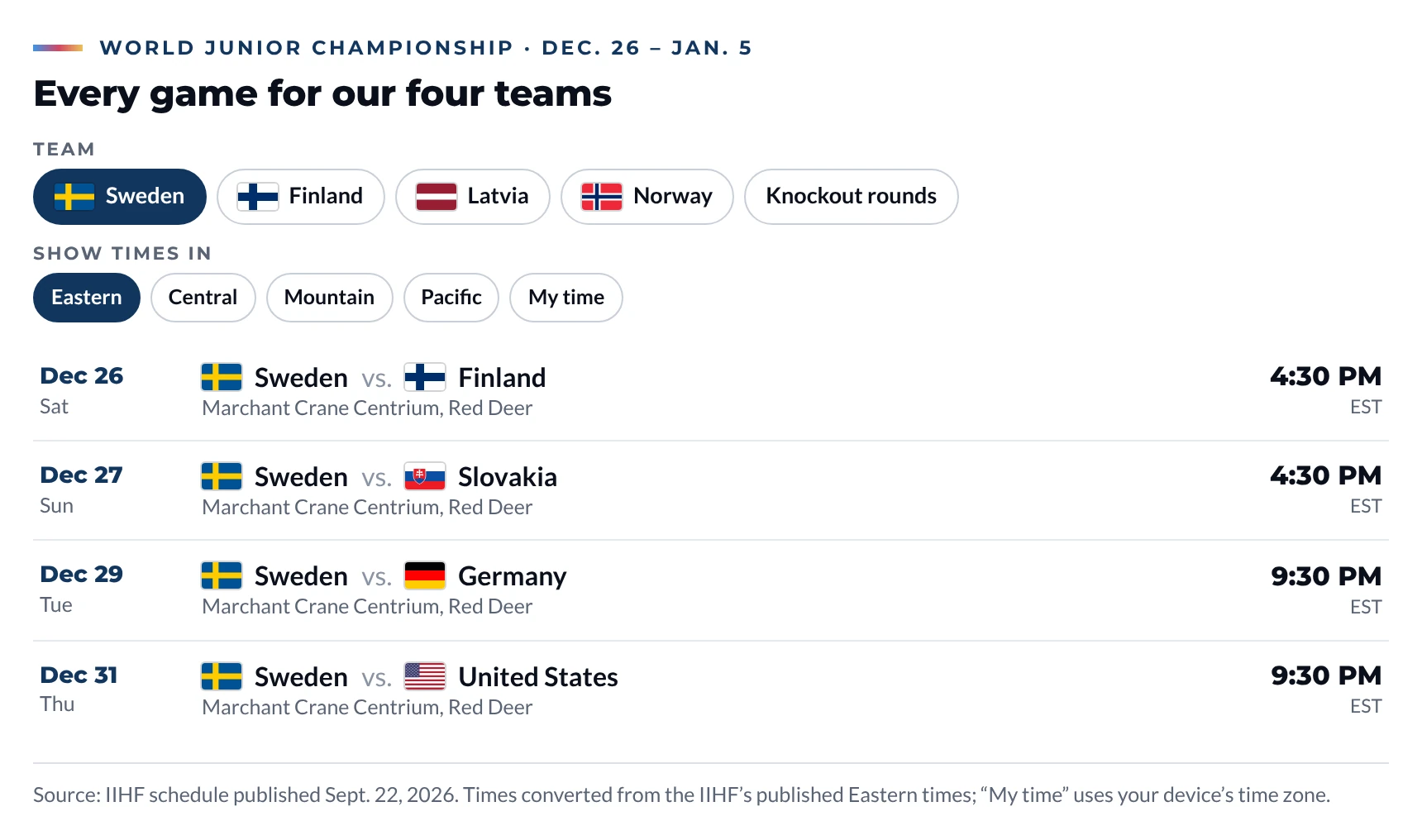
The opener is the oldest rivalry in the field: Sweden against Finland, Saturday, Dec. 26, at 4:30 p.m. Eastern. Latvia starts against Czechia on Dec. 27 and meets Canada on Dec. 28. Norway opens against Czechia on Dec. 26 and plays Canada on Dec. 29. Latvia and Norway meet on Dec. 30, a game that could decide which of them reaches the knockout round.
Sweden comes in as champion for the first time since 2012, when it won the title in Alberta, beating Russia in overtime in the final in Calgary. Finland finished fourth last year. Latvia finished seventh, its group stage ending with four points.

What is still open
The Christmas tournament is settled. The rest of the season is not. The CAS ruling also covers the men’s world championship in Germany in May, and Germany’s federation has said so plainly. “We now need that same level of planning security for our home World Championship in May,” its chief executive, Frank H Lutz, said after the IIHF’s announcement. When the ruling came down, he had warned that admitting Russia would carry “significant security, political and financial consequences for us as hosts.” Norway has already said it will not face Russia there.
The women’s world championship is in Canada, so the federal government’s entry rules would again be the first question. The under-18 championships are split between Minnesota and the Czech Republic. The court’s full award, with its reasoning, has not been published.
Until it is, the Edmonton and Red Deer answer is a practical one rather than a legal one. The tournament stays where the host country’s border rules allow it to be played.
Sources: Court of Arbitration for Sport statement on the RIHF v. IIHF procedure, Nov. 5, 2026; IIHF statements of Oct. 30 and Nov. 15, 2026, as reported by the Associated Press; Swedish Ice Hockey Association statement, Finnish and Latvian positions and the remarks of Mark Carney and Hockey Canada, as reported by The Canadian Press, Nov. 3, 2026; Norwegian Ice Hockey Association release of Nov. 8, 2026, as reported by Daily Faceoff; Russian Ice Hockey Federation and Mikhail Degtyarev, as reported by The Canadian Press, Nov. 16, 2026; Frank H Lutz, as reported by the Associated Press. Schedule from the IIHF as published Sept. 22, 2026; 2026 results from the IIHF. Lead photograph: Rogers Place, Edmonton, June 2024, by D. Benjamin Miller, CC0, via Wikimedia Commons.

)%20(1).avif)