Fewer Nordic Students at U.S. Colleges, but More Estonians and Finns
The number of international students at American colleges fell this year for the first time since the pandemic. The Institute of International Education’s annual Open Doors census, released on Nov. 16, counted 1,146,163 international students in the 2025/26 academic year, down 2.7 percent. New enrollment fell 18 percent.
The census also breaks those numbers down by country, and for the eight Nordic and Baltic countries it tells a longer and more particular story. Together they sent 6,791 students, about 5 percent fewer than a year earlier and less than two thirds of their peak at the turn of the century. Sweden, which once sent nearly 5,000 students a year, now sends half that.
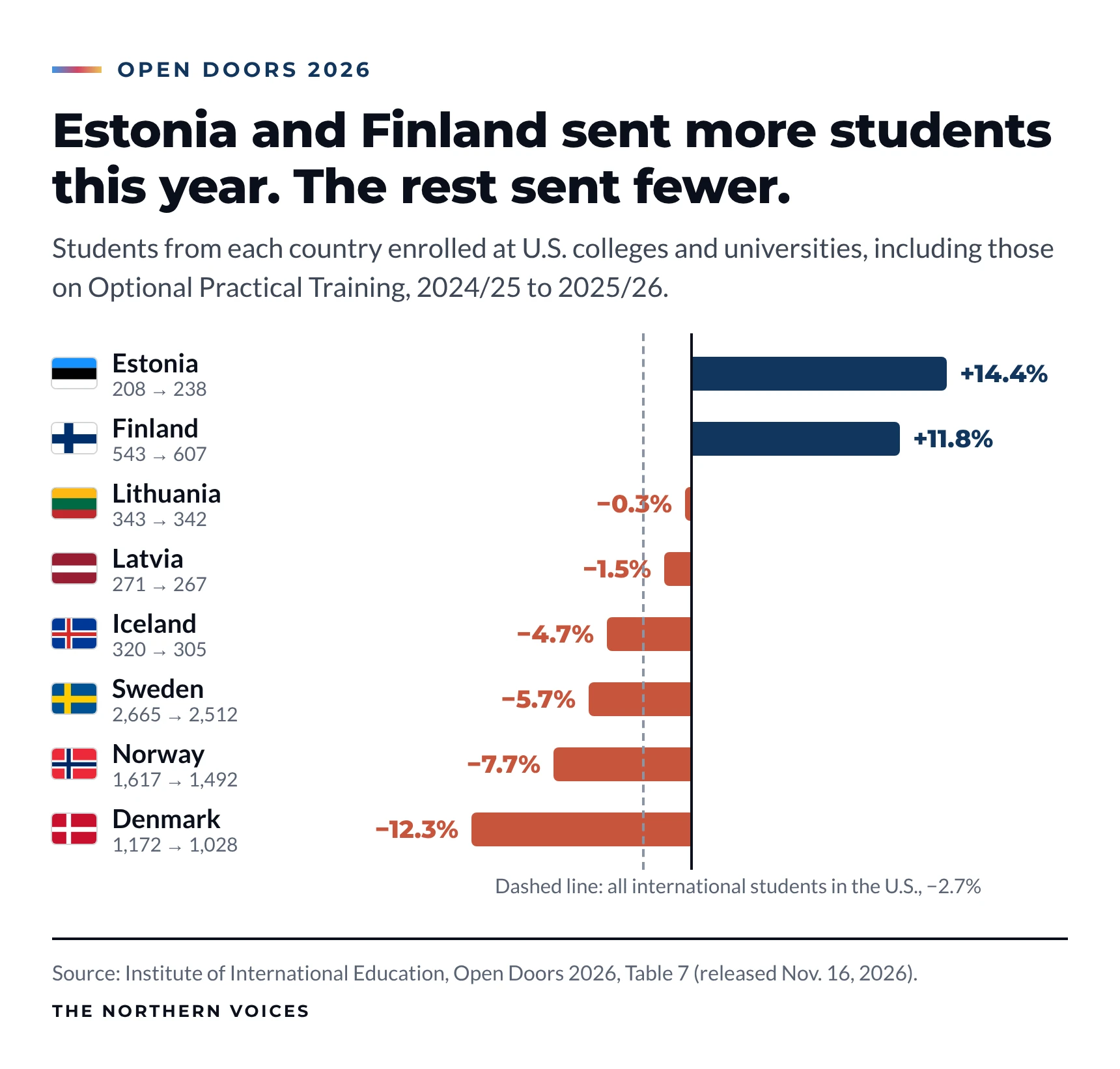
Two countries went the other way. Estonia sent 14 percent more students than a year ago, and Finland 12 percent more.
The numbers, country by country
Sweden remains the largest sender in the region, with 2,512 students in 2025/26, down from 2,665. Norway sent 1,492, down 7.7 percent. Denmark had the steepest fall, 12.3 percent, to 1,028.
The smaller countries move in small numbers, which makes their percentages jump. Estonia went from 208 students to 238. Finland went from 543 to 607. Latvia, Lithuania and Iceland were close to flat: 267, 342 and 305 students.
Nationally, the total fell 2.7 percent. Sweden, Norway, Denmark and Iceland fell faster than that, while Estonia and Finland grew.
The longer curve
A single year can mislead. Open Doors has counted students by country for decades, and the long series is clearer.
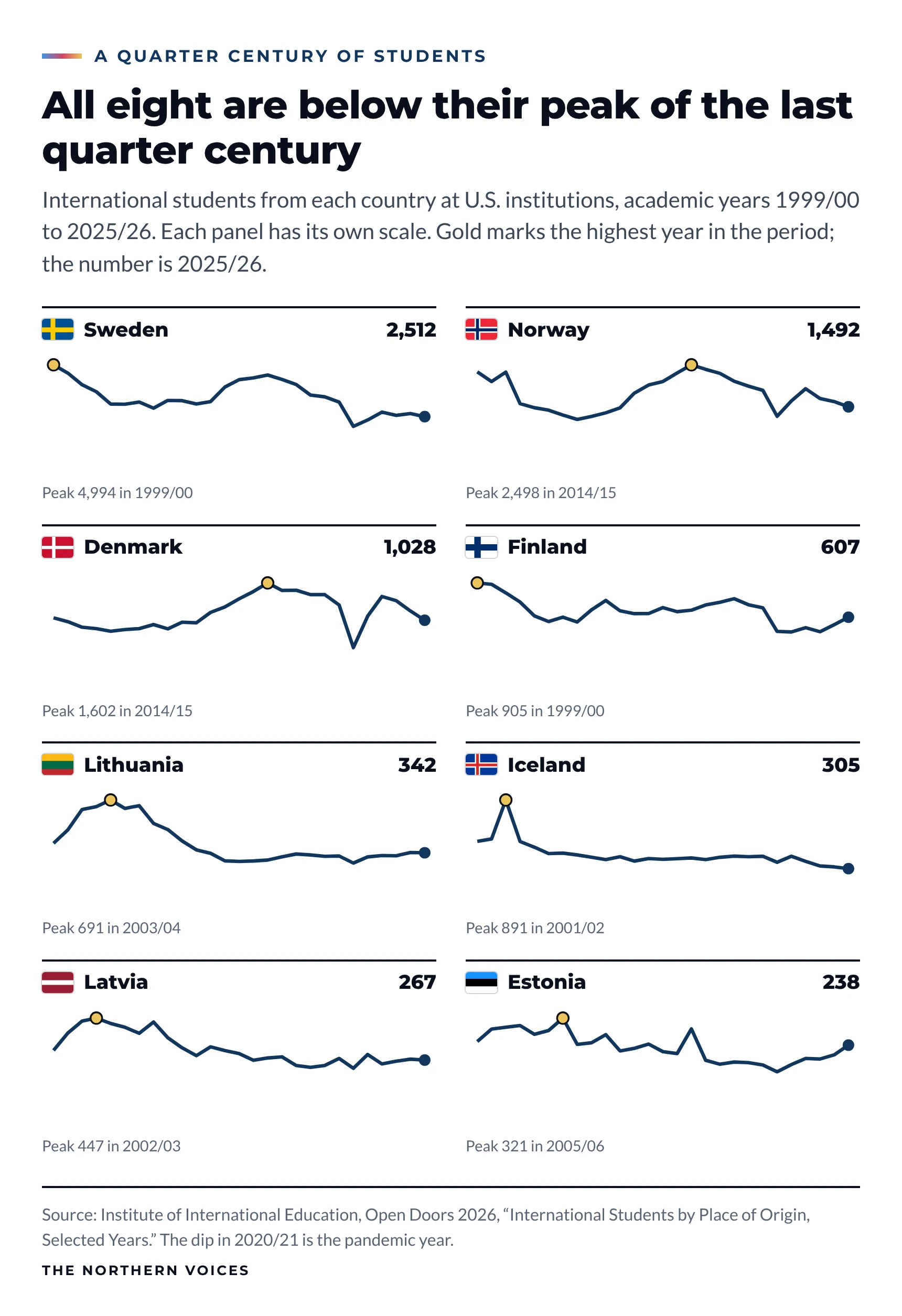
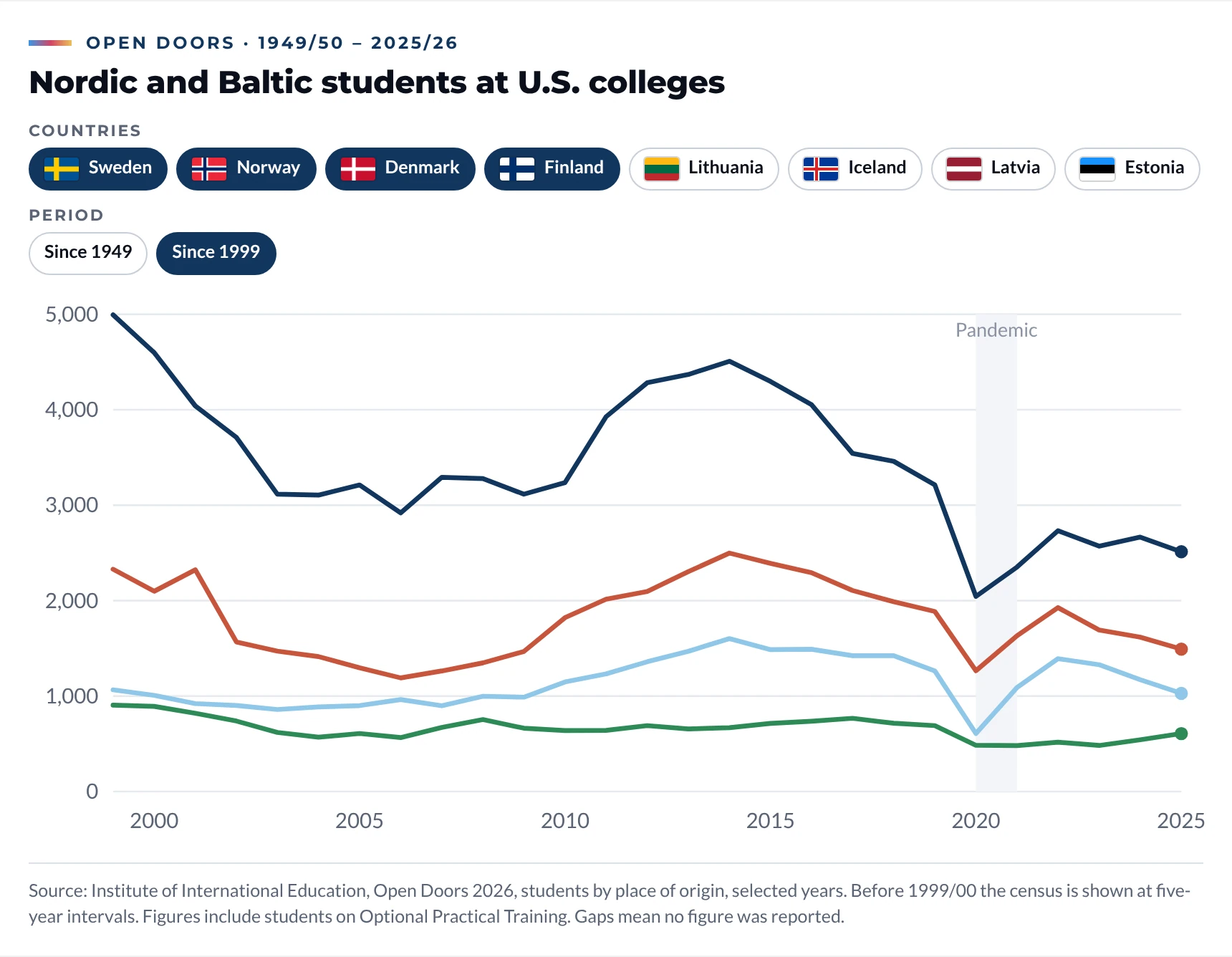
In 1999/00, Sweden sent 4,994 students to the United States. Norway peaked at 2,498 in 2014/15 and Denmark at 1,602 the same year. Lithuania’s high was 691 in 2003/04, Latvia’s 447 in 2002/03, Estonia’s 321 in 2005/06. Every one of the eight is now below its highest year of the last quarter century.
The older numbers have their own history. In 1949/50, the census counted 35 students from Estonia, 44 from Latvia and 46 from Lithuania, years when all three countries were under Soviet occupation. The tables show no figures for them from the mid-1970s through 1989/90; they reappear in the 1990s, after independence.
Combined, the eight countries sent 10,795 students in 1999/00 and 10,529 as recently as 2014/15. The pandemic year, 2020/21, took the total down to 5,423. It recovered to 7,706 in 2022/23 and has slipped every year since.
Norway’s own count
Norway’s student finance agency, Lånekassen, keeps a separate tally of the Norwegians it funds abroad, and its figures point the same way. In June 2025 it reported that 2,000 Norwegian students received its support to study in the United States in 2024–25, down from 2,400 two years earlier and 2,700 five years earlier.
Its director, Kjetil Moen, gave two likely reasons for fewer full degrees abroad: a more uncertain world, and a long stretch with a weaker Norwegian krone, both of which make years of study abroad feel less predictable. Lånekassen’s 2026 report carries a headline of its own: fewer students are going to the United States.
Who comes, and for what
The census also shows what the students come for, and here the region splits in two.
The Baltic students come for the bachelor’s degree. Undergraduates are 66 percent of Latvia’s students in the United States, 62 percent of Lithuania’s and Estonia’s. Sweden, at 63 percent, looks Baltic on this measure. Norway and Finland are just over half.
Denmark is different. A third of its students in the United States are in non-degree programs, a category that includes exchange semesters, and that is where most of this year’s drop came from: non-degree students from Denmark fell by nearly a fifth, from 424 to 342.
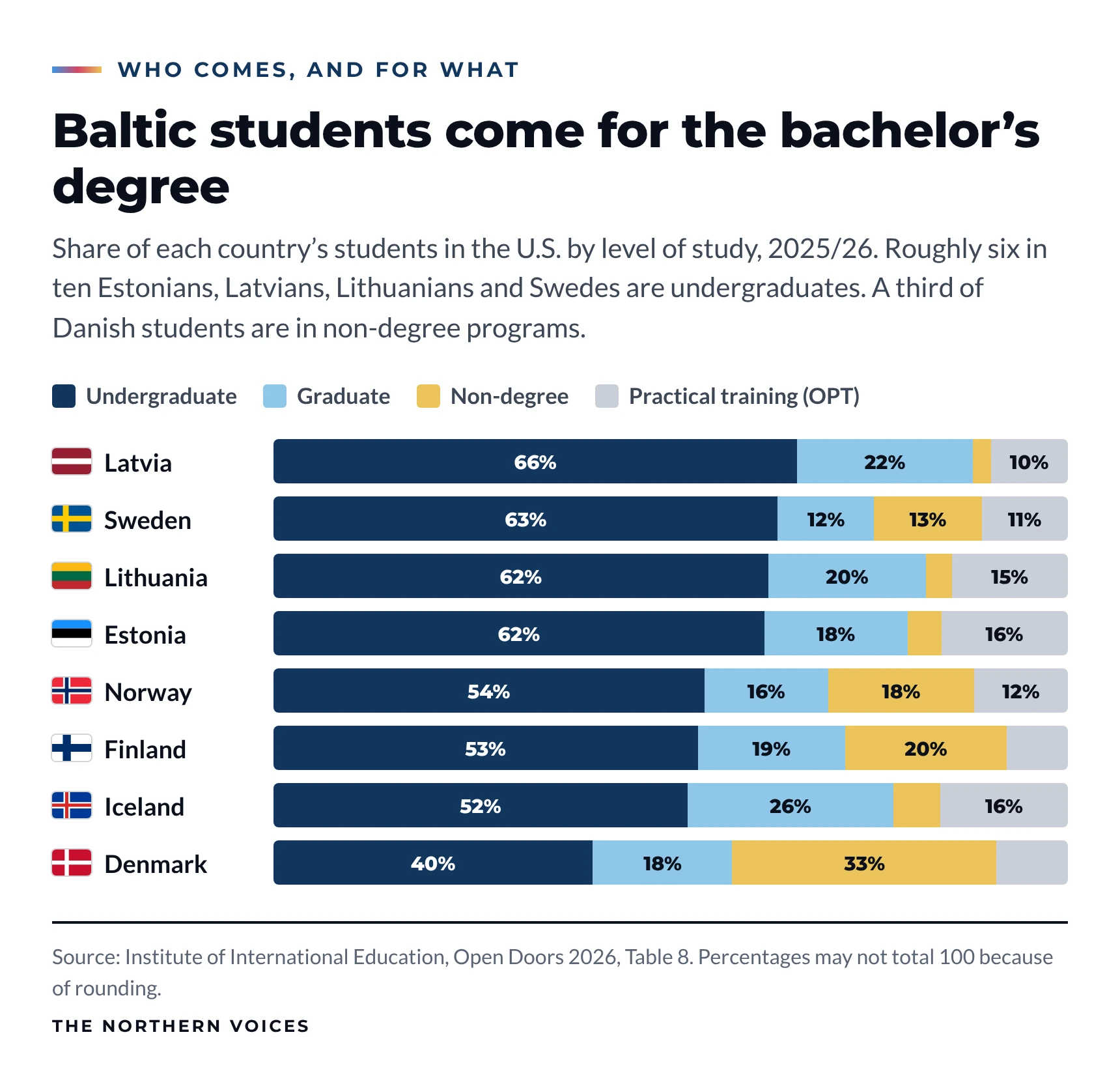
Estonia’s growth was spread across levels. It had 147 undergraduates, up from 138, and 43 graduate students, up from 34. Finland’s came largely from non-degree students, up from 85 to 123, and undergraduates, up from 297 to 324.
The census counts students on Optional Practical Training, the work period after graduation, as part of the total. Those numbers are small for every country in the region, from 26 for Latvia to 273 for Sweden.
Why this fall looks worse
The 2025/26 census covers last academic year. The Institute’s separate snapshot of this fall, based on 809 institutions, found new international enrollment down another 15 percent, the second double-digit fall in a row. Reporting on the release, WBUR in Boston listed what is pressing on students: a travel ban, student visa terminations, a proposed four-year limit on how long students may stay, which a federal judge has temporarily blocked, and an Oct. 7 proposal from the Department of Homeland Security for a $70,000 fee tied to the practical training program.
Mirka Martel, who leads research at the Institute, pointed to competition from universities abroad, new visa policies and the cost of an American degree. On practical training, she told WBUR: “We had 95% of institutions tell us that international students would likely look to another country if OPT was not available.” Fanta Aw, the chief executive of NAFSA, the association of international educators, called it “the perfect storm.”
For students from Estonia or Finland, a fee aimed at work after graduation matters less than for a graduate student counting on a job. For a Danish exchange student, a visa delay can end a semester before it starts. None of that is visible yet in the Nordic and Baltic figures for this fall, which Open Doors will not publish until next November.
What the long series shows is that the region was sending fewer students to the United States well before this year’s policies. Many of the colleges with the deepest Nordic roots, from St. Olaf in Minnesota to Pacific Lutheran in Washington, were founded by immigrants to educate their children. The question now is whether the traffic between them and the old countries keeps running at all.
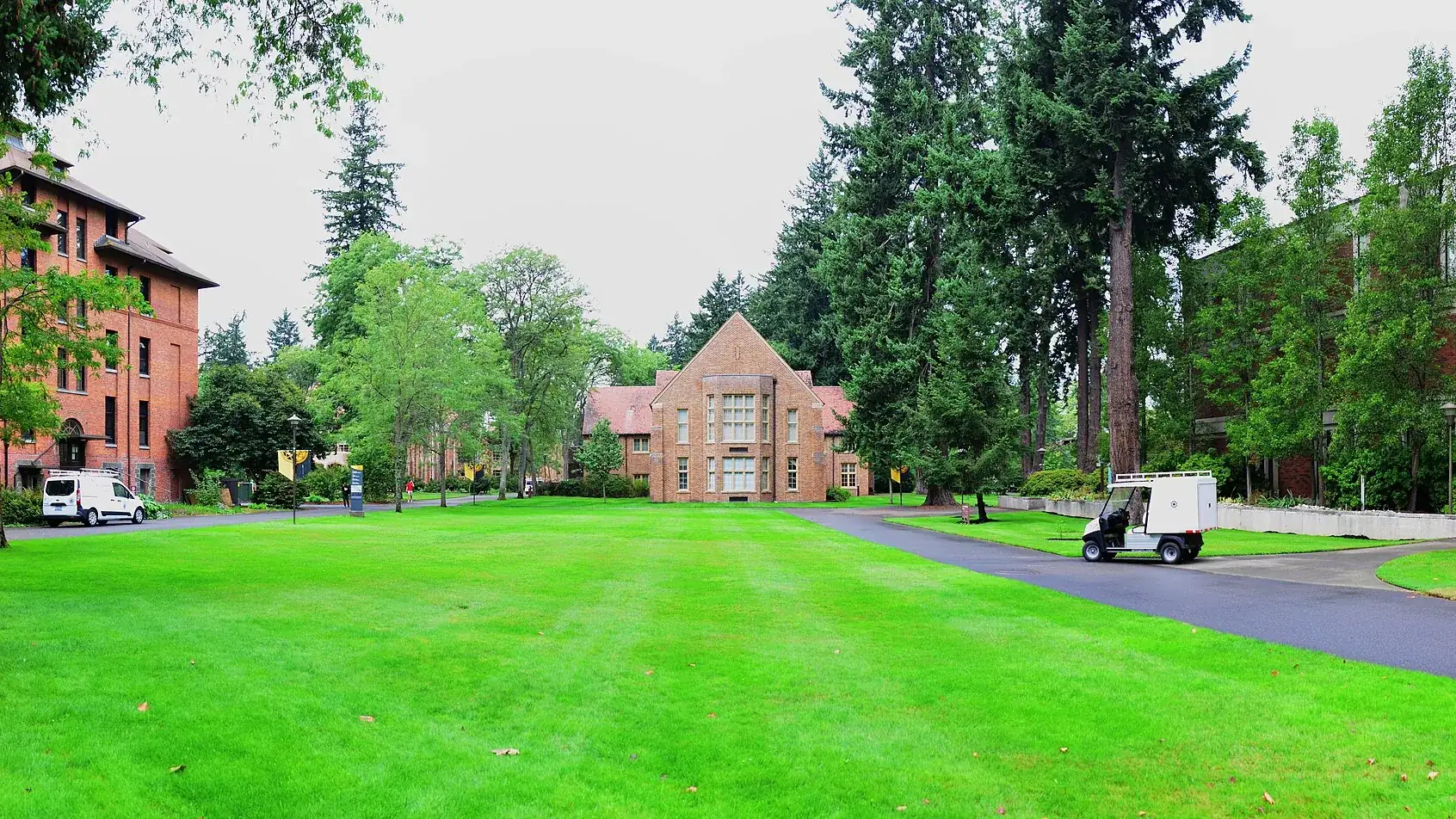
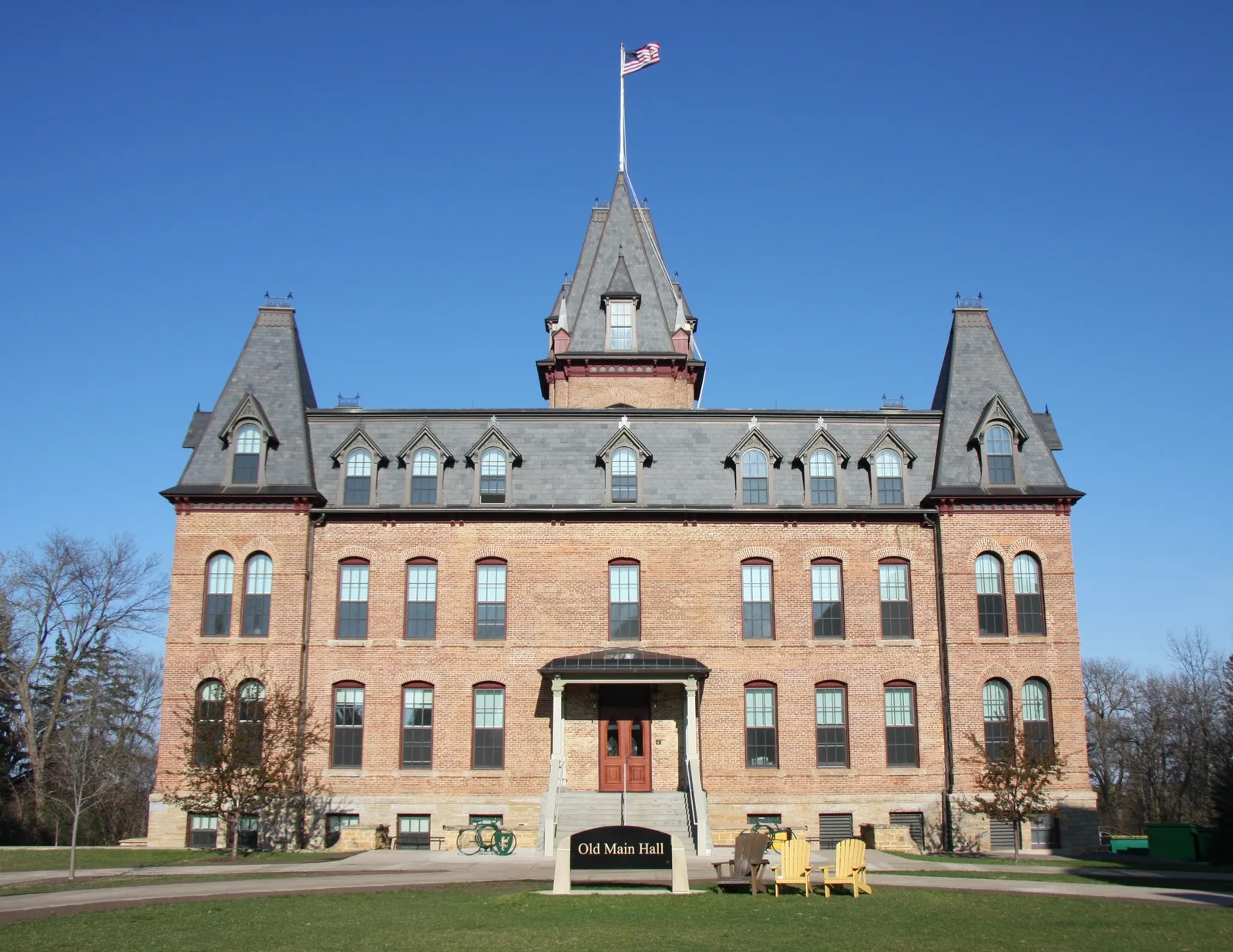
Sources: Institute of International Education, Open Doors 2026: International Student Census Tables (Tables 1, 7 and 8) and “International Students by Place of Origin, Selected Years, 1949/50–2025/26,” released Nov. 16, 2026. Figures include students on Optional Practical Training. Lånekassen, “Færre studerer utenlands,” June 18, 2025, and “Utdanningsstøtten 2026.” Fall 2026 snapshot figures, policy context and the quotations of Mirka Martel and Fanta Aw are from Suevon Lee’s report for WBUR, Nov. 16, 2026. Translations from Norwegian are ours. Lead photograph: the campus of Pacific Lutheran University in Parkland, Washington, founded by Norwegian Lutherans in 1890, by Joe Mabel, CC BY-SA 4.0, via Wikimedia Commons (cropped).

)%20(1).avif)