Few Nordic and Baltic Students Choose Canada, but More Are Arriving This Year

Canada is admitting far fewer foreign students than it did two years ago. Since the federal government capped new study permits in January 2024, the number of people holding one has fallen from more than 1 million to about 725,000 by September 2025, according to Immigration, Refugees and Citizenship Canada. In 2025, about 115,000 new international students arrived, 61 percent fewer than in 2024.
Students from the eight Nordic and Baltic countries were never a large part of the boom that came before the cap, and the cut has barely touched them. In fall 2024, Canada's public colleges and universities counted 870 enrollments from Estonia, Latvia, Lithuania, Finland, Sweden, Norway, Denmark and Iceland combined. In the United States, the Open Doors census counted 6,791 students from the same countries last academic year, roughly eight for every one in Canada.
This year, the Nordic and Baltic numbers are moving against the national trend. In the first nine months of 2026, about 455 study permits took effect for citizens of the eight countries, already more than in all of 2025. In July, August and September, the main intake for the fall term, permits for all international students fell 14.5 percent from a year earlier. For the eight countries, they rose from about 305 to about 355.
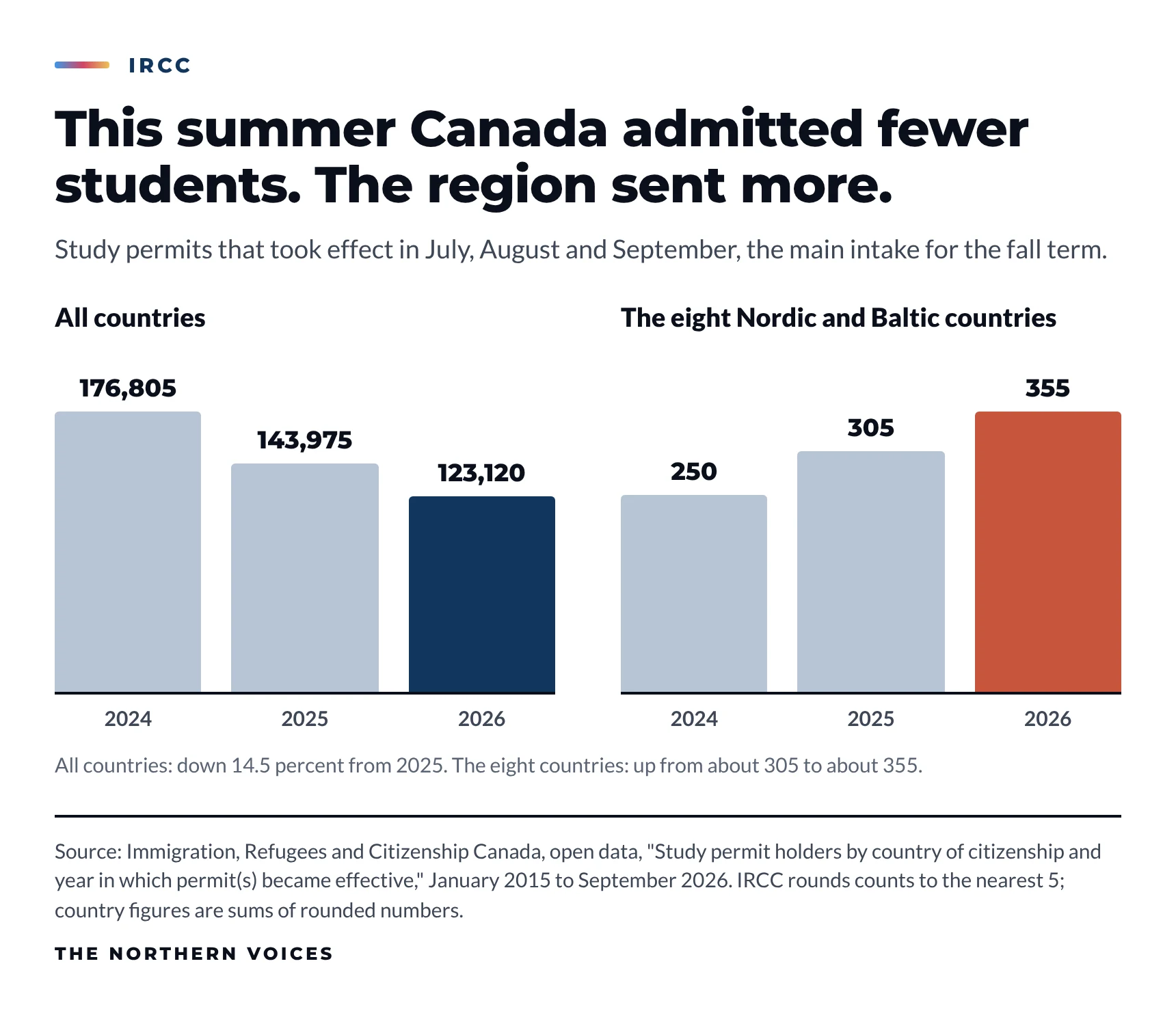
The numbers are small, and IRCC rounds each country's count to the nearest five, so a few dozen students can move them. Denmark accounts for much of the rise, with about 110 permits in the third quarter against 95 a year earlier. Norway went from about 65 to 80, and Sweden from 50 to 65. Finland, Latvia, Iceland and Estonia were flat, and Lithuania rose slightly.
The numbers, country by country
The fullest picture of who is actually in class comes from Statistics Canada, which collects enrollments from every public college and university each fall. Its latest figures, released on Oct. 1, cover the 2024/25 academic year. That was the first full year under the cap.
Sweden sends the most students, with 303 enrollments, nearly as many as the year before. Denmark follows with 216, down from 282, the largest drop in the region. Norway fell from 153 to 129, and Finland from 138 to 123. The three Baltic countries and Iceland send a few dozen each: 30 from Lithuania, 24 each from Latvia and Iceland, and 21 from Estonia.
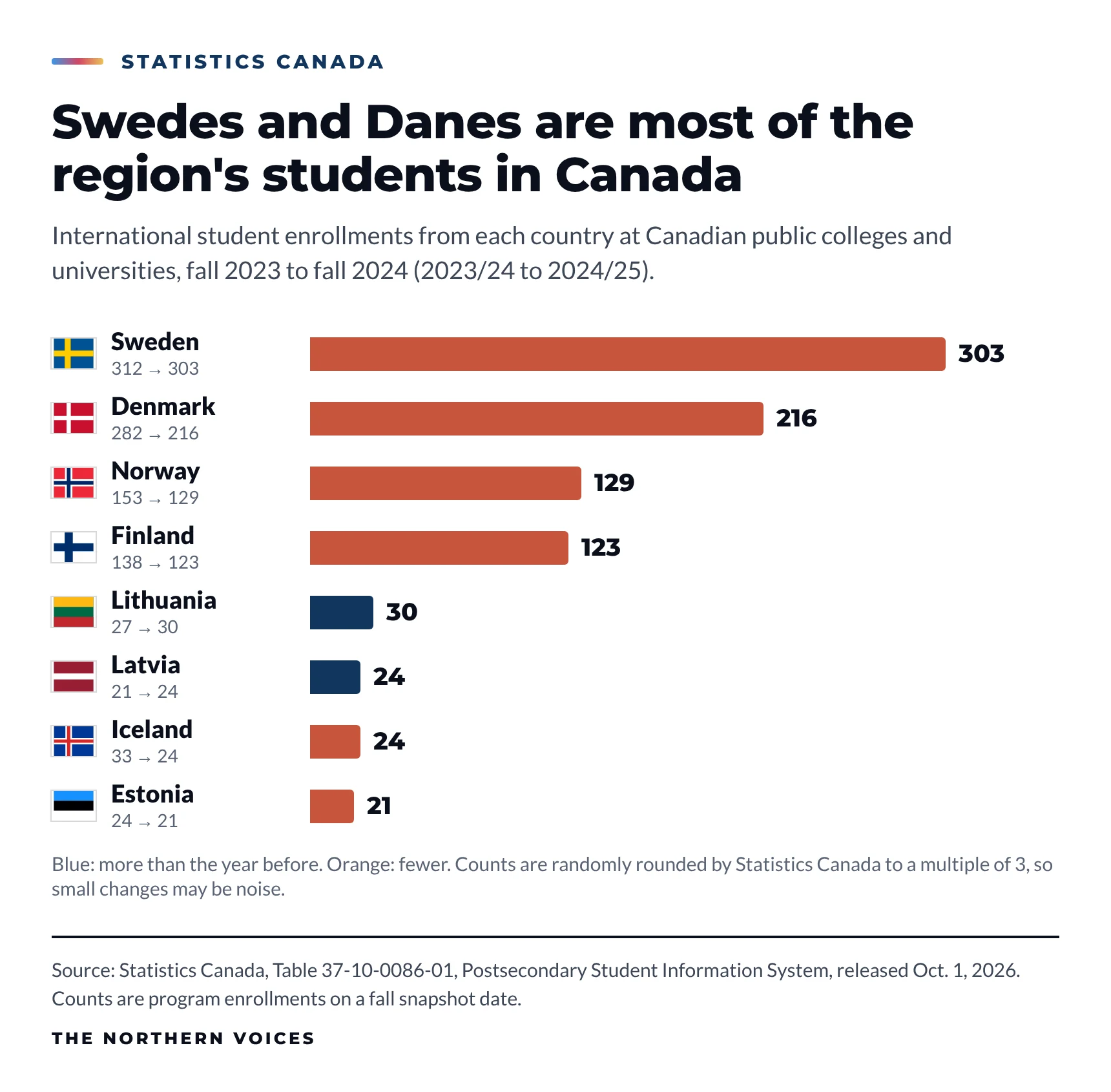
Together the eight countries went from 990 enrollments to 870, a fall of 12 percent. That is steeper than the 6.9 percent drop in international enrollment across Canada. Statistics Canada randomly rounds its counts to a multiple of three to protect privacy, so the smallest changes, such as Estonia's or Latvia's, may be noise.

The longer curve
Over a quarter century, the two lines have run in opposite directions. At the end of 2000, Canada had 122,620 study permit holders, and 1,530 of them came from the eight countries. By the end of 2024, Canada had 996,375, more than eight times as many. The Nordic and Baltic count had fallen to 680.
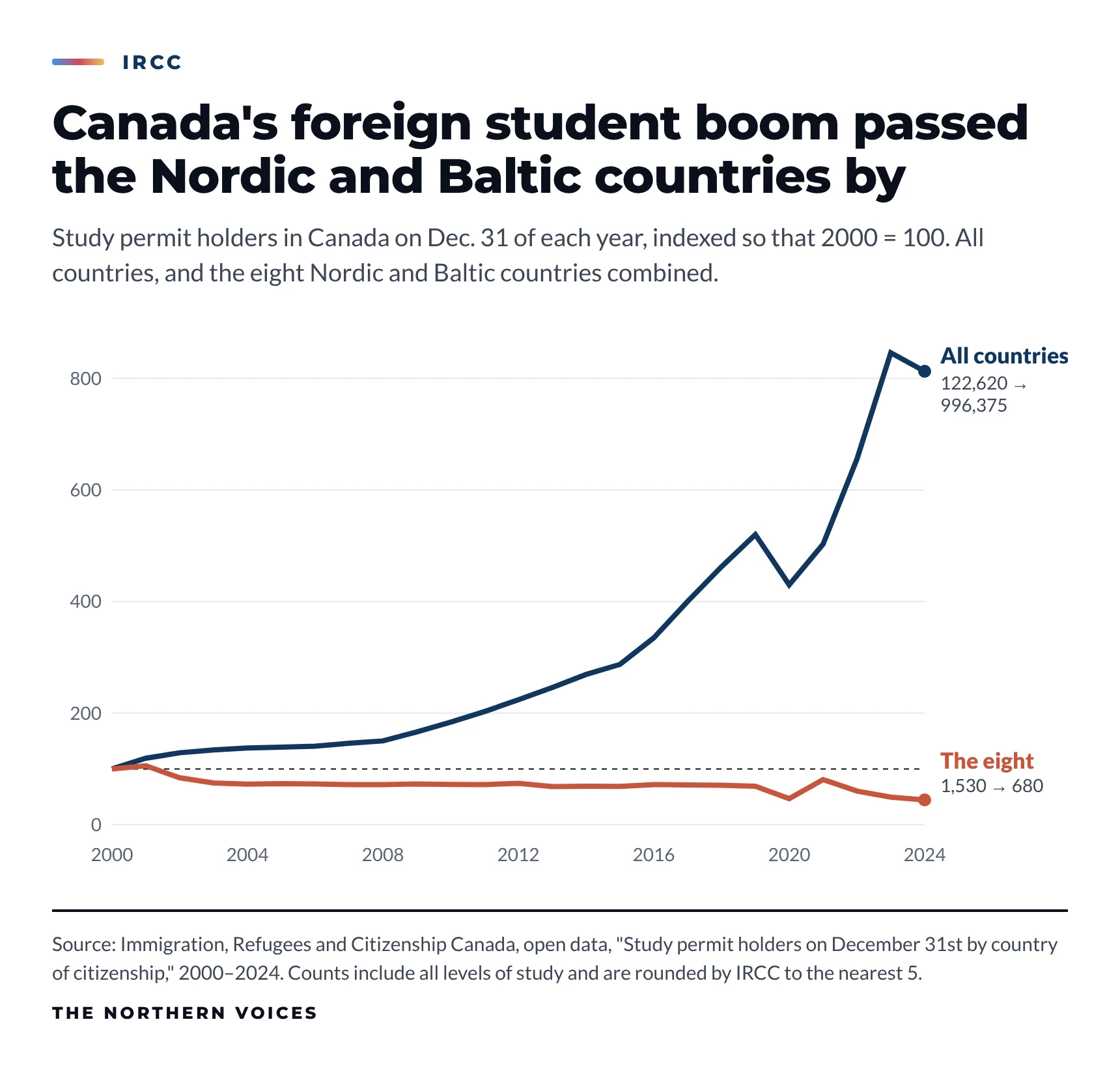
Almost all of that decline is Nordic. Sweden had 525 study permit holders in Canada in 2000 and 175 in 2024. Finland went from 280 to 105, Norway from 295 to 140, Denmark from 255 to 120 and Iceland from 100 to 35. The Baltic countries moved the other way in a small way: Estonia from 15 to 30, Latvia from 30 to 40 and Lithuania from 30 to 35.
The United States has seen a decline too, but from a much larger base. Open Doors counted 10,795 students from the eight countries at American colleges in 1999/00 and 6,791 last year, and Sweden now sends half what it once did. Our look at those numbers follows each country back to 1949/50.

The enrollment series from Statistics Canada, which goes back to 1992/93, tells a slightly different story. It counts 450 Nordic and Baltic enrollments that year, a steady climb to a peak of 1,452 in 2018/19, a pandemic low of 465 in 2020/21 and a partial recovery to 1,074 in 2022/23. It has fallen in each of the two years since.
The two sources measure different things. IRCC counts people with a valid permit on one day of the year, at every level of study, including schoolchildren. Statistics Canada counts program enrollments at public colleges and universities on a fall snapshot date. Exchange students who stay less than six months do not need a study permit, so they appear in the second count but not the first.
Where they study
Nordic and Baltic students in Canada are overwhelmingly at universities. Of the 870 enrollments in 2024/25, 777 were at universities and about 90 at colleges. Across Canada, international students are split almost evenly: 266,874 at universities and 266,508 at colleges.
That difference may help explain why the cap has passed them by. Statistics Canada said colleges were more affected by the 2024 limit on new permits. Since Jan. 1, 2026, master's and doctoral students at public institutions have also been exempt from the provincial attestation letter, the document through which the cap's spaces are handed out.
Some of the region's students reach Canada by way of the United States, and not all of them show up in these tables. Ingmar Kiviloo, an Estonian violinist and composer, graduated from Berklee College of Music in Boston this year and is continuing with a master's degree in composition at the University of Toronto. He also holds Canadian citizenship through his father, an Estonian from Toronto's diaspora community, so Statistics Canada counts him as a Canadian student. Read more about his move from Boston to Toronto.
Nordic and Baltic students are also spread more evenly across the country. Ontario has more than half of Canada's international students but about 40 percent of the Nordic and Baltic ones, with 351 enrollments. British Columbia had 201, nearly a quarter, and Quebec 177, about a fifth. Both provinces draw a larger share of the region's students than of international students overall. Alberta had 54. Women outnumbered men, 459 to 366.
What students face now
Coming to Canada has become harder for everyone. Since September 2025, applicants must show they have C$22,895 to cover a year's living costs, on top of tuition and travel. Off-campus work is capped at 24 hours a week. IRCC told a House of Commons committee this year that it refused 59 percent of new study permit applications in 2025, up from 52 percent in 2024. Those rates cover all countries.
The squeeze is set to continue. For 2026, IRCC plans to issue up to 408,000 study permits, including 155,000 for newly arriving students. That is 7 percent below the 2025 target and 16 percent below 2024.
For a student from Stockholm, Tallinn or Reykjavik, those numbers rarely bite. The region's students are few and mostly bound for universities, where the cap has been felt less. What the long series shows is a different problem: a quarter century in which Canada became one of the world's largest destinations for international students, and the Nordic and Baltic countries mostly looked elsewhere. Statistics Canada's figures for 2025/26, due next fall, will show whether this year's rise in permits turns into more students in Canadian classrooms.
Sources: Statistics Canada, Table 37-10-0086-01, "Postsecondary enrolments, by status of student in Canada, country of citizenship and gender," and "Canadian postsecondary enrolments and graduates, 2024/2025," The Daily, Oct. 1, 2026. Counts are randomly rounded to a multiple of 3. Immigration, Refugees and Citizenship Canada open data: "Study permit holders on December 31st by country of citizenship," 2000–2024, and "Study permit holders by country of citizenship and year in which permit(s) became effective," January 2015 to September 2026, rounded to the nearest 5. IRCC, "2026 provincial and territorial allocations under the international student cap," Nov. 25, 2025, and briefing to the House of Commons Standing Committee on Citizenship and Immigration, March 23, 2026. Institute of International Education, Open Doors 2026. Lead photograph: the courtyard of University College at the University of Toronto, by Jeff Hitchcock, CC BY 2.0, via Wikimedia Commons (cropped).

)%20(1).avif)