The Nordic and Baltic Oscar Entries: Two Athletes, a Novel and a War

Every autumn, each country gets to put one film forward for the Academy Award for best international feature. This year all eight Nordic and Baltic countries did, and the list they produced is unusually grounded in real lives. Two of the films are about Soviet-era sportswomen. One adapts a Nobel Prize-winning novel. One follows a young Danish woman punished for a wartime love affair. One is a documentary filmed in a Reykjavík nursing home.
Academy members begin preliminary voting on Dec. 7. A shortlist of fifteen films from all countries is due on Dec. 15, the five nominees on Jan. 21, and the 99th Academy Awards on March 14.
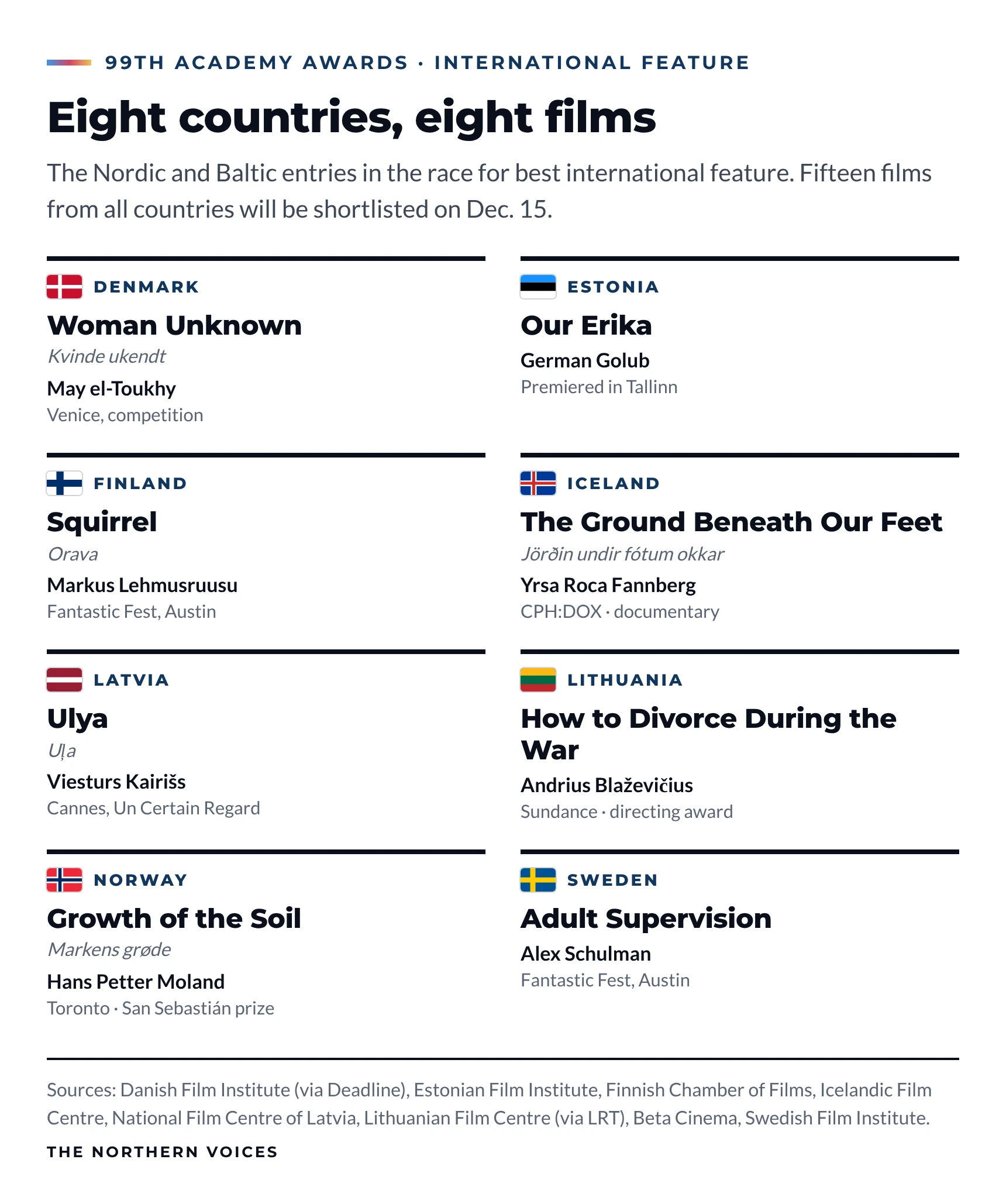
Denmark: Woman Unknown
May el-Toukhy’s first feature since Queen of Hearts in 2019 premiered in competition at the Venice Film Festival on Sept. 6, the only film by a woman in this year’s competition. Kvinde ukendt follows Marie, a young nanny and housemaid about to marry the wealthy older widower she works for. During the German occupation she had a relationship with a German soldier, and after the war that past comes back for her.
In her director’s statement, el-Toukhy says the film is about the women Denmark called “horizontal collaborators,” and cites Svetlana Alexievich’s The Unwomanly Face of War as an influence. The film is a Danish, Swedish and Latvian co-production, with Riga’s Nafta Films among the producers. Denmark chose it from a shortlist of three.
Estonia: Our Erika
German Golub’s first feature is a biography of Erika Salumäe, the track cyclist who grew up in an orphanage and became a world record holder and Olympic champion. She won the sprint at Seoul in 1988 for the Soviet Union and again at Barcelona in 1992, by then for Estonia. Karolin Jürise, who plays her, trained as an athlete for the part and learned Russian for it. The Estonian Film Institute’s committee announced its choice on Aug. 26. Golub has described the film as a story of “how far a person can go in pursuit of a dream and love.”

Latvia: Ulya
Viesturs Kairišs’s film takes its story from the life of Uļjana Semjonova, the Latvian basketball center who won Olympic gold for the Soviet Union in 1976 and 1980. In the film, a giant girl raised in an isolated community of Russian Old Believers is pulled into professional sport and the modern world. Kārlis Arnolds Avots, who plays a leading role and co-wrote the script, won best actor at the Jerusalem Film Festival. Ulya premiered in the Un Certain Regard section at Cannes in May, as we reported at the time, and opened in Latvia on Sept. 16. It is a Latvian, Estonian, Polish and Lithuanian co-production.

Lithuania: How to Divorce During the War
Andrius Blaževičius won the directing award in Sundance’s world cinema dramatic competition in January. His third feature is a dry comedy about Marija, an ambitious advertising manager who tells her struggling filmmaker partner she wants a divorce, at the worst possible moment: the days after Russia’s full-scale invasion of Ukraine. Ignas Miškinis, who chaired Lithuania’s selection committee, said “one of the main arguments for choosing this film was its relevance and proximity.” It opened in American theaters in August, released by Zeitgeist Films with Kino Lorber.

Norway: Growth of the Soil
Hans Petter Moland’s adaptation of Markens grøde, the 1917 novel that won Knut Hamsun the Nobel Prize, follows Isak, a man with no past who clears a farm in the mountains and builds a life with Inger. It runs 149 minutes. The film premiered at Toronto and won two prizes at San Sebastián in September, including the Silver Shell for best leading performance for Asta Kamma August, who plays Inger. Greenwich Entertainment has the North American rights.
Hamsun remains a difficult figure in Norway because of his support for the Nazi occupation. Moland’s film returns to the book that made his name, a generation before that.
Sweden: Adult Supervision
Alex Schulman, best known in Sweden as a writer and podcaster, makes his debut as a director with the story of three fathers who chaperone their teenage daughters on a rowdy school trip to a remote island. Old memories come up, the adults’ games turn into power struggles, and then into violence. Gustaf Skarsgård, Fares Fares and Linus Wahlgren play the fathers. “Adult Supervision is a film that refuses to let its audience off the hook,” said Petter Mattsson, who chaired the Swedish Film Institute’s Oscar committee. The film had its world premiere at Fantastic Fest in Austin.
Finland: Squirrel
Markus Lehmusruusu’s Orava is the only science fiction on the list. In a future without nature, Pasi, a lonely maker of synthetic animals, finds the last living squirrel on earth and breaks every rule to keep it alive, while the squirrel sinks into depression and Pasi falls in love. Finland’s committee called it “a bold and socially resonant film, creating its distinctive world with exceptional precision.” It also played Fantastic Fest, which gave two of this year’s Nordic entries their first American audiences.
Iceland: The Ground Beneath Our Feet
Iceland sent a documentary. Yrsa Roca Fannberg filmed the residents of Grund, a nursing home in Reykjavík where she has worked for years. Jörðin undir fótum okkar premiered at CPH:DOX in Copenhagen in 2025 and played Nordisk Panorama and Reykjavík’s film festival. Documentaries rarely make the international feature shortlist, but the category does accept them.
What the list says
Four of the eight are rooted in real people or in a famous book. Two are debuts. Two had their first American screenings at a genre festival in Texas. And at least two are cross-border projects between the Nordic and Baltic countries: a Danish film made with a Riga production company, and a Latvian film made with Estonian and Lithuanian partners.
Denmark is the only one of the eight to have won the category this century, with In a Better World in 2011 and Another Round in 2021. Latvia’s animated Flow was nominated in 2025, the year it won best animated feature. The shortlist on Dec. 15 will show which of these films the Academy’s voters have actually watched.

Sources: Danish Film Institute shortlist, via Ritzau and The Copenhagen Post, Aug. 25, 2026, and Denmark’s selection, via Deadline; La Biennale di Venezia film page for Kvinde ukendt; Estonian Film Institute, Aug. 26, 2026; Finnish Film Foundation, Sept. 8, 2026, and its catalogue; Icelandic Film Centre and RIFF; National Film Centre of Latvia, Aug. 18, 2026; LRT, Aug. 11, 2026, and The Arts STL on the U.S. release; Beta Cinema and Señal News on Growth of the Soil; Swedish Film Institute press releases of Sept. 2 and Sept. 26, 2026. Academy calendar as reported by Dork, Sept. 18, 2026. Lead photograph: May el-Toukhy at the Venice Film Festival on Sept. 6, 2026, the day Woman Unknown premiered, by Harald Krichel, CC BY-SA 4.0, via Wikimedia Commons (cropped).

)%20(1).avif)