The Northern Voices Turns Two: More Than Twice the Readers, a Rebuilt Site and Our First Supporter

A year ago this month, I wrote here that The Northern Voices had passed 13,000 readers in its first year. For a small, independent publication about the Nordic and Baltic countries, written from North America, that number felt almost too good to be true. This November I went back to the numbers, half expecting the second year to settle down. It didn't. It more than doubled. But what I keep coming back to isn't only how many of you there are. It's the kind of publication we've tried to become for you.
Readers, counted carefully
Between Nov. 18, 2025, and Nov. 18, 2026, Google Analytics counted roughly 29,500 readers. That's more than twice last year's figure. Behind it are people who chose to spend part of their day reading about places they love. The United States alone sent 13,300 readers, more than our whole first year. Germany, the U.K. and Canada each sent between 1,200 and 1,500. Estonia and Sweden each passed 1,000, and Finland sent 700.
I want to be careful with that number, because a publication that asks you to trust its reporting should hold its own figures to the same standard. The raw total in our analytics is closer to 50,000, and it would have been easy to lead with that. But about 20,500 of those "readers" came from Singapore and China, and they spent an average of zero to three seconds on the site. That is automated crawling, not people, so I've left it out. Last year's 13,000 wasn't filtered the same way, so treat the comparison as approximate. The direction is not in doubt.
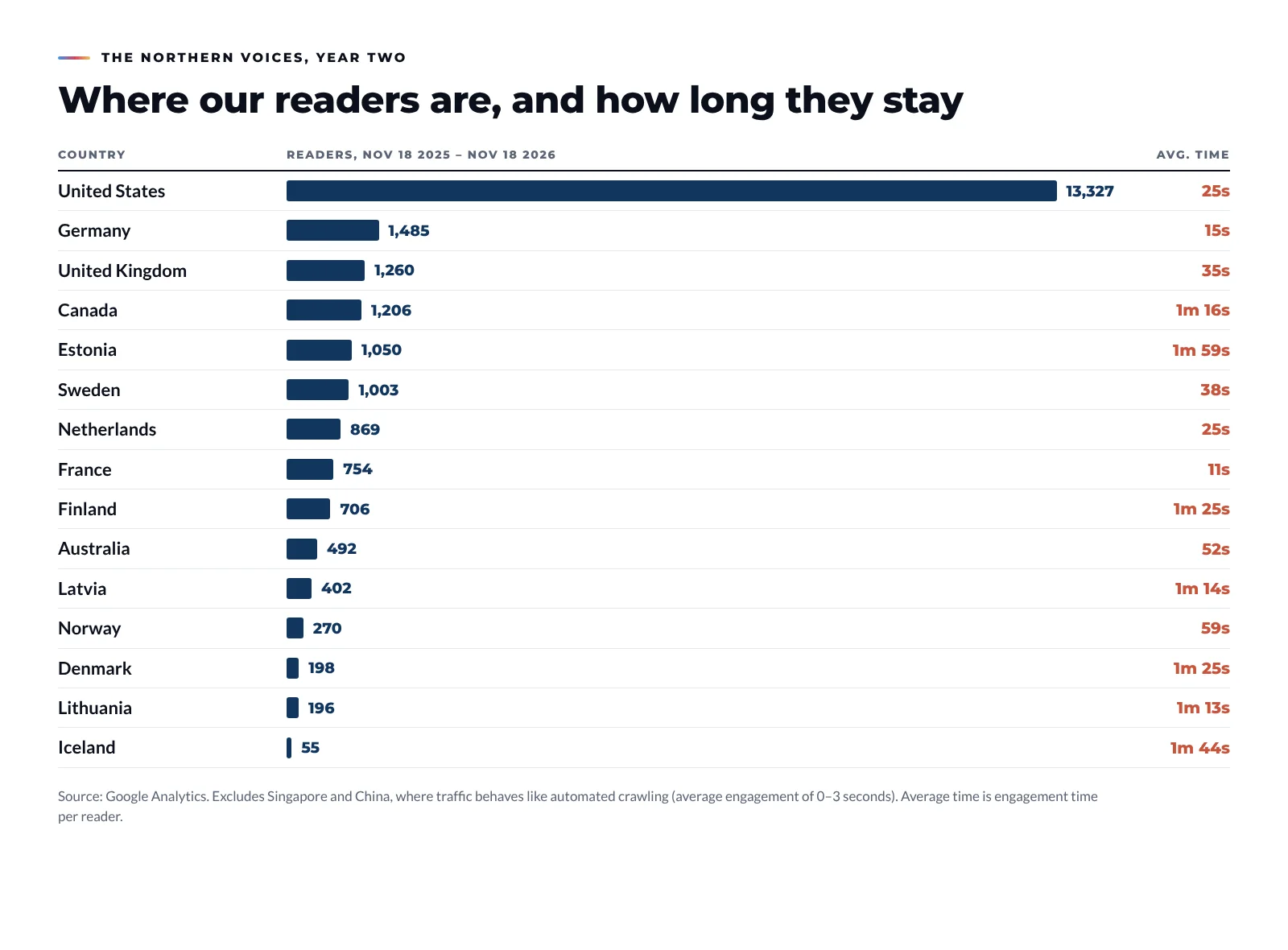
The figure that moves me most is the second column in that chart. Readers in most of the Nordic and Baltic countries, and in Canada, stay with a story far longer than the average reader. Readers in Estonia spend almost two minutes on an article on average. Readers in Iceland, Finland and Denmark spend a minute and a half or more. That's exactly who we started this for: people who know these places, or come from them, and want to read about them properly.
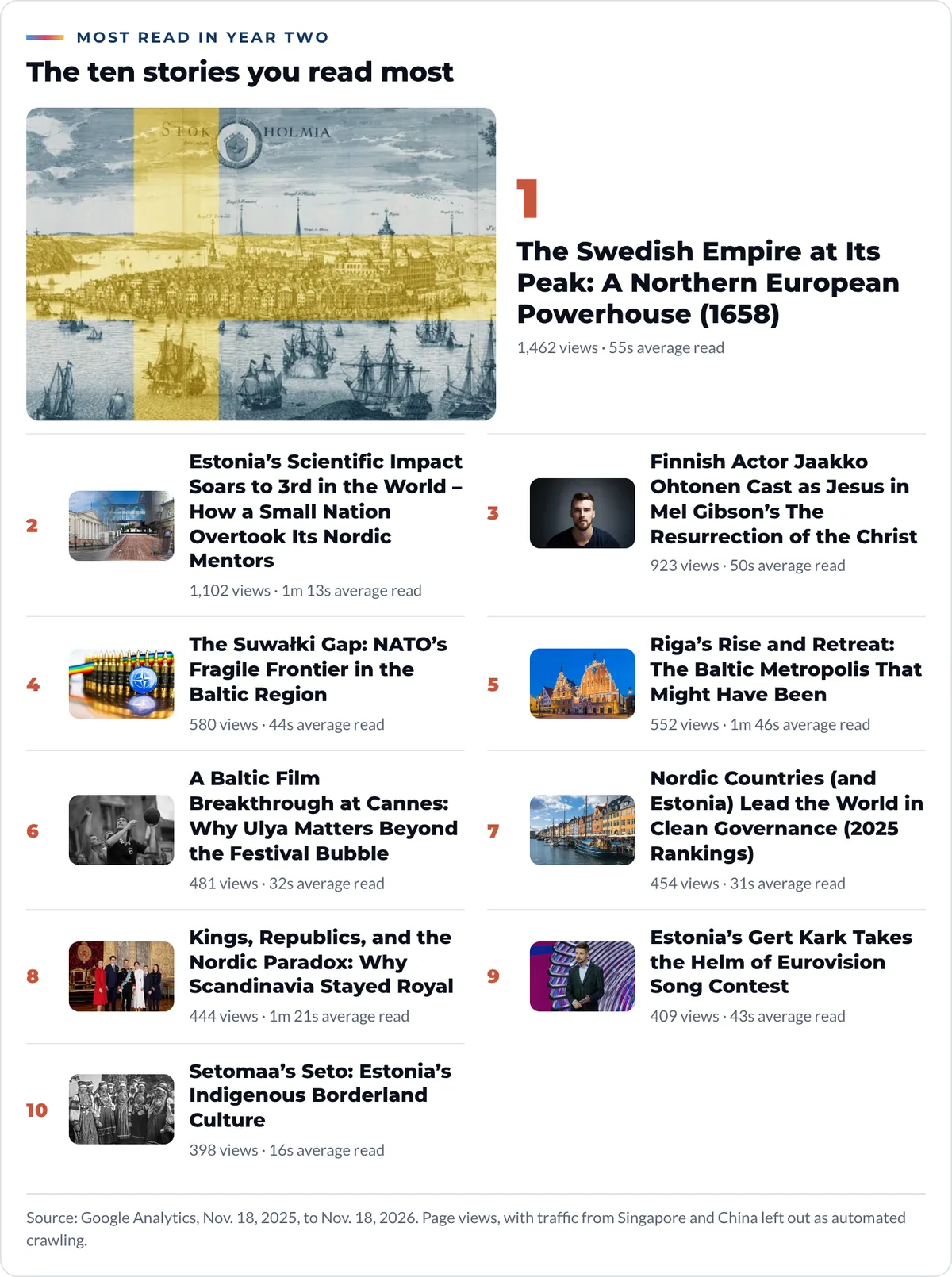
The most-read stories of the year were long ones. They included The Swedish Empire at Its Peak, Estonia's scientific impact rising to third in the world, Finnish actor Jaakko Ohtonen's casting as Jesus in Mel Gibson's new film, The Suwałki Gap, Riga's Rise and Retreat and Why Scandinavia Stayed Royal. History, science, security and culture, read by people who want depth. It's a quiet answer to anyone who says nobody reads long stories online anymore.
More people are also finding us on their own. In our second year, our stories appeared in Google search results about 1.47 million times, and readers clicked through to us 6,500 times. More than 1,100 different pages of the site turned up in those searches; The Swedish Empire at Its Peak alone appeared more than 380,000 times. Google keeps this data for only 16 months, so there's no fair comparison with our first year.
A site rebuilt for reading
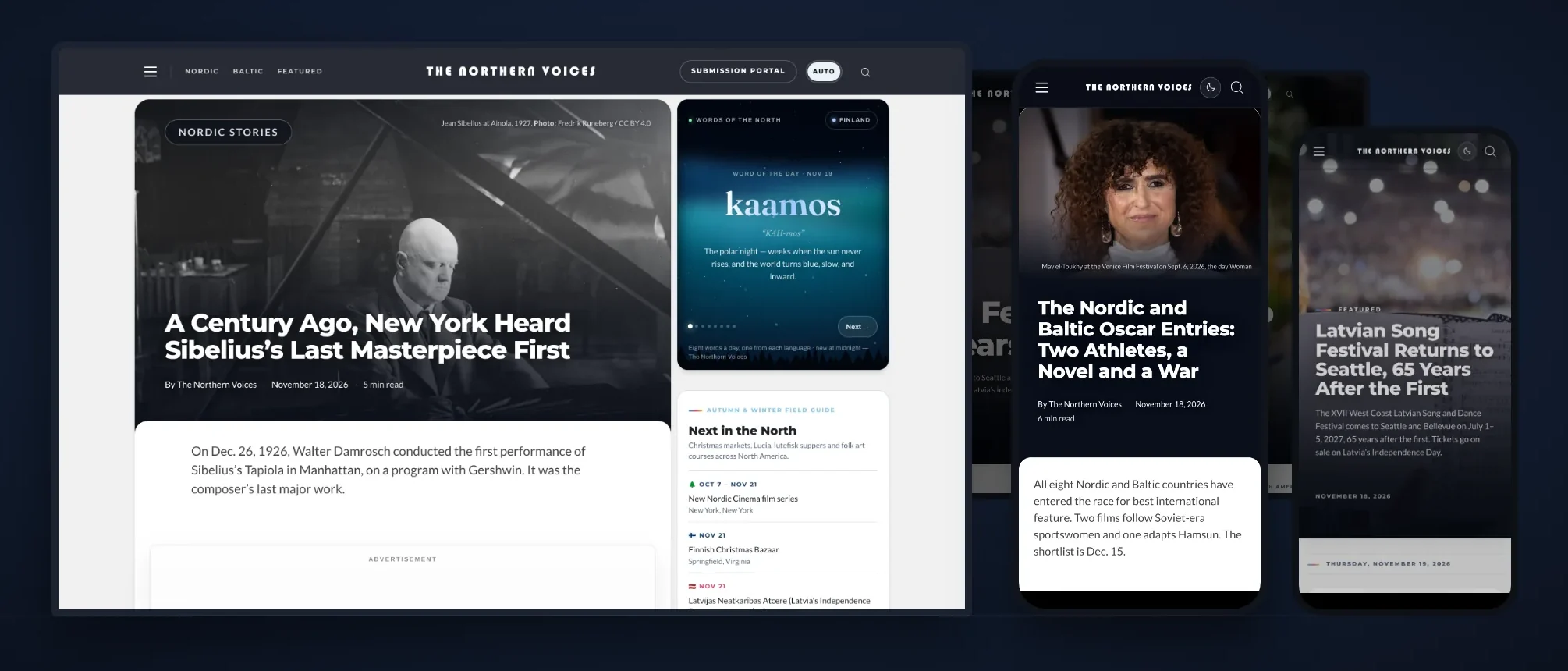
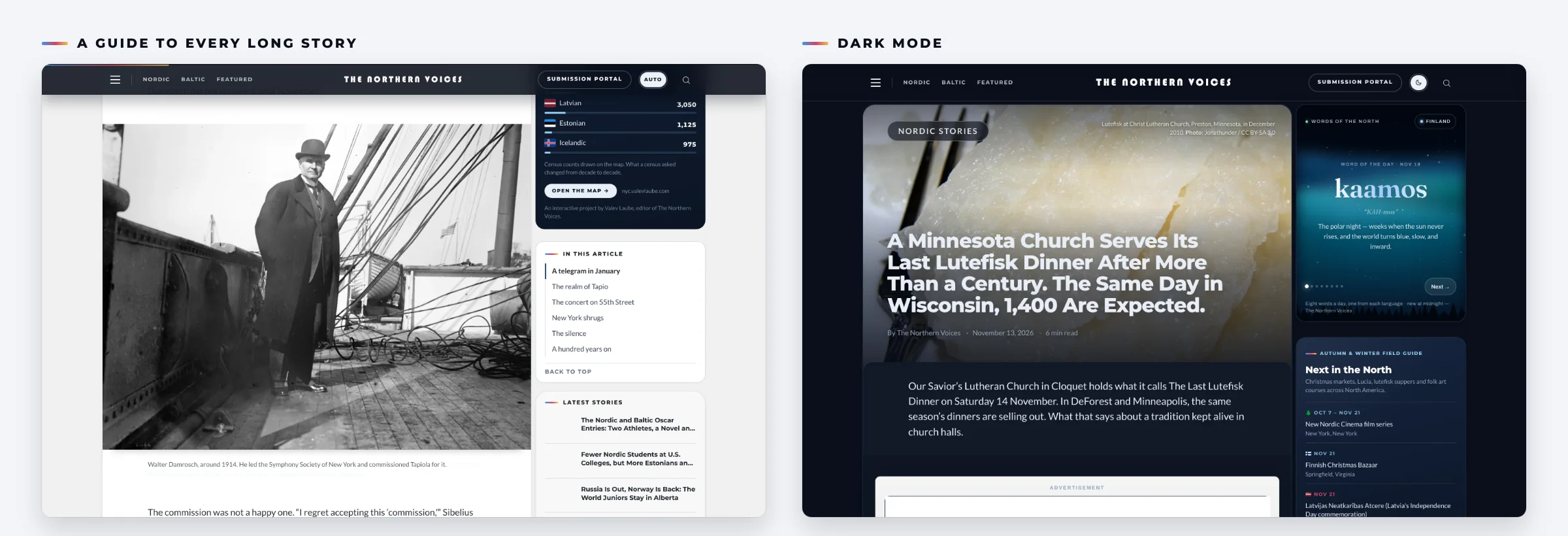
If you've visited lately, you'll have noticed the biggest change. Every story now opens on its lead photograph, with the headline set over the picture. Section pages open the same way, on the newest story in that section. Long articles carry a short guide, "In this article," that stays beside the text as you read, with the latest stories underneath. There is a dark mode the site remembers, and a focused reading view.
Most of the work this year, though, went into things you may never notice but should always be able to count on:
- Lead photographs carry their credit. Where a story names its photographer, the name and license now appear on the picture itself.
- Sources are set out at the end of the stories that use them, and every story ends with a corrections line and a ready-made citation.
- Bylines link to who wrote the piece, whether that's a named writer or the newsroom.
- We went back through the archive and corrected more than a hundred errors, from swapped dates and wrong anniversaries to misspelled Estonian, Latvian and Icelandic names.
- The site is faster. A typical story page used to download about 10 megabytes of images; it now downloads under 2.5. Pages no longer jump around while they load, which matters most on a phone.
Alongside the publication I've also built a small set of interactive projects, among them a Eurovision forecast, a map of where New York's neighborhoods came from and an interactive flight along the route of the Baltic Way. They are linked at the bottom of every page, marked as projects by the editor and kept separate from our reporting.
Our first supporter: the Estonian American National Council
For two years The Northern Voices was entirely self-funded, built on time, care and a stubborn belief that these stories deserved a home. This fall that changed. The Estonian American National Council, the nationally elected central organization of Estonian Americans, founded in 1952, approved a grant to support a new interview series for the publication. Its board voted for it unanimously.
In its letter, the Council wrote that preserving these stories accurately is essential, not only to honoring the past but to "building a bridge to the future." I couldn't have put the purpose of this series better myself. The Council's logo now sits in the footer of every page under "Supported by." It's the first name there, and I hope it won't be the last.
A note on independence, because it matters: the grant supports the interview series. The Council has offered to suggest people we might talk to, and that's welcome. But what we publish, and how, remains our decision alone.
Coming next: Estonian American lives, in their own words
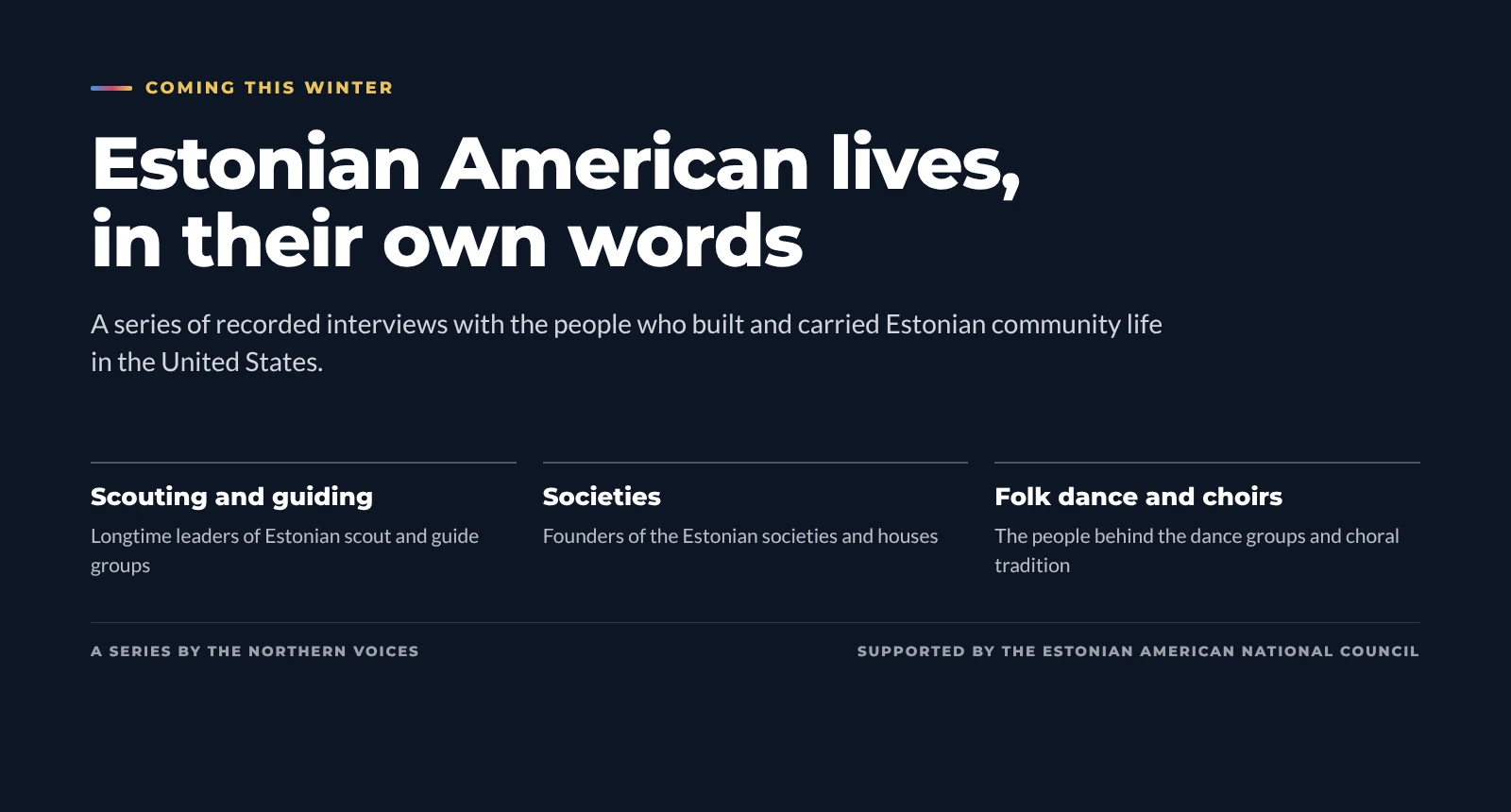
The series is a set of long, recorded interviews with the people who built and carried Estonian community life in the United States. Some have done it for decades, many of them as volunteers, keeping the songs, the dances and the language alive far from where they began. We'll talk with longtime leaders of Estonian scouting and guiding, with founders of Estonian societies, and with the people behind the folk dance groups and the choral tradition.
Each interview will be published free on The Northern Voices, as a written story with photographs. The full recordings will go to the Council's archive, or to another suitable archive we choose together, so they outlast any website. The Council marks its 75th anniversary in 2027, and some of what we record may also help with the history it is preparing for that occasion.
Organizations founded in the 1950s are passing to a new generation, and the people who remember how they began won't always be there to ask. Their memories deserve better than to be lost by default, and that's why this work can't wait. If you know someone whose story belongs in this series, a scout leader, a society founder, a dancer or a choir director, please write to us. In time I hope to bring the same format to the other Nordic and Baltic communities we cover.
Thank you
None of this works without you, and I mean that literally. Thank you to everyone who read, shared, wrote in with a correction or a tip, or sent us a story. Thank you to the Estonian American National Council for believing in this work before anyone else put their name behind it. If you would like to help us keep going, you can support The Northern Voices with a donation, and organizations interested in partnering with us can get in touch.

Two years ago this was an idea and an empty page. Today it's a publication tens of thousands of people have found their way to, and I'm grateful for every one of you. Here is to the third year, and to all the stories still waiting to be told.
Valev Laube is the founder and editor of The Northern Voices.