What It Costs to Live in Tallinn in 2026

One comparison has followed Tallinn around since 2025: that everyday prices in the Estonian capital outrank those in Tokyo and Rome. The ranking behind it, Numbeo's cost-of-living index, leaves out rent, the largest bill most households pay, and says nothing about what people earn.
This guide does the arithmetic the other way round, with the newest official figures available in November 2026: what people in Tallinn are paid, what apartments rent for, what has become cheaper and dearer this year, and how much of a paycheck the rent takes. All amounts are in euros.
What people earn
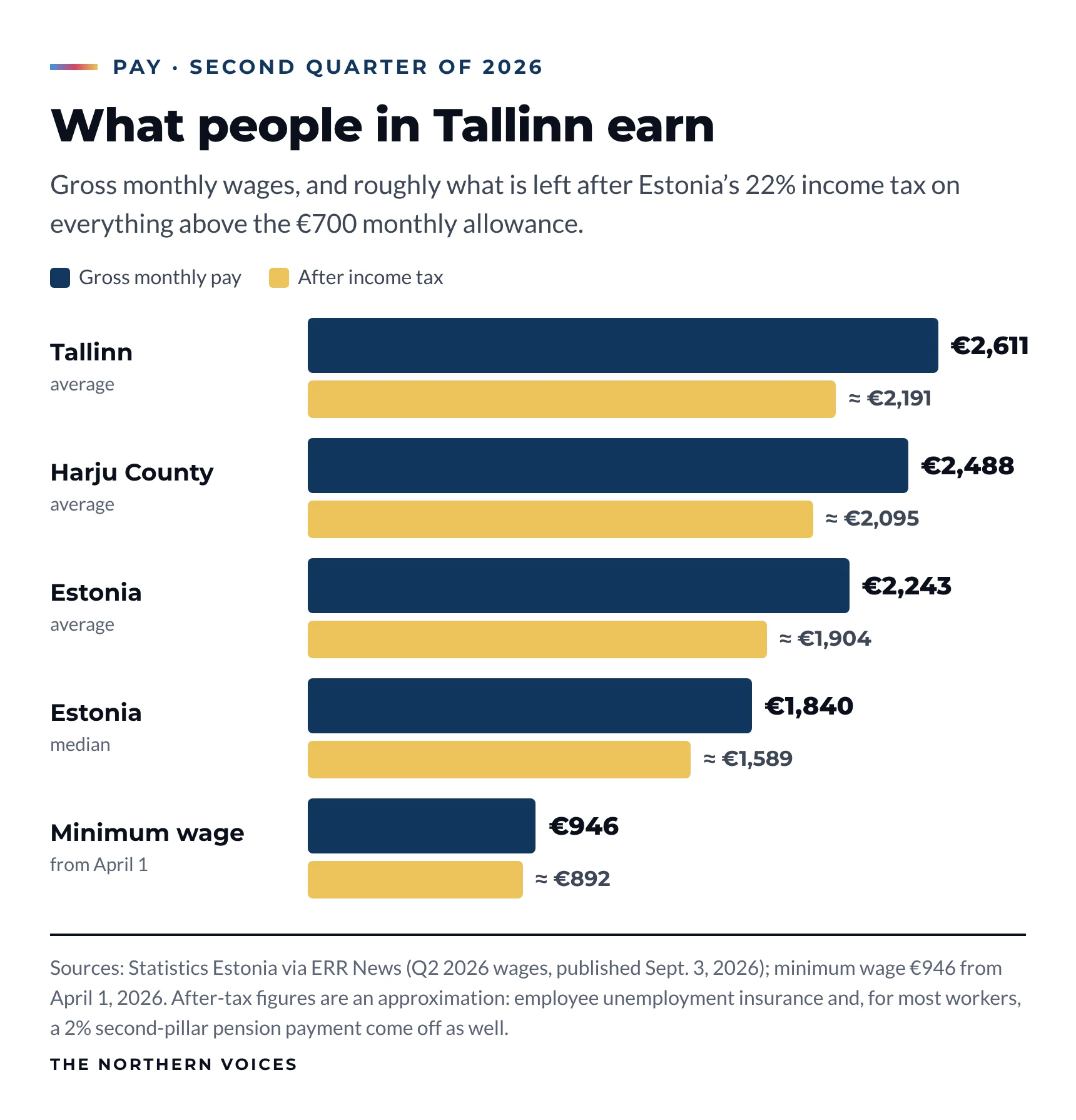
The average gross monthly wage in Tallinn was €2,611 in the second quarter of 2026, according to Statistics Estonia, 5.3% more than a year earlier. Harju County, which surrounds the capital, averaged €2,488, the highest of any county. Across Estonia the average was €2,243 and the median, the pay of the worker in the middle, €1,840.
The minimum wage rose to €946 a month on April 1, up from €886.
Take-home pay is simpler to estimate than in most of Europe. Income tax stays at a flat 22% in 2026, after parliament dropped a planned rise to 24% in December 2025, and since January every taxpayer gets the same €700 a month tax-free, whatever their income. A worker on the national median keeps roughly €1,590 after income tax; one on Tallinn's average, about €2,190. Unemployment insurance and, for most people, a 2% payment into the second-pillar pension fund come off as well.
What an apartment costs
Rent is where Tallinn stops looking cheap. Median asking rents on kv.ee, Estonia's largest property site, were about €400 a month for a studio, €620 for a one-bedroom and €890 for two bedrooms in the second quarter, according to an analysis by Global Property Guide. Apartments with three or more bedrooms asked around €1,450. In the City Center the same sizes ran from €450 to €1,500.

Those are the prices landlords advertise, and they leave out the running costs. In most Estonian apartment buildings, heating, water, maintenance and the repair fund arrive as a separate monthly bill from the apartment association, and in winter the heating share is the largest part of it.
Neighborhood matters as much as size. The City Center runs roughly 10% above the citywide median. Kalamaja and the rest of Põhja-Tallinn, the timber-house districts north of the Old Town, are among the most sought-after addresses. The large housing estates of Lasnamäe, Mustamäe and Õismäe, built in the Soviet decades and home to a large share of the city's population, generally offer more space for the money.

Buying has become dearer too. The median Tallinn apartment sold for €2,988 per square meter in January, more than 5% above a year earlier, according to the real estate agency Uus Maa. At that price a 50-square-meter flat costs about €150,000. Apartment prices across Estonia were 6.9% higher in the first quarter than a year before, Statistics Estonia reported, even as fewer homes changed hands: Tallinn apartment sales fell about 13% in January.

How much of a paycheck the rent takes
Put the two sets of numbers together and the picture splits. On Tallinn's average wage, a one-bedroom at the median asking rent takes about 28% of take-home pay, inside the common rule of thumb of keeping rent under 30%. On the national median wage it takes 39%. On the minimum wage, even a studio swallows 45% and a one-bedroom 70%.
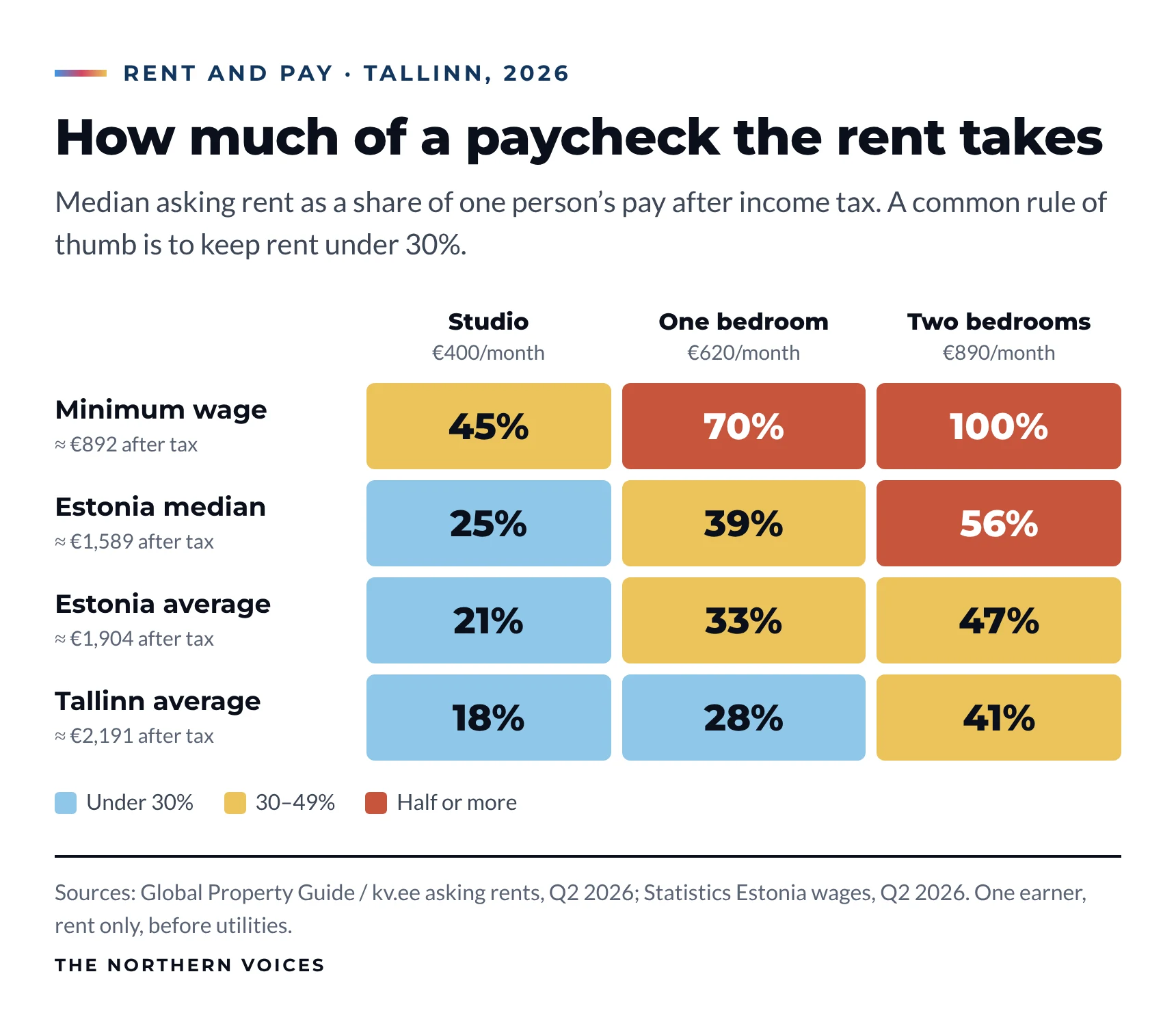
For one earner on a typical Estonian wage, the numbers work best with a studio, a shared flat or a second income. The calculator below the chart runs the same sum for a salary and an apartment of your choosing.
Food, energy and everything else
Day-to-day prices are now the better news. Consumer prices in Estonia rose 1.5% in the year to August, the smallest increase since spring 2021, according to Statistics Estonia. Food and soft drinks were 2.6% cheaper than a year earlier, and clothing and shoes 4.6% cheaper.
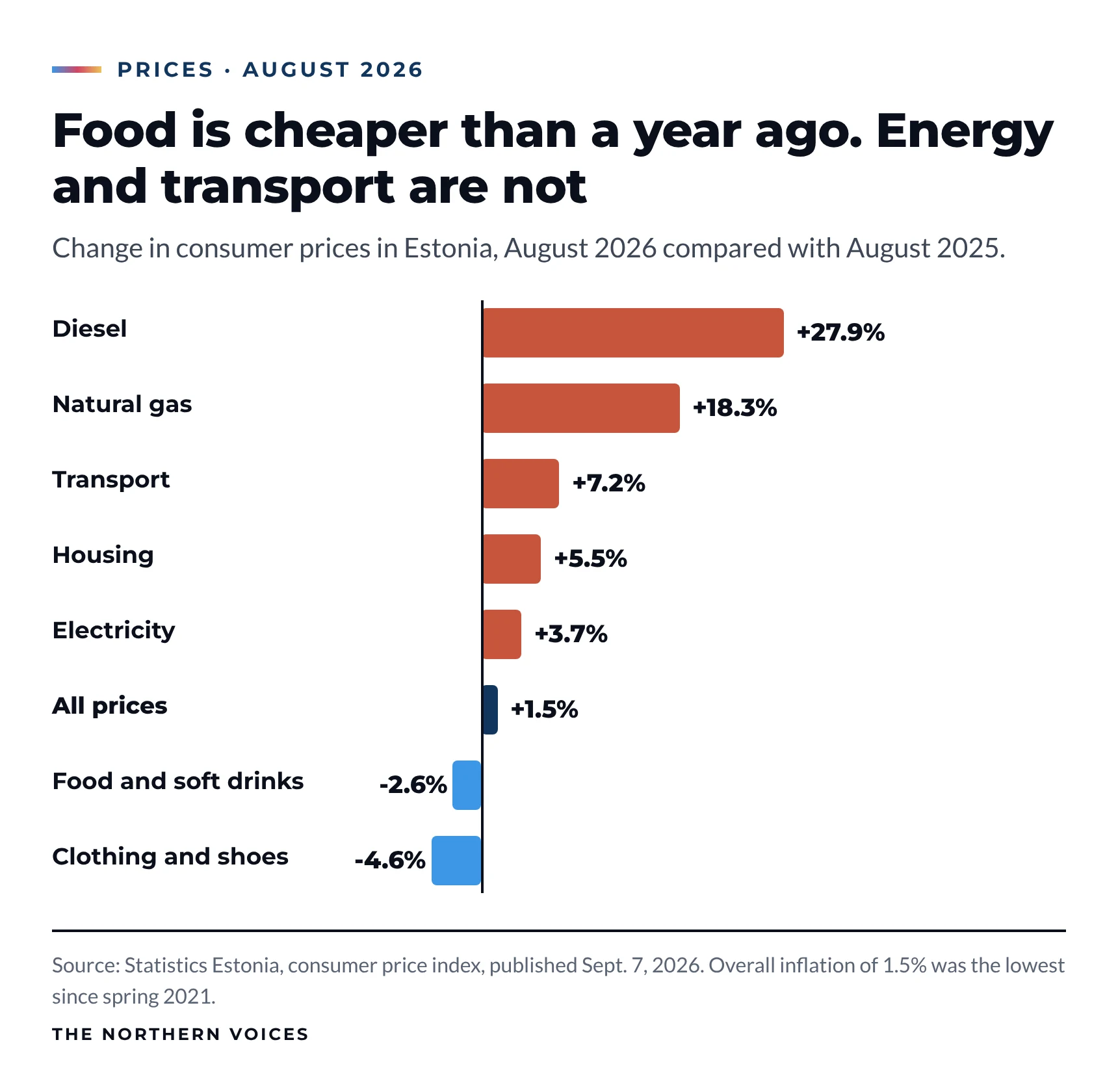
The pressure has moved to energy and transport. Housing costs, which include utilities and rent payments, were up 5.5%, network gas 18.3% and electricity 3.7%. Diesel cost 27.9% more than a year earlier and petrol 7.9% more. Most goods and services also carry a higher sales tax than eighteen months ago: Estonia's standard value-added tax rose from 22% to 24% on July 1, 2025.
Electricity deserves a separate warning for anyone arriving from North America. Many Estonian households buy power on contracts tied to the hourly exchange price, which can swing sharply from month to month. In January the average Estonian electricity price reached 15.4 cents per kilowatt-hour, 68% more than a year earlier, the energy company Enefit reported. Fixed-price contracts cost more in mild months and less when winter bites.
Getting around
Here Tallinn is unusually generous. Since 2013, anyone registered as a resident of the city has ridden its buses, trams and trolleybuses free of charge, and the free travel extends to night buses and to Elron trains within the city. Riders need a personalized Ühiskaart, the city's travel card, and must tap it each time they board. Part of every resident's income tax also goes to the municipality where they are registered, so registering is worth doing for the city as well as for the rider.
Visitors and people registered elsewhere pay €2 for an hour of travel or €30 for a 30-day pass. Since March 16, a joint ticket has covered city transport, Elron trains and county buses across northern Estonia, at €48 to €90 a month depending on the zone, ERR News reported.

So is Tallinn expensive?
For someone earning a local wage, the answer depends almost entirely on rent. Life in a modest flat is comfortable on the capital's average pay, tight on the national median and very hard on the minimum wage. Cheaper groceries in 2026 help at the margin, and free transport helps more than most newcomers expect. Housing and energy decide the month.
Sources and method
Wages: Statistics Estonia, second quarter of 2026, as reported by ERR News on Sept. 3, 2026. Minimum wage: agreement between Estonia's employers and trade unions, in force from April 1, 2026. Income tax and VAT: EY Global Tax News, Dec. 8, 2025. Rents: Global Property Guide analysis of kv.ee asking rents, second quarter of 2026. Sale prices: Uus Maa, March 2026, and the Statistics Estonia dwelling price index, June 2026. Consumer prices: Statistics Estonia, Sept. 7, 2026. Electricity: Enefit energy market overview for January 2026. Transport: Tallinn city fares, and ERR News, Jan. 30, 2026.
Take-home figures apply the 22% income tax to gross pay above the €700 monthly allowance and leave out the employee's unemployment-insurance and pension contributions, so actual net pay is somewhat lower. Asking rents are what landlords advertise, not what tenants sign.
Lead photograph: Tallinn's Old Town from Toompea in autumn, by William John Gauthier, CC BY-SA 2.0, via Wikimedia Commons.

)%20(1).avif)