Estonian Americans: Who They Are and Where They Live

On East 34th Street in Manhattan, between Second and Third Avenues, a four-story Beaux-Arts townhouse carries the words Estonian House over its door. Estonian refugees bought it in 1946, before most of them had even reached the United States. Eight decades later it still holds a school, choirs, a folk dance group and the community's newspaper.
The building is the clearest trace of a community that has always been small. About 28,000 people in the United States say they have Estonian roots, fewer than live in Tartu, Estonia's second city. Most descend from the refugees who fled the Soviet army in 1944 and came to America after the Second World War. This guide sets out who Estonian Americans are, where they live and how they came, using the latest Census Bureau figures.
How many Estonian Americans there are
In the Census Bureau's American Community Survey for 2020 to 2024, 27,959 people reported Estonian ancestry, as a first or second answer to the question about their origins. That is about one American in 12,000.
The number has barely moved in a generation. The 1990 census counted 26,762 people of Estonian ancestry. The survey's estimates for 2005 to 2007 put the figure at 26,771, and those for 2017 to 2021 at 29,219.
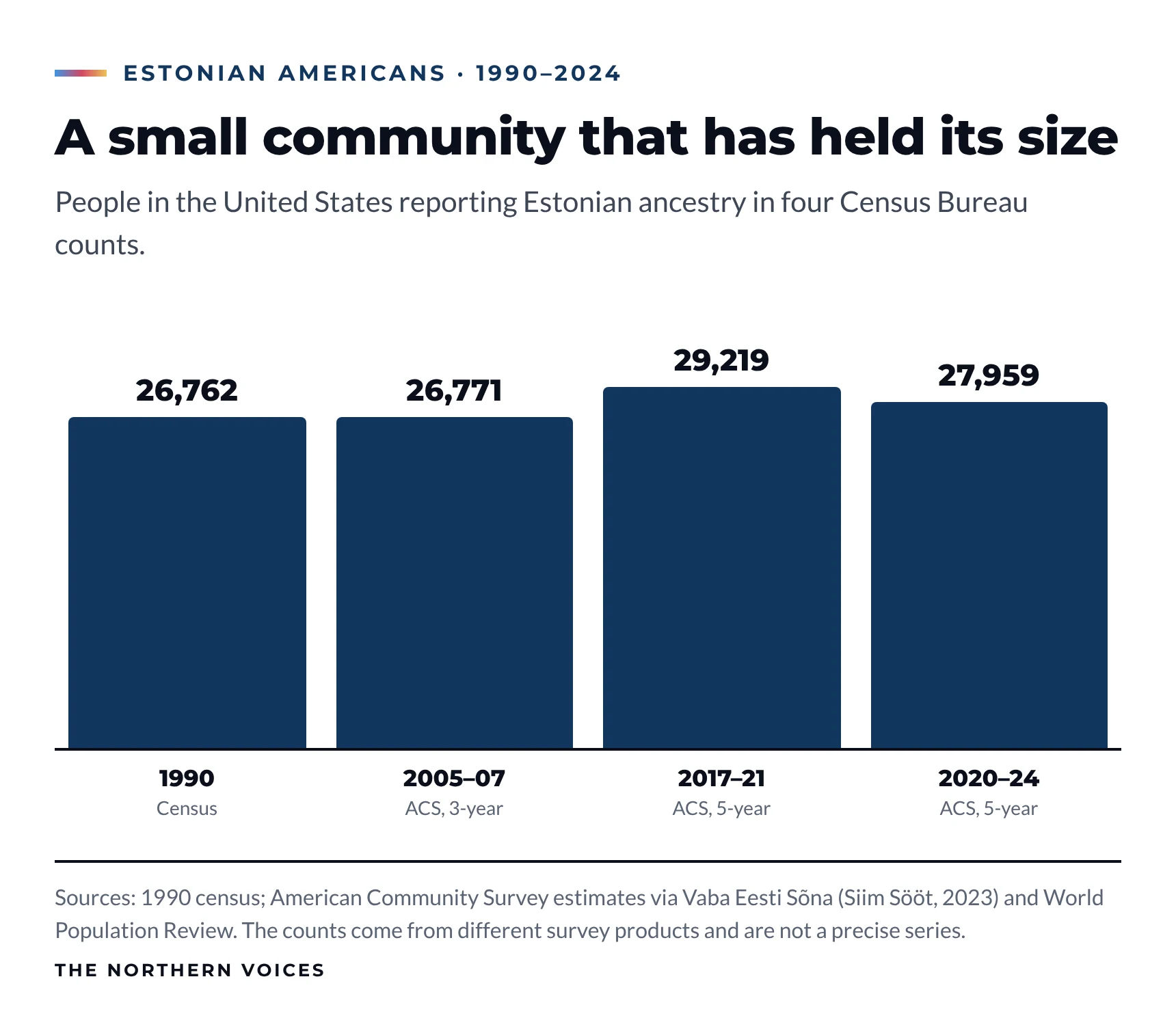
These counts measure ancestry as people describe it, not birthplace or citizenship. They include the grandchildren of refugees who may speak little Estonian, and they leave out some people born in Estonia who give another answer. Because the survey samples only part of the population, the figures for a group this small carry margins of error, and the four counts in the chart come from different survey products. They show a community holding its size rather than a precise trend.
Where they live
California has the most people of Estonian ancestry, 4,230, followed by New York with 2,959 and Florida with 2,263. New Jersey, Pennsylvania, Washington, Texas, Illinois, Oregon and Massachusetts complete the top ten. No state has more than a few thousand.
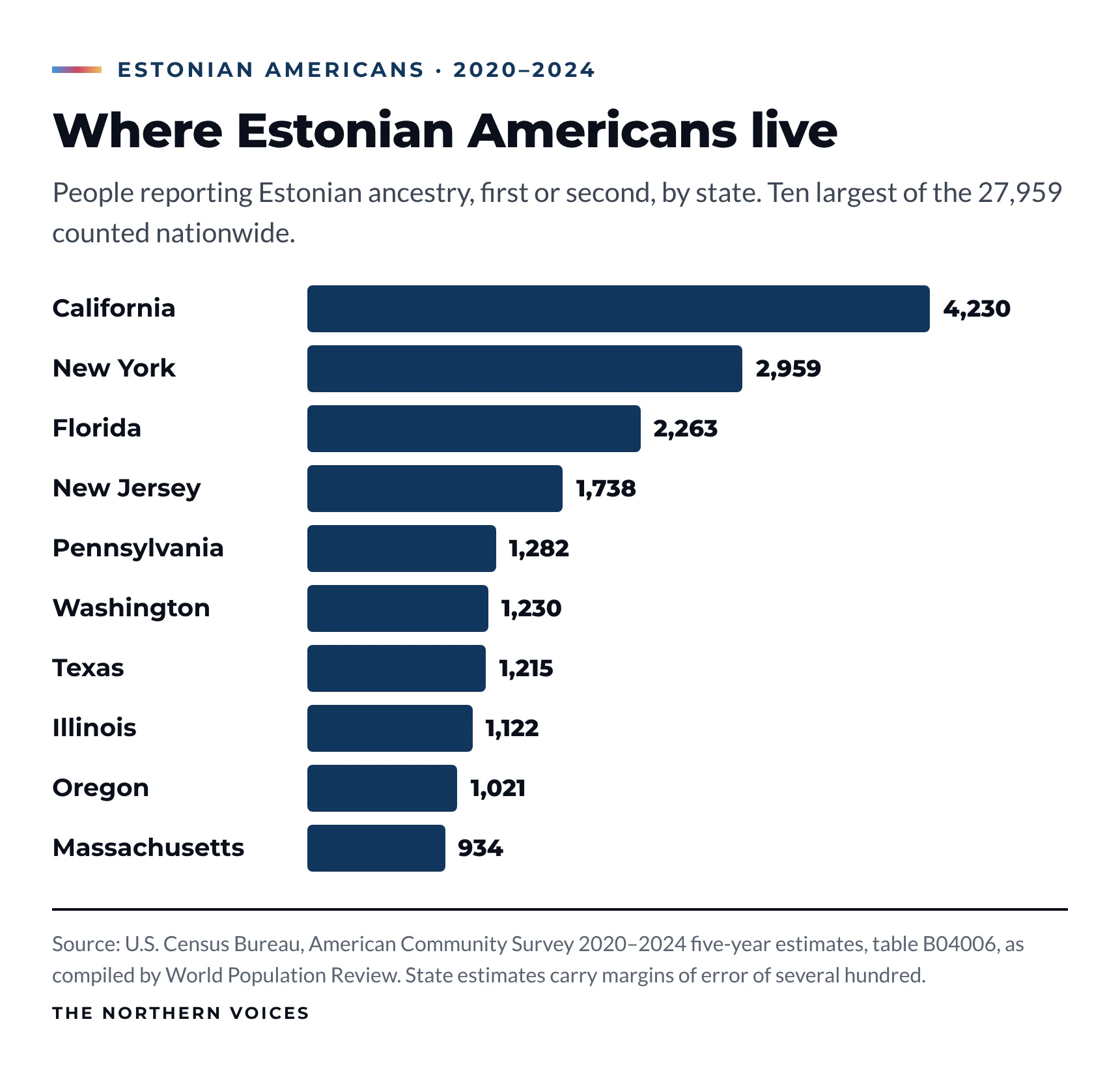
By metropolitan area the picture is clearer. In an analysis of the five-year survey data published by Vaba Eesti Sõna in 2023, Siim Sööt counted 3,406 people of Estonian ancestry in the New York area, 1,675 around Los Angeles, 1,304 around Seattle, 1,006 around Portland, Oregon, and 979 around Chicago. He found that 95% live in metropolitan areas. He also cautioned that the Seattle and Portland figures carry unusually wide margins of error.
New York's lead is historical. The postwar refugees settled first around the city and in New Jersey, and the institutions they built there are still the community's center.
How they came
The first Estonians in North America arrived in 1627 in New Sweden, the colony on the Delaware River, when Estonia was part of the Swedish realm. A larger movement began in the late nineteenth century, when Estonia belonged to the Russian Empire. Those emigrants are hard to count, because American officials often recorded them as Russians.

The community that exists today was formed by the Second World War. In 1944, as the Soviet army returned, about 80,000 people fled Estonia by sea for Germany and Sweden. Many died when their boats were bombed or struck mines. Those who reached Germany spent years in camps for displaced persons.
The Displaced Persons Act of 1948, and its revision in 1950, opened the way to America. About 11,000 Estonians entered the United States between 1948 and 1952, and Baltic applicants received 40% of the visas issued under the law. Each refugee needed a sponsor who promised housing and work.
One sponsor was Seabrook Farms, the frozen-vegetable company in southern New Jersey. It sponsored more than 600 Estonians, who began arriving in 1949 and were housed in barracks at the company's Hoover Village, according to an exhibit by Rutgers University Libraries. Many wrote that the barracks were worse than the camps they had left. Within a few years they had formed their own clubs and churches and an Estonian Cub Scout troop.
The institutions they built
The Estonian House at 243 East 34th Street was built in 1898 and 1899 for the Civic Club, a club founded by the social reformer F. Norton Goddard, to a design by the Brooklyn architect Thomas A. Gray. In 1946 Goddard's widow sold it for $25,000 to the New York Estonian Educational Society, which still owns it. The city designated it a landmark in 1978, and it was added to the National Register of Historic Places in 1982.

The house is home to the New York Estonian School, the Foundation for Estonian Arts and Letters, choirs, a folk dance group and Vaba Eesti Sõna, the Estonian-language weekly founded in New York in 1949. Its story, and the community around it, are told in our history of Estonians in New York City. A plan to renew the Estonian houses of New York and Chicago is described in our piece on Alo Möldre's designs.
The refugees also built a political voice. The Estonian American National Council was founded in New York on July 19, 1952, to unite Estonian exiles and press for Estonia's freedom. In 1961 it joined the American Latvian Association and the Lithuanian American Council to form the Joint Baltic American National Committee, which still speaks for all three communities in Washington. Since Estonia restored its independence in 1991, the council has worked to support the country's security and to keep Estonian culture alive in the United States. Its elected council met in October 2023 at the Lakewood Estonian House in New Jersey. Our report from a recent council forum shows what concerns it today.
Notable Estonian Americans
The best-known family is musical: the conductor Neeme Järvi and his sons Paavo and Kristjan, both conductors, along with his daughter Maarika, a flutist. Edmund S. Valtman, who fled Estonia in 1944, won the Pulitzer Prize for editorial cartooning. The astronomer Alar Toomre and the neuroscientist Jaak Panksepp built their careers in American universities. Toomas Hendrik Ilves, who grew up in New Jersey, returned to become president of Estonia from 2006 to 2016.
The tie to Estonia today
Many Estonian Americans keep Estonian citizenship, and with it a vote. Since August 2024 the embassy in Washington has been the only Estonian mission in the United States offering consular services, after the consulates general in New York and San Francisco closed. At the Riigikogu election of March 7, 2027, citizens abroad will for the first time be able to vote from a smartphone as well as a computer. Our explainer covers how voting from North America will work.
Sources and method
Population and states: U.S. Census Bureau, American Community Survey 2020–2024 five-year estimates, table B04006 (people reporting ancestry), as compiled by World Population Review; the 1990 census figure as cited in Wikipedia. Earlier survey estimates and metropolitan areas: Siim Sööt in Vaba Eesti Sõna, Sept. 15, 2023 and Nov. 21, 2023. History and the Displaced Persons Act: Wikipedia, Estonian Americans. Seabrook Farms: Rutgers University Libraries. Estonian House: Wikipedia, Civic Club / Estonian House. Estonian American National Council: council history. Joint Baltic American National Committee: Wikipedia, American Latvian Association.
Ancestry counts are survey estimates and include people who name Estonian as a second ancestry. State figures carry margins of error of up to several hundred, and the national counts from different survey years are not a strict series.
Lead photograph: the Embassy of Estonia in Washington in April 2026, by ajay_suresh, CC BY 4.0, via Wikimedia Commons.

)%20(1).avif)